Inspiration
In the age of generative AI, seeing an image is no longer enough.
We increasingly want to know:
- Where did this content come from?
- Who created it?
- Has it been edited?
- Was AI involved?
- Can I trace it back to the original?
Content Credentials, based on the C2PA standard, provide a powerful foundation for answering these questions by giving digital content a verifiable provenance history.
But there is still a usability gap. Understanding provenance often requires knowing where to look, opening specialized tools, and interpreting technical metadata.
So we asked:
What if understanding the history of content was as easy as asking a question?
That inspired VerifyHere — an exploration of making Content Credentials conversational with WebMCP.
What it does
VerifyHere lets you talk to the provenance of your content.
Instead of manually digging through metadata, you can simply ask:
"Where did this photo come from?"
"Has this image been edited?"
"What changed?"
"Take me back to the original."
VerifyHere uses WebMCP to connect these natural-language questions with the underlying provenance information.
The experience follows content across its journey:
Capture → Verify → Edit → Trace → Recover
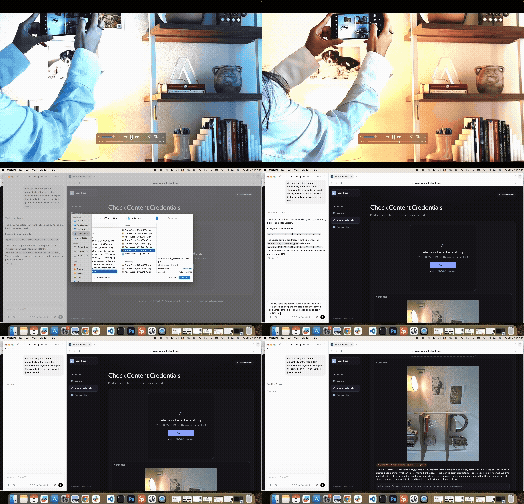
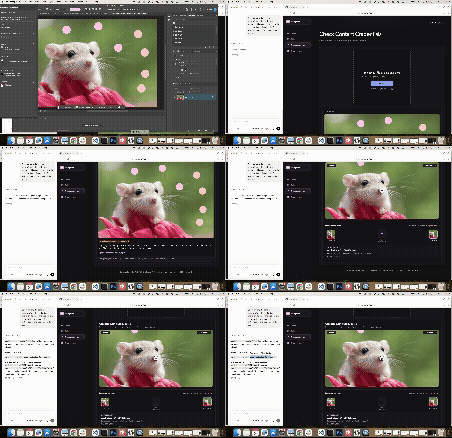
For example, a photographer can capture an image with Content Credentials, inspect its provenance, edit it in Photoshop, and then explore how the edited asset relates to the original.
The goal isn't to tell people what to trust. It's to give them more context about how content came to be.
How we built it
We built VerifyHere as a web experience combining WebMCP with C2PA Content Credentials.
Our application exposes provenance capabilities as tools that an AI agent can discover and invoke through WebMCP.
This means the user doesn't need to understand C2PA manifests, cryptographic signatures, or metadata structures.
They can express their intent naturally:
"Tell me where this image came from."
WebMCP can then connect that request to the appropriate capability in VerifyHere, inspect the available provenance information, and return an understandable answer.
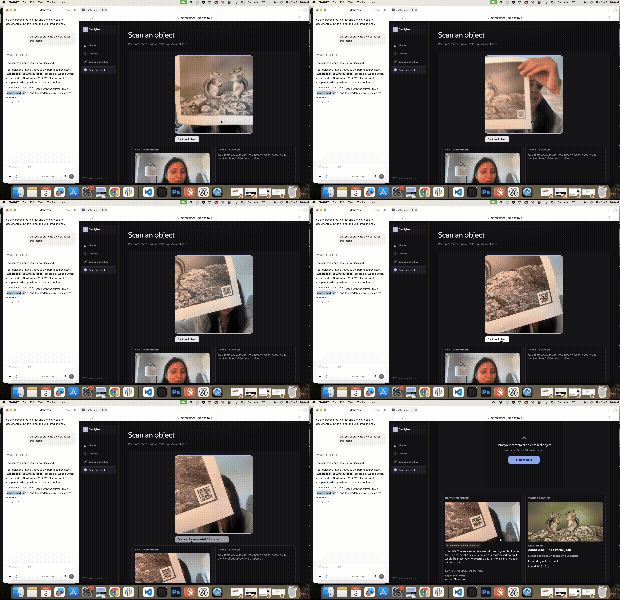
When an edited asset contains provenance linking it to an earlier asset, VerifyHere can also help users explore that chain and move back toward the original.
This turns Content Credentials from something users inspect into something they can interact with conversationally.
Challenges we ran into
One of our biggest challenges was provenance at capture.
We experimented with different mobile capture workflows and quickly discovered that real-world C2PA interoperability isn't always as straightforward as the specification makes it appear.
Credentials can behave differently across capture applications, exports, file transfers, editing workflows, and verification experiences.
That challenge actually reinforced the motivation behind VerifyHere:
Users shouldn't have to understand the implementation details of provenance technology to benefit from it.
We also thought carefully about the distinction between edited content and untrustworthy content.
An image being edited doesn't automatically make it misleading. Photography and creative work naturally involve editing.
Content provenance isn't about labeling content as "good" or "bad." It's about providing transparency and context, so people can understand what happened and make their own informed decisions.
What we learned
Our biggest learning was that Content Credentials become much more approachable when we stop thinking about provenance purely as metadata people need to inspect.
Instead, provenance can become context that agents can reason over.
WebMCP provides an exciting bridge between these two worlds.
The underlying provenance can remain structured, machine-readable, and cryptographically verifiable, while the user experience can become as simple as asking:
"Tell me the story behind this image."
We also learned how important durability and interoperability are.
Content travels everywhere — through editing tools, websites, social platforms, downloads, screenshots, and even into the physical world. Provenance becomes most useful when people can continue discovering that history wherever the content travels.
What's next for VerifyHere
We imagine VerifyHere going far beyond inspecting individual images.
The same conversational provenance experience could extend to:
- Creative libraries
- Published media
- Video
- AI-generated and AI-edited content
- Social content
- Physical and printed media
Imagine asking:
"Which photos in my library are original camera captures?"
or:
"Show me everything derived from this original."
or simply:
"Can I learn more about where this came from?"
Agents could help creators trace their work, understand how it has changed, discover missing provenance, find originals, and receive attribution as their content travels across the internet.
Our vision is simple: provenance shouldn't be something you have to hunt for. It should be as easy as asking.
Built With
- c2pa
- node.js
- webmcp

Log in or sign up for Devpost to join the conversation.