-
-
VerifyAI
Inspiration
AI can generate impressive answers in seconds, but confidence does not guarantee correctness. It can hallucinate facts, make calculation errors, or present unsupported claims as truth.
We asked ourselves: What if AI had to prove its answers before showing them?
That question inspired VerifyFirst AI — a project built around the idea that verification should be an essential part of AI, not an optional afterthought.
What it does
VerifyFirst AI is an evidence-first AI agent that checks AI-generated answers before presenting them to users.
It follows a structured verification process:
- Generates an initial answer privately.
- Breaks the answer into individual claims.
- Checks claims using independent evidence, trusted sources, calculations, and logical reasoning.
- Identifies incorrect, contradictory, or unsupported statements.
- Corrects errors based on verification findings.
- Releases the final answer with evidence and transparent uncertainty.
When a claim cannot be sufficiently verified, VerifyFirst AI aims to communicate that uncertainty rather than confidently guessing.
How we built it
We designed VerifyFirst AI as a modular AI agent with separate stages for generation, claim extraction, evidence retrieval, verification, correction, and final answer release.
We use NVIDIA Nemotron models through Nebius Token Factory for AI-powered reasoning and generation. The verification architecture combines model-based analysis with deterministic checks and external evidence retrieval.
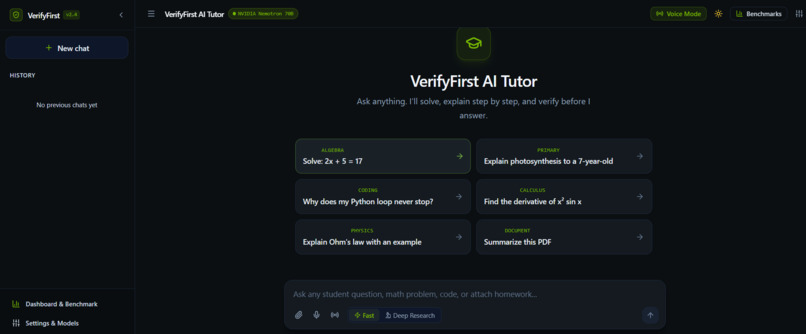
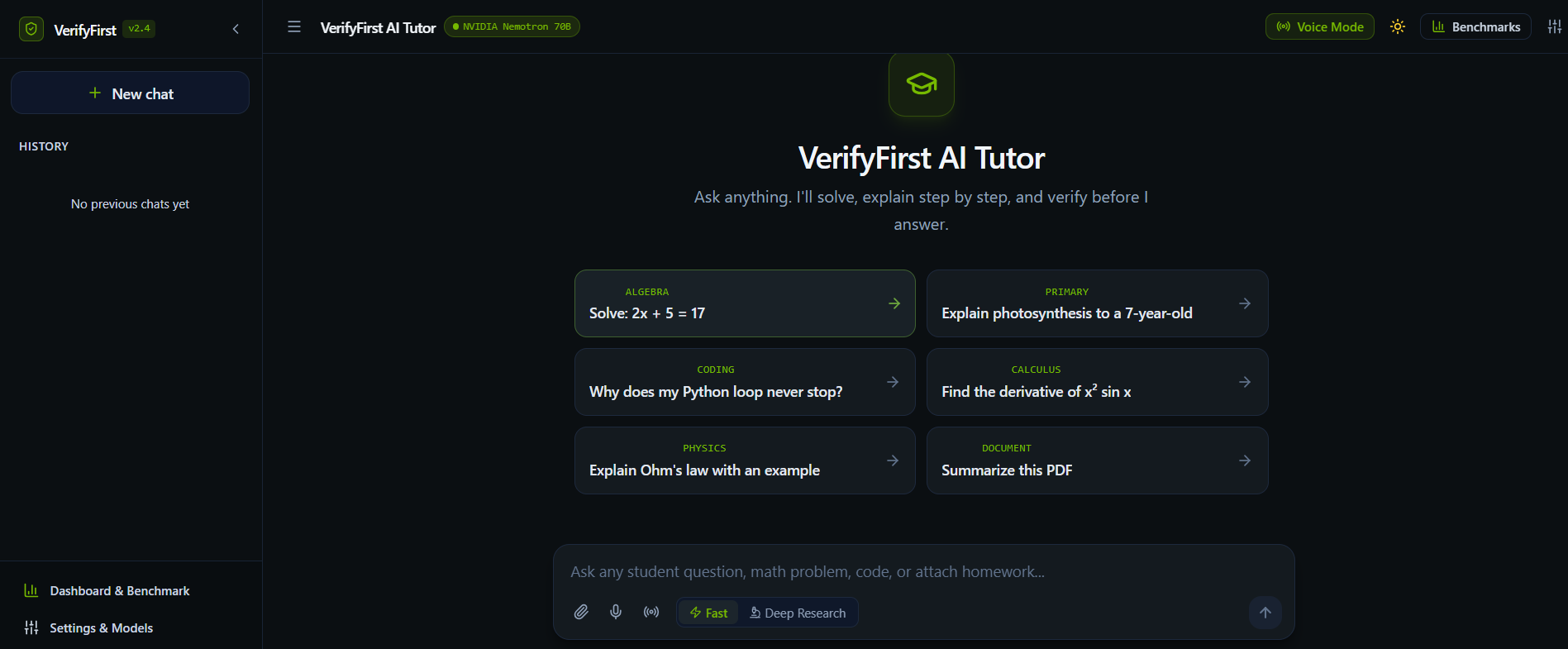
For the user experience, we designed an interactive interface that visualizes the verification journey, showing how claims are examined, evidence is evaluated, and errors are corrected before the final answer appears.
Our focus was to make the verification process understandable rather than hiding it behind a conventional chat interface.
Challenges we ran into
One major challenge was ensuring that verification was more than simply asking another AI model whether an answer was correct.
We needed to break responses into individual claims and determine the appropriate verification method for each one.
Another challenge was handling conflicting or insufficient evidence. A reliable system must distinguish between verified information, contradicted claims, and statements that remain uncertain.
We also had to consider the trade-offs between verification quality, response speed, and computational cost.
Accomplishments that we're proud of
We are proud of developing an approach that treats verification as a core part of the AI response process.
Our key accomplishments include:
- Designing a claim-level verification workflow.
- Combining AI reasoning with evidence-based and deterministic checks.
- Building a correction process that uses verification findings.
- Introducing a release gate to prevent unsupported answers from being presented as fully verified.
- Creating an interactive experience that makes AI verification visible and understandable.
Most importantly, we are exploring a different standard for AI: not just generating answers, but establishing why those answers deserve trust.
What we learned
We learned that generating an answer and verifying an answer are two fundamentally different tasks.
Breaking responses into individual claims makes errors easier to identify and correct. We also learned that independent AI agreement is not the same as factual proof.
Different claims require different verification methods. Mathematical statements may need deterministic calculations, while factual claims require reliable evidence.
Perhaps our biggest lesson was that admitting uncertainty is a strength. A trustworthy AI should know when it does not have enough evidence to answer confidently.
What's next for VerifyFirst AI — Trust Before Answers
We want to expand VerifyFirst AI beyond general question answering.
Our next steps include:
- Advanced document and research verification.
- Code execution and automated testing.
- Stronger source reliability and contradiction detection.
- More sophisticated claim-level confidence and uncertainty reporting.
- Benchmarking against standard AI responses to measure factual accuracy and error correction.
- Reducing verification latency and computational costs.
Our long-term vision is to make evidence-first verification a standard layer in AI systems.
AI should not just answer. It should verify first.
Built With
- aistudio
