-
-
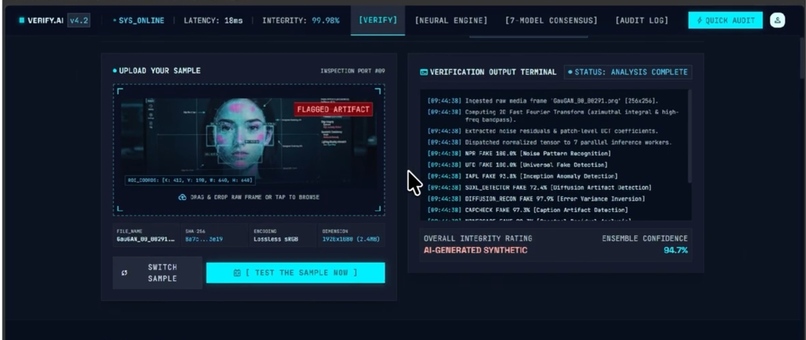
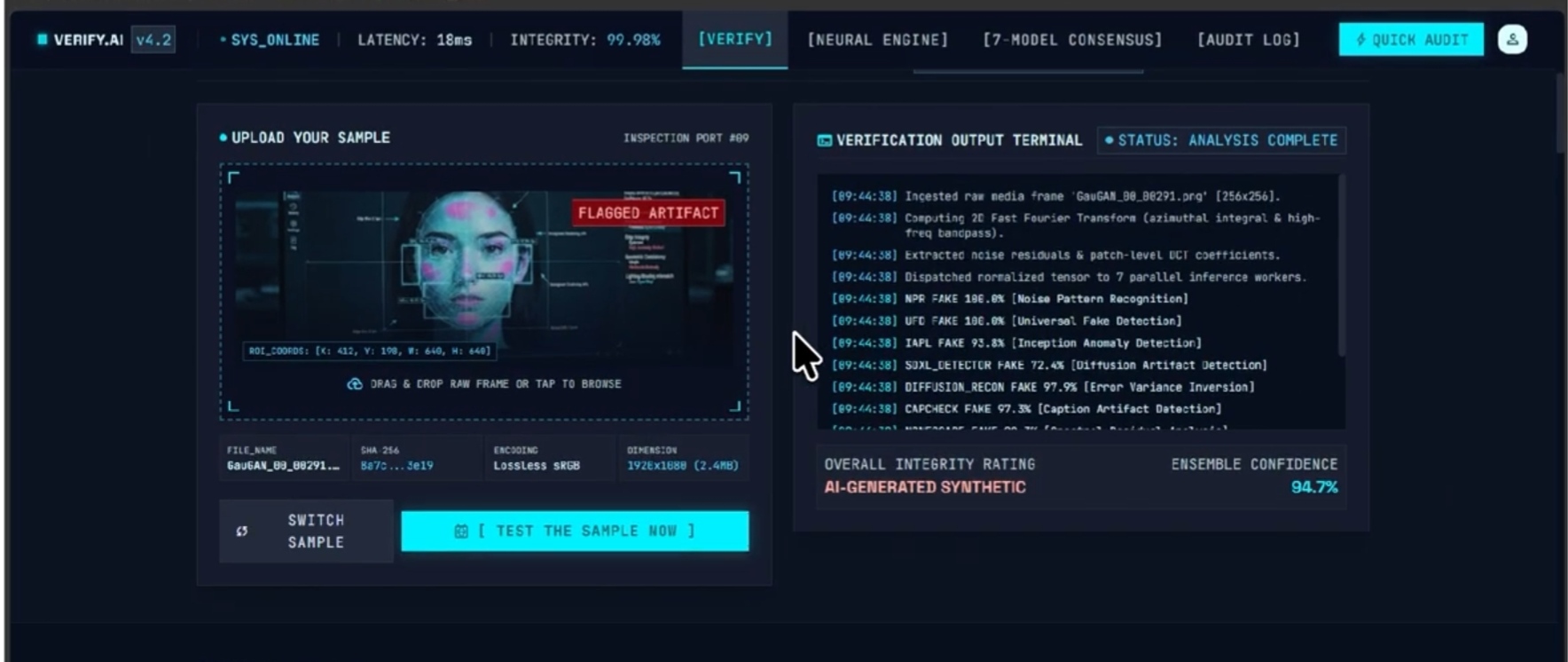
Landing+uploading page +multi-feature accessories
-
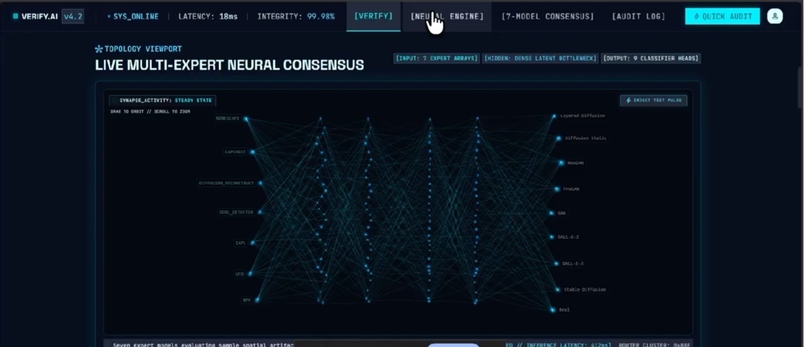
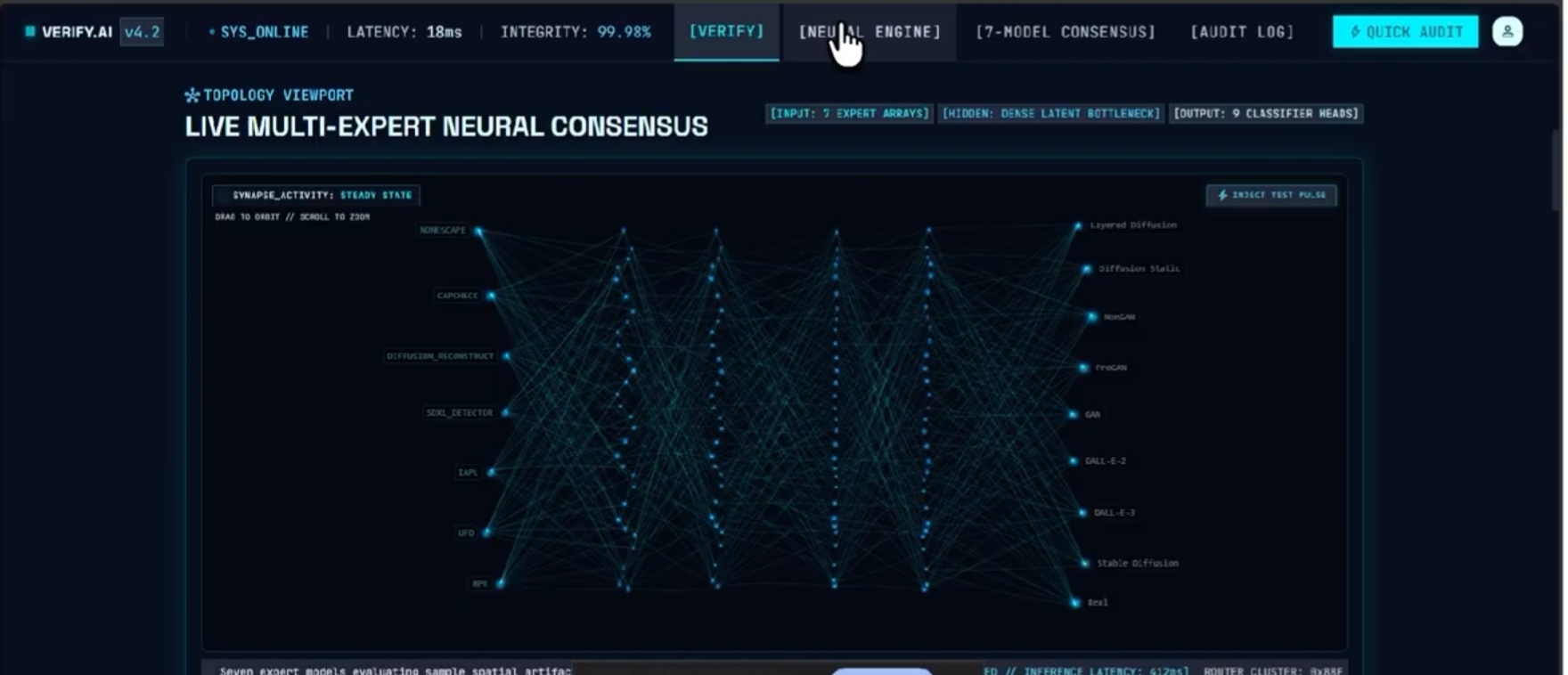
Live 3D neural network of the 7 experts moving I side the ui interface
Inspiration
Single deepfake detection models often fail because they specialize in catching specific types of manipulation (like GAN noise or Stable Diffusion artifacts). We built VERIFY.AI to solve this bottleneck. By orchestrating a multi-expert ensemble gateway that runs diverse vision forensics models in parallel, we eliminate single points of failure in synthetic media verification.
What it does
VERIFY.AI is a microservice-based deepfake detection platform. Users upload an image to a forensic terminal, which routes it through a FastAPI gateway to 7 state-of-the-art specialist vision models in parallel (NPR, UFD, IAPL, SDXL-detector, umm-maybe, CapCheck, and Nonescape). The gateway aggregates their decisions via a weighted neural consensus strategy to deliver a unified verdict. It also visualizes the real-time voting matrix and issues an offline-verifiable "thermal receipt" complete with a SHA256 file hash.
How we built it
- Backend Gateway: Built with FastAPI using asyncio to handle asynchronous fan-out inference to 7 distinct containerized endpoints.
- Forensic Frontend: Developed a React/Vite dashboard using Three.js (Living Filament visualization) for real-time neural consensus topography and Tailwind CSS for the dark terminal aesthetic.
- AI & Inference: Integrated PyTorch, Torchvision, and Hug Face Transformers to host 7 specialized models fully offline.
- Deployment: Packaged into a 9-container Docker Compose setup alongside native Windows/Linux automated script launchers.
Challenges we ran into
Orchestrating 7 separate machine learning models locally introduced huge VRAM, dependency, and concurrency challenges. We solved this by designing a lightweight microservice pattern where each model runs on its own port, isolated via strict environment management. We also had to engineer custom asynchronous polling routines in the gateway to ensure single slow models wouldn't bottleneck the ensemble response.
Accomplishments that we're proud of
We successfully achieved 100% offline local operations after the initial weight download. We are incredibly proud of constructing a fully transparent, auditable breakdown system where users aren't just given a vague percentage score, but can see exactly which specific forensic markers (e.g., GAN noise vs. spectral residuals) triggered the final verdict.
What we learned
We learned deep insights into multimodal image forensics and the practical engineering hurdles of running large ensemble architectures locally. We gained hands-on experience optimizing Docker setups for heavy GPU pass-through tasks across isolated networks.
What's next for Verify.Ai
We plan to introduce dynamic meta-learners to automatically adjust model weights based on evolving benchmark performance. We also plan to expand the gateway to support video frame extraction for temporal deepfake analysis.

Log in or sign up for Devpost to join the conversation.