Inspiration
In a world where information spreads faster than it can be verified, determining whether a claim is supported by reliable evidence is increasingly challenging.
Many AI systems can generate convincing answers, but users may struggle to understand where those answers came from or whether the cited evidence actually supports them.
This inspired VeriFlow AI, a multi-agent evidence analysis system designed to make AI-assisted fact-checking more transparent, structured, and explainable.
Our goal is not to replace human judgment, but to help people investigate claims using traceable sources, evidence quotations, and clearly labeled preliminary assessments.
What it does
VeriFlow AI transforms a factual claim into a structured research and verification workflow powered by NVIDIA Nemotron through Nebius Token Factory.
Instead of generating an unsupported yes-or-no answer, VeriFlow AI:
- Develops targeted research queries.
- Retrieves relevant online sources.
- Evaluates whether each source supports, contradicts, or provides insufficient evidence for the claim.
- Checks whether cited quotations match the retrieved source text.
- Produces a preliminary evidence-based assessment with explanations and source references.
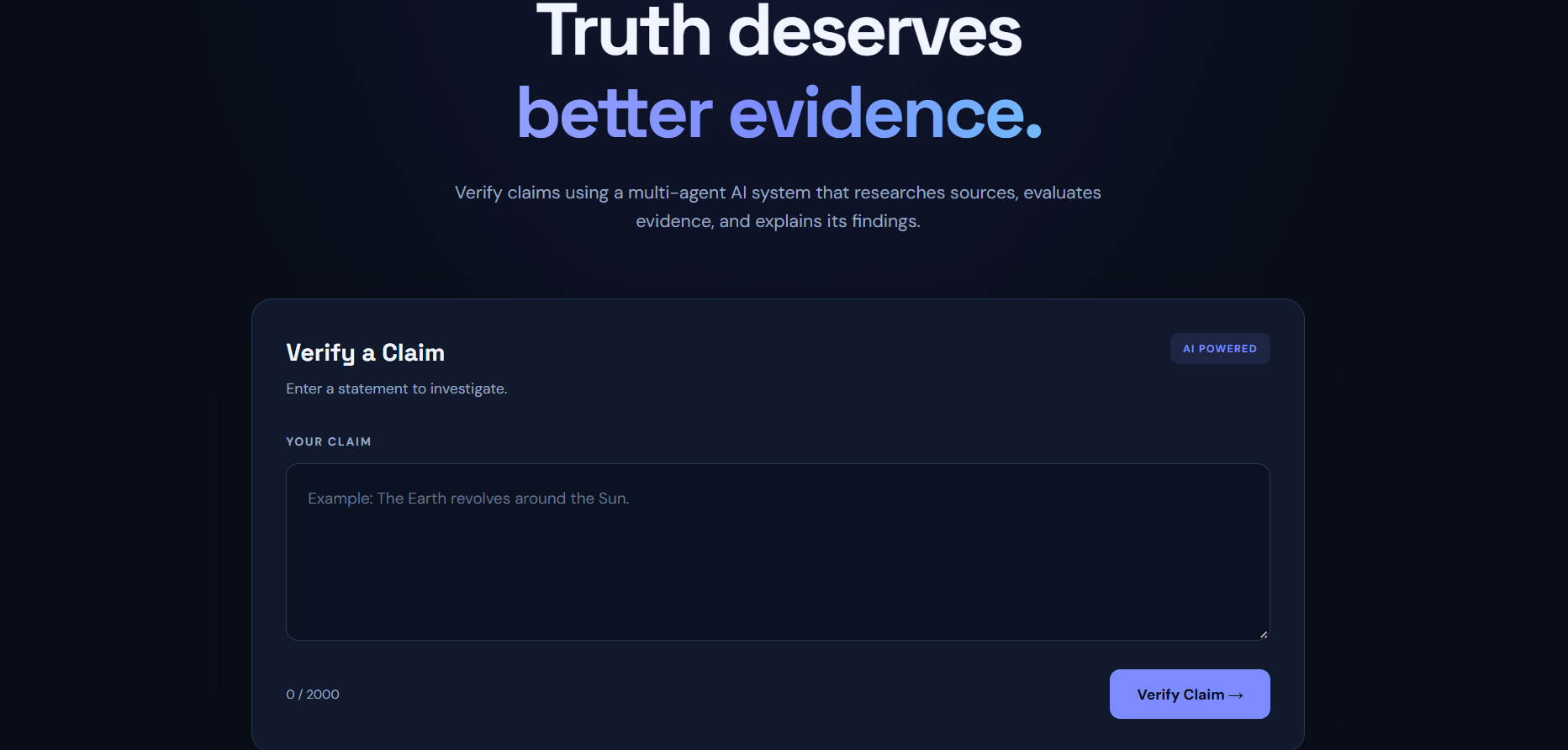
- Presents the results through an interactive web interface.
- Allows users to export their analysis as a PDF report.
The system can also identify conflicting or insufficient evidence rather than forcing a definitive conclusion.
How we built it
VeriFlow AI uses a modular architecture with five specialized AI and validation components.
1. Planning Agent
Uses NVIDIA Nemotron to break a claim into targeted research queries.
2. Research Agent
Uses Tavily Search to retrieve and organize relevant online sources.
3. Verification Agent
Uses NVIDIA Nemotron to examine source excerpts independently and classify their relationship to the claim as SUPPORTS, CONTRADICTS, or INSUFFICIENT.
4. Evidence Validator
Checks whether quotations provided by the verification process appear in the retrieved source excerpts, reducing the risk of fabricated citations.
5. Decision Agent
Aggregates the evidence assessments and generates an explainable preliminary verdict, including supporting and contradicting evidence counts.
Technology stack
- AI model: NVIDIA Nemotron-3 Nano 30B
- AI inference: Nebius Token Factory
- Programming language: Python
- Backend: FastAPI
- Research: Tavily Search API
- Frontend: HTML, CSS, and JavaScript
- Live progress: Server-Sent Events (SSE)
- PDF generation: ReportLab
- Deployment: Render
- Version control: GitHub
The application is deployed as a publicly accessible web service.
Challenges we faced
One of the most important challenges was ensuring that the AI evaluated evidence in context rather than relying on keyword matching.
For example, a passage describing the Sun's apparent movement across the sky should not automatically be interpreted as evidence that the Sun physically revolves around Earth.
We improved the verification instructions to distinguish physical claims from apparent observations, historical beliefs, hypothetical scenarios, and quoted opinions.
Another challenge involved inconsistent model responses, including invalid JSON and occasional request timeouts.
We introduced response validation, retry handling, diagnostic logging, and performance measurements to improve the system's reliability and make failures easier to investigate.
We also worked on connecting the backend, live progress updates, evidence reports, and PDF export into a usable web application.
Accomplishments we're proud of
- Built an end-to-end multi-agent evidence analysis pipeline.
- Integrated NVIDIA Nemotron through Nebius Token Factory.
- Connected external research to source-level AI verification.
- Added exact quotation matching to improve citation traceability.
- Implemented preliminary verdicts that can acknowledge conflicting or insufficient evidence.
- Created an interactive web interface with live analysis progress.
- Added downloadable PDF reports.
- Successfully deployed the application online using Render.
What we learned
Building VeriFlow AI reinforced an important lesson: an AI-generated answer is not the same as verified evidence.
Reliable AI-assisted analysis requires careful source interpretation, explicit uncertainty, transparent reasoning, and safeguards against misleading citations.
We also gained practical experience integrating LLM inference, external search APIs, backend orchestration, streaming updates, testing, and cloud deployment.
What's next for VeriFlow AI
Future improvements could include:
- Expanding evaluation across a larger and more diverse benchmark.
- Improving source credibility assessment and evidence weighting.
- Adding stronger safeguards against unreliable or incomplete model responses.
- Supporting multilingual fact-checking.
- Introducing deeper document analysis and source cross-referencing.
- Improving latency through more efficient verification workflows.
Our long-term vision is to make evidence-based AI analysis more accessible, transparent, and useful for researchers, students, journalists, and everyday users.
VeriFlow AI — Investigate claims. Examine evidence. Understand the verdict.

Log in or sign up for Devpost to join the conversation.