VeriFlow AI — Verify Work. Build Trust. Pay Smarter.
Inspiration
Freelance projects often face a simple but frustrating problem: clients and freelancers don't always share the same understanding of what was promised, what counts as completed work, and when a milestone should be approved for payment.
Project requirements get scattered across messages, revisions become difficult to track, and disagreements can arise when expectations are unclear.
We wanted to build a solution that makes freelance collaboration more transparent, structured, and accountable.
That's how VeriFlow AI was born.
What it does
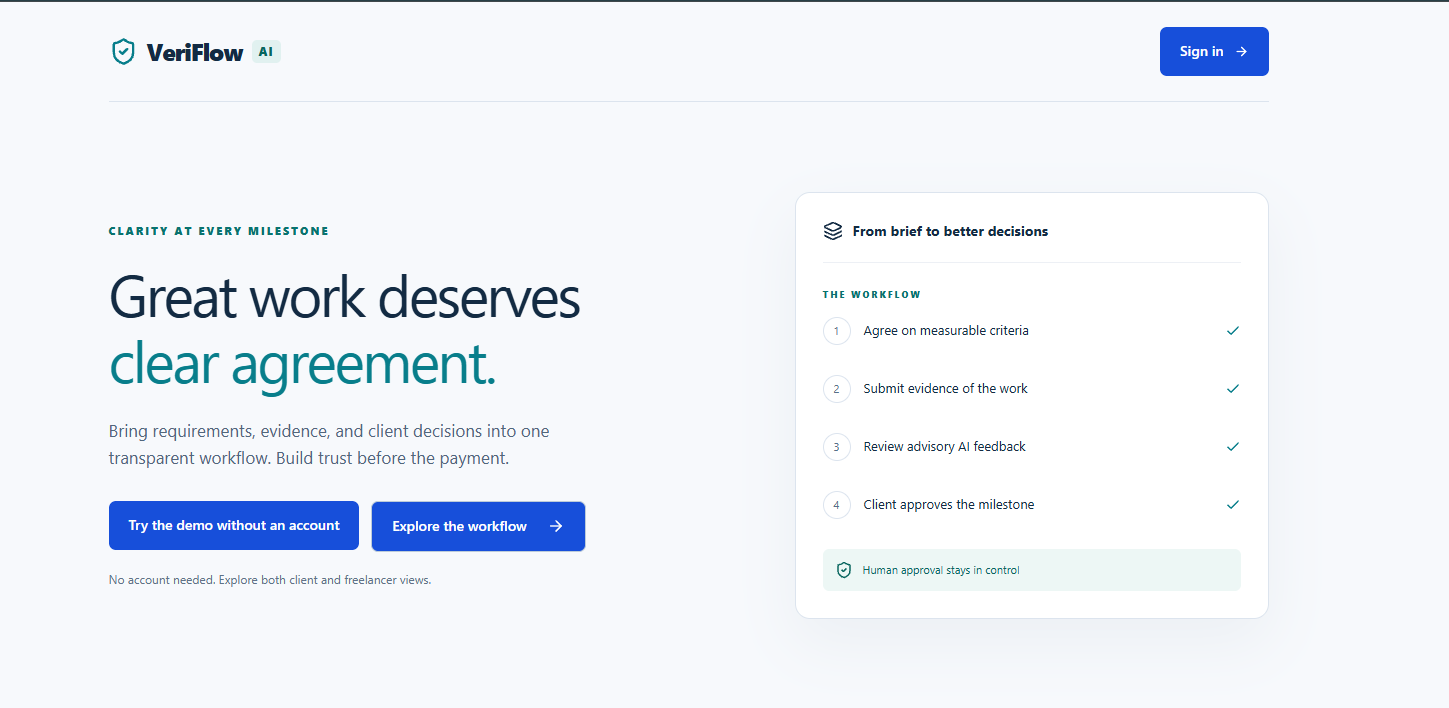
VeriFlow AI is a shared milestone-based workspace that helps clients and freelancers manage projects from agreement to delivery.
Key features include:
- Structured Project Creation: Clients define project details, budgets, milestones, and acceptance criteria.
- AI-Assisted Milestone Planning: AI can suggest milestone structures, which clients review and save before they become part of the agreement.
- Work Submission & Revisions: Freelancers submit descriptions, reproduction notes, and reference links. Previous submissions remain accessible when revisions are requested.
- AI Advisory Review: AI organizes submitted evidence against milestone acceptance criteria and highlights potentially missing information. The final approval decision always belongs to the client.
- Transparent Project History: Agreements, submissions, revisions, and decisions stay together in one shared workspace.
- PayPal Integration Design: The application is designed around PayPal Sandbox checkout, with server-side payment verification before recording a completed payment.
How we built it
We approached VeriFlow AI as a workflow and accountability problem rather than simply another freelance marketplace.
The application brings together project management, milestone tracking, evidence submissions, AI-assisted assessment, and payment workflow design.
We focused on making each milestone follow a clear process:
- Define the agreement and acceptance criteria.
- Submit work with supporting evidence.
- Review the submission against the agreed criteria.
- Request revisions or approve the milestone.
- Maintain a record of decisions and payment status.
AI is designed as an advisory assistant, not an autonomous decision-maker. This ensures that important project approval decisions remain under human control.
Challenges we faced
One of our biggest challenges was designing a workflow that could be transparent for both parties without making AI the final authority.
We also had to consider how revisions should be tracked, how previous submissions should remain accessible, and how payment records should be handled responsibly.
Another important challenge was distinguishing between a successful-looking frontend interaction and a genuinely verified backend operation. This influenced how we designed the payment workflow and documented the prototype's current limitations.
What we learned
Building VeriFlow AI helped us understand that useful AI applications are not just about generating responses. They must fit into real workflows, provide understandable feedback, and respect human decision-making.
We also learned the importance of clear acceptance criteria, persistent project history, and server-side validation when designing applications involving financial workflows.
What's next
Our vision is to evolve VeriFlow AI into a more complete freelance collaboration platform with credential-backed AI reviews, fully configured PayPal Sandbox transactions, stronger evidence verification, and production-ready deployment.
VeriFlow AI — Clear agreements. Transparent work. Accountable decisions.
Current prototype disclosure: AI assessment is demonstrated in simulated mock mode. PayPal checkout is currently unconfigured. Reference links are stored but not independently inspected. The prototype is not an escrow service, does not execute freelancer payouts, and does not guarantee dispute resolution.
Built With
- artificial-intelligence
- automation
- fintech
- generative-ai
- next.js
- node.js
- paypal
- paypal-sandbox
- postgresql
- prisma
- project-management
- react
- rest-api
- typescript
- web-development

