Inspiration
During a natural disaster, sending an emergency warning is only the first step. The bigger challenge is knowing whether the warning actually reached people in remote or poorly connected areas. This inspired us to build VERIFIRE AI — Verified Emergency Relay & Response Network.
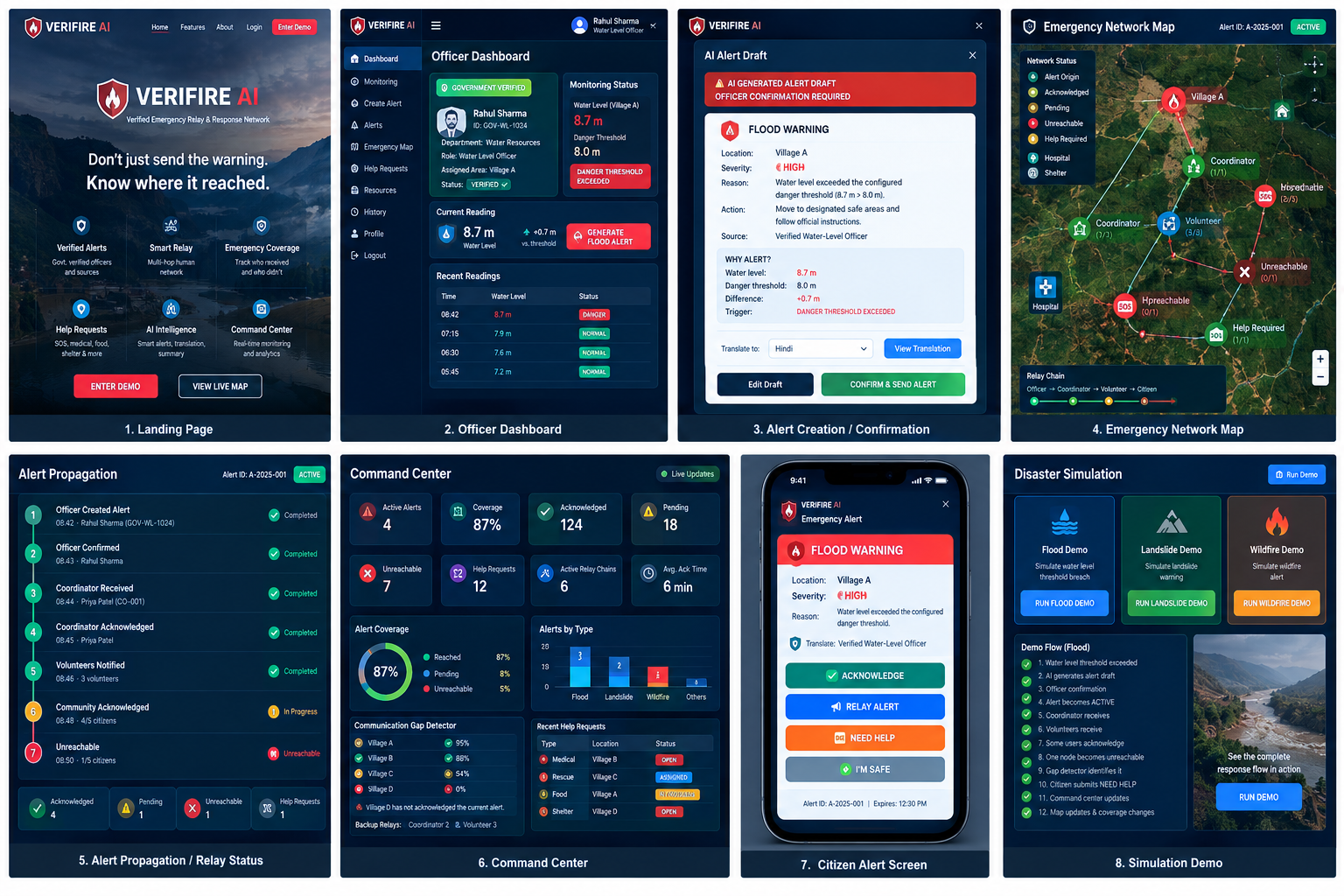
Our idea is to create a trusted, multi-hop emergency communication network where an authorized officer can issue a verified alert, and the alert can propagate through pre-registered local coordinators, volunteers, and citizens. Instead of simply showing that an alert was sent, VERIFIRE AI shows where the alert reached, who acknowledged it, and where communication gaps remain.
How We Built It
We designed VERIFIRE AI as a role-based emergency response platform:
- Government/Admin: verifies and manages authorized users.
- Field Officer: monitors disaster-related readings and confirms alerts.
- Local Coordinator & Volunteer: receive, acknowledge, and relay verified alerts.
- Citizen: receives alerts and can report that they are safe or need help.
- Command Center: monitors alert coverage, acknowledgements, unreachable nodes, and help requests.
- Emergency Network Map: visualizes how an alert propagates from the source through the verified relay network.
For the AI layer, we use NVIDIA Nemotron through Nebius to structure alerts, explain why an alert was triggered, generate clear emergency messages, summarize information, support multilingual communication, and help prioritize relay paths.
The application is built with React, TypeScript, Tailwind CSS, Python, FastAPI, SQLite/PostgreSQL, Leaflet/OpenStreetMap, React Flow, and Recharts.
What We Learned
While building VERIFIRE AI, we learned that emergency AI should not independently declare a disaster. The system needs a clear chain of responsibility:
Monitoring/Sensor Reading → Safety Threshold → AI Alert Draft → Authorized Officer Confirmation → Verified Relay → Acknowledgement & Coverage Tracking
We also learned how important role-based access, audit logs, alert expiry, communication-gap detection, and human confirmation are for a safety-focused system.
Challenges
One of our biggest challenges was designing a system that is useful without pretending to replace existing government emergency-alert infrastructure. We therefore focused on the last-mile human relay and visibility layer.
Another challenge was handling unreachable recipients. VERIFIRE AI addresses this by tracking acknowledgement status and identifying communication gaps so authorized backup relays can be used.
We also had to balance AI automation with human control. AI assists with structuring, explaining, translating, and prioritizing information, while the authorized officer remains responsible for confirming an emergency alert.
Our Goal
VERIFIRE AI is built around one simple question:
Don't just send the warning. Know where it reached.
Our goal is to make emergency communication more transparent, traceable, and resilient for communities that may be difficult to reach during disasters.

Log in or sign up for Devpost to join the conversation.