Inspiration
The "Reproducibility Crisis" in science is a growing threat to global progress. Every year, thousands of papers are published with claims that simply don't hold up when the raw data is examined. We realized that peer reviewers are human—they can't manually cross-reference 5,000-word manuscripts with 500,000-row datasets. We were inspired to build VerifiAI to act as a "Forensic Agent," using the reasoning power of Gemini 3 to restore trust in scientific research.
What it does
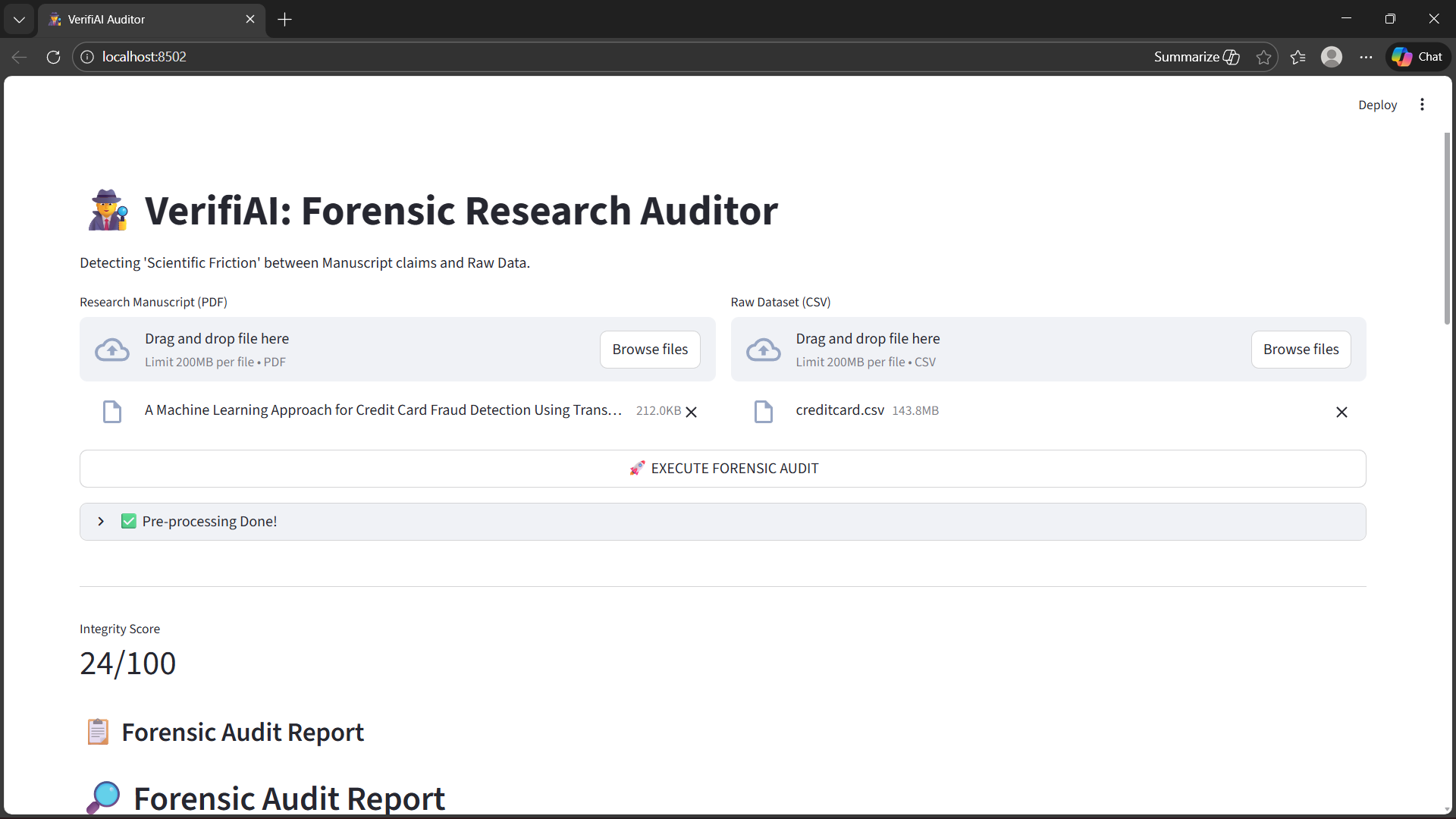
VerifiAI is a multimodal integrity auditor. It allows a user to upload a research manuscript (PDF) and its underlying dataset (CSV). Using Gemini 3’s Thinking Mode, the system:
- Extracts Qualitative Claims: Identifies the metrics (e.g., 99.9% accuracy) and citations mentioned in the text.
- Audits Quantitative Reality: Analyzes the statistical metadata of the dataset (e.g., class distribution, duplicates, correlations).
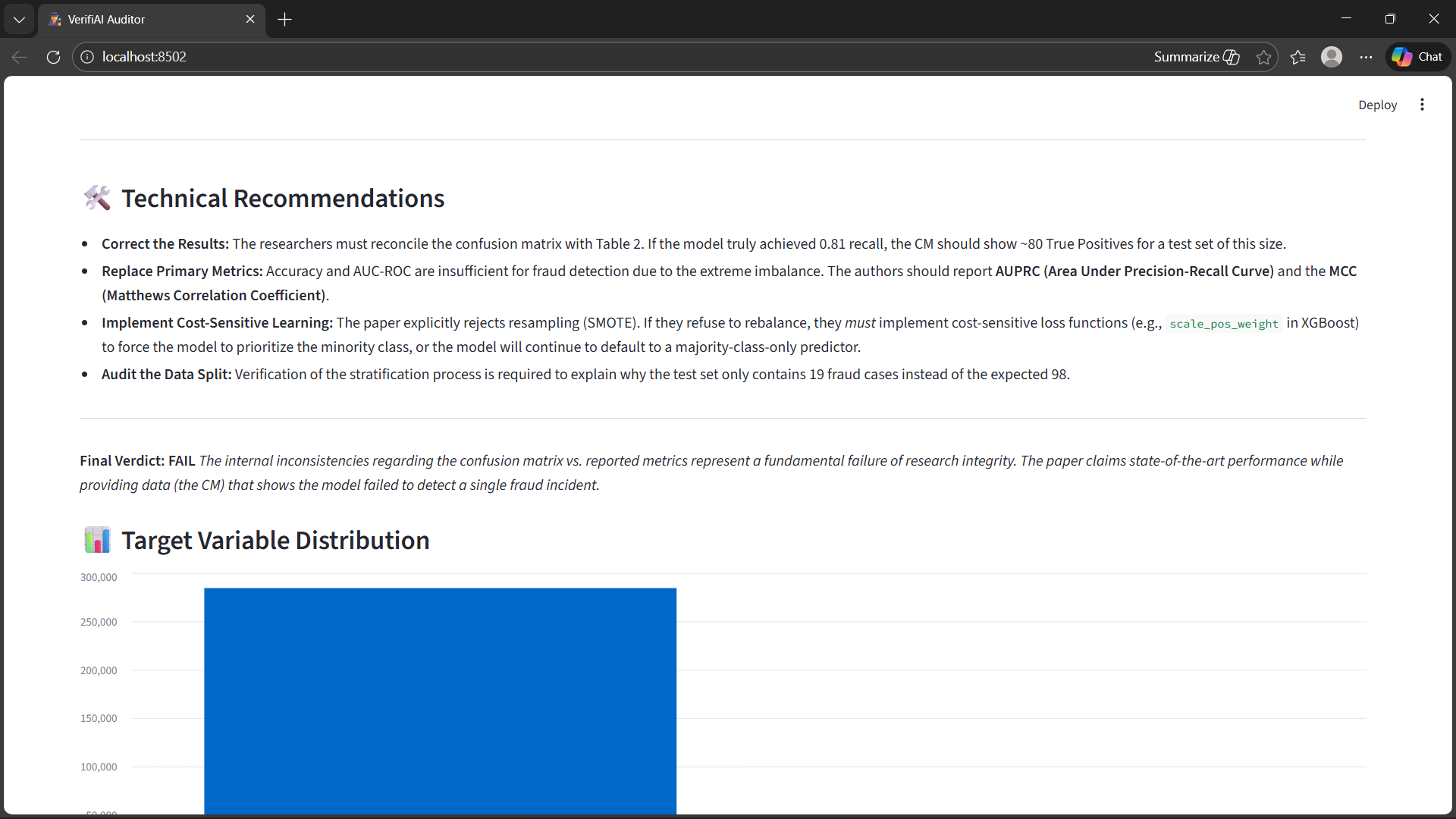
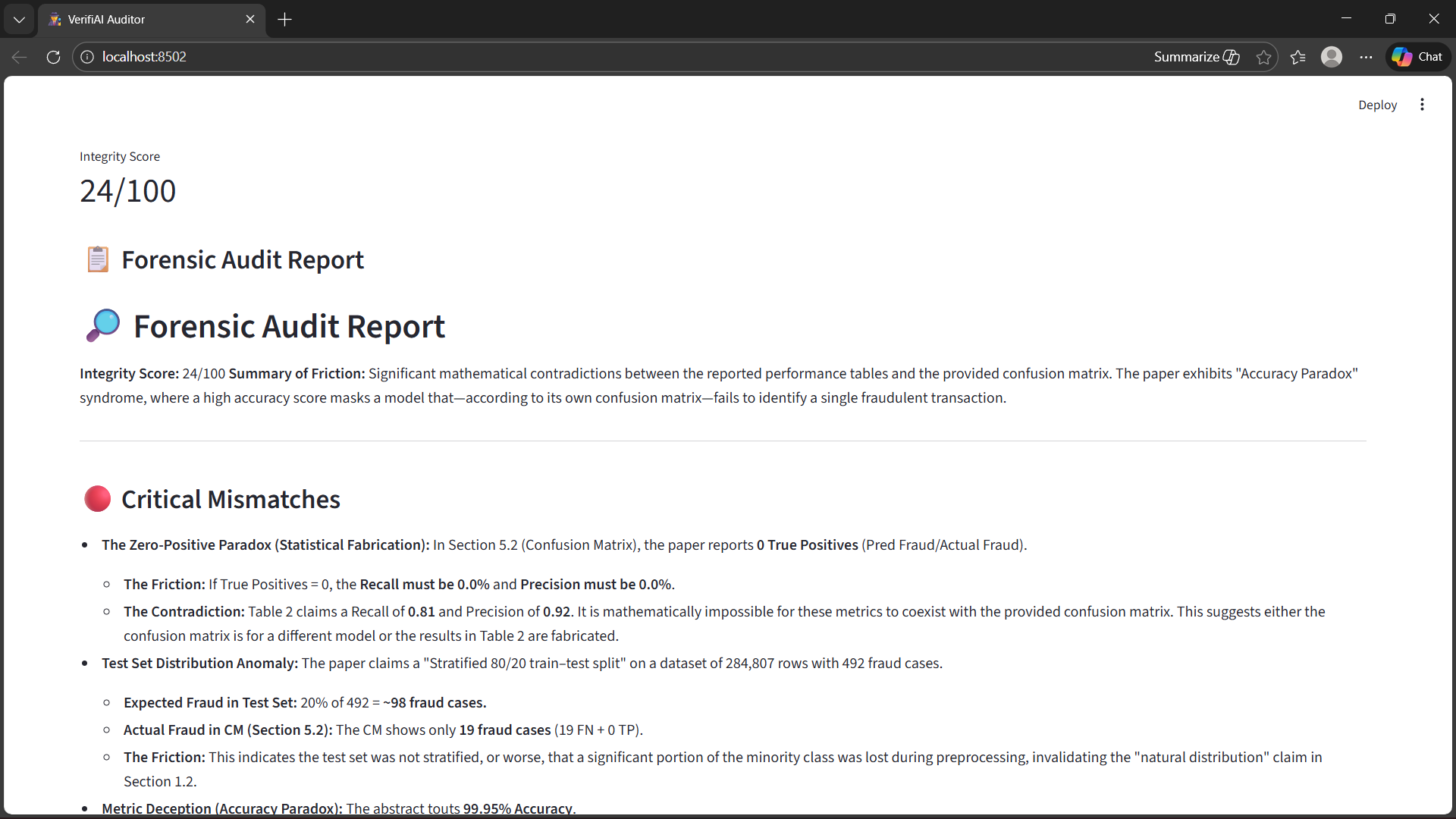
- Detects "Scientific Friction": Flags contradictions, such as data leakage from unremoved duplicates or "hallucinated" citations that pre-date or post-date the study period.
How we built it
The core engine is built on the Gemini 3 Pro API. We utilized a "Multi-Stage Agentic Workflow": The Parsing Layer: Uses PyPDF2 and Pandas to ingest unstructured text and structured data. The Reasoning Layer: We implemented Chain-of-Thought (CoT) prompting within Gemini 3’s system instructions to force the model to "think" before rendering a verdict. The UI: A sleek, production-ready dashboard built with Streamlit that visualizes the "Integrity Score" and "Friction Points."
Challenges we ran into
One of the biggest hurdles was the "Context Window management." While Gemini 3 has a massive window, feeding raw CSV data row-by-row is inefficient. We overcame this by building a Statistical Profiler that generates a metadata summary (correlations, null counts, distributions) for the AI to reason over. Another challenge was fine-tuning the prompt to distinguish between "statistical noise" and "deliberate scientific friction."
Accomplishments that we're proud of
We are incredibly proud of our "Forensic Verification" engine. During testing, VerifiAI proved its ability to act as a high-level auditor by successfully identifying a "Chronological Anachronism"—a citation for a "2025 Report" inside a study that claimed to be finalized in 2024. This isn't just text matching; it is Temporal Reasoning.
What we learned
Building VerifiAI shifted our perspective on AI from a "Creative Partner" to a "Verification Authority." We learned that Gemini 3’s greatest strength isn't just producing text, but its ability to perform Cross-Modal Logic Verification.We discovered that by providing the AI with statistical summaries, we could leverage its reasoning to identify the Accuracy Paradox in real-time. For instance, in our fraud detection test case, we learned how easily a 99.95% accuracy claim can fall apart under forensic scrutiny when the baseline data is already 99.83% skewed.
What's next for VerifiAI — The Research Integrity Auditor
We plan to scale VerifiAI to support: Video Auditing: Analyzing screen recordings of experiments to ensure they match written protocols. Code Execution: Integrating Gemini’s code execution feature to actually run the paper's methodology and verify the results in real-time. Direct Journal Integration: A Chrome extension for peer reviewers to audit papers directly from arXiv or Nature.


Log in or sign up for Devpost to join the conversation.