-
-
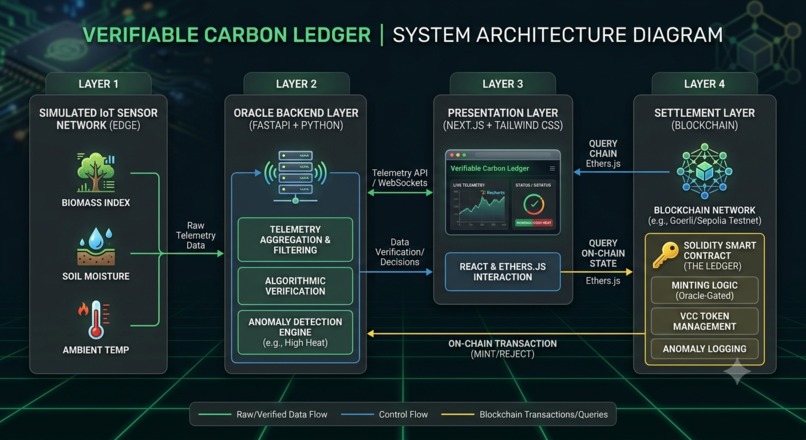
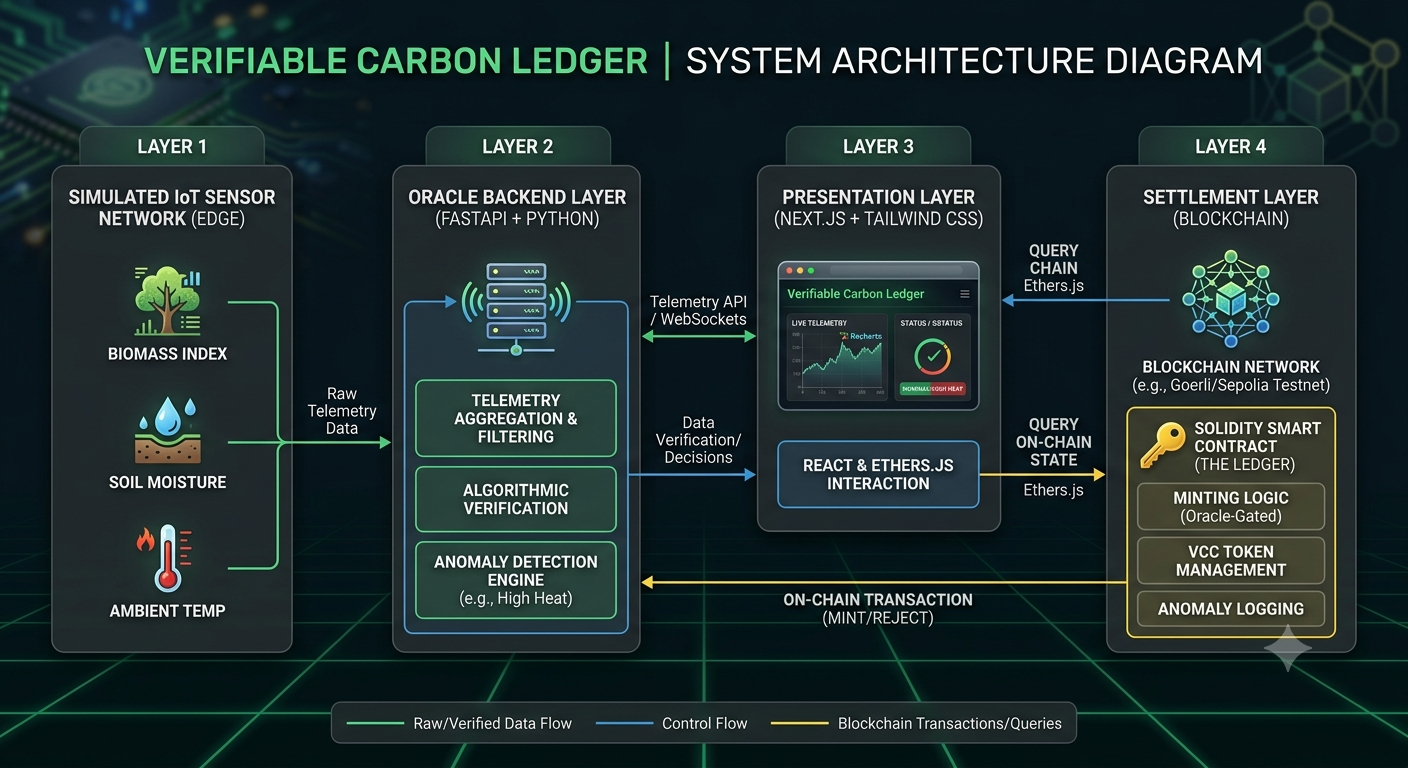
System Architecture
The multi-billion dollar carbon credit market is currently plagued by a critical vulnerability: greenwashing. Companies buy offsets, but there is rarely ongoing, verifiable proof that the forests they are paying to protect actually remain healthy and intact. We realized that without a cryptographic link between real-world environmental health and the carbon credits themselves, the system is fundamentally broken. We wanted to build a trustless bridge—a system where nature itself dictates the minting of credits, removing human bias and manual reporting from the equation. The Verifiable Carbon Ledger is a decentralized IoT-to-blockchain oracle system. It acts as an automated, tamper-proof command center for carbon markets.
Real-Time Monitoring: It ingests live environmental telemetry (biomass index, soil moisture, and ambient temperature) from reforestation sectors.
Algorithmic Verification: The backend oracle evaluates this data continuously. If conditions are nominal, it communicates with our smart contract to automatically mint Verifiable Carbon Credits (VCC).
Automated Risk Mitigation: If the system detects an anomaly—such as a sudden temperature spike indicating a forest fire—the oracle instantly halts the minting process and logs a rejected transaction on-chain, ensuring credits are never issued for compromised land. We architected the platform across three distinct layers to ensure scalability and security:
The Presentation Layer (Frontend): We built a high-performance, dark-mode cyber command center using Next.js 14, styled with Tailwind CSS. We utilized Recharts to render zero-latency, real-time data visualizations of the environmental telemetry.
The Oracle Layer (Backend): We developed a high-throughput FastAPI Python server that simulates edge IoT sensor data. It includes an anomaly injection engine (using probability modeling) to test the system's resilience to extreme weather events.
The Smart Contract Layer (Blockchain): We wrote custom Solidity smart contracts to handle the minting logic, incorporating secure integer scaling math and strict oracle-gating modifiers. The frontend communicates with this ledger using ethers.js. The biggest hurdle was bridging the gap between off-chain, high-frequency IoT data and the deterministic, state-based environment of a blockchain. Passing floating-point environmental metrics (like 24.5°C) into Solidity required implementing careful integer-scaling math in the contract layer. Additionally, perfectly synchronizing the React state in our Next.js dashboard so that the live telemetry chart and the blockchain transaction logs updated harmoniously without causing render-blocking performance issues took several iterations to get right. We are incredibly proud of successfully integrating three completely different paradigms—hardware data simulation, centralized backend logic, and decentralized smart contracts—into one seamless, sub-second latency application. Watching the dashboard independently detect a "High Heat Anomaly," reject the smart contract transaction, and visualize it on the UI in real-time is a massive technical win for us. Building this reinforced our understanding of the "Oracle Problem" in Web3. We learned exactly how vulnerable smart contracts are to the off-chain data they rely on, and how crucial it is to sanitize and verify that data before it touches the blockchain. We also deepened our expertise in React component lifecycles, advanced Next.js configuration, and building responsive data visualizations. For Brainwave 2026, we built a robust software prototype. The immediate next step is crossing the hardware barrier. We plan to:
Integrate Real Hardware: Swap our edge simulation for actual physical LoRaWAN IoT sensors deployed in a local environment.
Decentralize the Oracle: Move from a single backend oracle to a multi-node consensus network (like Chainlink DONs) to prevent a single point of failure in data reporting.
Dynamic NFTs: Evolve our VCC tokens into dynamic NFTs whose metadata visually degrades or flourishes based on the historical health of the specific land tract they represent.
Built With
- api
- blockchain
- climate-tech
- ethers.js
- fastapi
- green-tech
- iot
- next.js
- oracle
- python
- react
- recharts
- refi
- simulation
- smart-contracts
- solidity
- tailwind-css
- typescript
- web-sockets
- web3

Log in or sign up for Devpost to join the conversation.