-
-
-
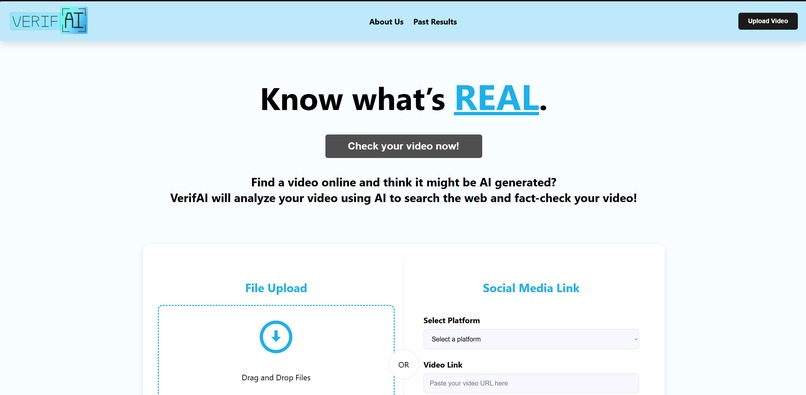
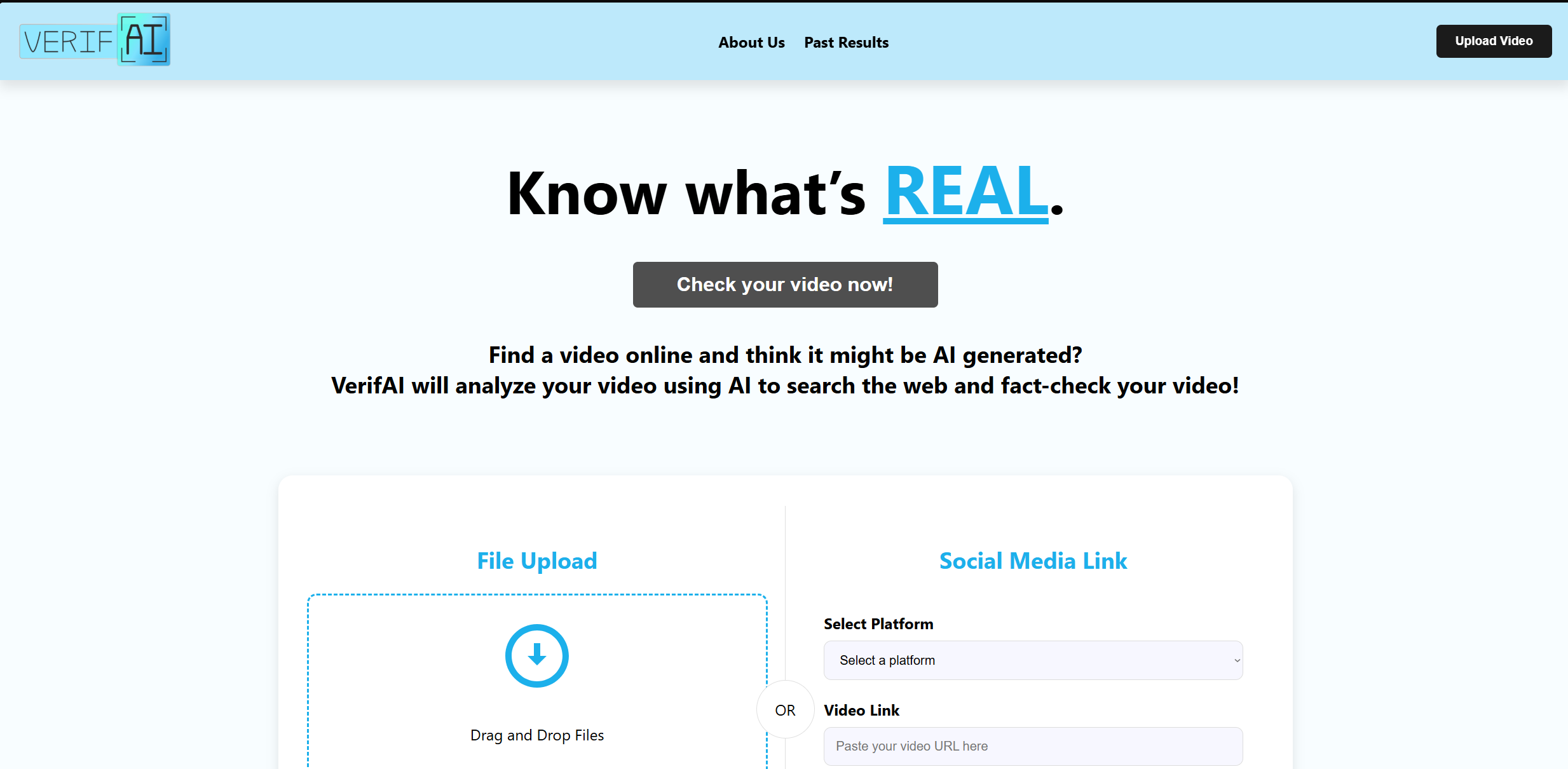
VerifAI landing page
Inspiration
With the rise of AI, particularly the recent improvements in image and video creation, it is becoming increasingly difficult to tell if content online is real or not. This becomes an issue when deepfake videos are created where real people are posed sharing seemingly real news that could affect a person's life if taken at face value. The most vulnerable groups to these kinds of misinformation attacks are those with low technical prowess, most common among children and the elderly. Our team at Bugged n' Loaded believe that the internet should be transparent about the sources of information available to the public, and that people should not have to worry about every video being fake.
What it does
VerifAI will analyze the video a user uploads to the application and compare the content found in the video to news articles online. To analyze the video, we implemented Google Gemini Video understanding to break down videos into keywords that are used to search for news articles online. If there are no highly relevant news articles that match the content found in the video, VerifAI will suggest that the video is likely AI-generated. If articles do appear, VerifAI will instead return a list of sources that can be used to verify the authenticity of the video.
How we built it
For our frontend, we used Figma to design the UI of the website, React to build our codebase, and Cursor AI to assist our coding efforts. For the backend, we used Google Gemini API Video Understanding features to review the video, Node.js to host the server and run functions, Express.js for middleware, and TheNewsAPI to search the web for relevant news articles.
Challenges we ran into
Creating efficient prompts with Google Gemini and using the results of it's interpretations was difficult to breakdown into a process. We settled on using a scale approach where Gemini was given a set of criteria to match "closeness" of the news articles received to the content of the video. The low number of requests on TheNewsAPI makes it difficult to get the most accurate results. With the free version, we only get 3 articles per request. Despite this, we still find the results are accurate when reviewing mainstream news and large figures (ex. Political figures, natural disasters, etc.)
Accomplishments that we're proud of
The ability to upload both local videos and YouTube videos proves that we can go further into other social media platforms to verifai the legitimacy of more and more videos. This project held many firsts for our team, including using Google Gemini API, React, and Node.js distributed among the four of us. One of the biggest accomplishments is having created the application we have now in just this weekend with a team of mostly strangers who (with the exception of one of us) have never done a hackathon before.
What we learned
New API's, new libraries, new design techniques, new understanding of servers, and the importance of AI in the future of software development. It's important that, as software developers, we are able to adapt and learn new skills in this ever-changing environment of the tech world. Learning to adapt to new challenges in our environment is what inspired this idea to begin with, and has proven true as we navigate using AI APIs and prompt engineering.
What's next for VerifAI
Going forwards, we hope to continue working on the project to get the full application complete and potentially uploaded to the web for the public to use. In the long term, we would like to add more social platforms to accept links from, as well as a mobile port to allow for near-instant verificAItion of videos you see online to protect the legitimacy of online content.
Built With
- cursor
- express.js
- figma
- googlegemini
- javascript
- node.js
- react
- thenewsapi
- youtube


Log in or sign up for Devpost to join the conversation.