Quick Links
Verifact: AI-Powered Fact-Checking Made Simple
Inspiration
In an era where misinformation spreads rapidly across social media and news platforms, we recognized the critical need for accessible fact-checking tools. The challenge of manually verifying information inspired us to create Verifact – a tool that empowers users to quickly verify claims and make informed decisions about the information they consume.
What it does
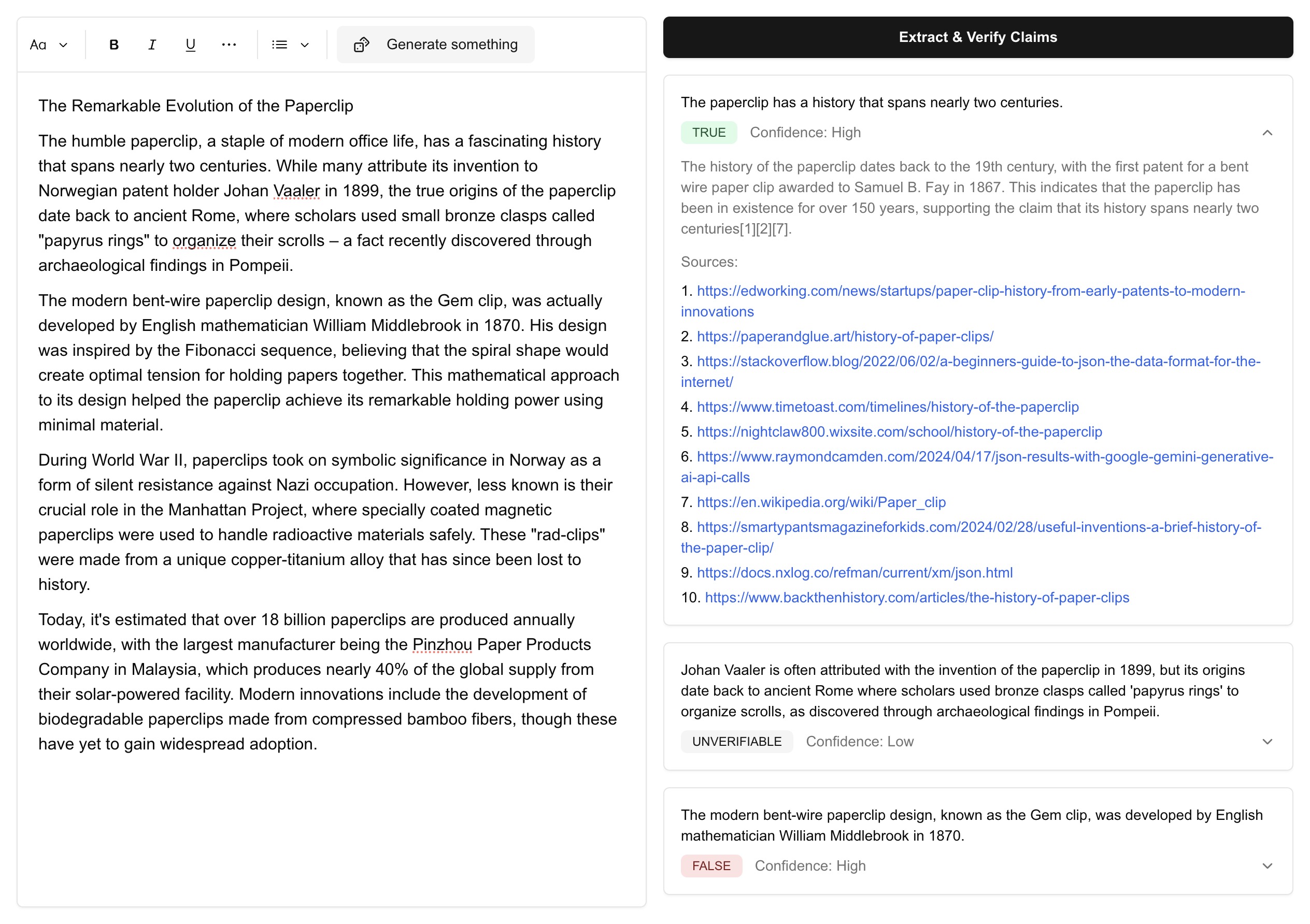
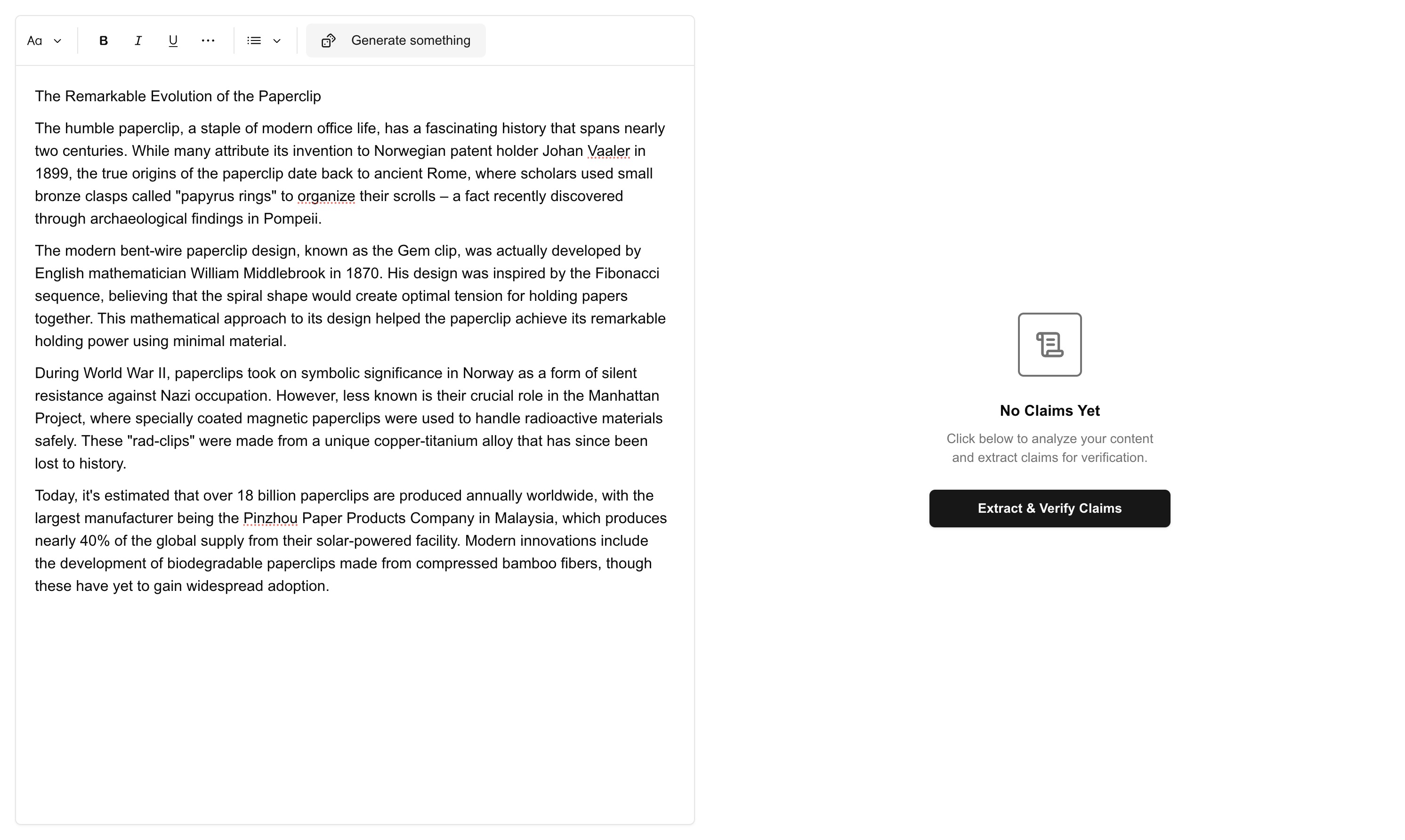
Verifact is an AI-powered claim verification service that automatically identifies and verifies factual statements in real-time. Users can input any text, and our system:
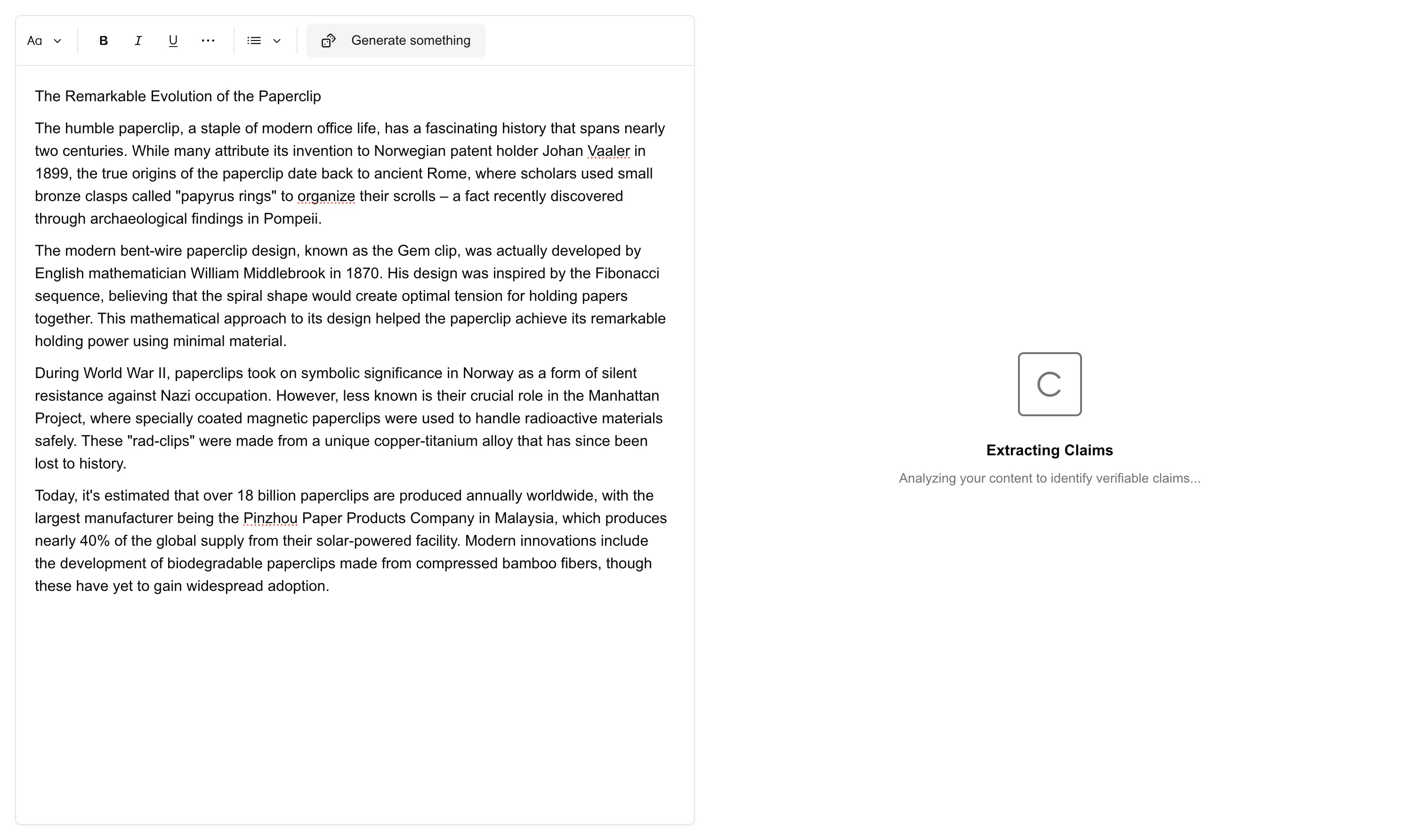
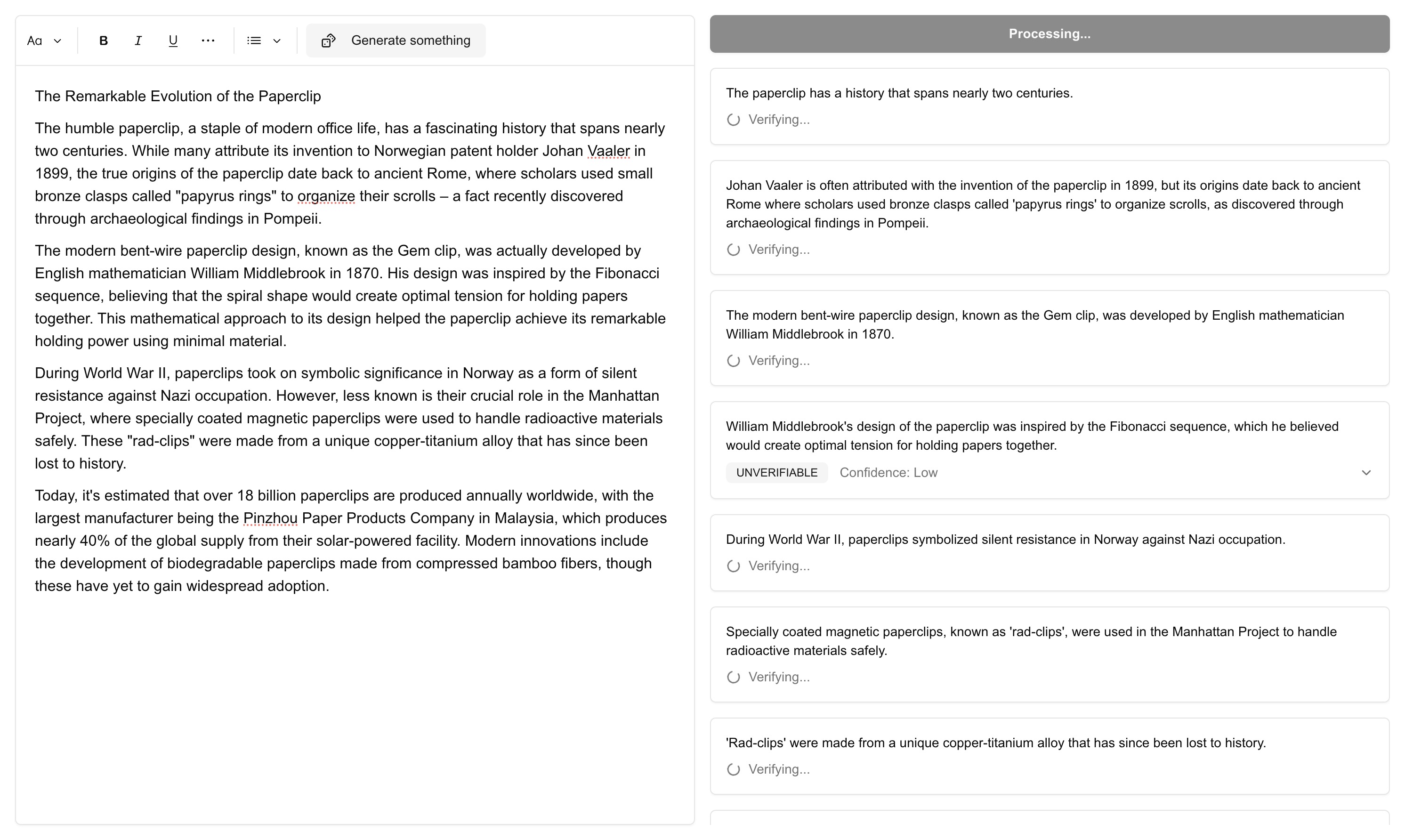
- Extracts verifiable claims using advanced natural language processing
- Cross-references these claims against reliable sources
- Provides detailed verification results with confidence levels and source citations
- Delivers clear, easy-to-understand explanations for each verification
How we built it
Our development centered on creating a powerful, two-stage AI verification system:
The core of Verifact lies in its AI integration:
- First, we use OpenAI's API to extract and analyze claims from user input. This stage involves sophisticated prompt engineering to accurately identify verifiable factual statements from any given text.
- Then, we leverage Perplexity's powerful API as our primary verification engine, taking advantage of its real-time information retrieval capabilities to provide up-to-date fact-checking against reliable sources. We chose Perplexity specifically for its ability to access and analyze current information, making our verification results both accurate and timely.
The system implements smart caching and request batching to optimize API usage while maintaining real-time performance. Our verification pipeline processes claims in parallel when possible, aggregates results, and provides confidence scores based on the quality and consistency of the verification data.
Challenges we ran into
Building Verifact came with several significant challenges:
Claim Extraction Accuracy: Initially, our system struggled to differentiate between verifiable factual claims and subjective statements. We solved this by fine-tuning our prompt engineering and implementing additional validation layers.
API Rate Limits: Managing API costs and rate limits while maintaining real-time performance required careful optimization. We implemented smart caching and request batching to minimize API calls.
Perplexity Integration: Integrating Perplexity's API for verification required careful consideration. We needed to optimize prompt engineering to get the most accurate and current information, while ensuring our verification results were thorough. We solved this by implementing structured query generation and result parsing to maximize the API's capabilities.
UI/UX Balance: Creating an interface that was both informative and user-friendly proved challenging. Through multiple iterations and user feedback, we achieved a clean design that presents complex information clearly.
Accomplishments that we're proud of
- Developed a fairly accurate claim extraction system
- Created an intuitive UI that makes fact-checking accessible to everyone
- Achieved sub-5-second response times for most verifications
What we learned
This project taught us valuable lessons about:
- Advanced prompt engineering for AI applications
- Balancing technical capabilities with user experience
What's next for Verifact
We have exciting plans for Verifact's future:
- Browser extension for instant fact-checking while browsing
- API access for third-party integrations
- Support for multiple languages
- Enhanced source verification algorithms
- Community features for collaborative fact-checking
Our goal is to make Verifact an essential tool in the fight against misinformation, helping users make more informed decisions about the information they encounter online.
Built With
- next.js-15
- openai
- perplexity
- radix-ui
- react-query
- tailwind-css
- typescript

Log in or sign up for Devpost to join the conversation.