-
-
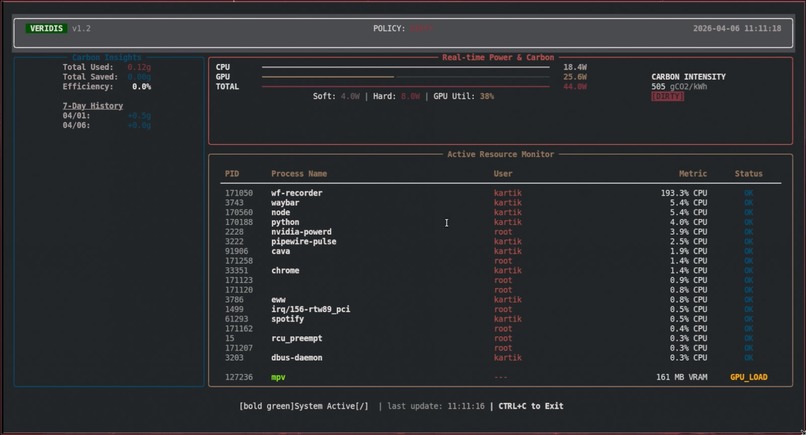
Terminal Interface
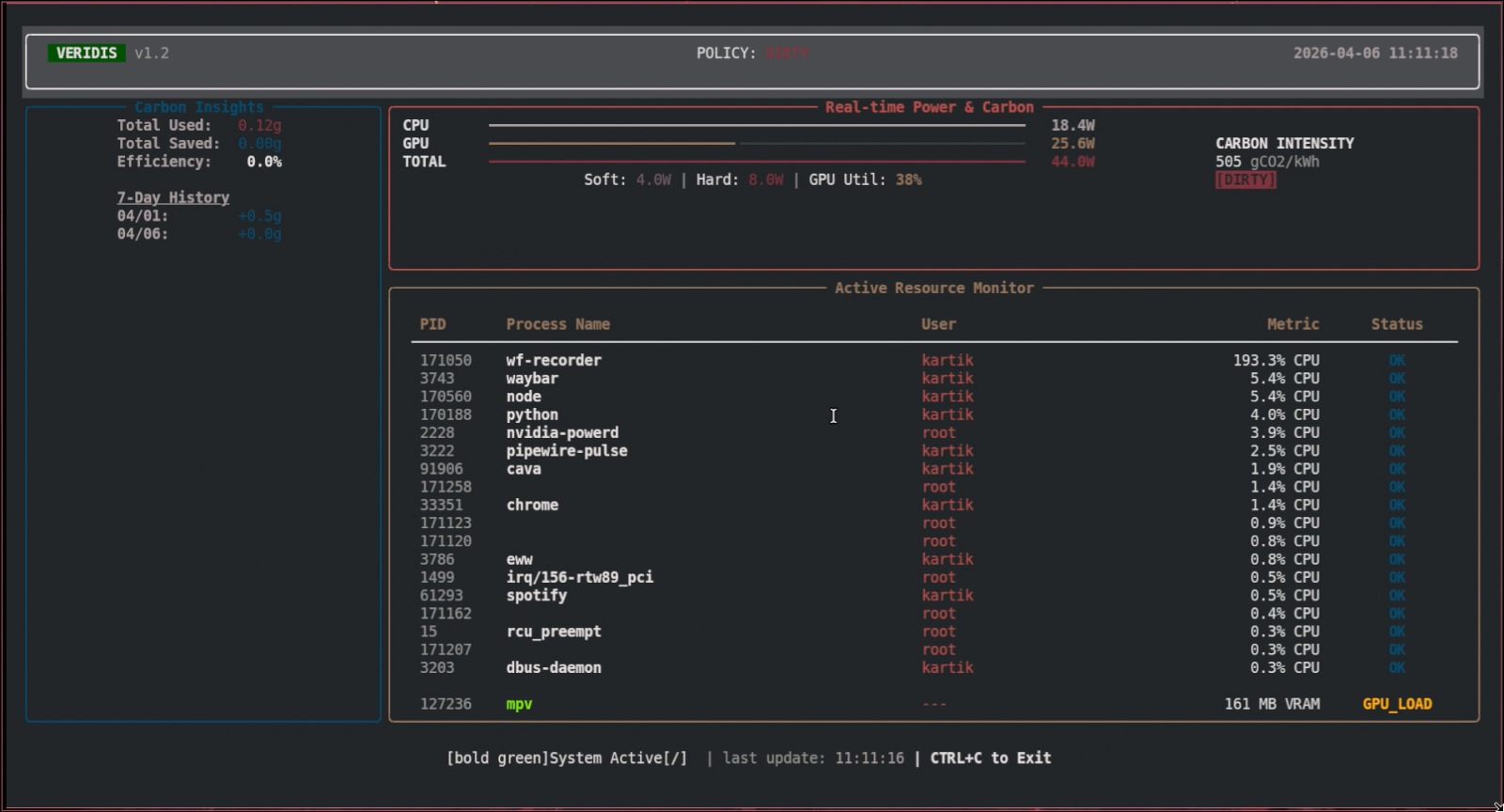
Veridis
Decarbonizing Compute at the Kernel Level
Synchronizing system workloads with green energy grids, one CPU cycle at a time.
Inspiration
The global computing ecosystem spanning billions of edge devices, workstations, and servers is one of the fastest-growing sources of carbon emissions worldwide. Yet despite this scale, operating systems continue to schedule heavy workloads with zero awareness of grid health, wasting green energy and burning dirty power indiscriminately.
Veridis was built to change that. By making the OS itself "climate-conscious," Veridis automatically throttles non-critical tasks when grid carbon intensity is high, and unleashes them when renewable energy is abundant turning every machine into an active participant in the global energy transition.
How We Built It
Veridis bridges high-level carbon APIs with low-level Linux primitives through three tightly integrated layers:
1. Kernel Space - eBPF
Custom C programs hook into sched_switch to track exact CPU execution time with near-zero overhead, giving us a precise, real-time view of workload activity without destabilizing the kernel.
2. User Space Daemon - C++
An efficient daemon reads eBPF maps, polls Intel RAPL for CPU energy metrics, and fetches GPU power data — assembling a continuous, hardware-accurate picture of the system's energy draw.
3. Throttling Logic - Carbon-Aware Scheduling
Real-time carbon footprint is calculated using the following integral:
$$C_{\text{total}} = \int_{t_0}^{t_1} \left( P_{\text{cpu}}(t) + P_{\text{gpu}}(t) \right) \cdot I_{\text{grid}}(t) \, dt$$
When $I_{\text{grid}}$ (grid carbon intensity) exceeds defined thresholds, the daemon migrates high-CPU PIDs into restricted cgroups, directly capping power draw. As the grid cleans up, workloads are automatically restored, ensuring no productivity is permanently sacrificed for sustainability.
4. Dashboard - Python TUI
A Python-based Terminal UI provides real-time visualization of power limits, grid intensity, and cumulative carbon savings, making the invisible impact of compute tangible for users and operators globally.
Global Impact
The implications of carbon-aware OS scheduling extend far beyond individual machines:
- Data centers running Linux workloads could shift batch jobs, model training, and indexing tasks to align with regional renewable energy peaks.
- Enterprise fleets of workstations could collectively reduce their carbon footprint without any change in user behavior.
- Developing regions with unstable or coal-heavy grids could use Veridis to intelligently adapt compute intensity to real-time grid conditions.
- At scale, coordinated kernel-level throttling could act as a distributed demand-response system, reducing strain on fossil-fuel peaker plants during high-demand periods worldwide.
Challenges
eBPF Safety Navigating the strict Linux kernel verifier required careful design to ensure stable, crash-free execution the kernel tolerates no ambiguity when it comes to safety guarantees. Hardware Precision Converting raw Intel RAPL microjoule counters into accurate real-time wattage is non-trivial across CPU architectures, requiring careful calibration to avoid misleading carbon estimates. Selective Throttling Building a robust process whitelist was critical, critical system processes must remain completely unaffected while resource-heavy background workloads are managed, ensuring the system stays stable and usable throughout.
We discovered the immense power of eBPF for system observability and how cgroups can be used as a reactive tool for environmental impact. Most importantly, we saw that software can be a physical lever for climate action by directly responding to the real-time state of the energy grid.

Log in or sign up for Devpost to join the conversation.