VeriCore — Project Story
Inspiration
VeriCore didn't start with a business plan. It started in a community.
I help lead one of Colombia's largest non-profit AI builder communities — free courses, shared projects, workshops at the country's biggest tech events. Out of it we created Igniters: someone who has lived a problem inside an industry for years brings it to the community, and builders work with them to solve it — scalably, for the whole industry, not as a one-off fix.
Adriana came through Igniters. One of Colombia's most experienced advisors on implementing AI for legal teams, she had catalogued the same failure across years of engagements: the AI wrote fluently, but had nothing real to reason over. Each firm's knowledge — cases, contracts, jurisprudence, precedent — lived scattered across drives, email threads, and the memory of whoever had been there longest. No AI rollout fixed that, because the problem was never the model. It was the missing layer underneath.
That is what we're solving. Not a hypothesis — a diagnosis she had already made across dozens of real firms.
The numbers agree. Thomson Reuters' Future of Professionals 2025 found AI could free ~240 hours per legal professional per year, worth ~$19,000 each. LemonTech's Radiografía LegalTech LATAM (100+ decision-makers across four LATAM countries) pinpoints the gap: 28.8% say document analysis is where AI creates most value; 31% name data security as the biggest barrier. The highest-value use case, blocked by the one concern most legal AI tools wave away. That gap is the product.
What it does
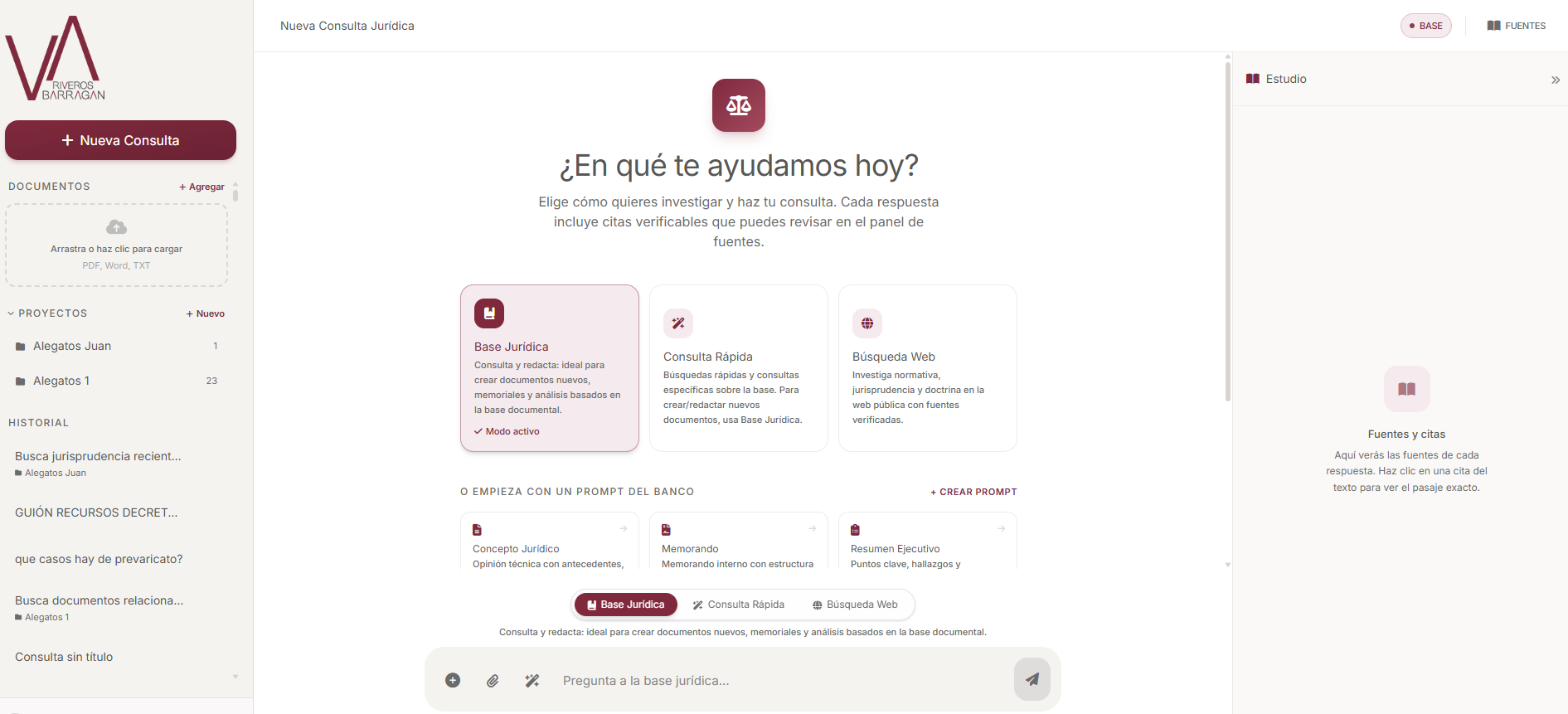
VeriCore is where a law firm centralizes its knowledge, and where legal AI agents connect to it. Three layers: Recover (semantic retrieval across private documents and public legal sources), Reason (answers governed by explicit legal rules — cite every source, never issue a closed legal decision), and Produce (ready-to-review drafts built from the same verified evidence, inheriting the same guarantees). Underneath sits a live knowledge graph, so what a case relates to stops living in one associate's head.
How we built it
A multi-tenant Next.js/TypeScript platform on Firebase and Google Cloud, deployed to Cloud Run. At the center is a private Vertex AI Search / Discovery Engine datastore per firm — the literal "centralize your data," not a metaphor. Gemini, via Vertex AI, reasons over it, plus public web grounding and a Discovery Engine session holding multi-turn state server-side.
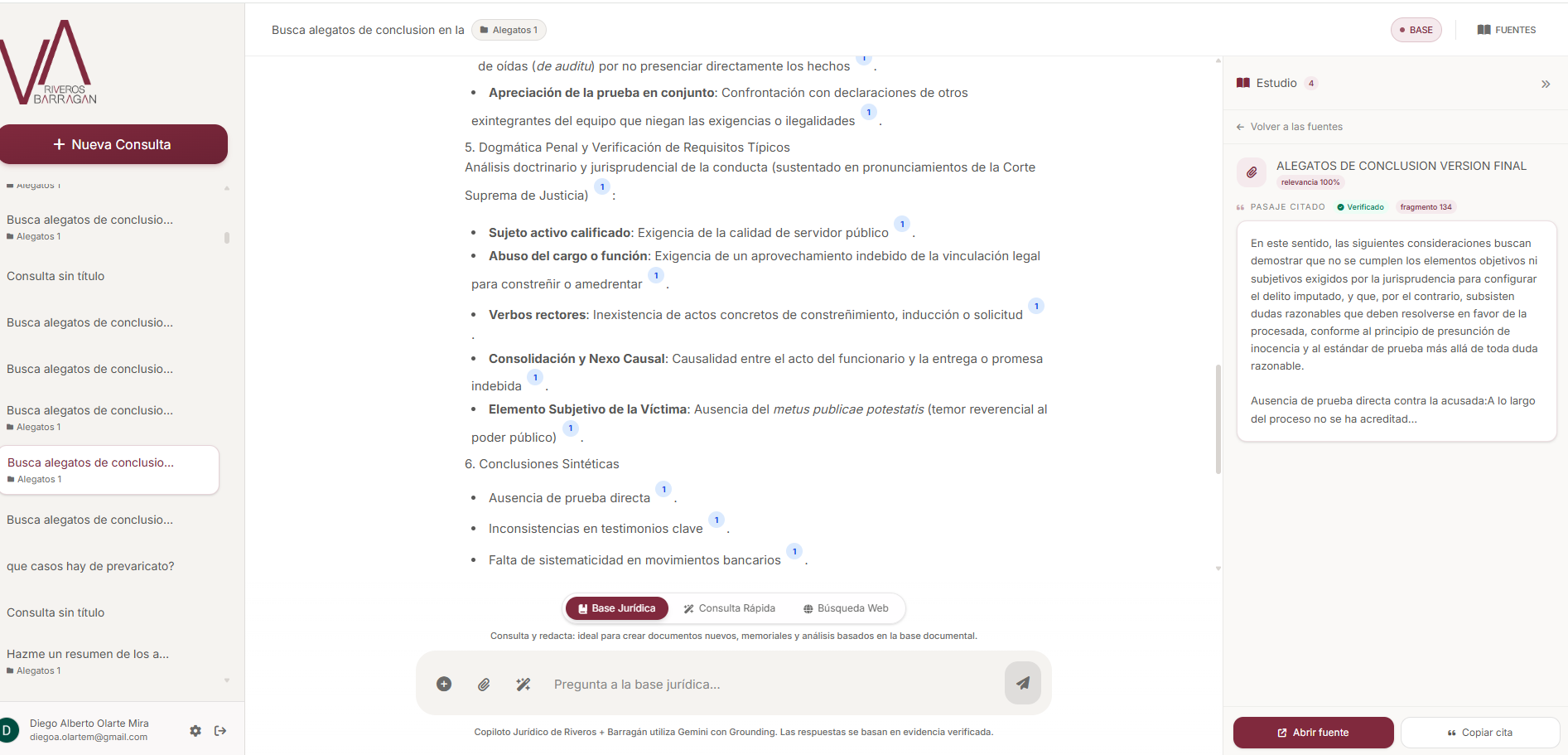
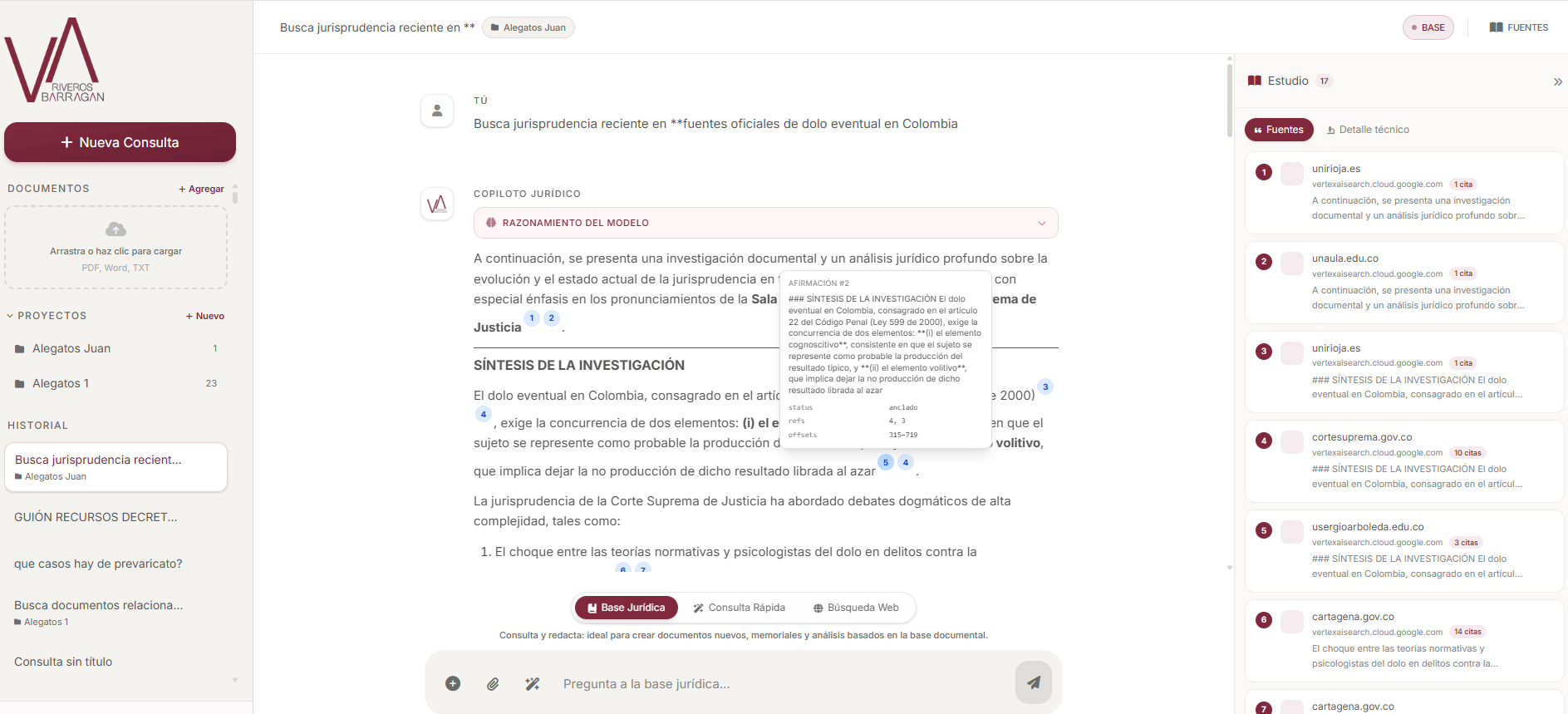
The piece we're proudest of is citation verification. When the model cites a document, VeriCore doesn't take its word for it — it locates the exact passage in the source, quotes it, and corrects the model when it misreports the page or fragment. No human reviews that decision before it happens.
Feeding the graph is a second framework: an autonomous librarian agent that turns raw case files into a linked knowledge wiki. It classifies each document, extracts parties, dates and amounts, creates a page for every entity, and — the part that matters — when a new document references an older one, it goes back and edits the older record to link forward, typing the relation: amendment, evidence of compliance, contradiction, complement. The taxonomy emerges from the corpus instead of being hand-maintained, and those typed links are what make retrieval fast — the system doesn't match words, it traverses how documents relate.
What AI does vs. what humans do
AI decides, unsupervised: verifying every citation against source and correcting the model when it's wrong; classifying each ingested document; deciding which entities and which typed relationships exist between documents, then rewriting the affected records; generating first-pass drafts from verified evidence. These run live without a human in the loop, and every query is logged — who asked, which sources were used, what the agent decided.
Humans decide, always: the final legal judgment. By design, critical tasks require human review — a lawyer signs the work, never the model. Adriana sets the taxonomy and reasoning rules, because that requires domain expertise no LLM has out of the box, and she owns client relationships. We own architecture.
Day to day, we run on AI ourselves. The platform was built with AI-assisted development throughout — how a two-person team shipped a multi-tenant production system in one window. We use it for market research, customer outreach, and our own marketing material. A human reviews anything that reaches a customer.
Jobs and economic opportunity beyond us
Actual. The community is the first output: free AI training that moved people into AI work who had no path in before. We extended that during this window — teaching product leaders across Colombia, on stage at Tech Day and in dedicated workshops, how to accelerate product development with Gemini and Google Cloud, using what we built here as the case study. Capability transferred, not just a product sold. And Igniters created an economic path for a domain expert: Adriana went from advising on other people's tools to co-owning the product that solves the problem she diagnosed.
At our first client, capacity returned is capacity to serve more clients. Our effect model is primary research — Adriana's task-level diagnostic across the firms she has advised — showing 40–75% saved per task (jurisprudence search 3–5h → 45–90min; drafting motions 1.5–3h → 25–60min). We report it as a scenario range rather than one flattering number: base case, 176 hours a month for an 11-person firm — 2,112 a year. Production logs are already capturing what will confirm or correct those figures across the nine pilots. The model is built to be tested, not asserted.
Potential. Freed attorney hours get spent on more clients — and the effect scales with the repository, so firms with the largest caseloads free the most capacity and reach the most people. Opening the platform lets other builders ship legal AI products on a verified data layer they didn't have to build. And Igniters is replicable: the next domain expert, in the next industry, with the next builders.
Challenges we ran into
Hallucinations — a wrong answer in legal work isn't bad UX, it's liability; solved with traceable sources, the verification loop, and mandatory human review. Taxonomy — the hardest one, and why the librarian agent exists: we hand-curated the ontology and proved it against hundreds of real legal documents before letting an agent extend it automatically. Privacy — the barrier 31% of LATAM legal leaders named; every firm's data lives in its own isolated tenant.
Accomplishments that we're proud of
We closed a real, paying law firm during the build window — $9,700 in revenue, not a letter of intent. It's an implementation-scale engagement: evidence firms will pay real money for structured, verifiable legal knowledge, not another chat subscription.
And it's repeatable: nine more firms are lined up for pilots. During the build window we presented VeriCore at Tech Day, one of Colombia's largest technology events, run by the Bogotá Chamber of Commerce — 5,000+ attendees and 700 C-level executives — and delivered a series of product-engineering talks to product leaders on how AI compresses the path from idea to shipped product, using VeriCore's own build on Gemini and Google Cloud as the worked example. VeriCore was then accepted into the Chamber of Commerce incubator, earning a booth at Go Fest (Aug 26–29), Colombia's largest entrepreneurship festival, in front of investors — secured during this window, taking place just after it.
That pipeline exists because of how this started. Igniters produces a product alongside a domain expert who already holds the industry's trust and its client network: Adriana is a LinkedIn Top Voice in legaltech, and firms write to her after her posts asking for help. Every customer and pilot we have came through that channel — zero paid marketing.
What we learned
The bottleneck in legal AI isn't generating fluent text. It's trust — and trust has to be engineered, not prompted into existence. You also cannot ask an AI to reason well over knowledge that isn't structured first. And pairing builders with someone who has lived the problem for years beats guessing at a market from outside.
What's next for VeriCore
This is the beginning, not the finished thing. Working inside real firms keeps surfacing core processes that consume hours and can be automated — which is how we know what to build next instead of guessing. Two are already in development.
External legal research. MCP servers connecting Colombia's four official legal databases (SUIN-Juriscol, Constitutional Court, Council of State, Judicial Branch) and vLex's commercial API directly into the agent, collapsing four separate portals and manual copy-paste into one grounded query. Because MCP is an open protocol, each connector doubles as infrastructure any agent on our platform can call.
Case tracking and procedural risk. A matter-tracking layer over every active case — filing number, procedural stage, response deadline, days remaining, next hearing — where AI scores each matter's priority and procedural risk and derives its status automatically. Missing a procedural deadline isn't an inconvenience in litigation, it's malpractice; having an agent watch every clock across every matter is the highest-stakes hour we can give a firm back.
Near term: convert the nine pilots, present at Go Fest (Aug 26–29) to its investor audience, roll the knowledge graph across every ingested document, ship both expansions, and take Igniters into the next industry.
But the destination is not to be a better agent. It's to be the layer underneath every agent. Each firm hosts its knowledge in its own secure, verified tenant, and any number of agents connect to it — ours or anyone else's — running on whatever model that firm trusts. We are deliberately model-agnostic: when you own the substrate, you don't need to bet on which LLM wins. The end state is exposing each firm's Discovery Engine knowledge base as an MCP server in its own right, so a firm's verified legal memory becomes callable from any AI ecosystem rather than locked inside ours.
Agents will keep changing, and fast. What has to persist is the firm's structured, verified, securely-hosted knowledge — and that is what we're building.
Built With
- cloud-run
- discovery-engine
- docker
- firebase
- firebase-auth
- firebase-storage
- firestore
- gemini
- google-cloud
- mammoth.js
- next.js
- node.js
- react
- tailwind
- typescript
- unpdf
- vercel-ai-sdk
- vertex-ai
- vertex-ai-search

Log in or sign up for Devpost to join the conversation.