-
-
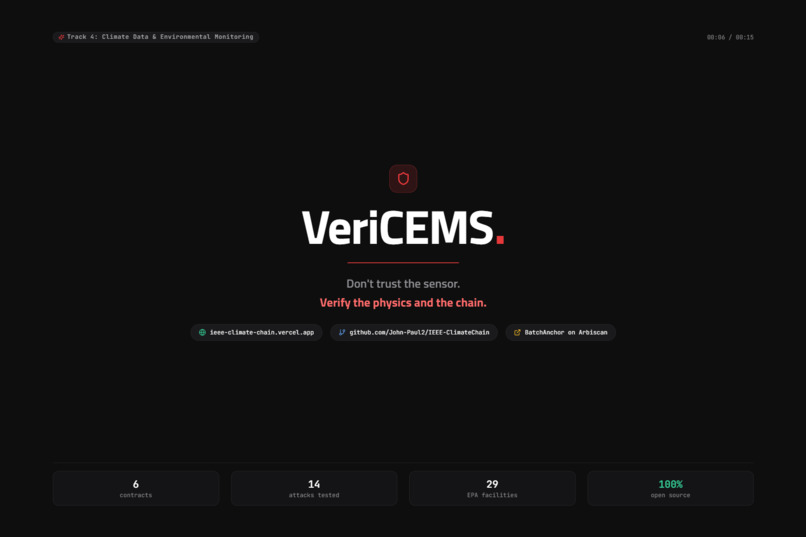
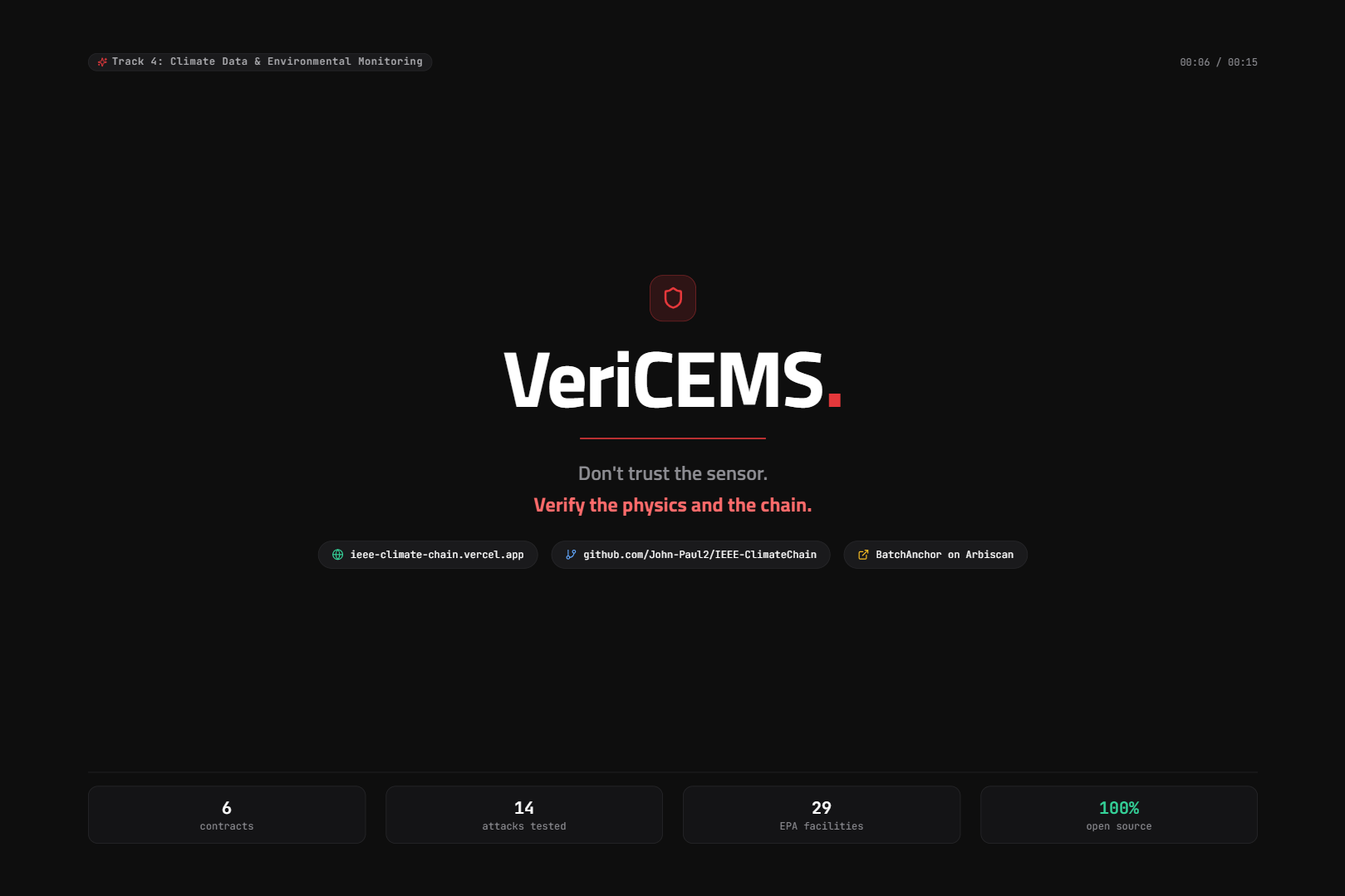
Title Card
-
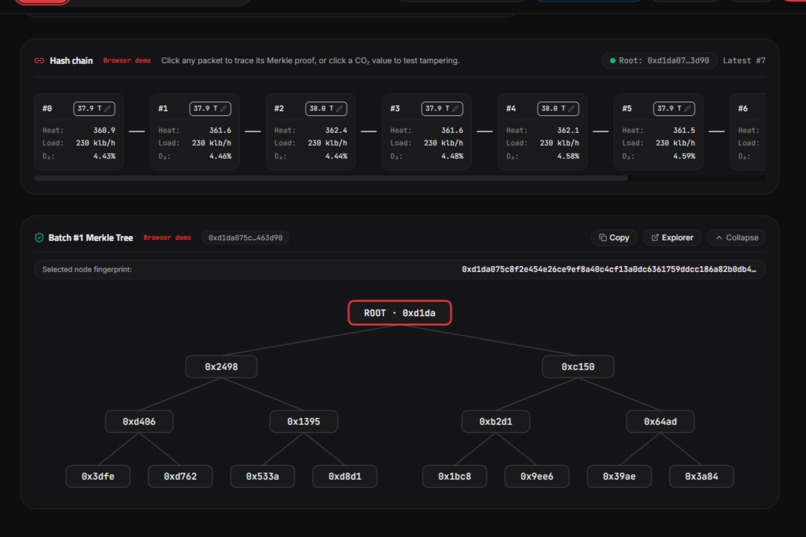
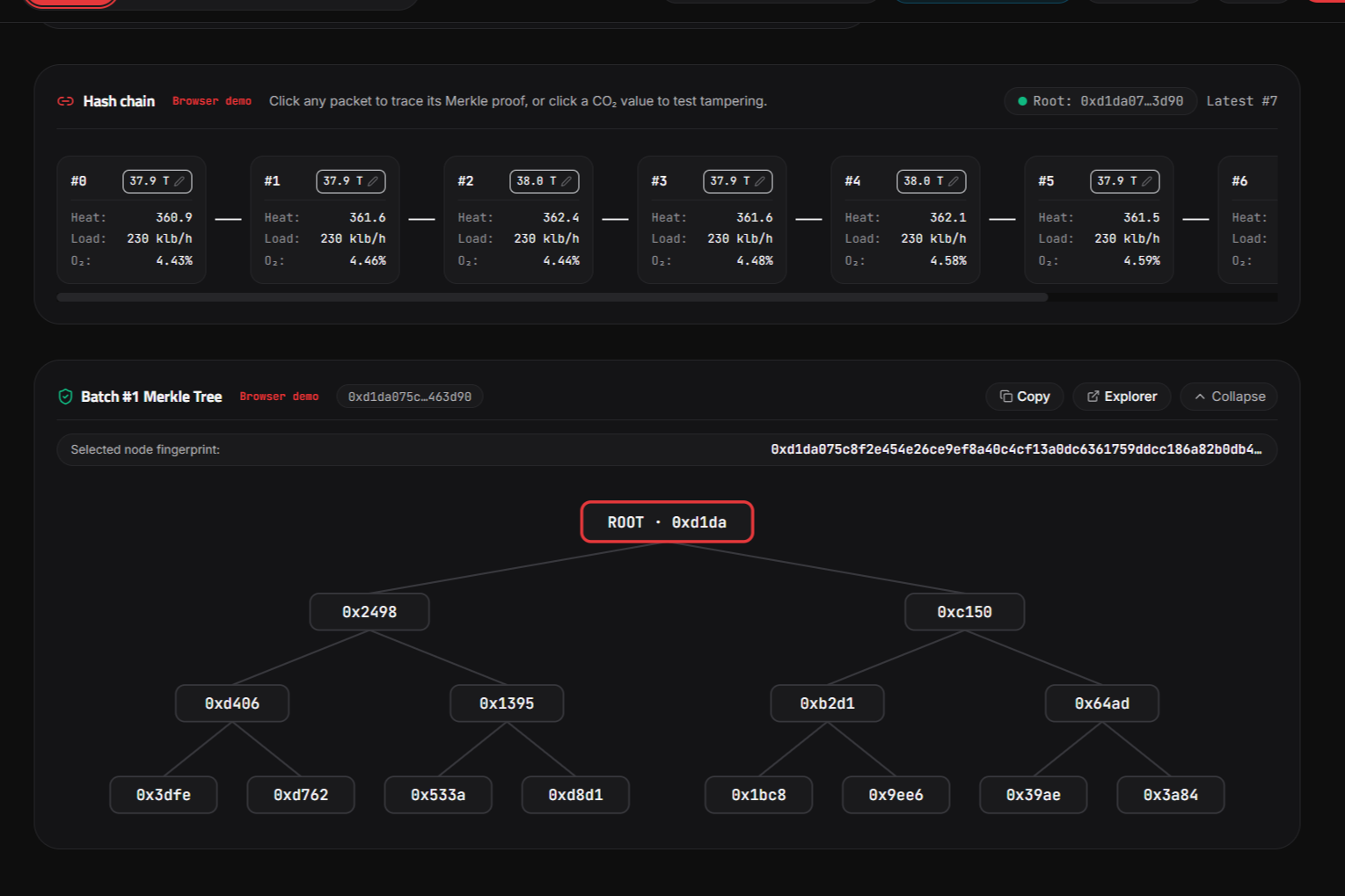
Merkle Tree
-
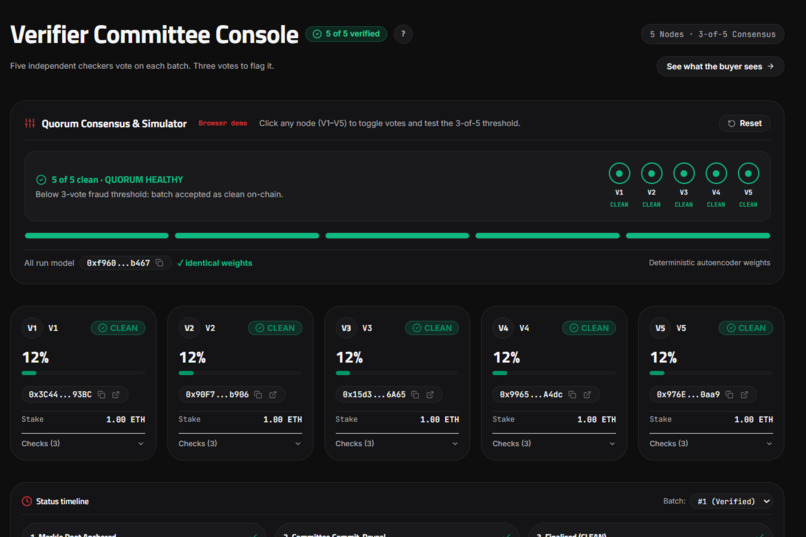
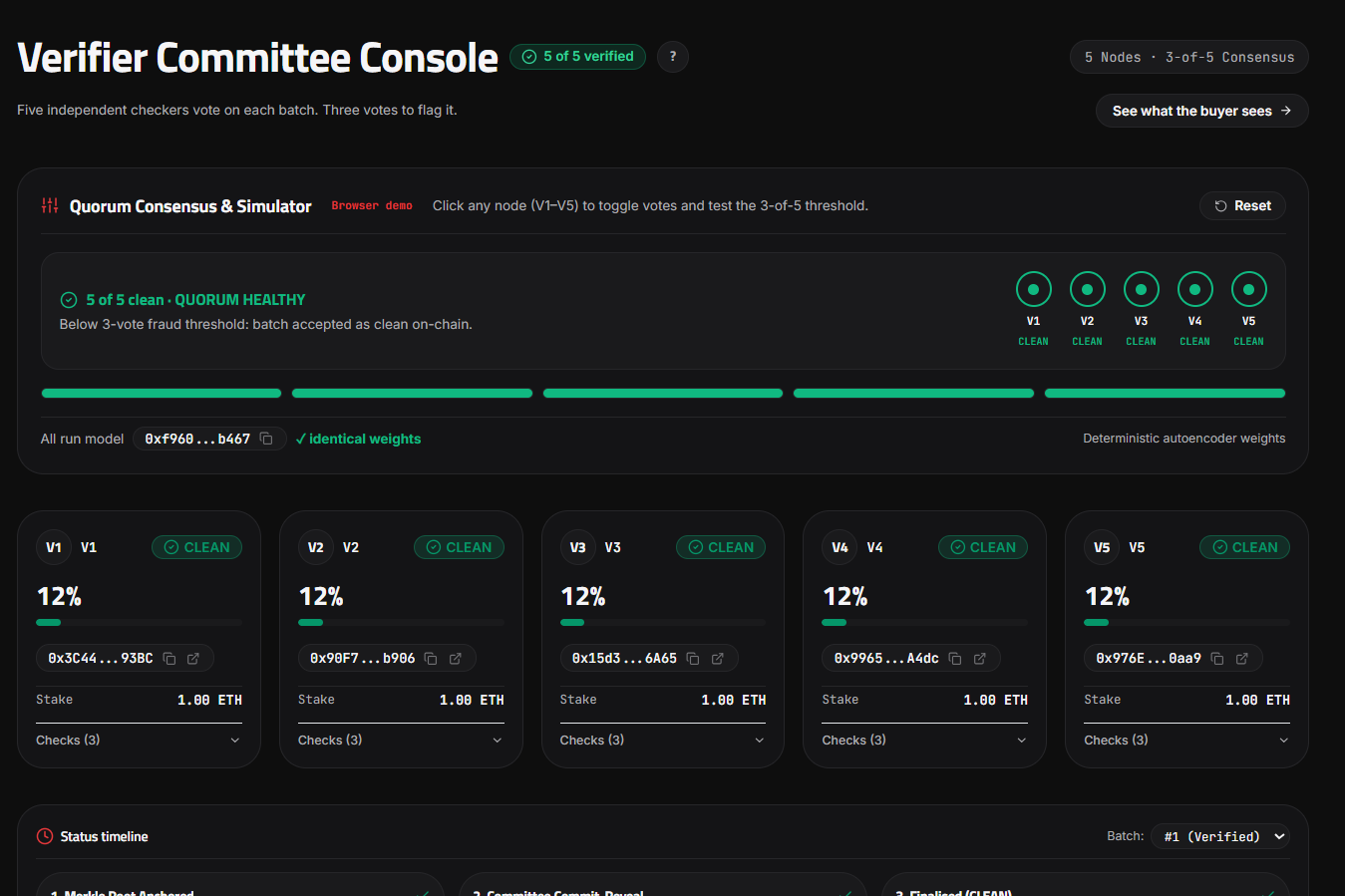
Quorum's Decision
-
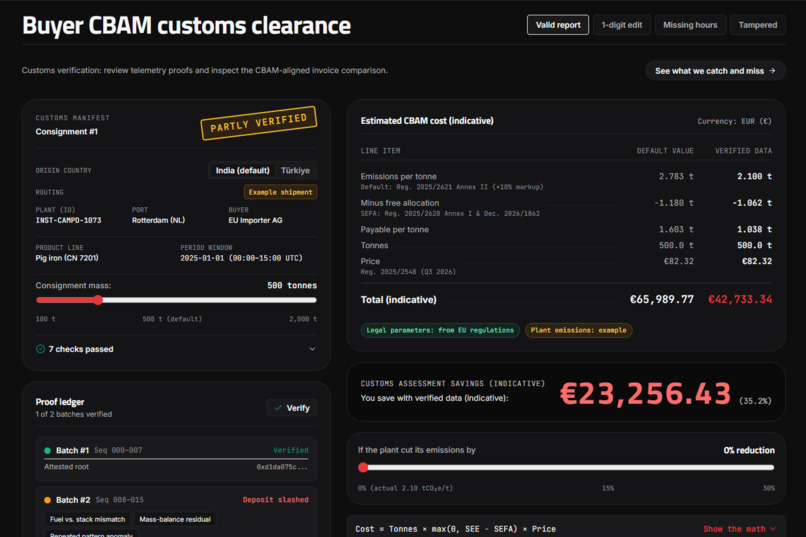
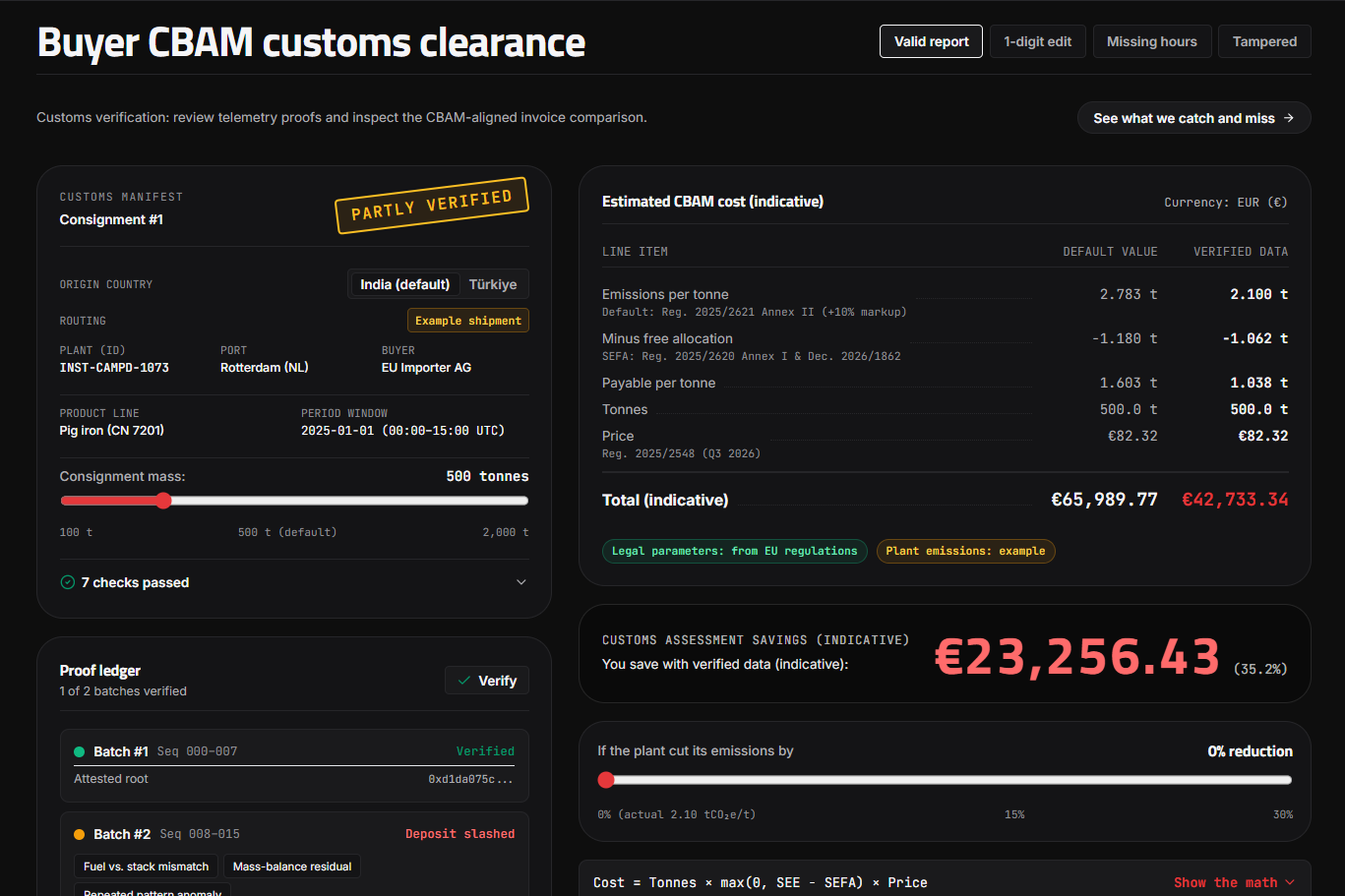
Buyer View
-
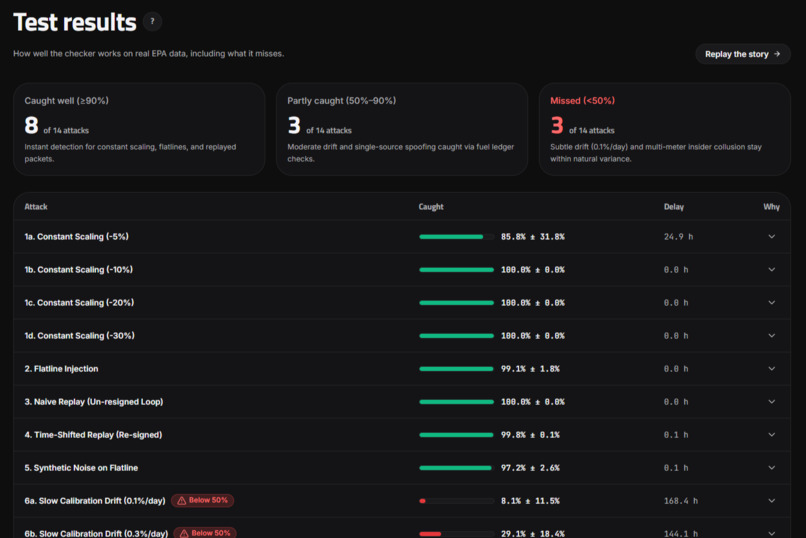
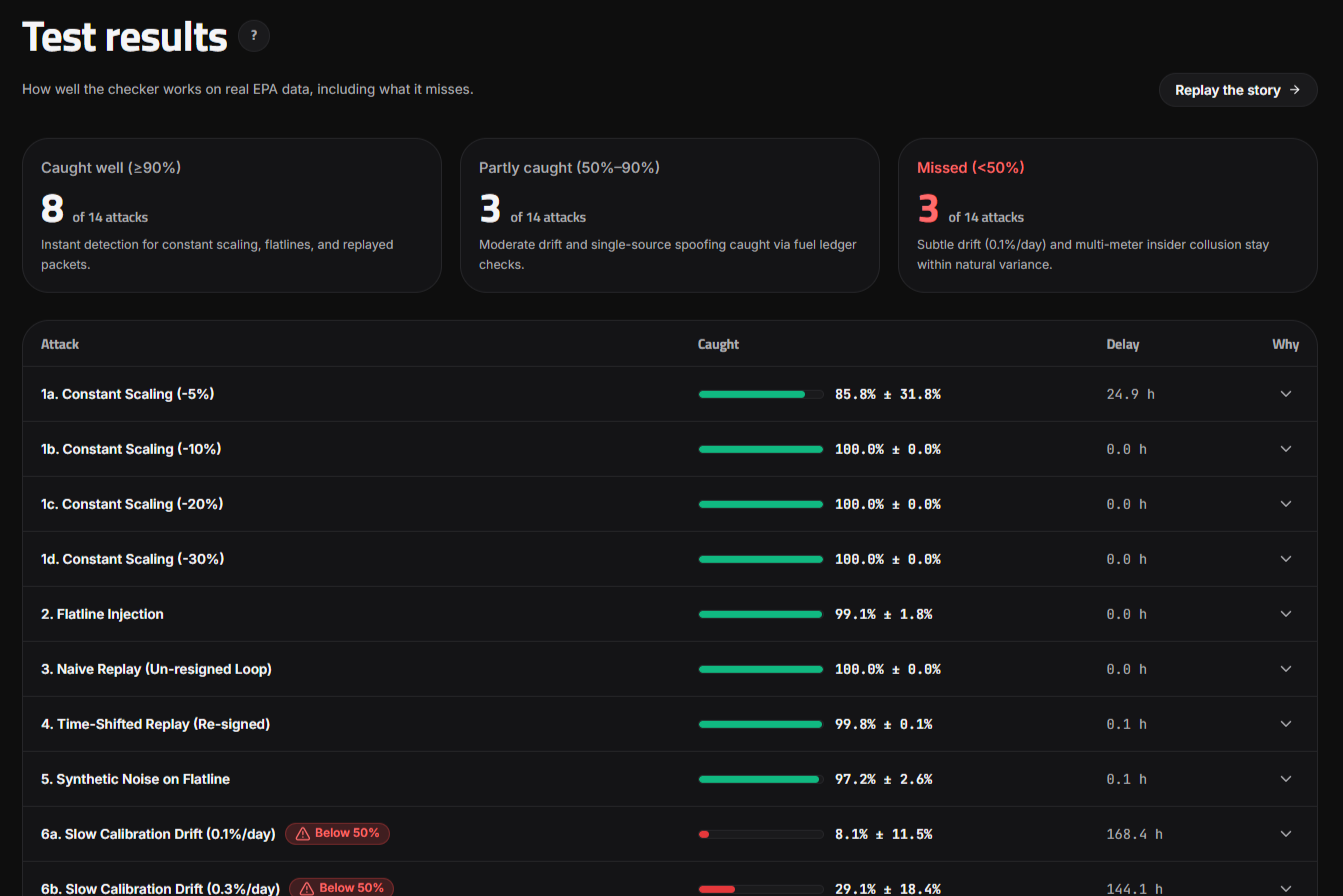
Tests Ran
-
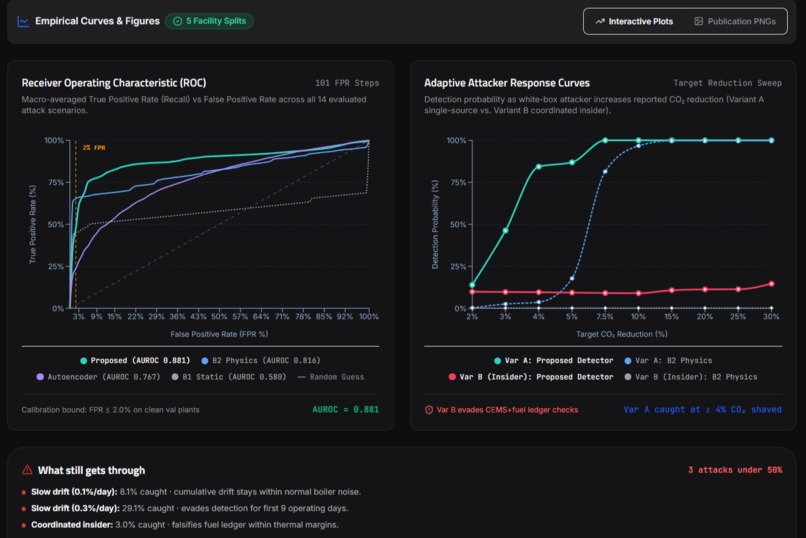
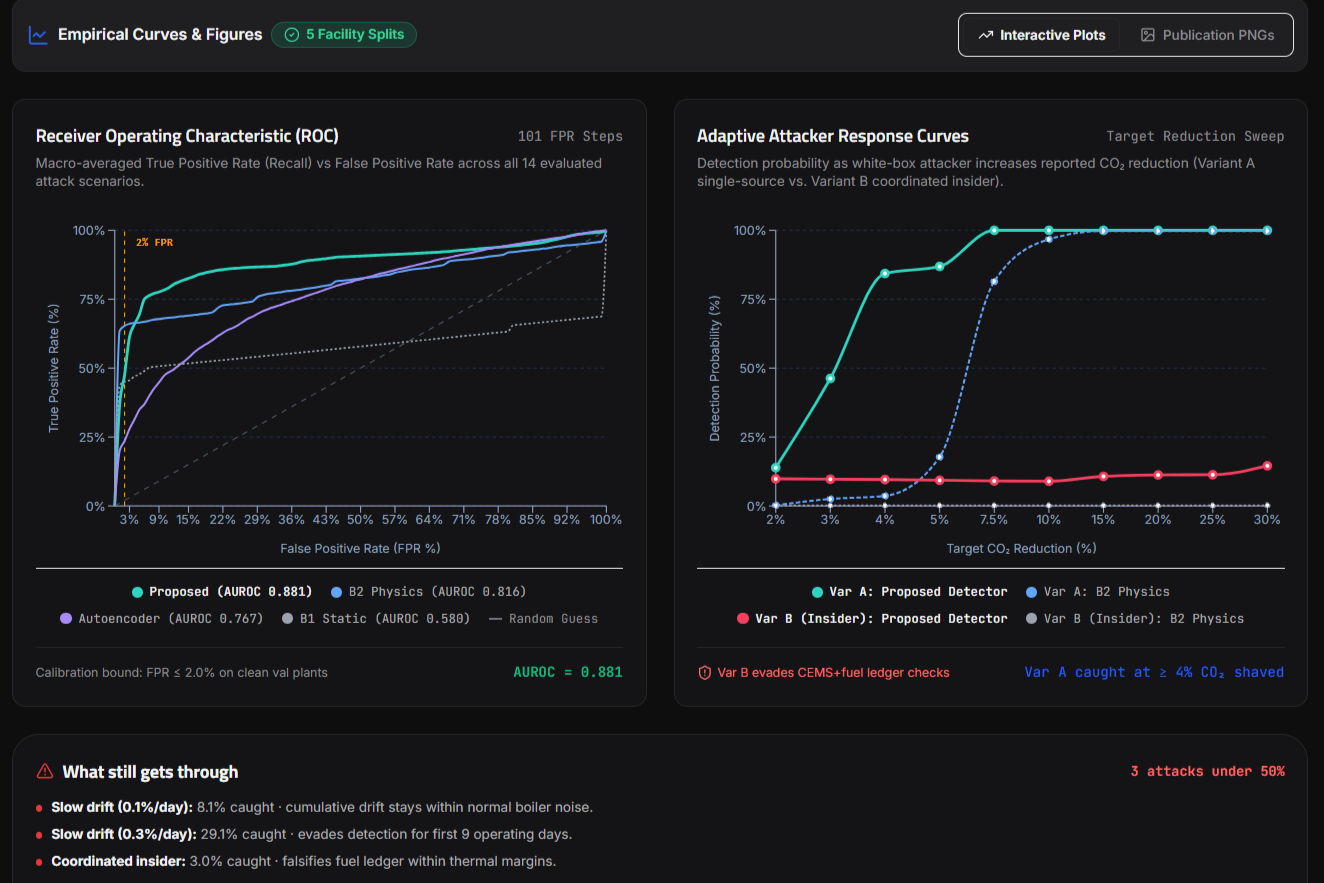
Analysis Graph
Track 4: Climate Data & Environmental Monitoring (bridging into carbon compliance)
The problem
Since 1 Jan 2026, EU importers of steel, cement and other goods pay a CBAM carbon cost. If a supplier can't prove its real emissions, the importer pays a marked-up default instead. But that proof starts at a smokestack sensor and a computer that the factory controls. A blockchain can't tell if the data was faked before it got there (the oracle problem).
What VeriCEMS does
A factory can fake its numbers after sealing them or before.
- After: every reading is signed and linked to the previous one in a SHA-256 hash chain. Batches are Merkle-anchored on Arbitrum Sepolia, so editing, dropping or replaying data breaks the chain.
- Before: each batch is checked against combustion physics (CO2 vs heat input) plus a small autoencoder. Five independent verifier nodes run the same committed model and vote with commit-reveal. If 3 of 5 flag a batch, it is quarantined, the operator can challenge, and an unchallenged flag slashes the operator's bonded deposit on-chain.
- The buyer: an EU importer re-checks the Merkle proof in the browser. Change one number and verification fails. The CBAM calculator shows the cost with default values (+10%) vs verified data. Example: 500 t of pig iron (CN 7201) from India, indicative EUR 65,989.77 default vs EUR 42,733.34 verified. The legal parameters come from EU regulations; only the plant's own emissions (2.10 tCO2e/t) are an example.
How we built it
Six Solidity contracts (Attestation, BatchAnchor, BondVault, Challenge, DeviceRegistry, VerifierQuorum) tested with Foundry, including fuzz and invariant tests, and deployed to Arbitrum Sepolia. A Python backend handles signing, the detector and verifier nodes. The React + TypeScript web app replays a recorded real run with real transactions. Everything is reproducible with make test and make benchmark.
Evidence
We tested 14 attacks, including an adaptive white-box attacker, on real hourly US EPA CAMPD data from 29 facilities, with a split by facility so no plant appears in both training and test. Overall recall is about 76%, versus about 53% for a plain physics baseline, and detection is faster (about 50 h vs about 107 h).
What still gets through (we say it openly)
Slow calibration drift and a coordinated insider who falsifies both stack and fuel meters mostly evade detection. The secure element and the five verifier nodes are simulated in this demo (production verifiers would be independent organisations). The data is a US power-plant proxy, labelled as such, and false positives are not zero.
Climate impact
Carbon pricing only cuts emissions if the numbers behind it can be trusted. VeriCEMS is that trust layer: it removes the incentive to under-report, and it rewards genuine cutters, because verified data replaces marked-up defaults. Our impact estimate is a scenario formula, not a claim of actual fraud: covered emissions x assumed misreporting rate x measured detection rate. Assumptions are in the impact document.
Adoption and scale
VeriCEMS doesn't replace accredited CBAM verifiers. It gives them continuous, tamper-evident evidence between annual audits. Batching means one 32-byte root per batch on an L2. Future work: satellite cross-checks, methodology-version records, and fault proofs for sequence breaks.
Built With
- arbitrum-sepolia
- cbam
- ecdsa
- epa-campd
- ethereum
- fastapi
- foundry
- framer-motion
- merkle-tree
- numpy
- onnx
- openzeppelin
- pandas
- python
- pytorch
- react
- recharts
- scikit-learn
- sha-256
- solidity
- tailwind-css
- typescript
- vercel
- viem
- vite


Log in or sign up for Devpost to join the conversation.