








Live app · API docs · MCP server · Architecture · Benchmarks · Limitations · Launch film
Forest carbon credits that prove themselves. Satellite AI scores every forest against a matched twin, a zero-knowledge proof puts the score on-chain, every record is signed post-quantum, and the credit keeps watching the forest after it is sold.
1 · The problem
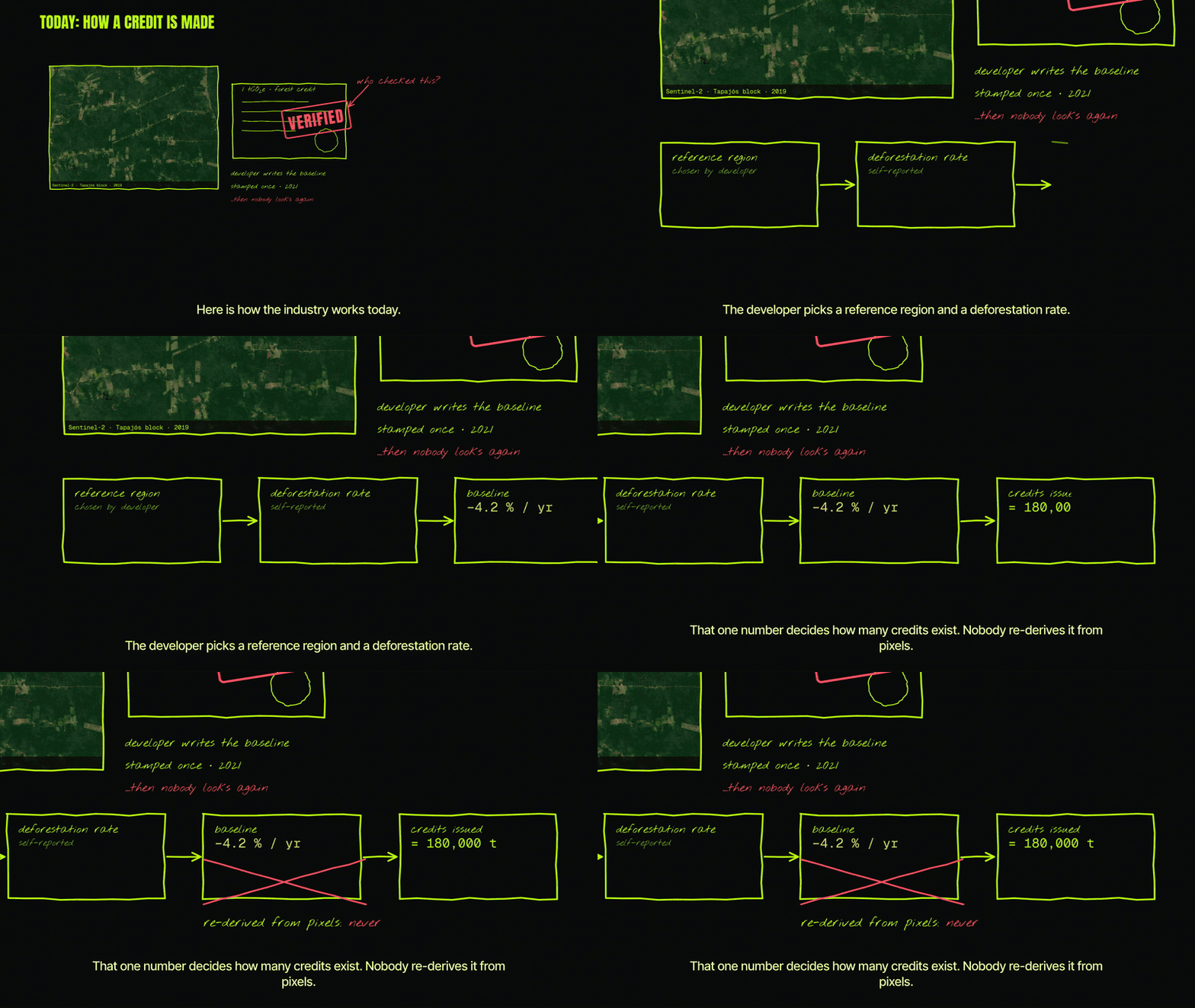
Today a forest credit is verified once, by someone you have to trust, against a baseline the developer wrote. Then nobody looks at the forest again.
| What happens today | What it costs | |
|---|---|---|
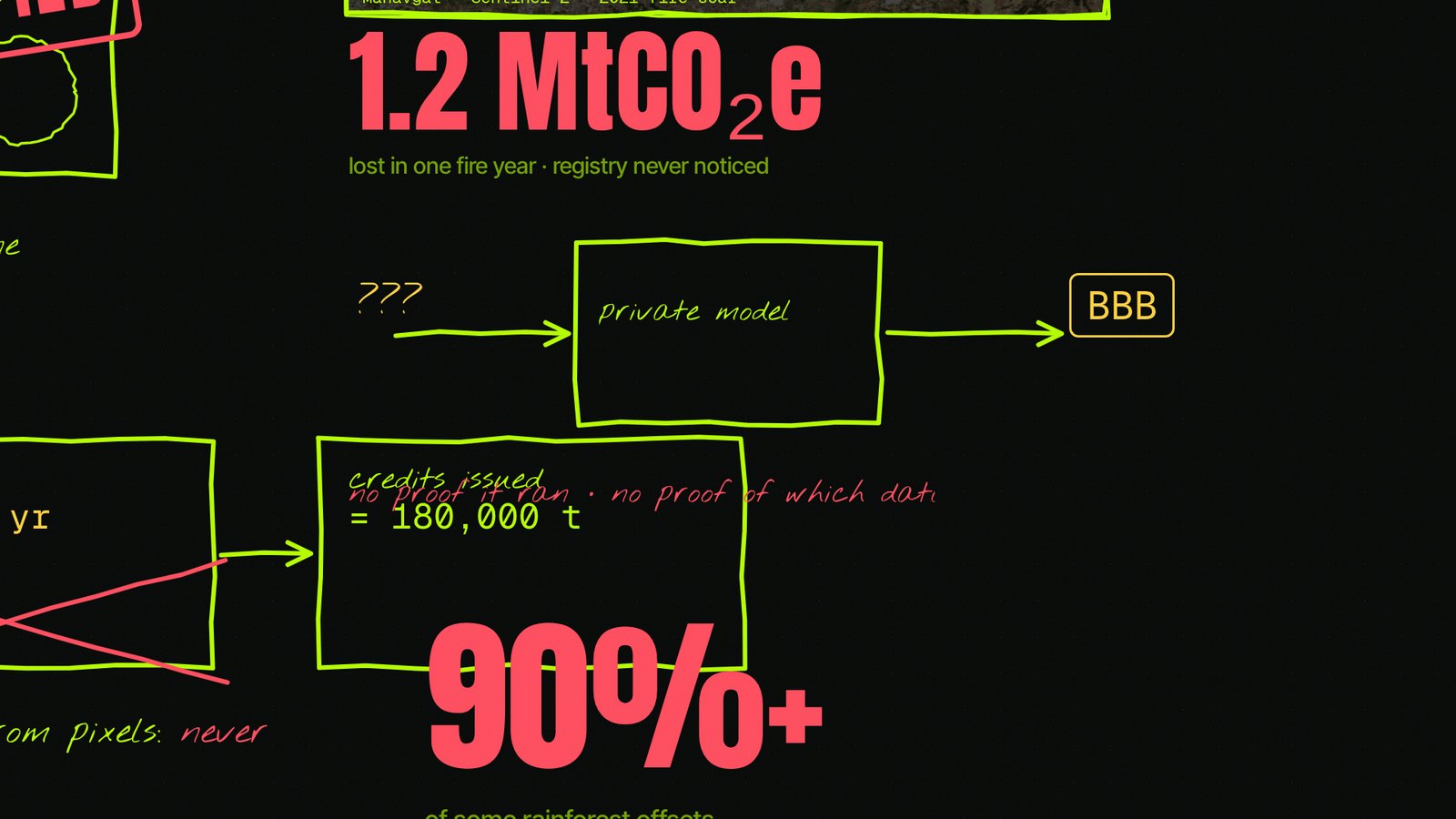
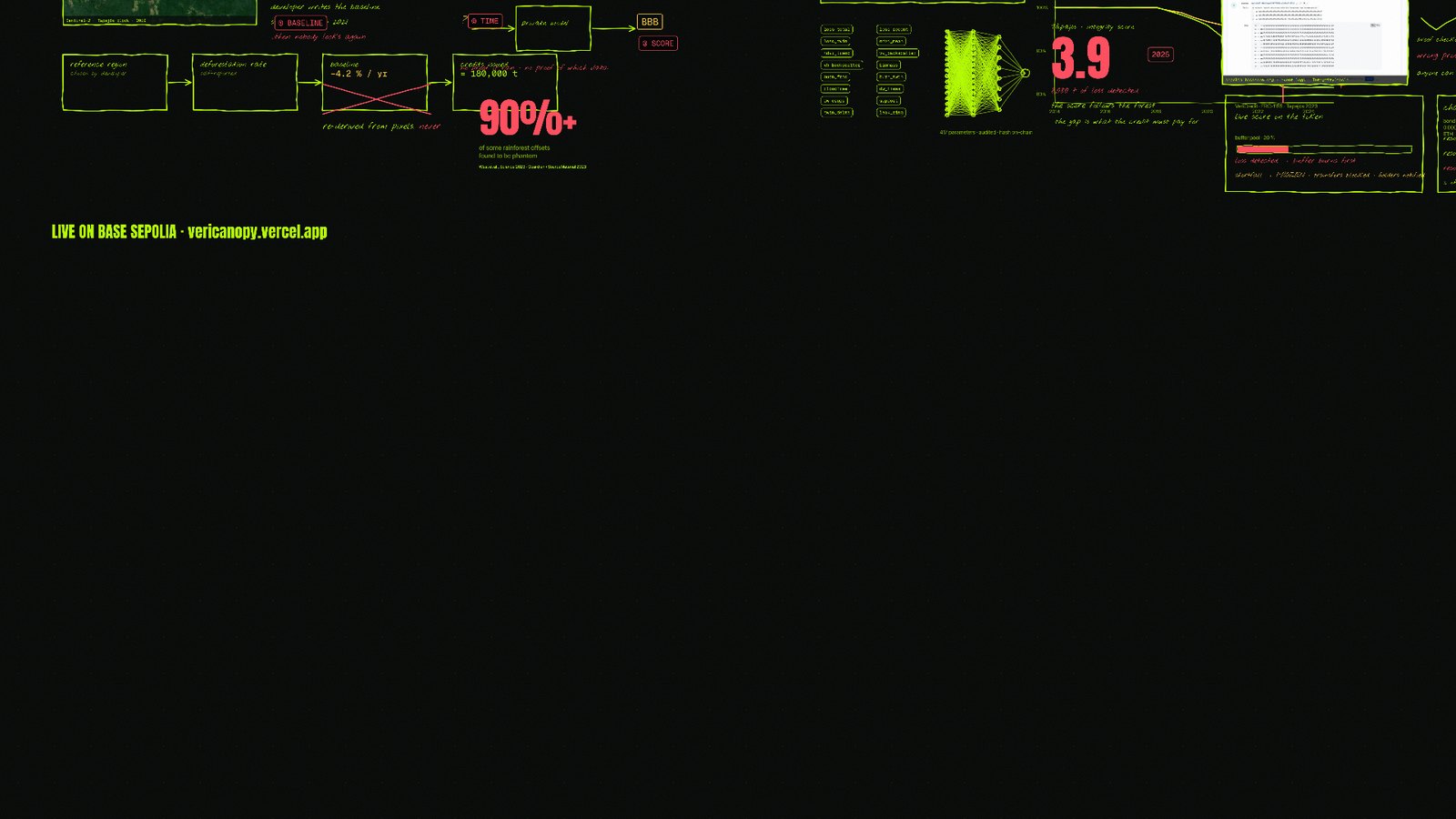
| ① Baseline | The developer picks the reference region and the deforestation rate. That one number decides how many credits exist. Nobody re-derives it from pixels. | Independent investigations found more than 90 % of some rainforest offsets to be phantom reductions (West et al., Science 2023; Guardian / SourceMaterial 2023). |
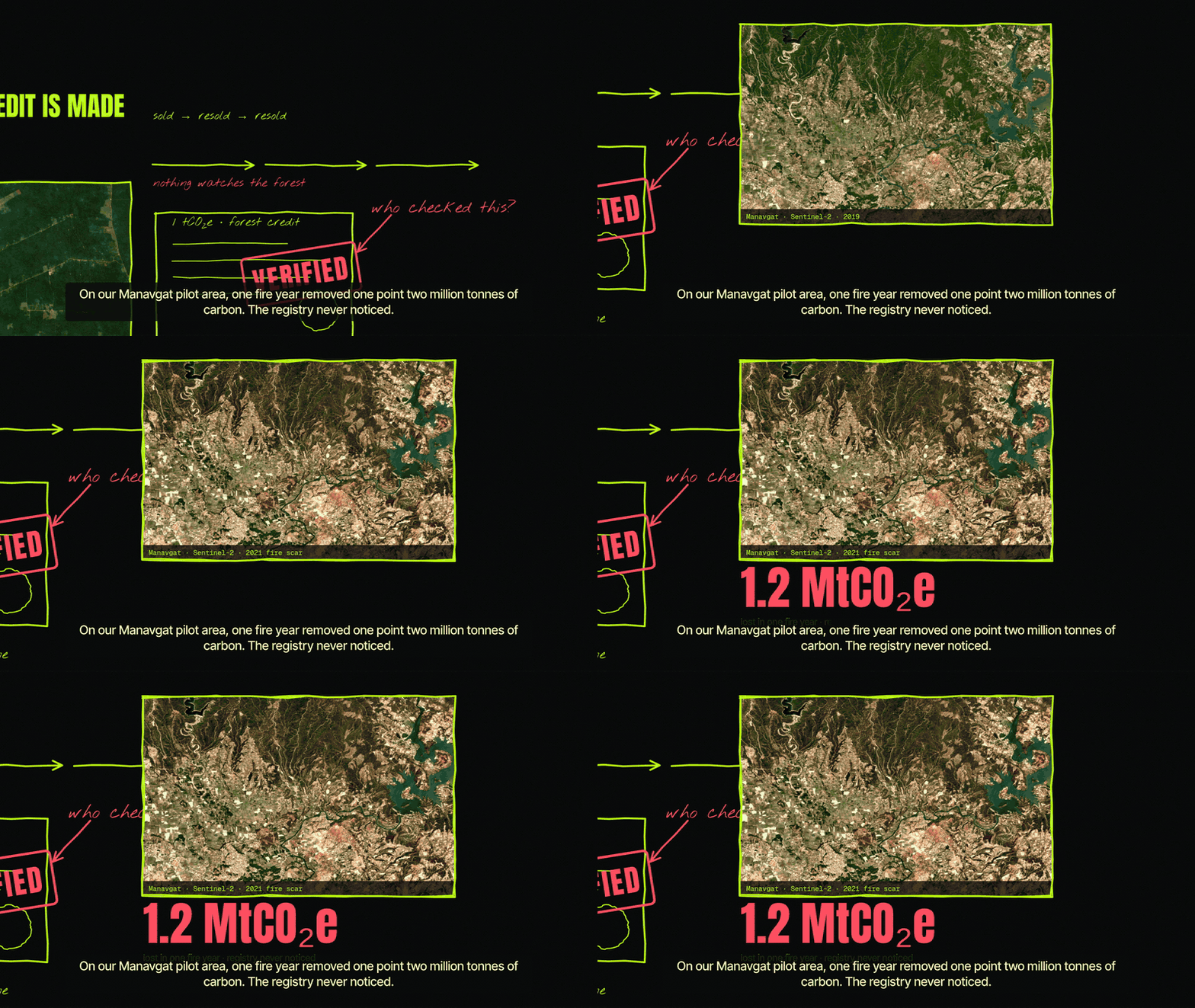
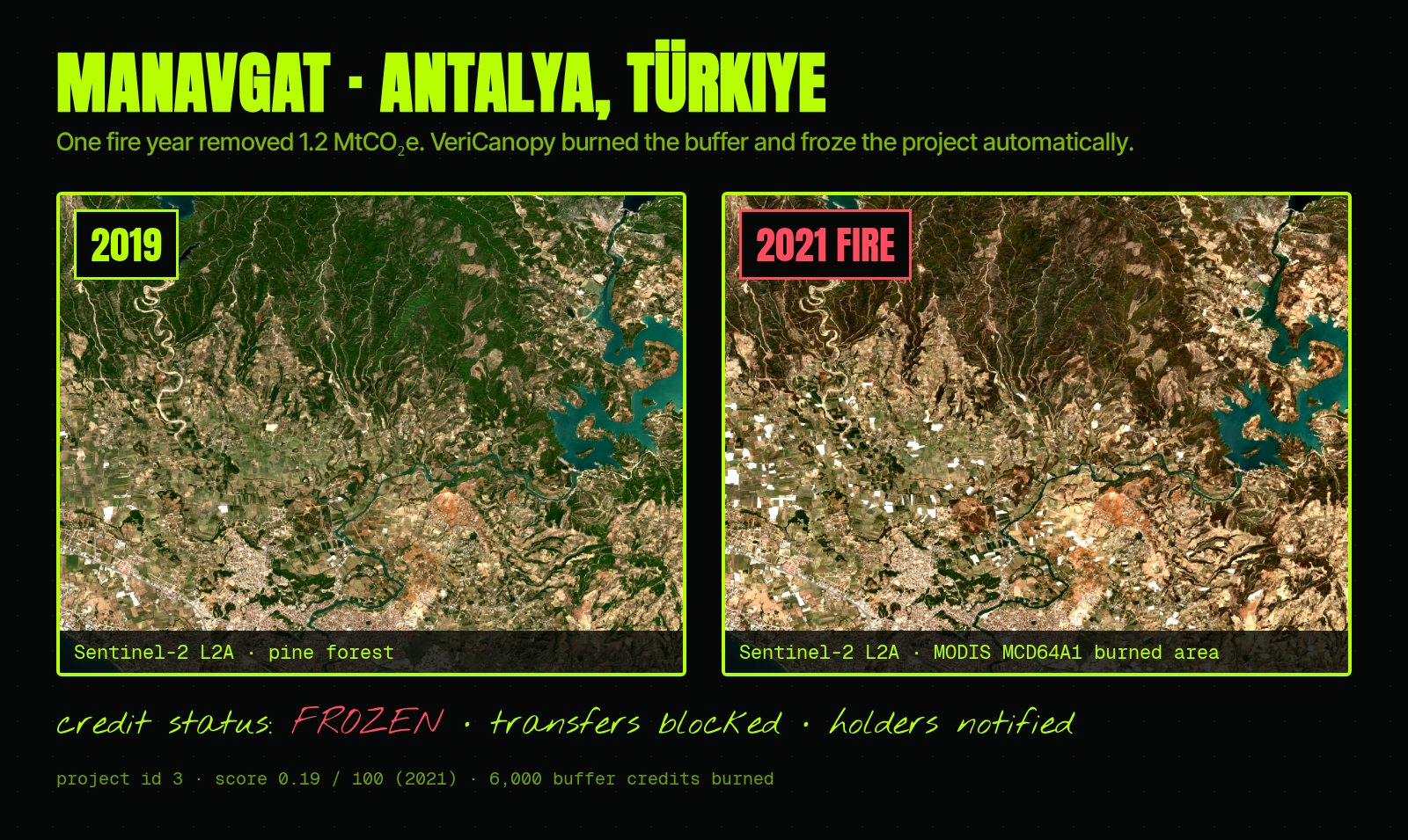
| ② Time | The credit is issued, sold and resold. Nothing re-scores the forest after issuance. | On our Manavgat pilot area a single fire year removed 1.2 MtCO₂e. The registry would never notice. |
| ③ Score | Ratings come from a private model and a letter grade. | No proof the model ran, no proof which data it saw. |
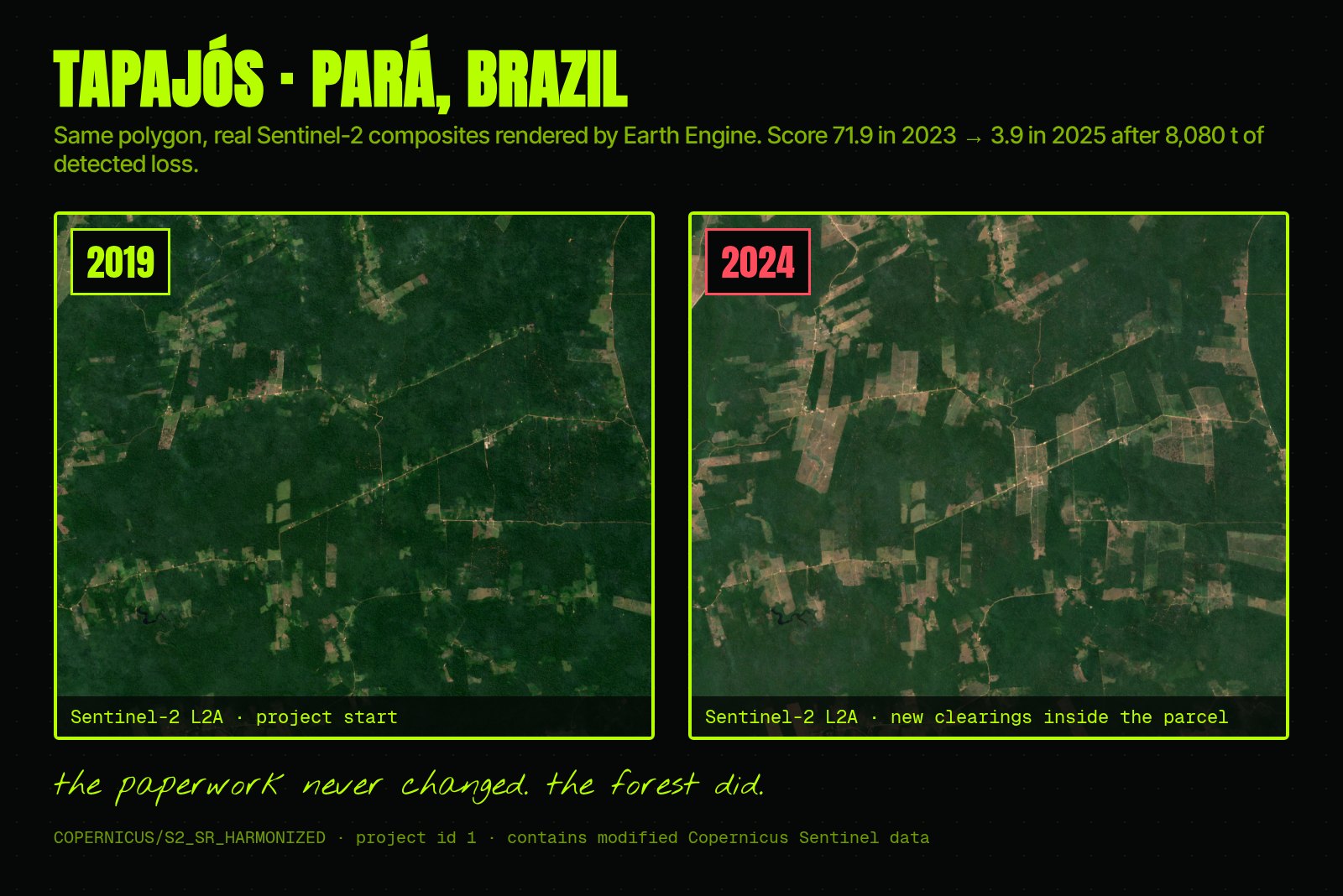
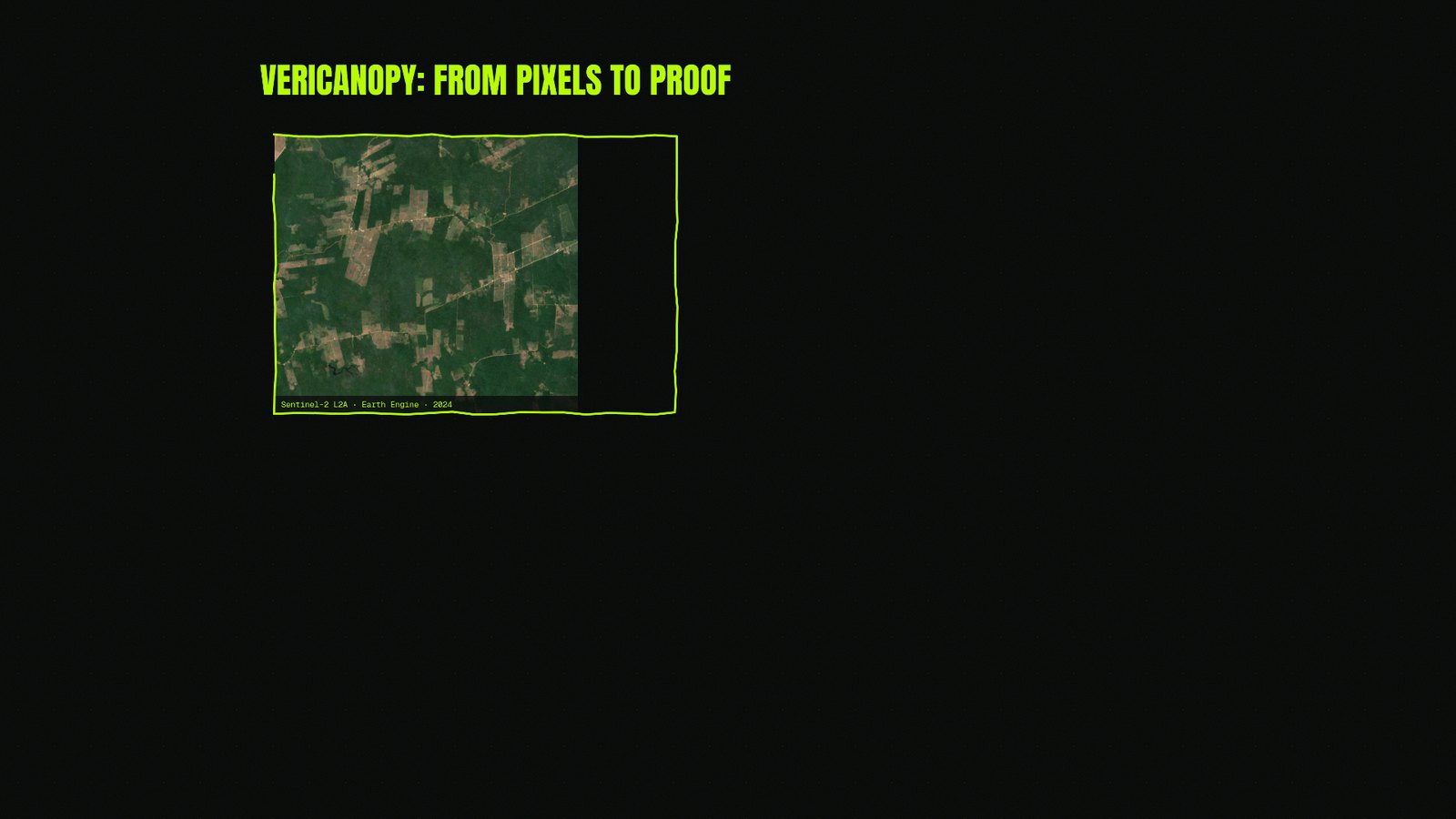
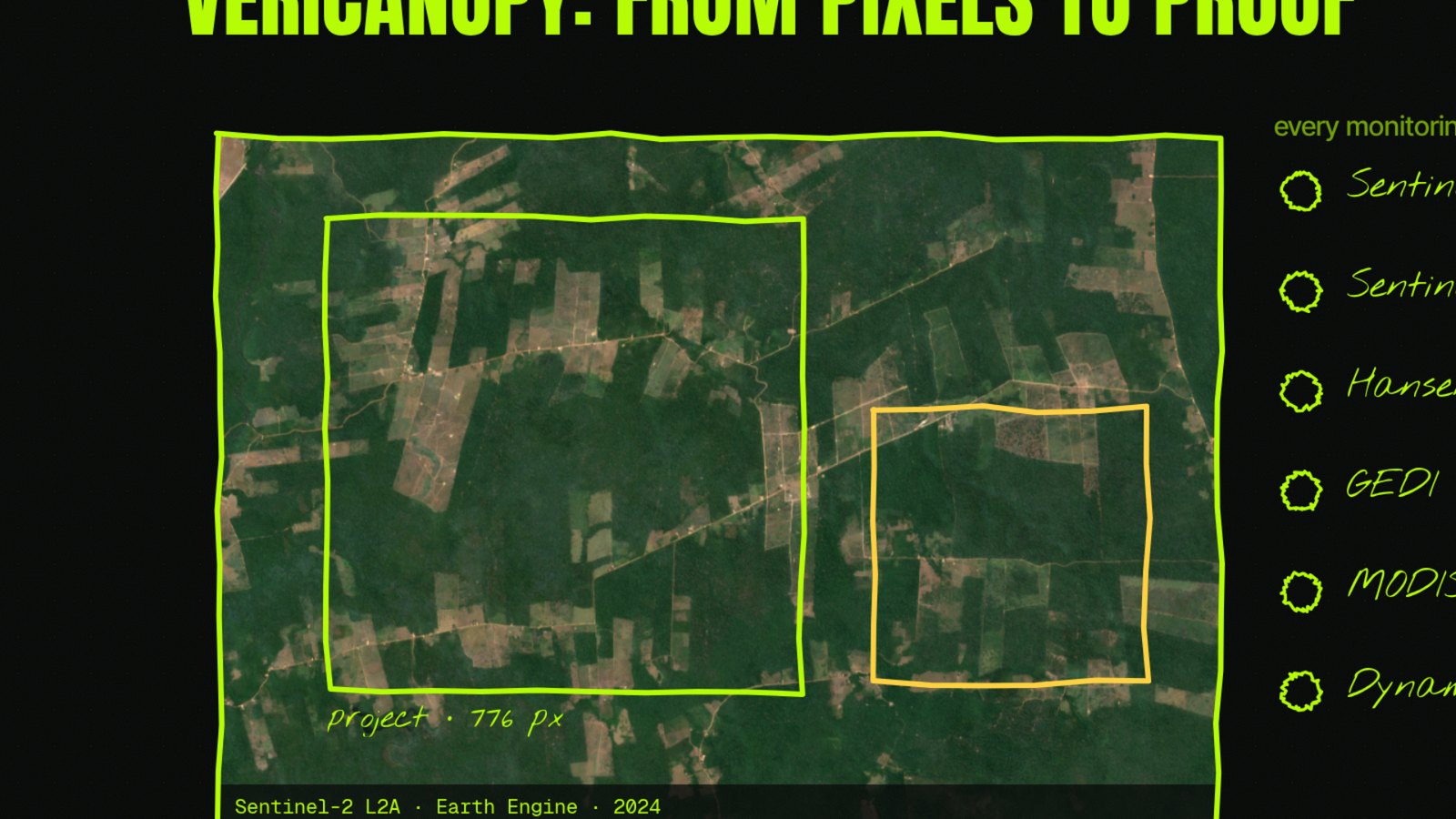
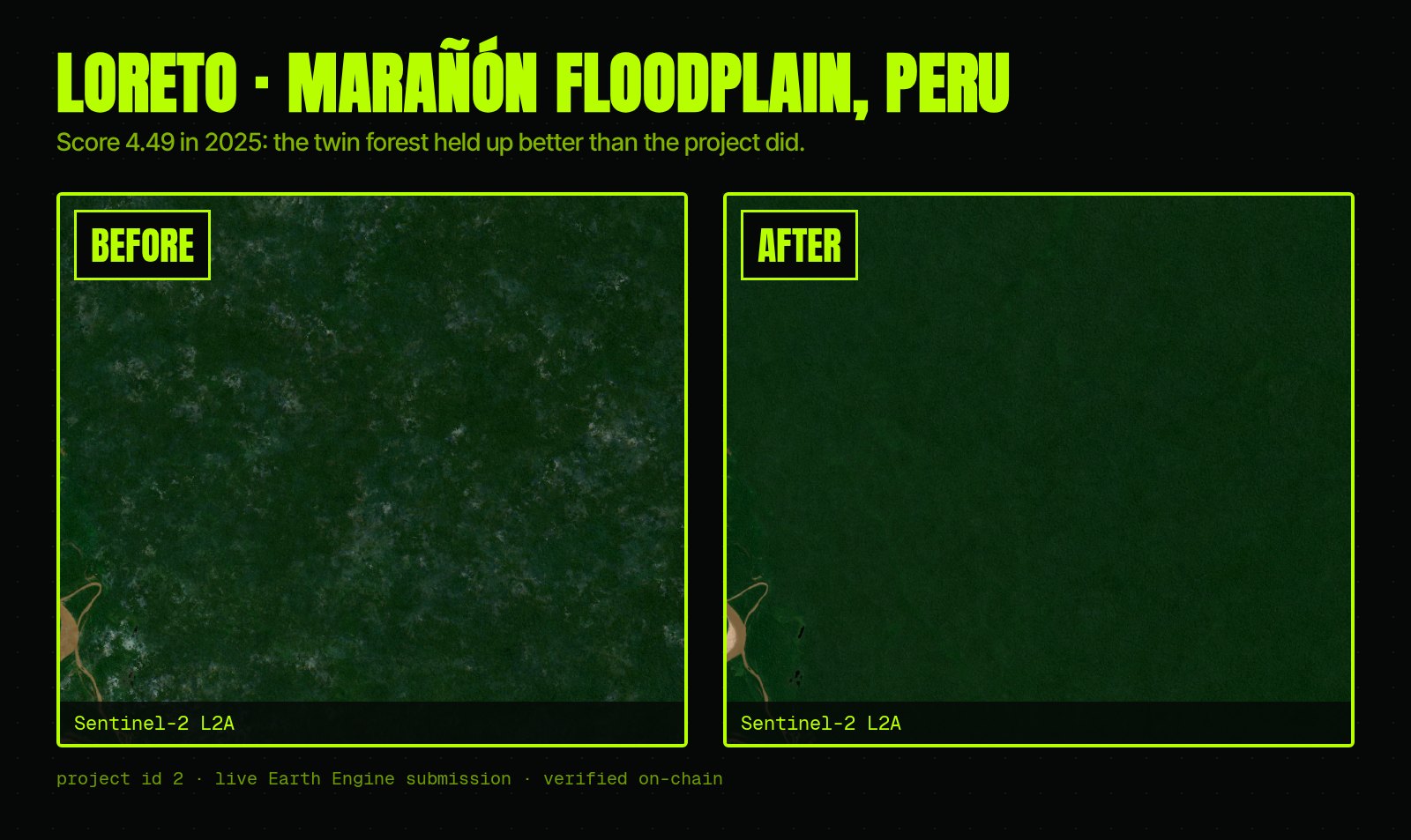
This is real satellite data, not a mock-up. Both cards below are Sentinel-2 L2A composites rendered by Google Earth Engine for the exact polygons registered on Base Sepolia:
2 · The solution: from pixels to proof
| Gap | Question | VeriCanopy's mechanism |
|---|---|---|
| Input | Was the right land and data used? Is this land sold twice? | Earth Engine evidence for the project and a matched twin forest; reproducible ML-DSA-65-signed manifest (datasets, dates, geometry hash, code commit); H3 cell exclusivity in ProjectRegistry; staked challenge game |
| Computation | Did the AI really run the registered model? | EZKL/Halo2 proof verified on-chain by Halo2Verifier; the score is decoded from the proof's public instances, never trusted from the oracle |
| Time | Is the credit still true today? | Living integrity score per period, automatic buffer burns, freeze on shortfall, holder notifications |
Step 1 · Evidence from pixels, against a twin forest
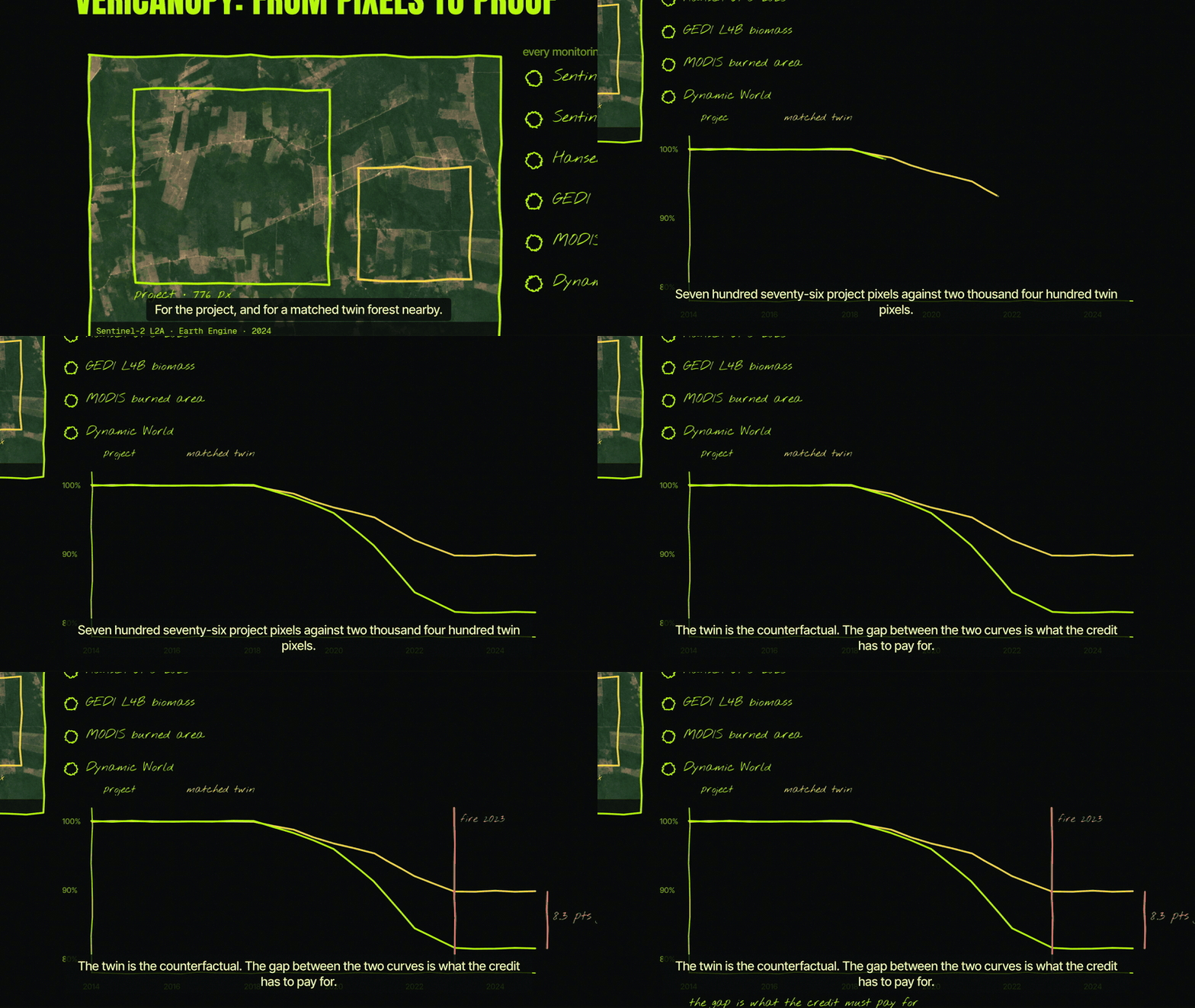
Every period the oracle pulls Sentinel-2, Sentinel-1, Hansen GFC 2025, GEDI L4B biomass, MODIS burned area and Dynamic World for the project polygon and a matched twin nearby: 776 project pixels against 2,396 twin pixels. The twin is the counterfactual, not the developer's spreadsheet.
Step 2 · An integrity score that follows the forest
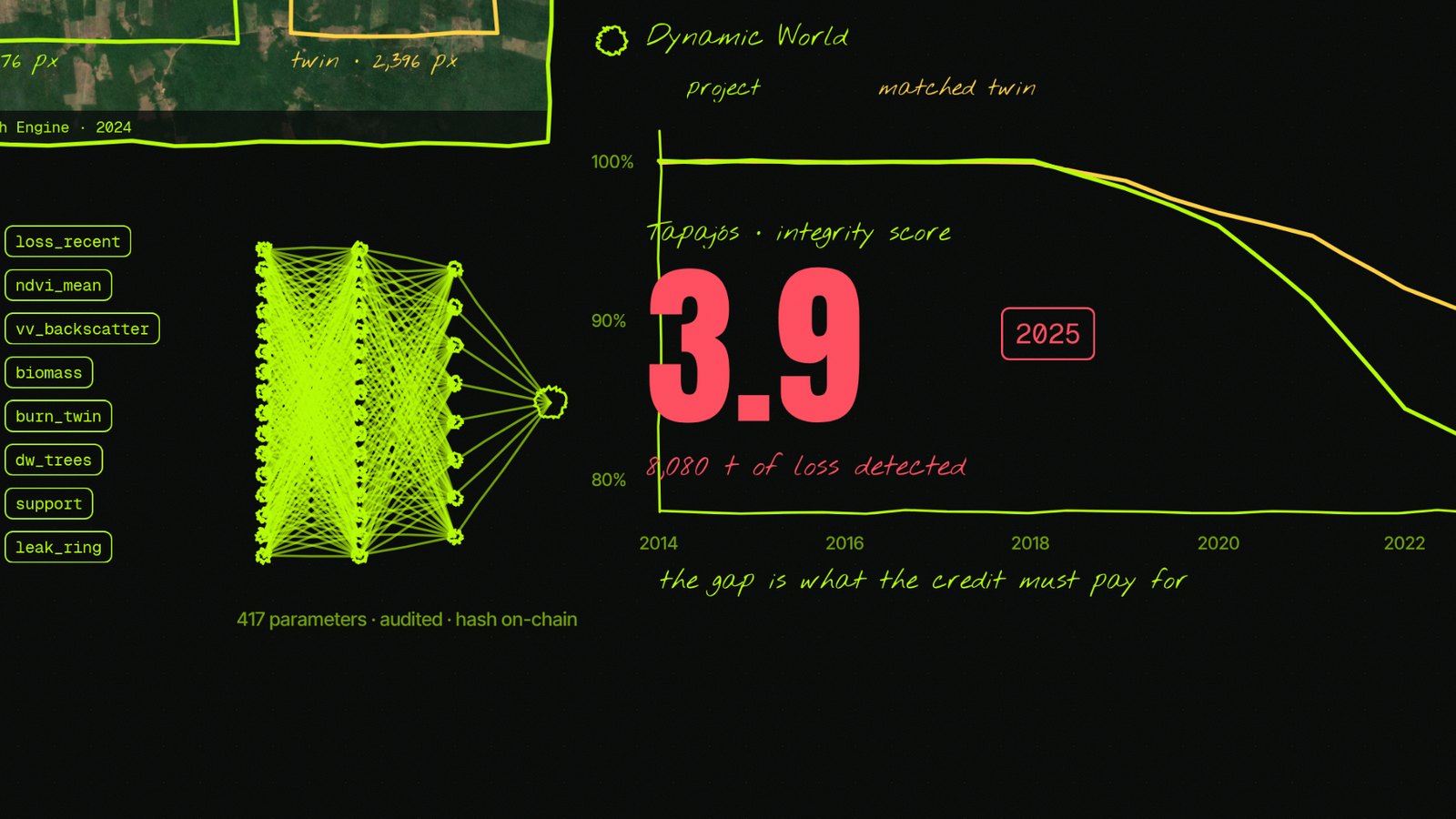
Sixteen features feed a 417-parameter audited network (MAE 0.0125 against the transparent expert rule, zero monotonicity violations). Tapajós scored 71.9 in 2023; after 8,080 t of detected loss it scores 3.9.
Step 3 · A zero-knowledge proof the oracle cannot fake
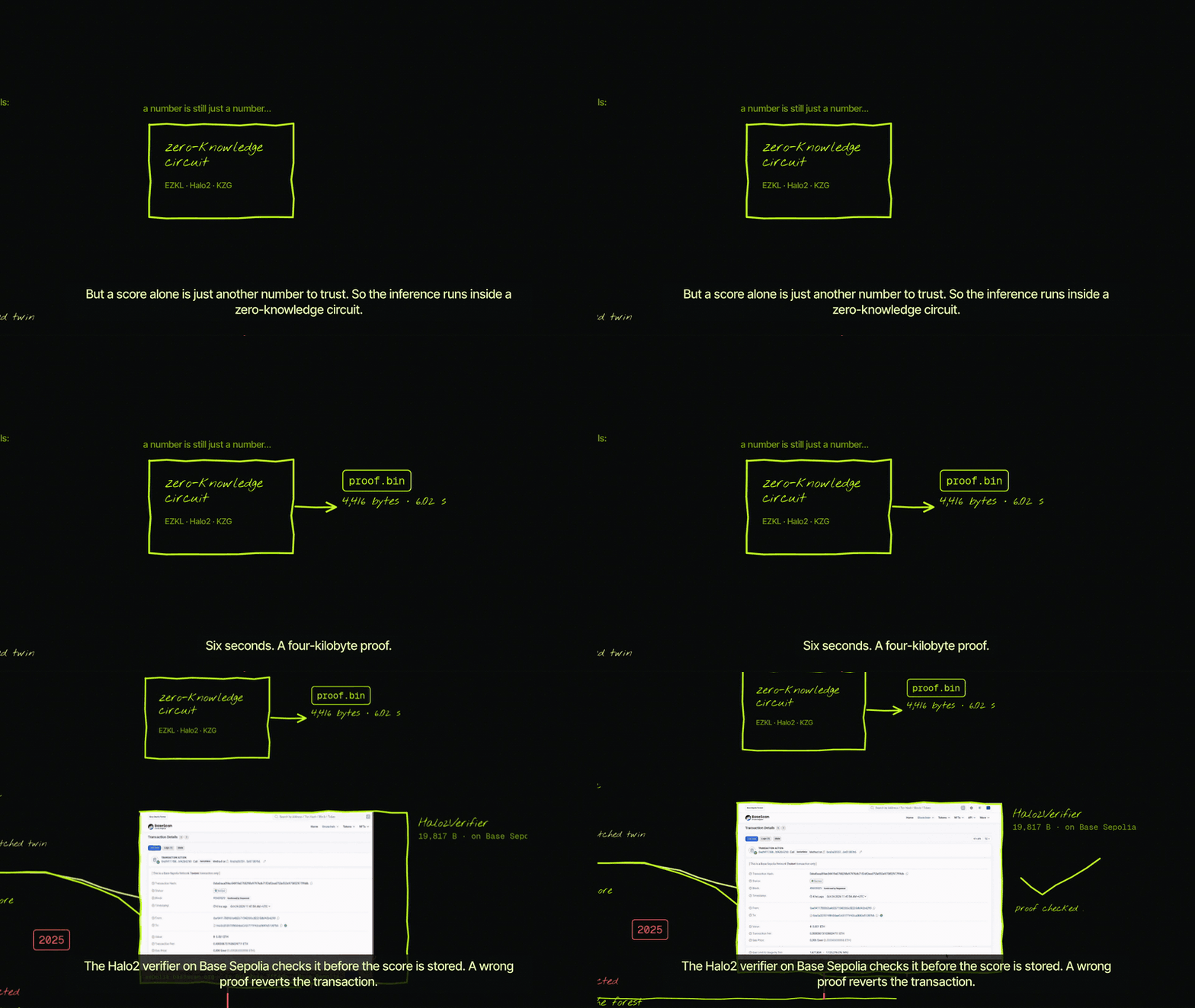
Inference runs inside a Halo2 circuit (EZKL 23.0.5): about 6 s, a 4,416-byte proof. Halo2Verifier on Base Sepolia checks it inside submitScore; a wrong proof reverts. The manifest is signed with ML-DSA-65 (FIPS 204) and the key is registered on-chain.
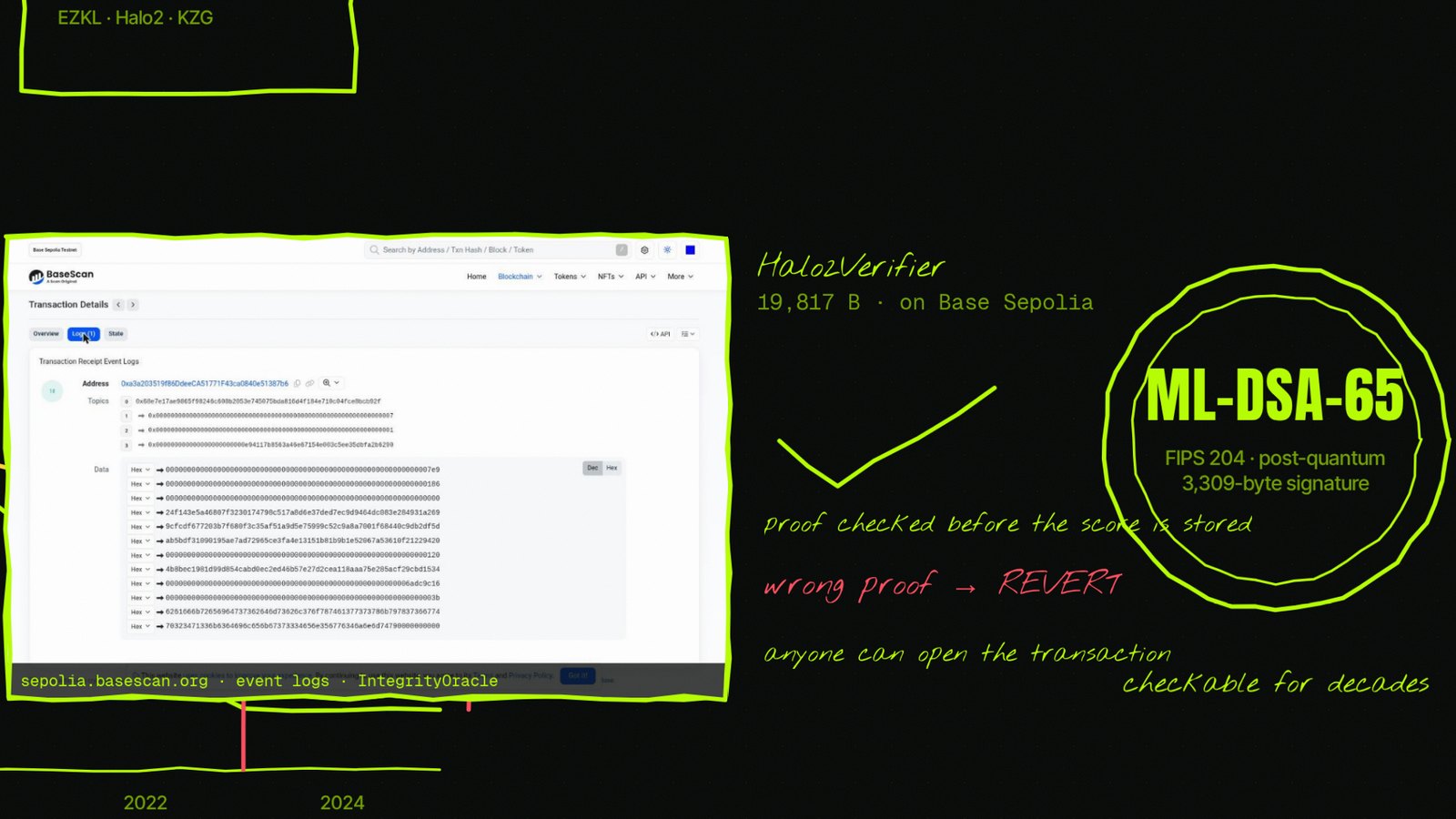
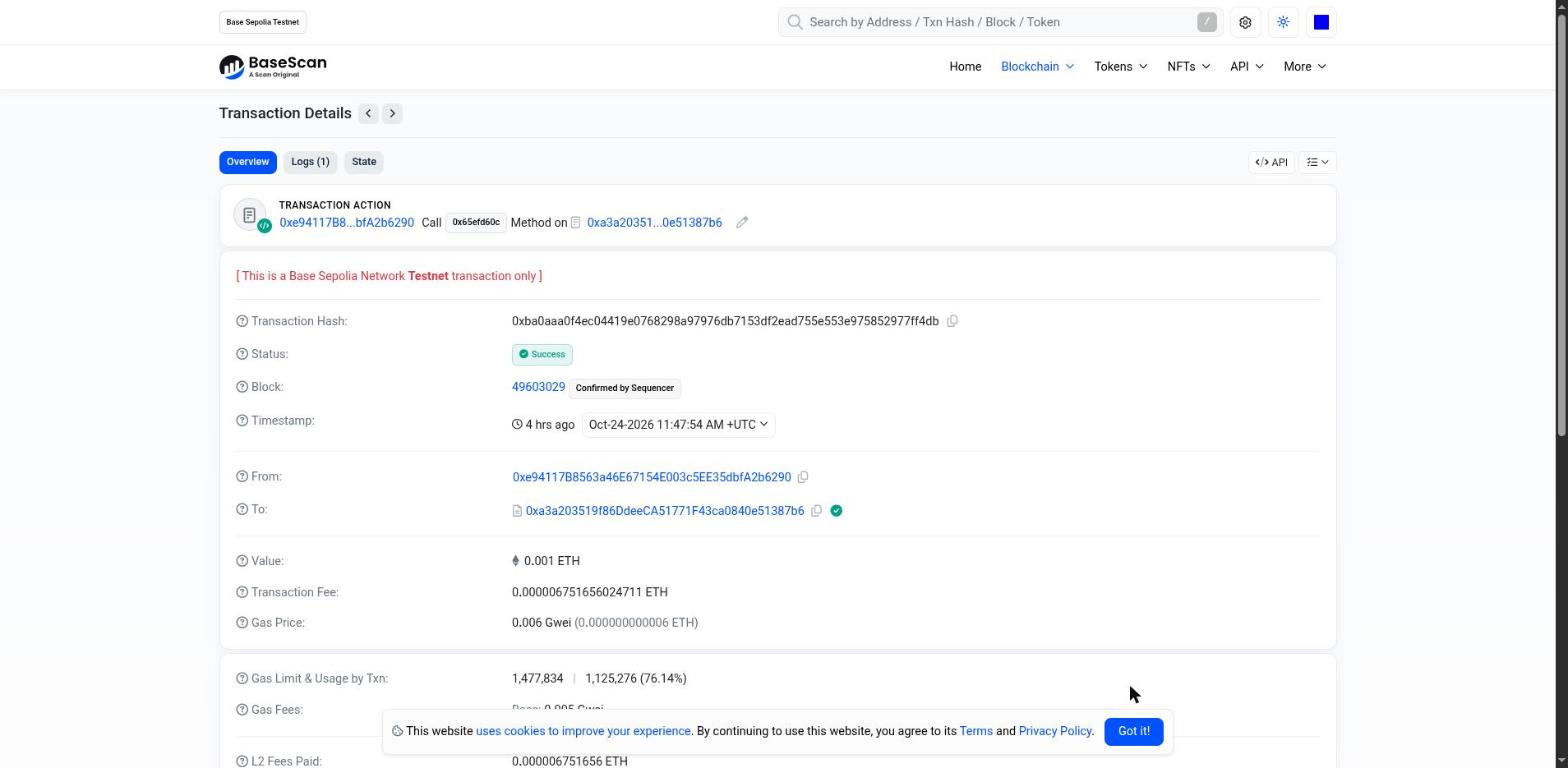
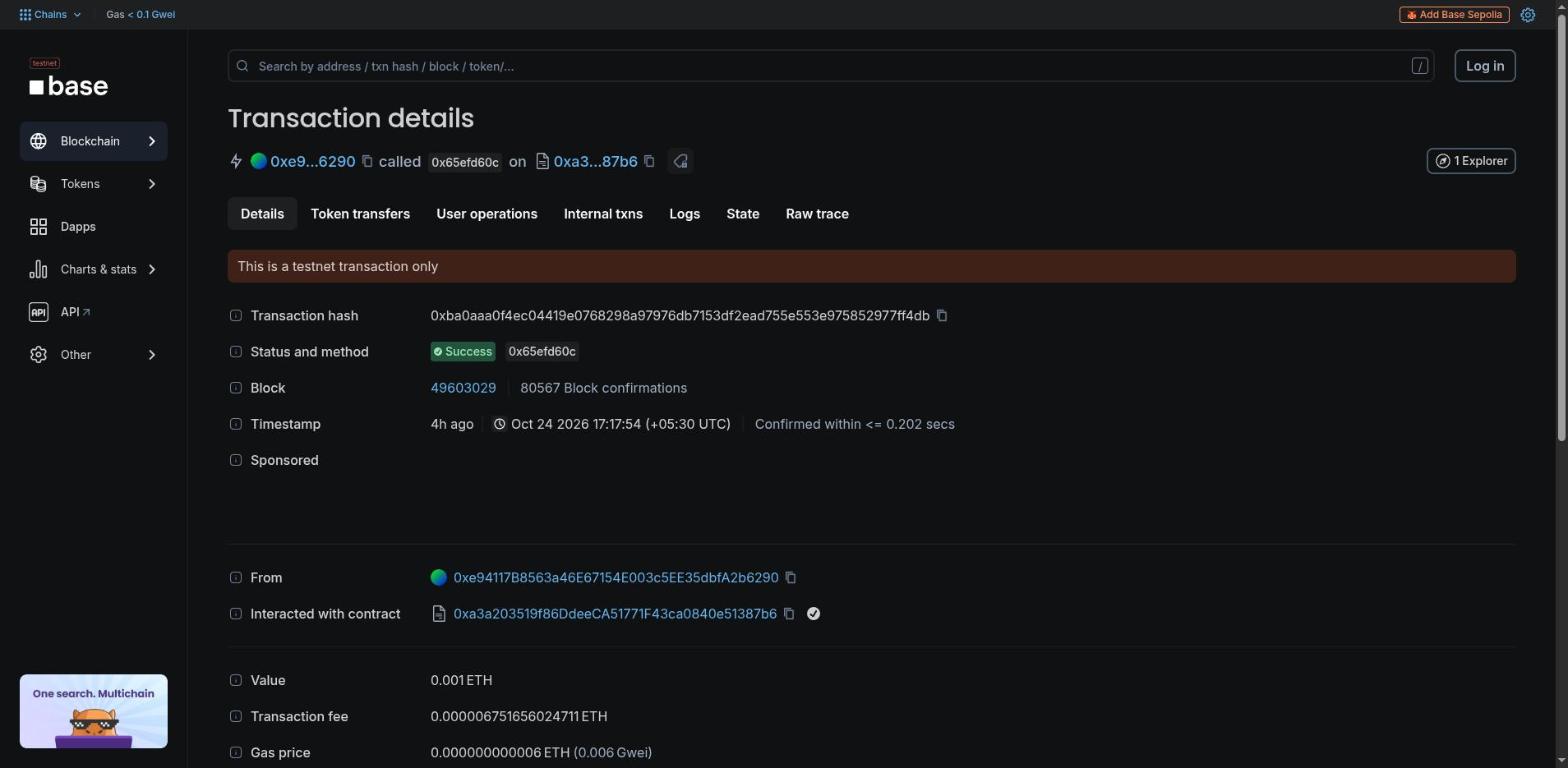
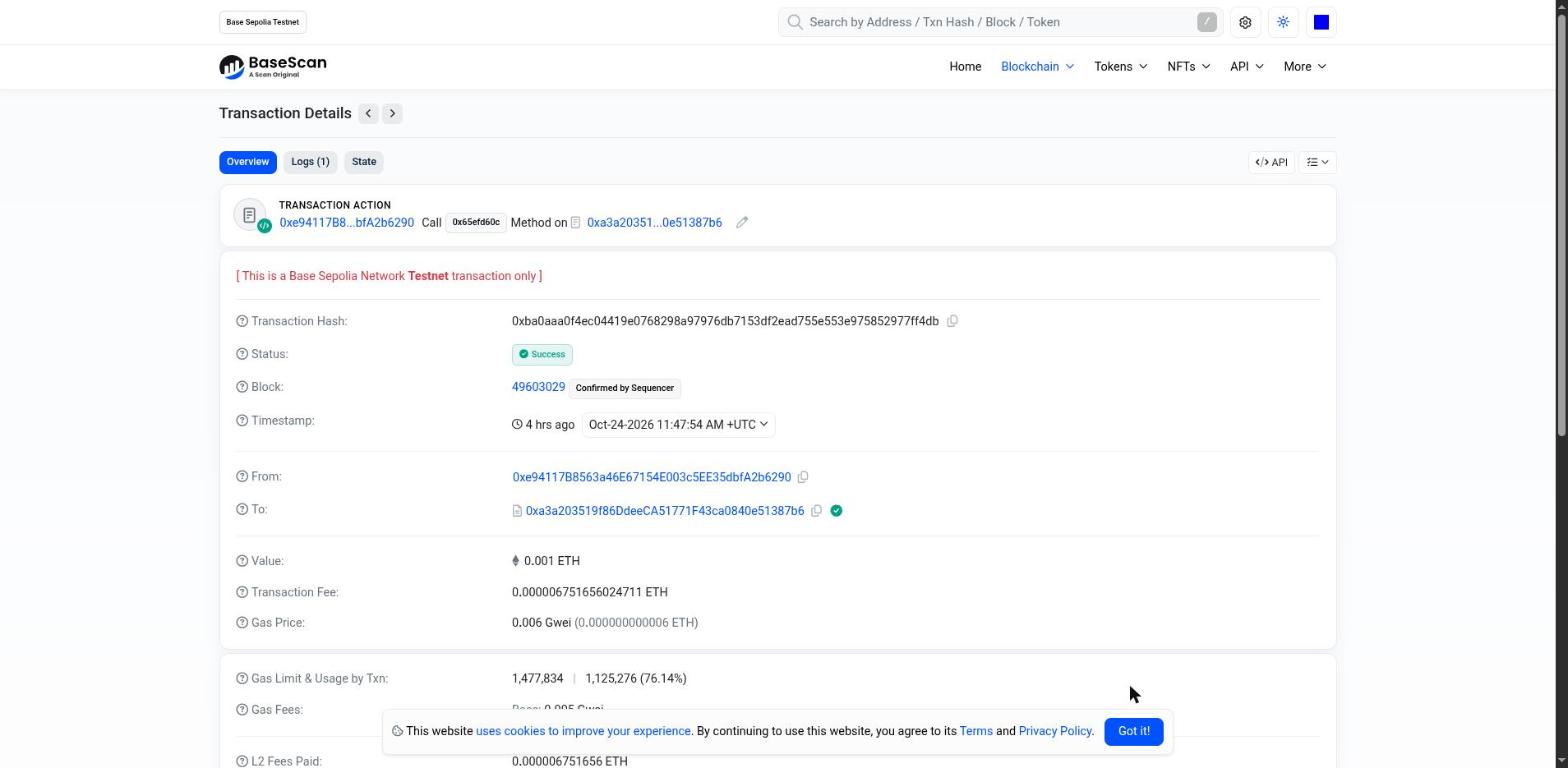
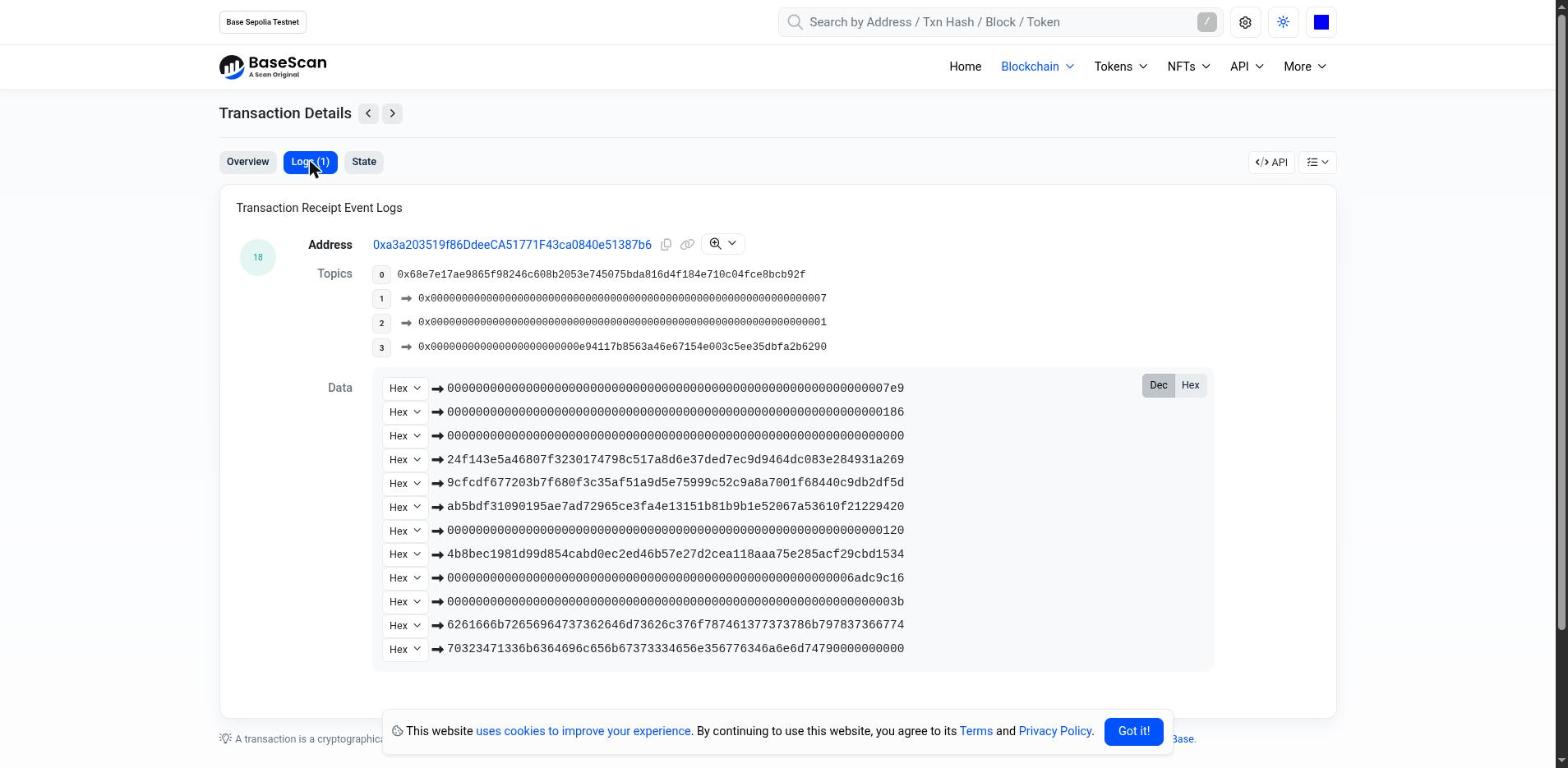
On-chain receipt. The real 2025 Tapajós submission, verified by the deployed verifier: 0xba0aaa…7ff4db (Base Sepolia, block 49,603,029, status Success). The event log carries period 7, project 1 and the oracle address as indexed topics.
Step 4 · A living credit
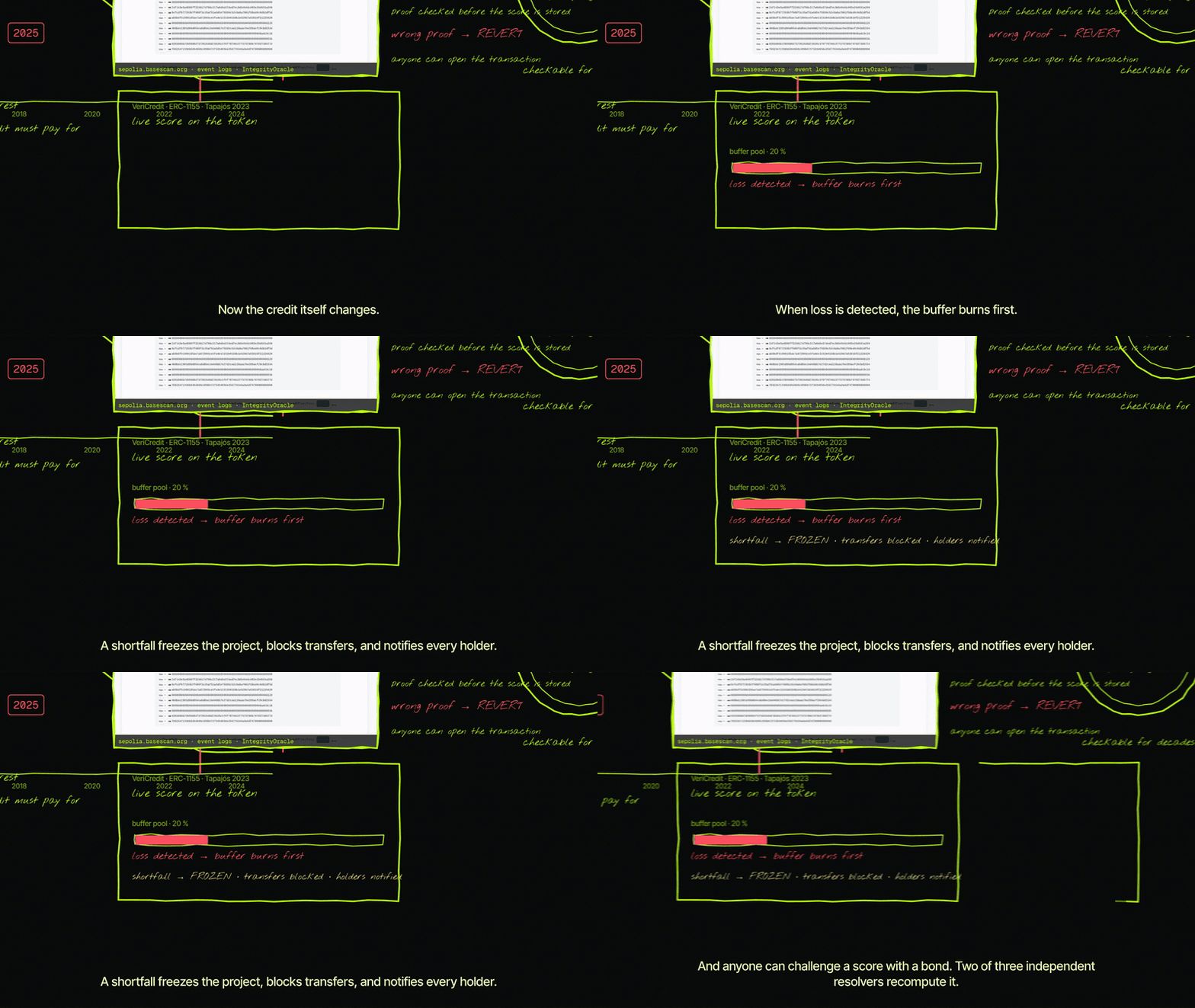
Credits carry the live score. Detected loss burns buffer credits first; a shortfall freezes the project, blocks transfers and notifies every holder. Anyone can challenge a score with a bond; two of three independent resolvers recompute it.
flowchart LR
  A[Sentinel-1/2 · Hansen GFC · GEDI L4B · MODIS · Dynamic World] --> B[Twin-forest matching<br/>776 vs 2,396 px]
  B --> C[16-feature vector fv1]
  C --> D[417-param MLP<br/>integrity score]
  D --> E[EZKL Halo2 proof<br/>4,416 B · ~6 s]
  E --> F[IntegrityOracle.submitScore<br/>Halo2Verifier · Base Sepolia]
  C --> G[Manifest signed ML-DSA-65]
  G --> F
  F --> H[VeriCredit ERC-1155<br/>buffer · freeze · challenges · market]
3 · Use it today (live on Base Sepolia)
Every clip below is a real recording of vericanopy.vercel.app, driven click by click.
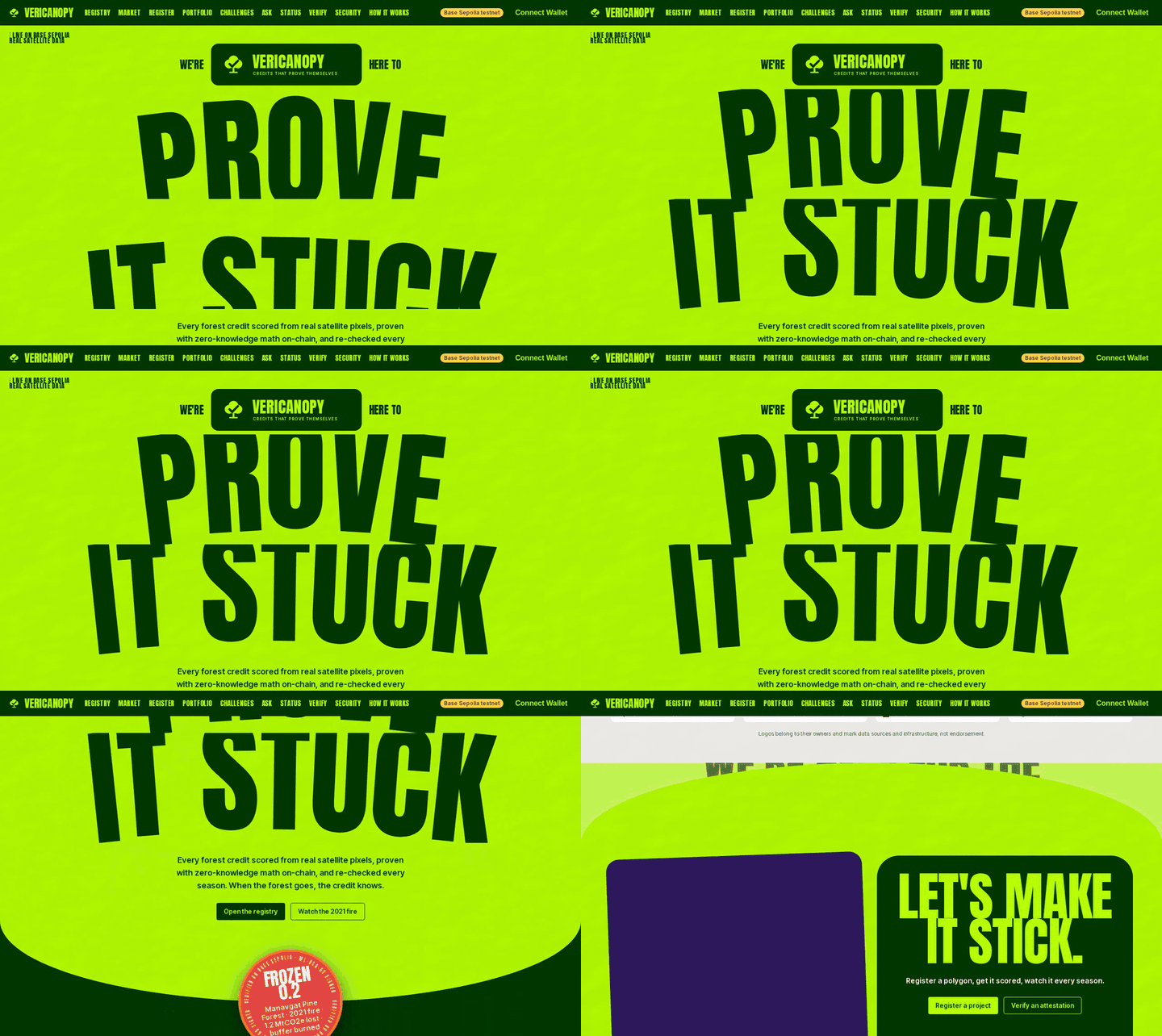
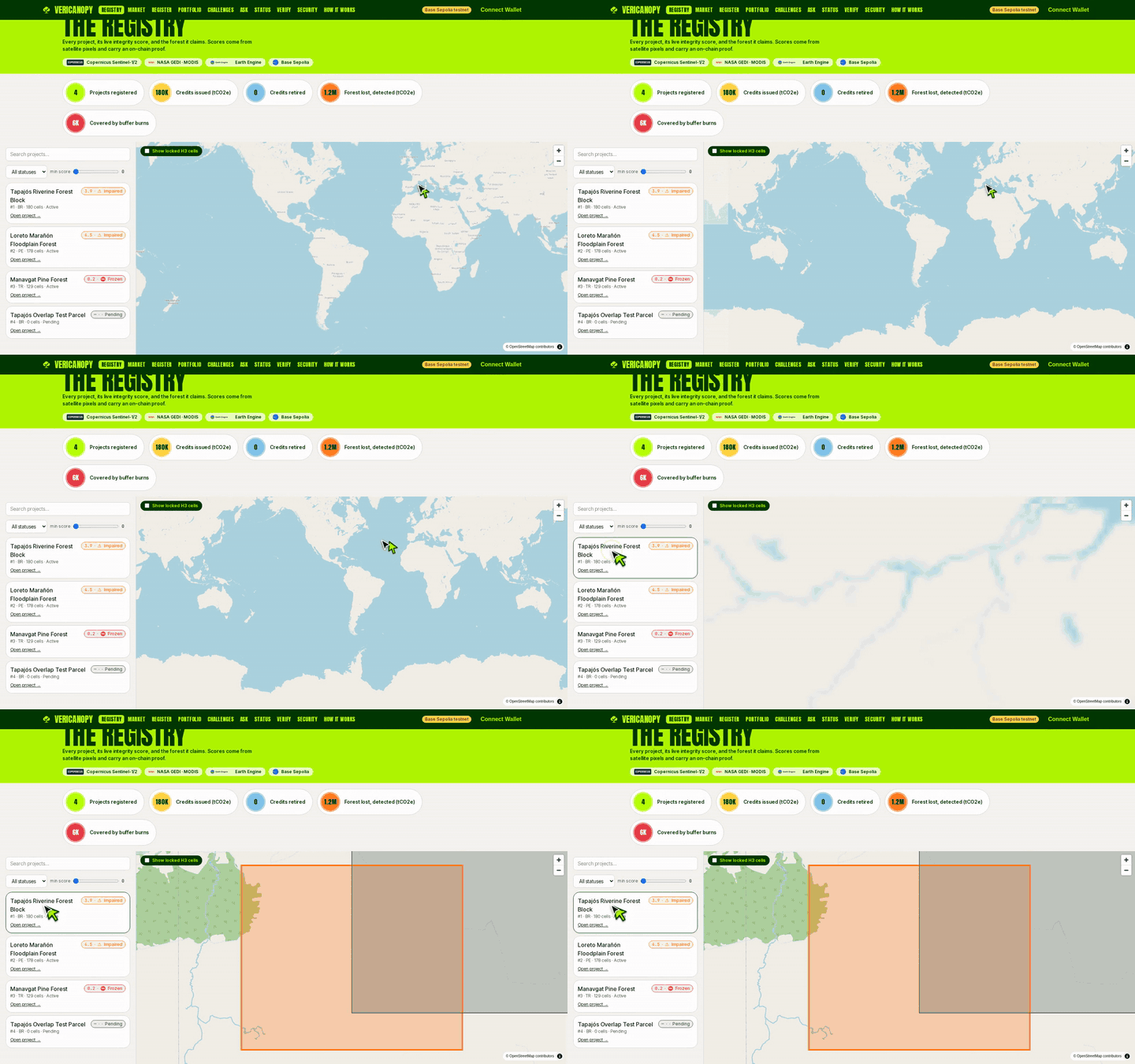 |
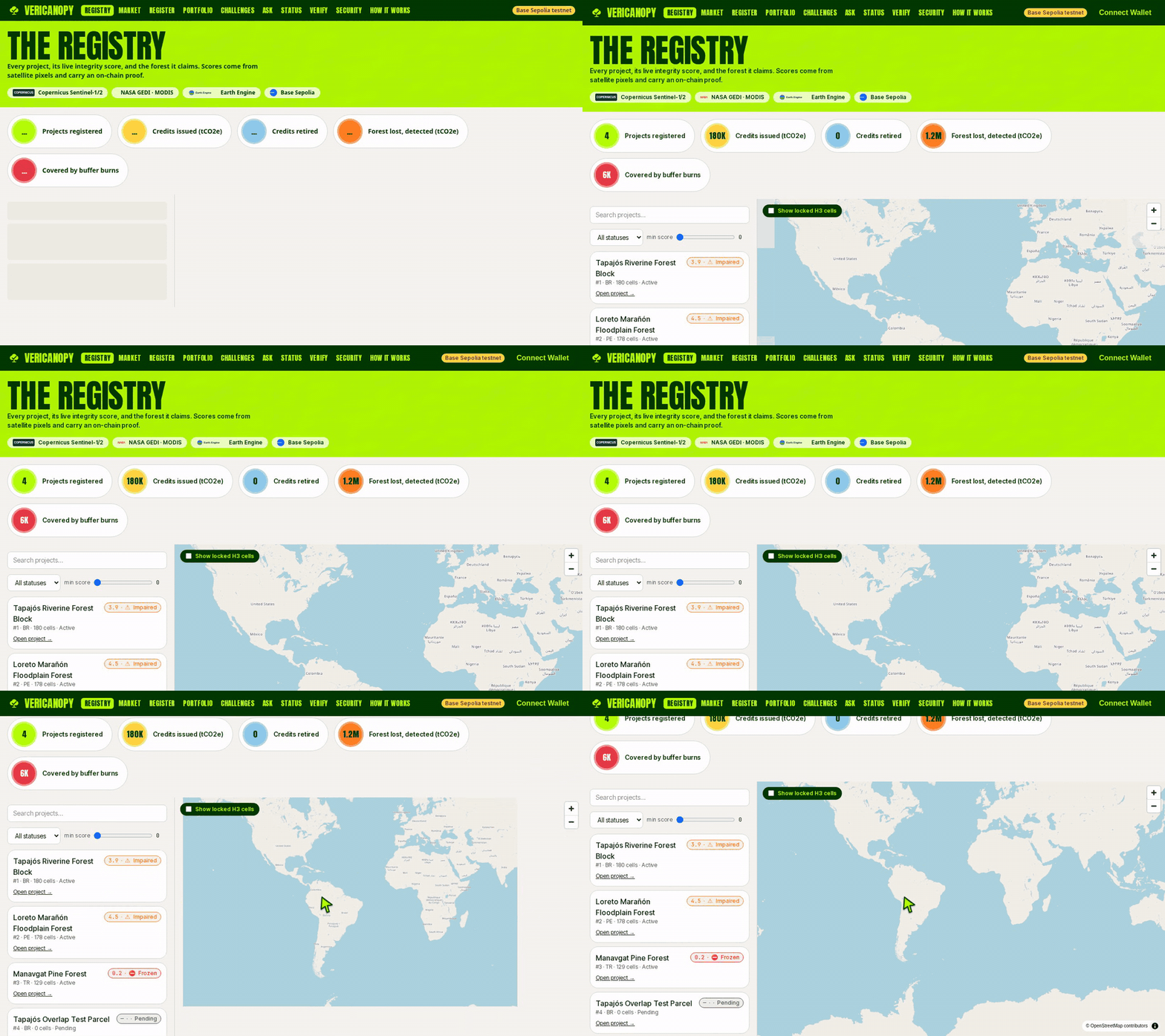
Registry. Every project on a map with its live integrity status, H3 cells, credits issued, loss detected and buffer coverage. |
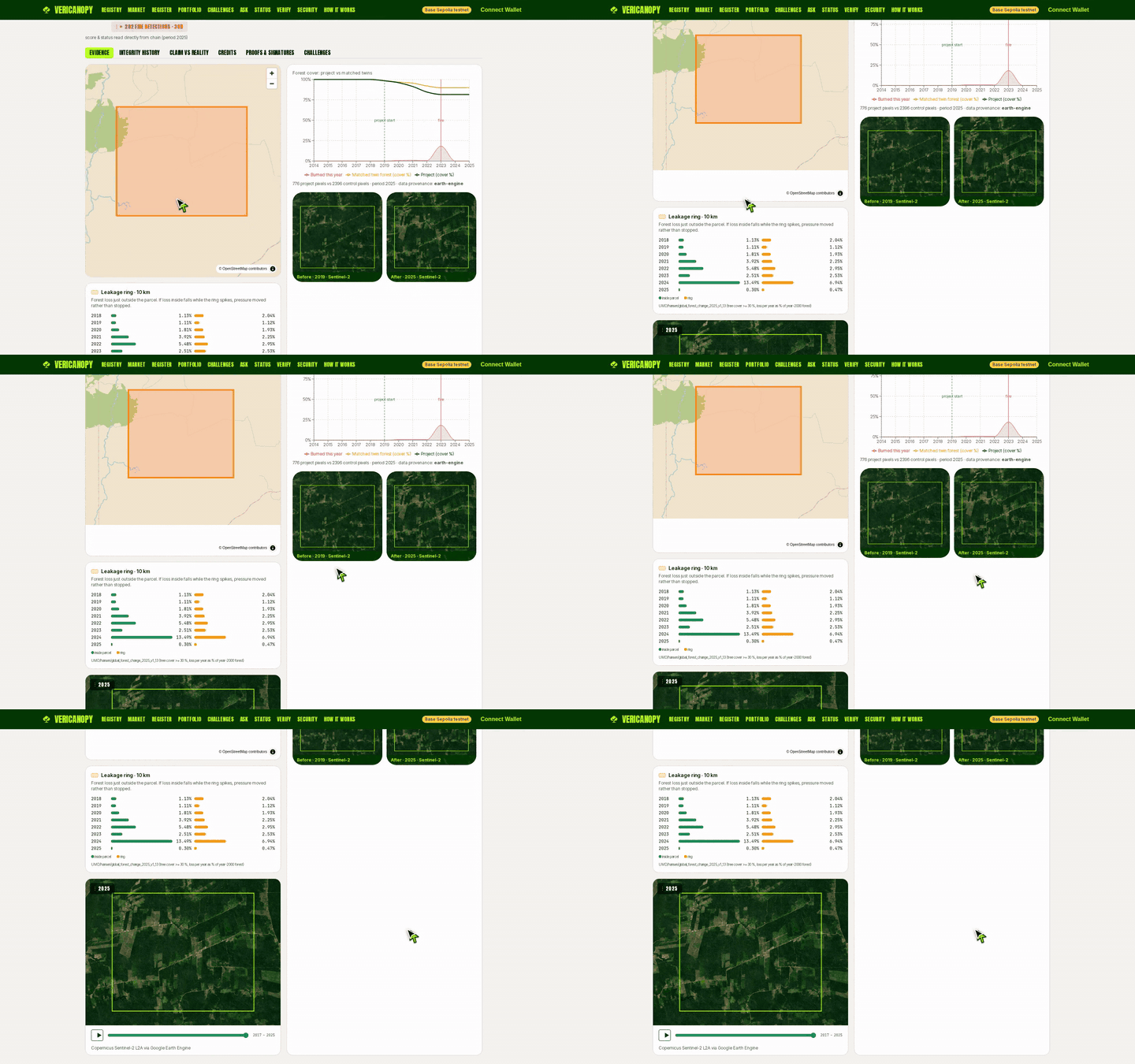 |
Project page. Real Sentinel-2 before/after, the twin-forest chart with the fire year, integrity history and claim vs reality. |
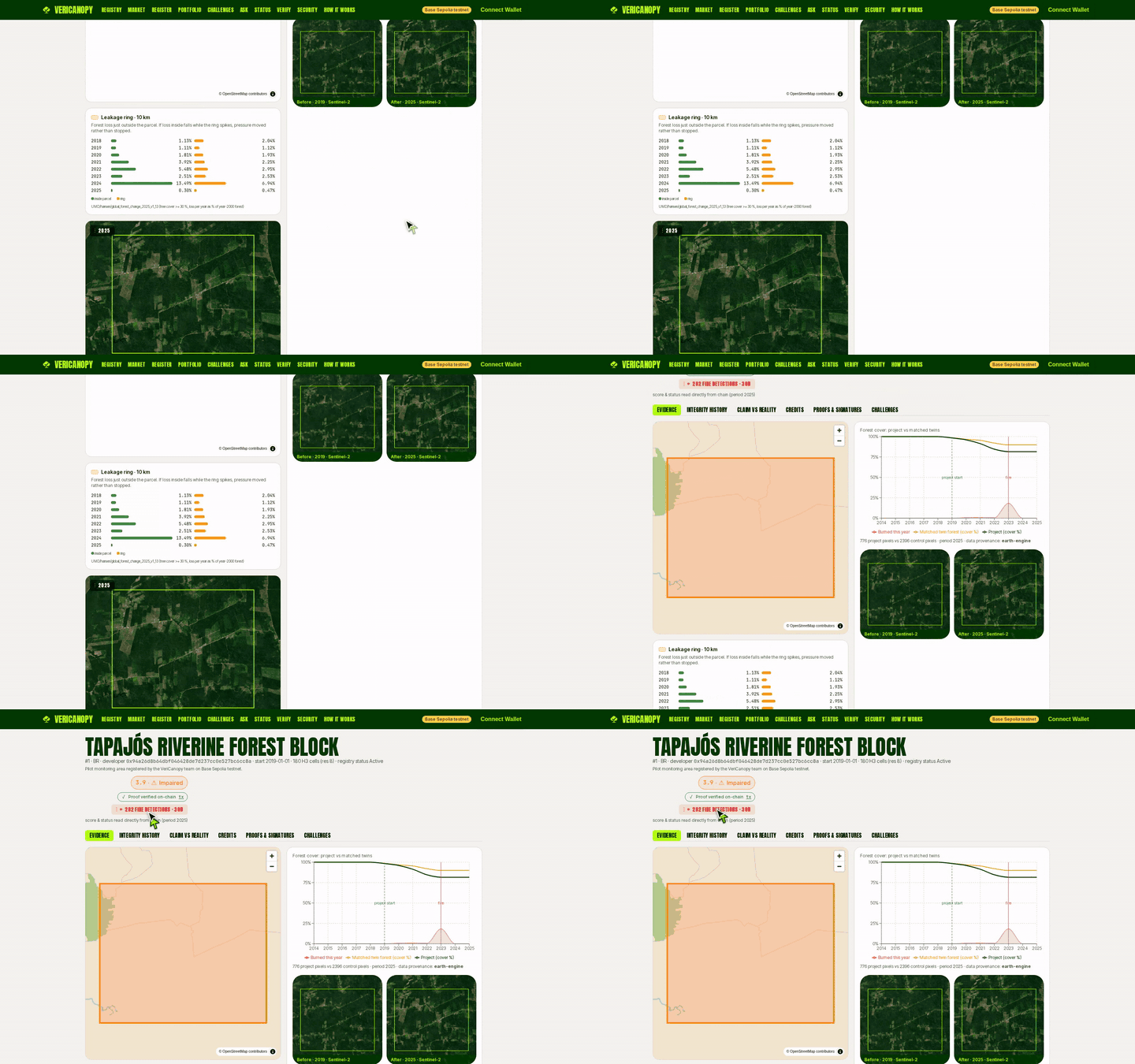 |
Year slider, fire watch, leakage ring. Scrub Sentinel-2 composites 2017–2025, NASA FIRMS detections for the last 30 days, and Hansen loss in a 10 km ring around the parcel. |
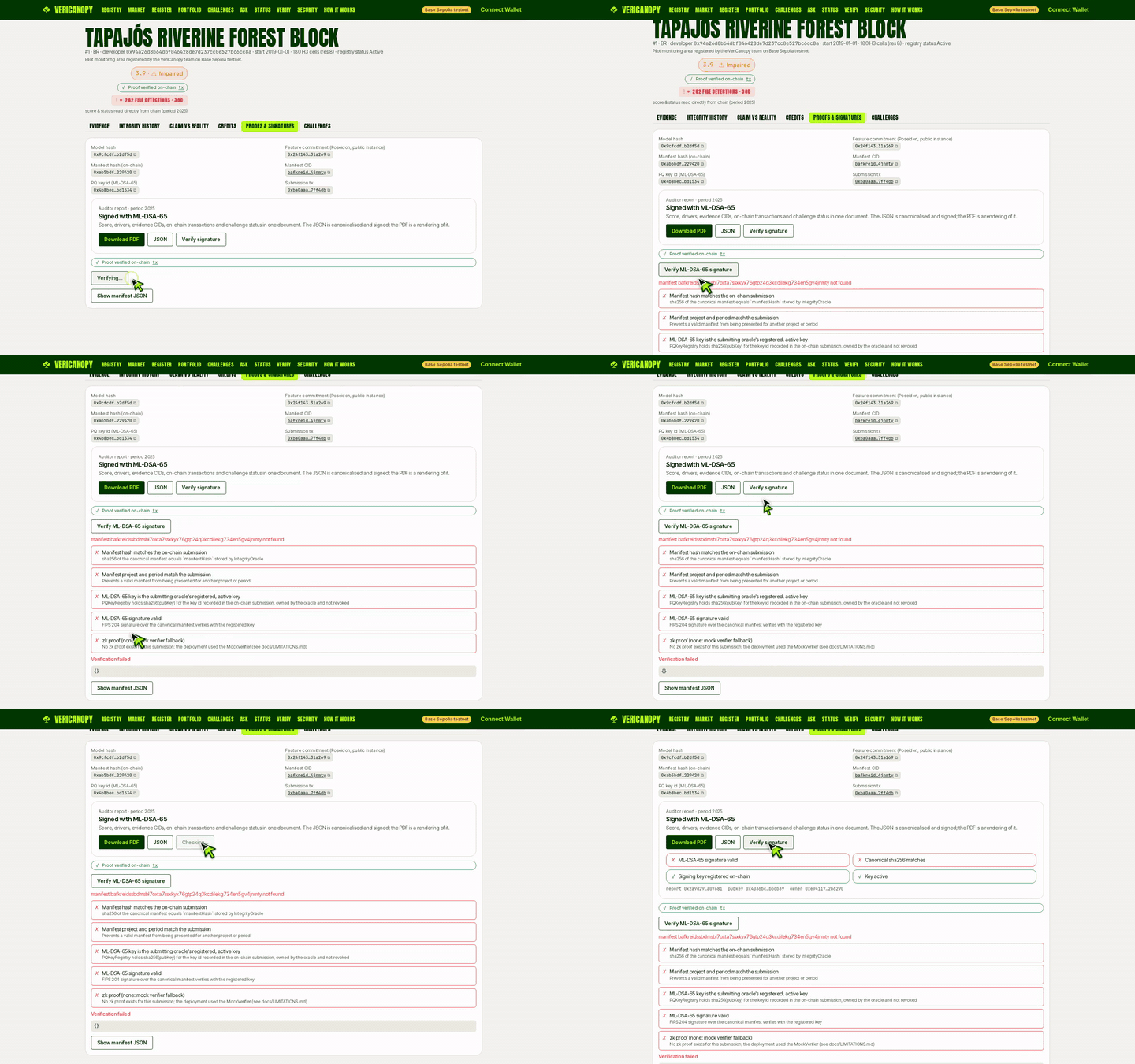 |
Proofs & signatures. Model hash, feature commitment, manifest CID, the on-chain tx, ML-DSA-65 verification, and a signed auditor report (PDF + JSON). |
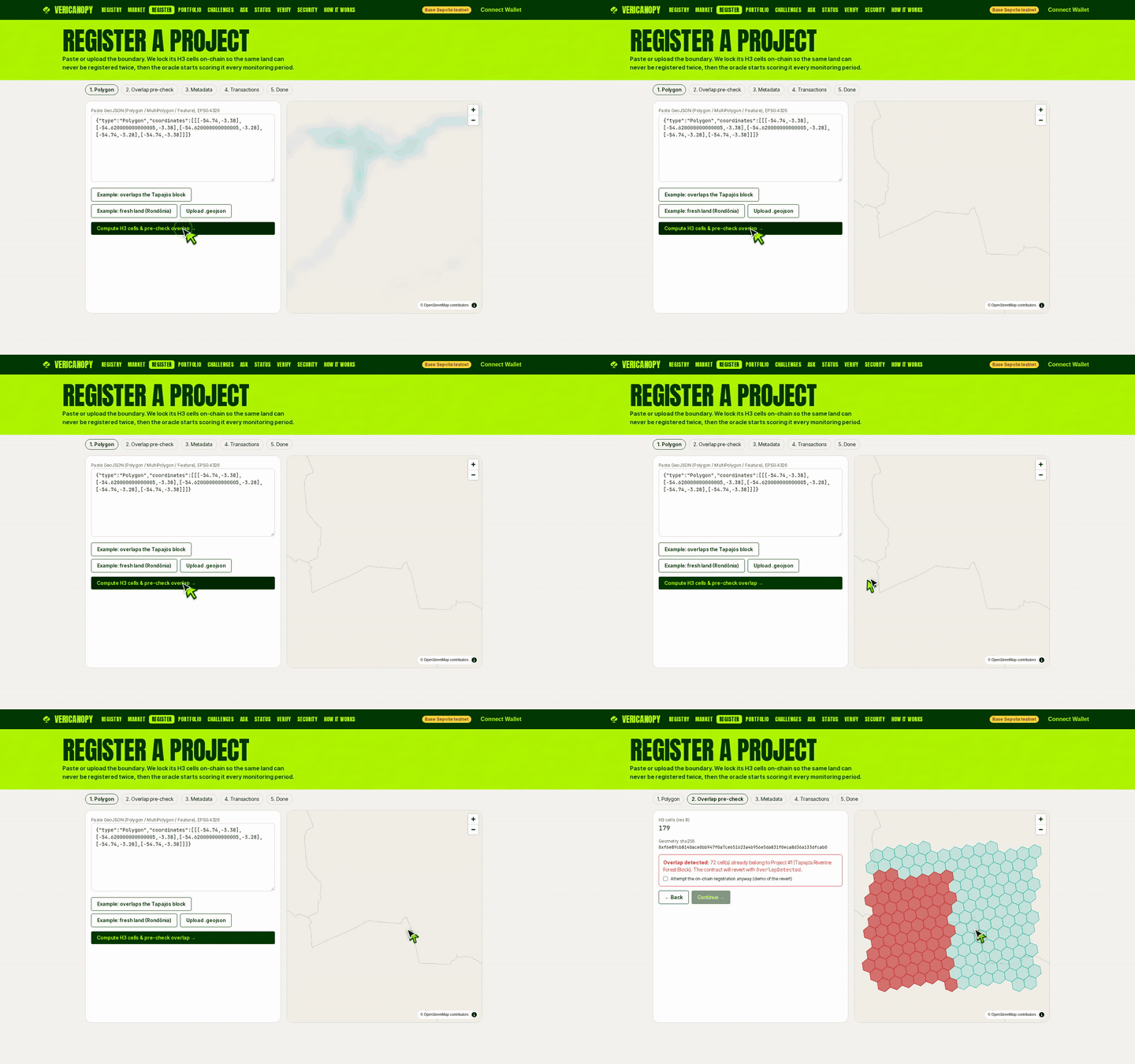 |
Register. Draw or paste a polygon; H3 overlap is pre-checked and the contract refuses land that is already registered (OverlapDetected). |
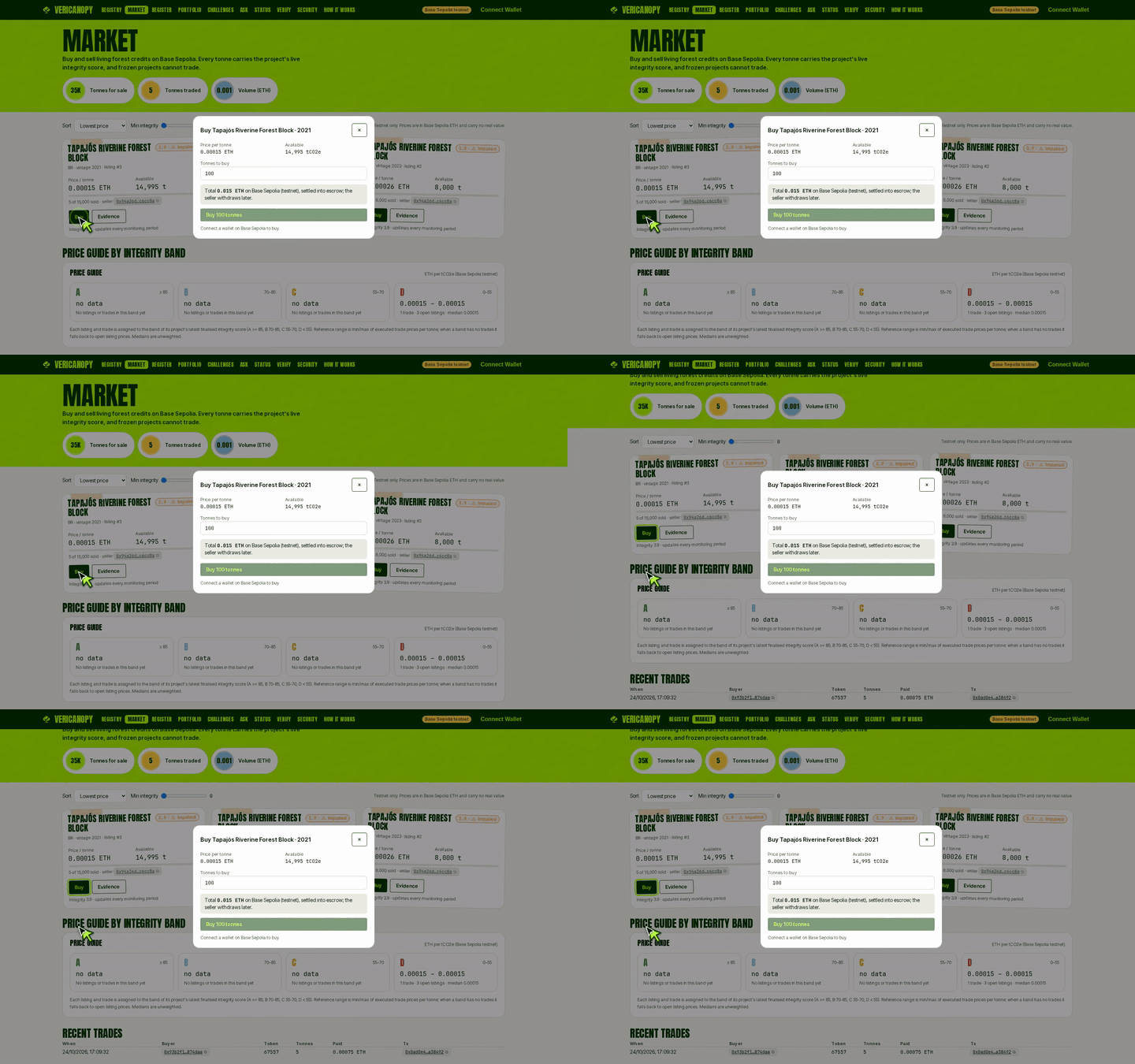 |
Market. Escrowed fixed-price listings with the integrity score on the price tag and a price guide by integrity band. Frozen projects cannot trade. |
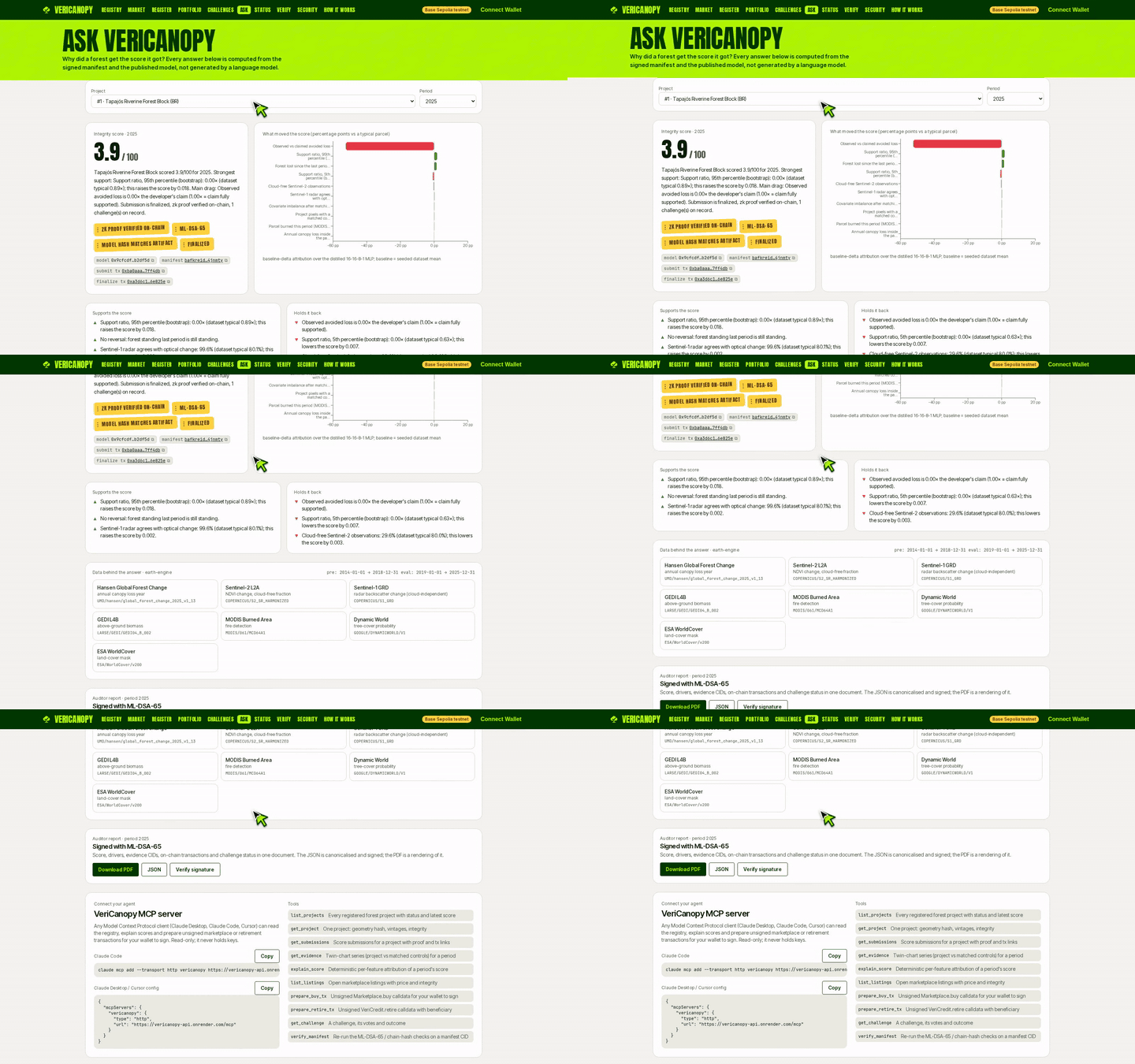 |
Ask. Deterministic, model-faithful explanation of any score: per-feature attribution, data sources, proof and signature status. No language model in the loop. |
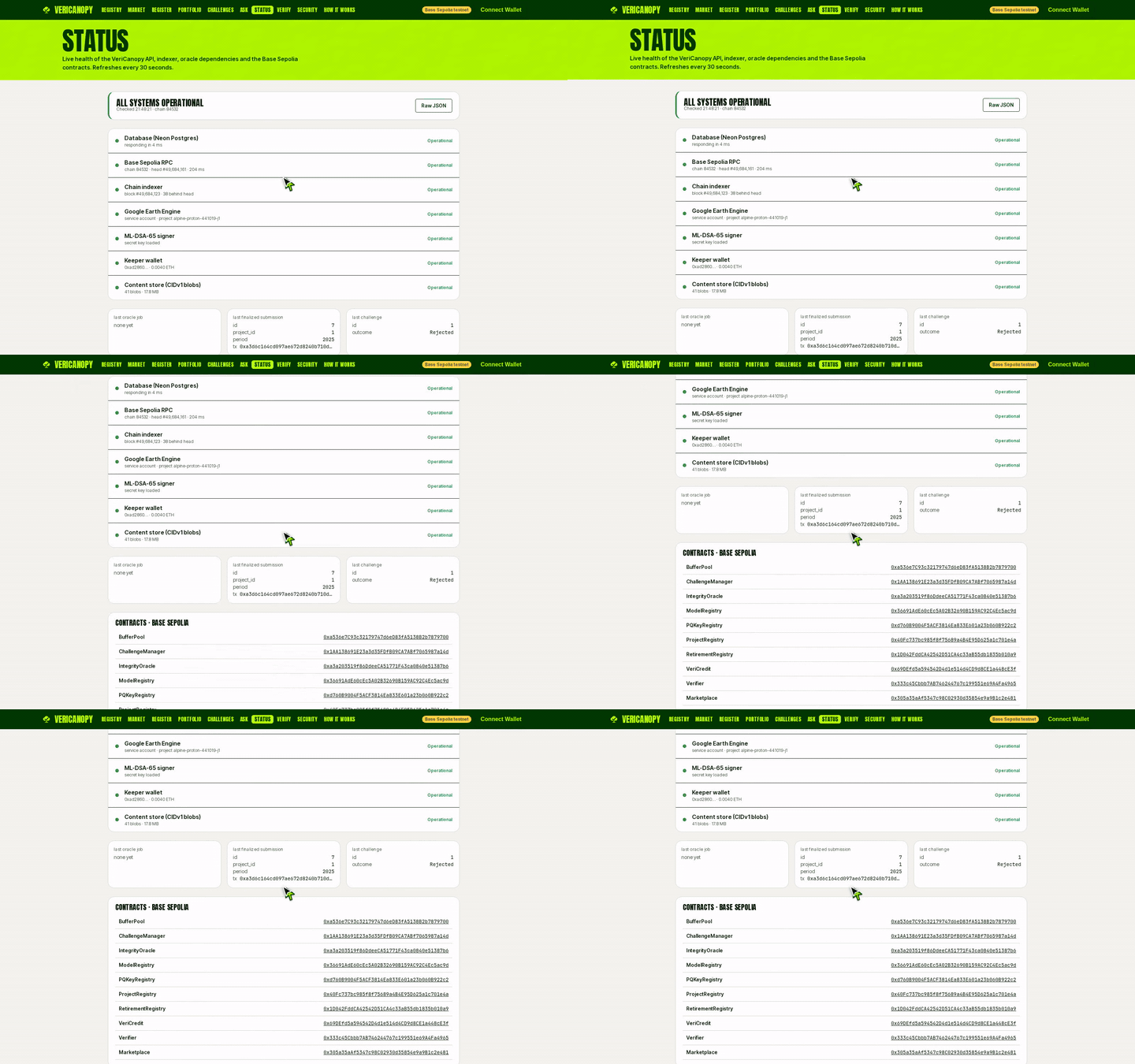 |
Status. Database, RPC head, indexer lag, Earth Engine, signer, keeper balance and all ten contracts, refreshed every 30 s. |
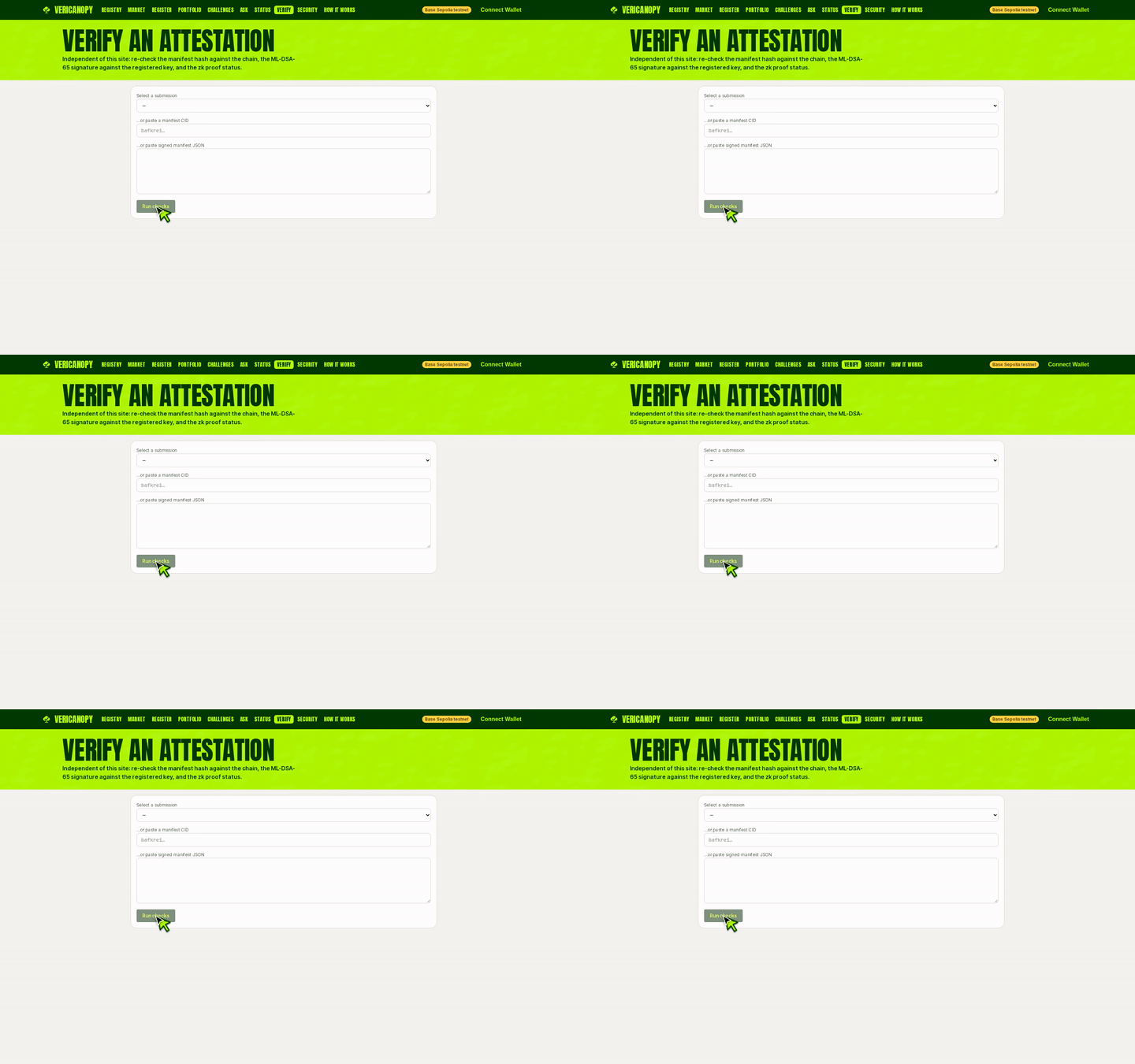 |
Verify. Re-check hash ↔ chain, key ↔ registry, signature and proof mode for any manifest. |
Also: Challenges with bonds and 2-of-3 resolver votes · Retirements with printable certificates · Alerts as JSON and RSS · Model registry page that compares the on-chain model hash with the published ONNX artifact.
4 · For agents: the VeriCanopy MCP server, working in claude.ai
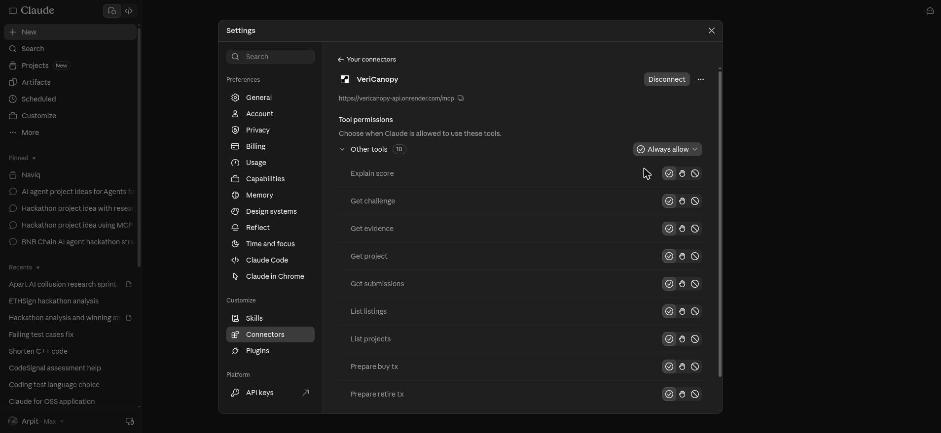
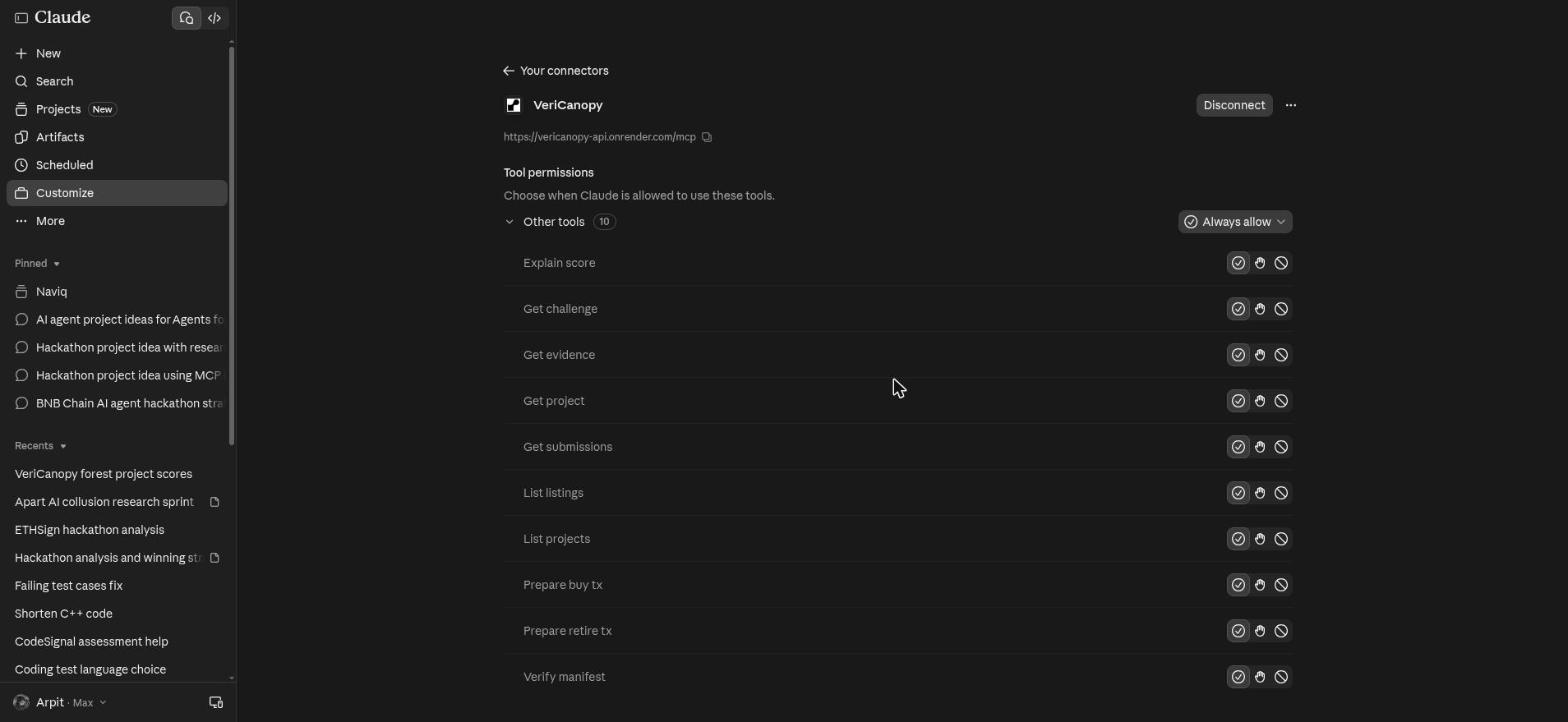
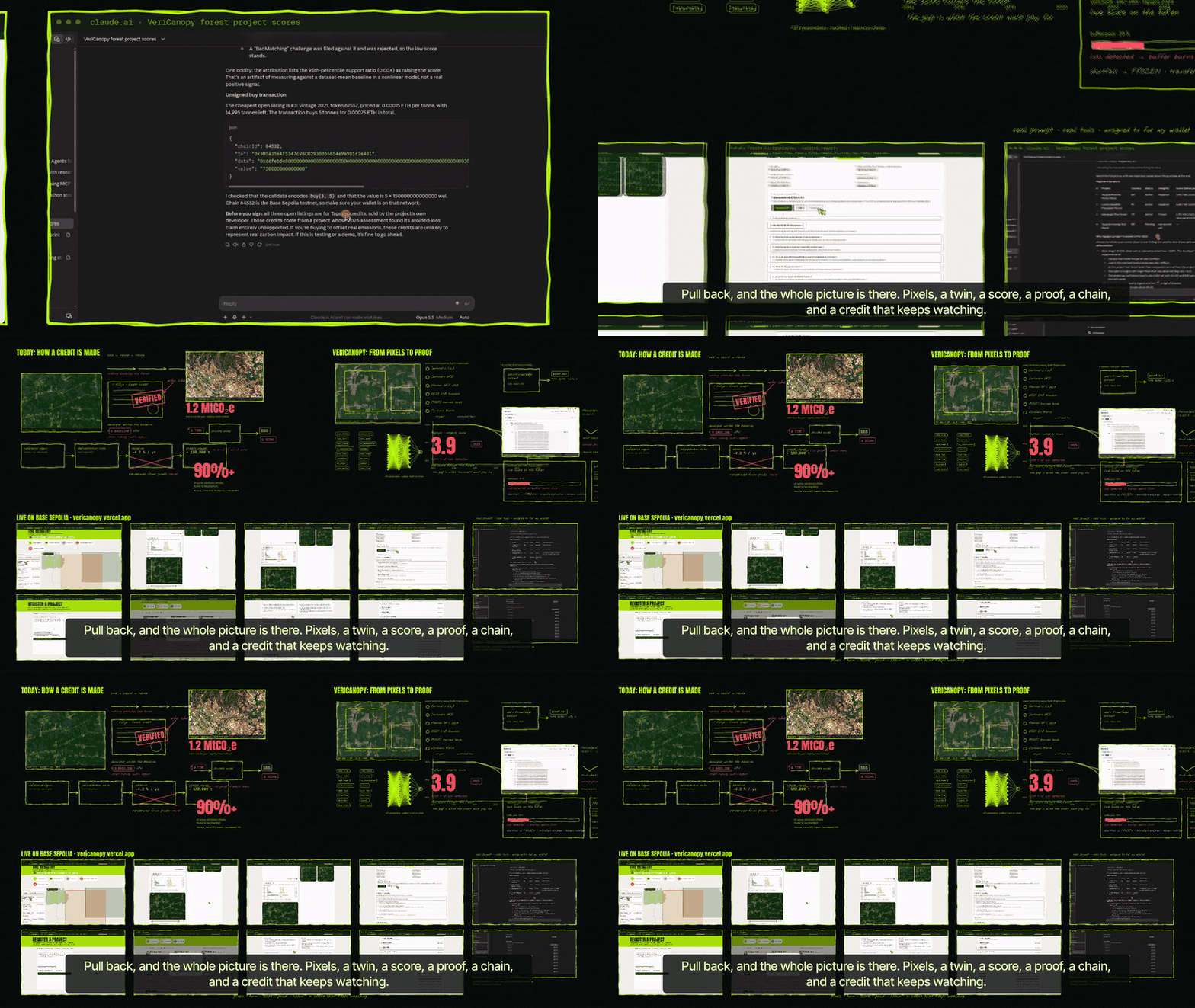
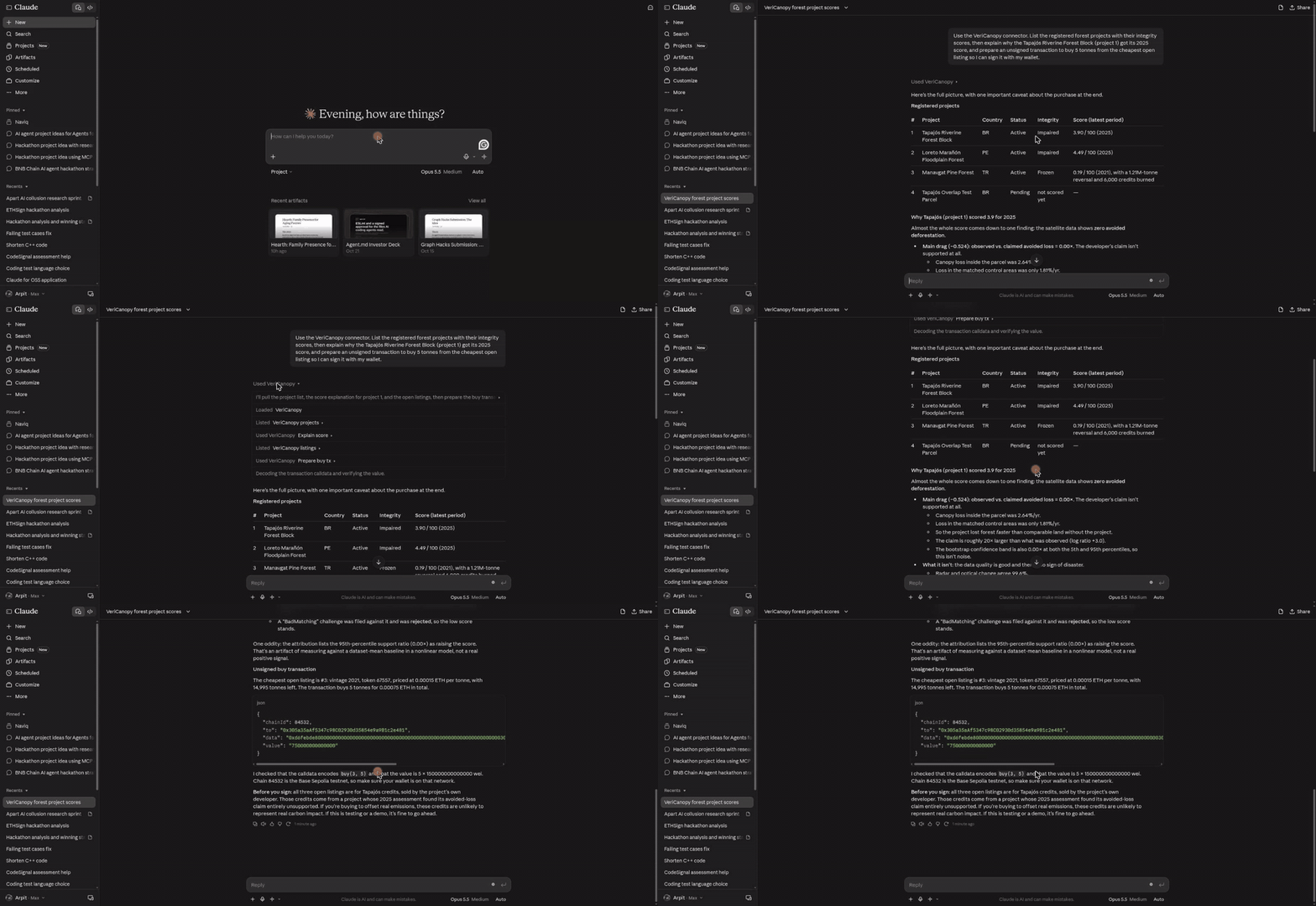
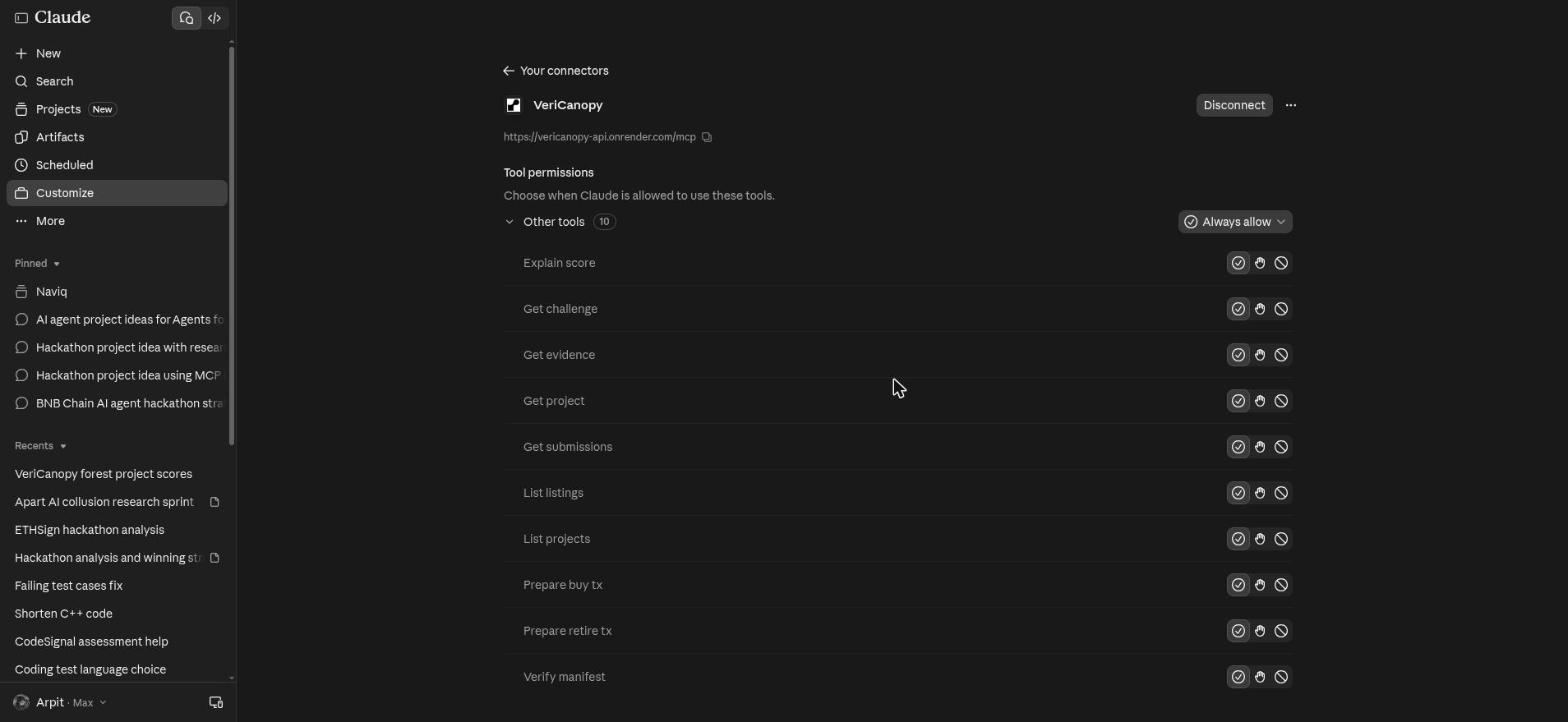
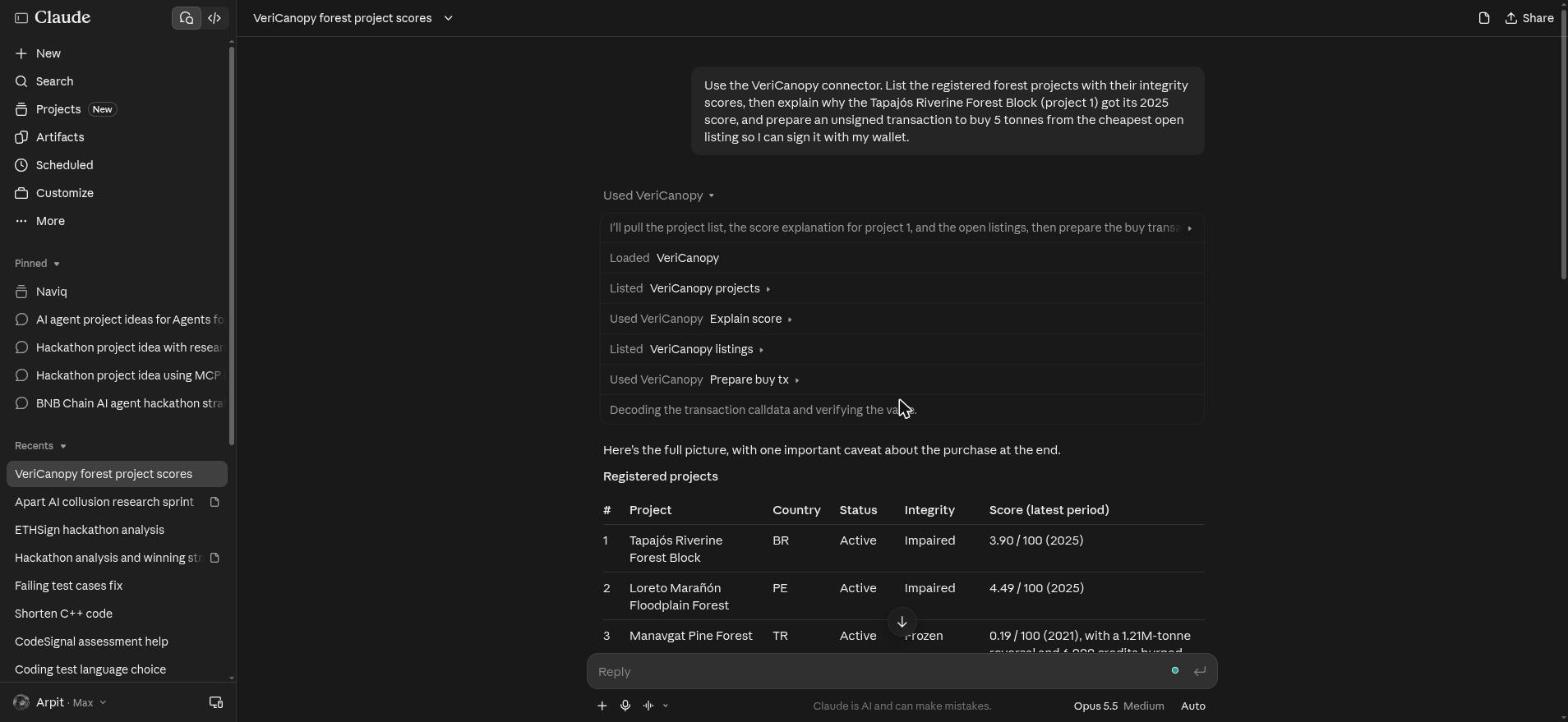
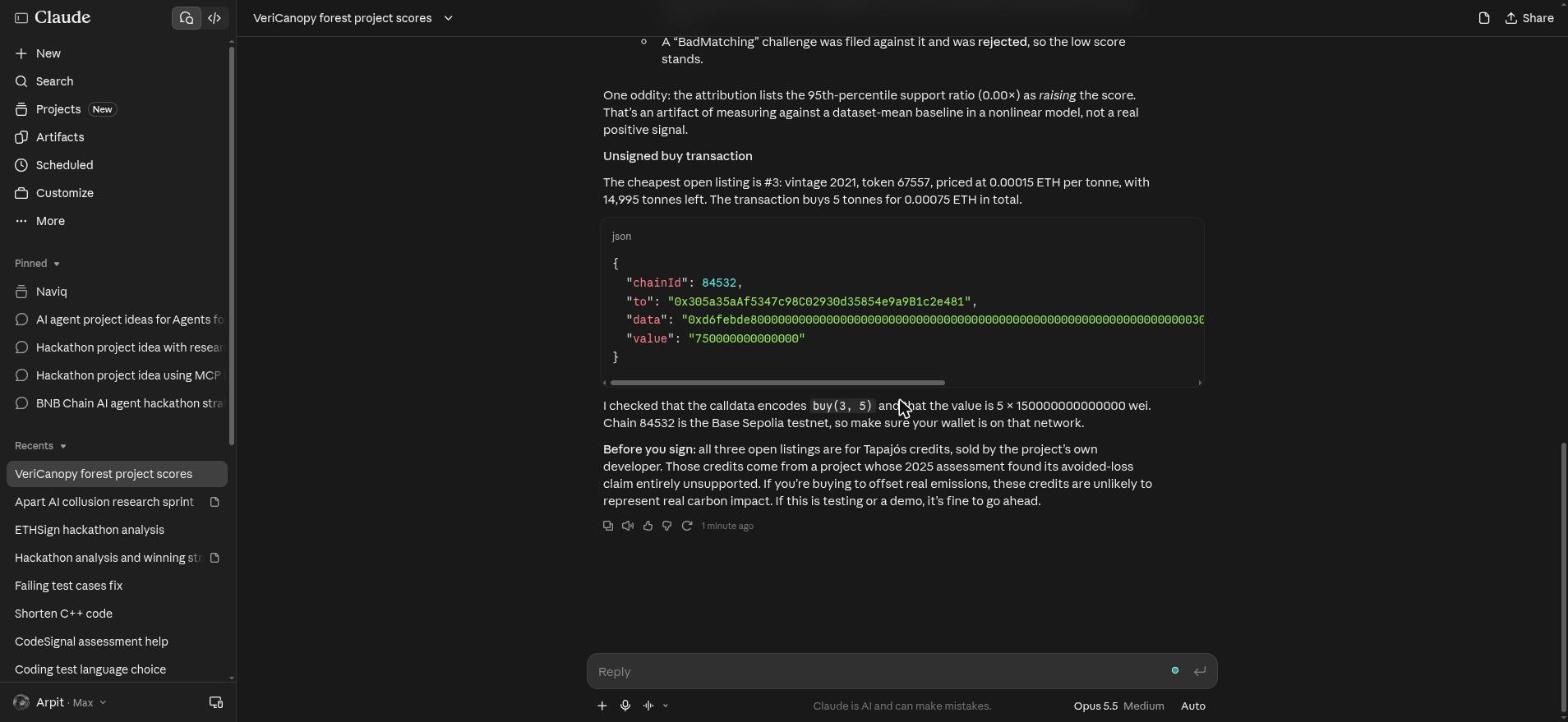
VeriCanopy is a Model Context Protocol server. Below is a real claude.ai session: the connector added under Customize → Connectors, then one prompt. Claude listed the projects, explained the 3.9 score feature by feature, found the cheapest listing and prepared an unsigned buy transaction for the user's wallet. The server holds no keys.
Connect it
# Claude Code, remote HTTP
claude mcp add --transport http vericanopy https://vericanopy-api.onrender.com/mcp/

# Any stdio client (Claude Desktop, Cursor) via the GitHub package
echo "@lsudoko:registry=https://npm.pkg.github.com" >> ~/.npmrc
npx -y @lsudoko/vericanopy-mcp
claude.ai: Customize → Connectors → Add custom connector → https://vericanopy-api.onrender.com/mcp/, no sign-in.
Tools: list_projects · get_project · get_submissions · get_evidence · explain_score · list_listings · prepare_buy_tx · prepare_retire_tx · get_challenge · verify_manifest. Package: @lsudoko/vericanopy-mcp (source). Details: docs/MCP.md.
Measured, not promised
Every number is produced by code in this repository (scripts/write_benchmarks.py, forge test --gas-report, pytest). Full table in docs/BENCHMARKS.md.
| Metric | Value |
|---|---|
Contract tests (incl. a real EZKL proof verified by the deployed Halo2Verifier, fuzz + invariants) |
55 |
| Backend tests (indexer idempotency, verify binding, market, feeds, MCP, reports) | 31 |
| Web smoke tests against production | 11 |
| Proof size / proving time (mean of 20) | 4,416 B / 6.02 s |
Halo2Verifier deployed bytecode |
19,817 B (limit 24,576) |
On-chain verify inside submitScore |
≈1.08 M gas |
| Model | 16-16-8-1 MLP, 417 params, MAE 0.0125, 0 monotonicity violations |
| ML-DSA-65 sign / verify (pure Python) | ≈118 ms / ≈19 ms |
| Satellite datasets via Earth Engine | 10 |
Pilot areas and data provenance
Two kinds of results exist on purpose:
- Live submissions on Base Sepolia (
provider: earthenginein the manifest): features extracted from real Hansen GFC 2025, Sentinel-1/2, GEDI L4B, MODIS burned-area and Dynamic World pixels for the pilot polygons, proven with EZKL and verified on-chain. The pilot polygons (Tapajós riverine block, Loreto Marañón floodplain, Manavgat pine forest) were drawn by us for monitoring; they are not issued carbon projects, so their real-data scores are low (Tapajós/2025 = 3.9, Manavgat/2021 = 0.2 with 1.2 MtCO2e of real 2021 loss). That is the system working as intended. - The first three submissions (
provider: fixture) were made before Earth Engine access existed and use deterministic labelled fixture samples; they remain on-chain, labelled as such.
Deployed addresses
| Component | Where |
|---|---|
| Web app | https://vericanopy.vercel.app (Vercel) |
| API, indexer, workers, MCP | https://vericanopy-api.onrender.com (Render, Docker, GET /api/v1/status) |
| Database | Neon Postgres (Alembic-managed) |
| Contracts | Base Sepolia (84532), contracts/deployments/84532.json |
| Contract | Address |
|---|---|
| ProjectRegistry | 0x40Fc737bc985f8f75689a4B4E95D625a1c701e4a |
| ModelRegistry | 0x36691AdE60cEc5A02B32690B159AC92C4Ec5ac9d |
| PQKeyRegistry | 0xd760B9004F5ACF3814Ea833E601a23b060B922c2 |
| IntegrityOracle | 0xa3a203519f86DdeeCA51771F43ca0840e51387b6 |
| Halo2Verifier | 0x333c45Cbbb7AB746244767c199551e69A4Fa4965 |
| ChallengeManager | 0x1AA138691E23a3d35FDfB09CA7ABf7065987a14d |
| VeriCredit (ERC-1155) | 0x69DEfd5a594542D4d1e514d4CD9d8CE1a448cE3f |
| BufferPool | 0xa536e7C93c32179747d6eD83fA5138B2b7879700 |
| RetirementRegistry | 0x1D042FddCA42542D51CA4c33aB55db1835b010a9 |
| Marketplace | 0x305a35aAf5347c98C02930d35854e9a9B1c2e481 |
First zk-verified submissions: #1, #2, #3.
Architecture
| Layer | Stack | Lives in |
|---|---|---|
| Contracts | Solidity 0.8.26, OpenZeppelin v5, Foundry; EZKL-generated Halo2Verifier |
contracts/ |
| AI pipeline | Python 3.11, Earth Engine, numpy, ONNX, EZKL 23.0.5, dilithium-py (ML-DSA-65) | ai/ |
| Backend | FastAPI, SQLAlchemy + Alembic (Neon Postgres), web3.py indexer, oracle + finalizer workers, content-addressed blob store, webhooks, MCP (FastMCP) | backend/ |
| Web | Next.js 16, wagmi/viem, RainbowKit, MapLibre, GSAP + Lenis | web/ |
| Ops | Vercel, Render (Docker), Neon, GitHub Actions CI + release workflow, ghcr.io image | .github/, render.yaml |
Details: docs/ARCHITECTURE.md · feeds, certificates and monitoring: docs/FEATURES.md · runbook: docs/DEPLOYMENT.md.
Quick start
# prerequisites: foundry, uv, node 22 + pnpm, python 3.11 (uv downloads it)
make setup          # venv + forge deps + pnpm install
make zk-setup       # EZKL circuit, keys, SRS, Solidity verifier (one-off, ~1 min + SRS download)
make chain          # terminal 1: anvil
make deploy         # terminal 2: Halo2Verifier + full stack → contracts/deployments/31337.json
make seed           # register the pilot areas (one overlapping parcel is rejected on purpose)
cd backend && ../.venv/bin/uvicorn app.main:app --reload &     # API + MCP on :8000
cd backend && ../.venv/bin/python -m app.indexer.run &         # indexer
cd backend && ../.venv/bin/python -m app.workers.scheduler &   # finalizer loop
cd web && pnpm dev                                             # http://localhost:3000
make submit P=1 Y=2025   # oracle: pipeline → proof → ML-DSA sign → submitScore
make e2e                 # the whole story on a local chain, every step asserted
make test                # forge test + pytest (ai, backend) + vitest/lint/build (web)
Copy .env.example to .env. With EE_SERVICE_ACCOUNT_JSON and EE_PROJECT the pipeline uses live Earth Engine data; without them it uses labelled fixture samples (see docs/LIMITATIONS.md).
Honesty: what is and is not proven
| Claim | Covered by |
|---|---|
| The registered model was used, unmodified | zk proof (fixed params; verifier bound to the circuit) + ModelRegistry |
| The score follows from the committed features | zk proof (Poseidon commitment of the 16 features is a public instance) |
| The features came from the stated satellite data | not the zk proof → reproducible manifest + challenge game |
| The scoring rule is scientifically right | not cryptography → open methodology + governance |
| Element | Quantum-safe? |
|---|---|
| Manifest attestations and auditor reports (ML-DSA-65) | ✅ |
| Hash commitments (SHA-256 / keccak256) | ✅ with sufficient output size |
| Ethereum transaction signatures (ECDSA) | ❌ ecosystem dependency (PQ account abstraction) |
| zk proofs (Halo2 + KZG) | ❌ pairing-based (hash-based STARK proofs on the roadmap) |
Repository
ai/          Earth Engine extraction, matching, fv1 features, MLP, EZKL circuit, ML-DSA-65
backend/     FastAPI API, indexer, oracle/finalizer workers, MCP server, Alembic migrations
contracts/   Foundry project, tests, deployment scripts, generated Halo2Verifier
web/         Next.js app
scripts/     deploy, seed, e2e, benchmarks, media
docs/        architecture, benchmarks, limitations, MCP, features, submission kit, launch film
brand/       logo and brand guide
Contributing: CONTRIBUTING.md · security: SECURITY.md · changes: CHANGELOG.md.
References
- Tropical forest carbon offsets deliver partial gains amid persistent over-crediting — https://pubmed.ncbi.nlm.nih.gov/41066561/
- Unobserved confounders cannot explain over-crediting in avoided deforestation carbon projects — https://pmc.ncbi.nlm.nih.gov/articles/PMC13253331/
- Dynamic ex-post baselines for enhancing the credibility of IFM carbon offsets — https://pubmed.ncbi.nlm.nih.gov/41728826/
- Forest carbon protocols underestimate climate-driven carbon loss risks — https://pubmed.ncbi.nlm.nih.gov/42162435/
- Widespread increases in future wildfire risk to global forest carbon offset projects revealed by explainable AI — https://arxiv.org/abs/2305.02397
- Global, robust and comparable digital carbon assets (PACT) — https://arxiv.org/abs/2403.14581
Data attributions
Hansen/UMD Global Forest Change, ESA Copernicus Sentinel-1/2, NASA GEDI L4B, NASA FIRMS and MODIS MCD64A1, SRTM, ESA WorldCover, Google Dynamic World (via Earth Engine). Basemap © OpenStreetMap contributors.
Licence
MIT — see LICENSE. Built for the IEEE ClimateChain Global Hackathon 2026, Carbon Markets & Emissions Transparency track. Testnet only; nothing here assesses any real carbon project.
Built With
- carbon-credit
- earth-engine
- mcp
- post-quantum
- sattelite-imaginary
