Inspiration
Environmental monitoring data underpins climate policy, carbon credit verification, and pollution regulation — yet the integrity of that data is rarely verified. Sensors malfunction, readings drift, and in some cases data is quietly altered after collection. We built Verdiq because we believe trustworthy environmental data requires two independent guarantees: statistical plausibility and cryptographic provenance.
What it does
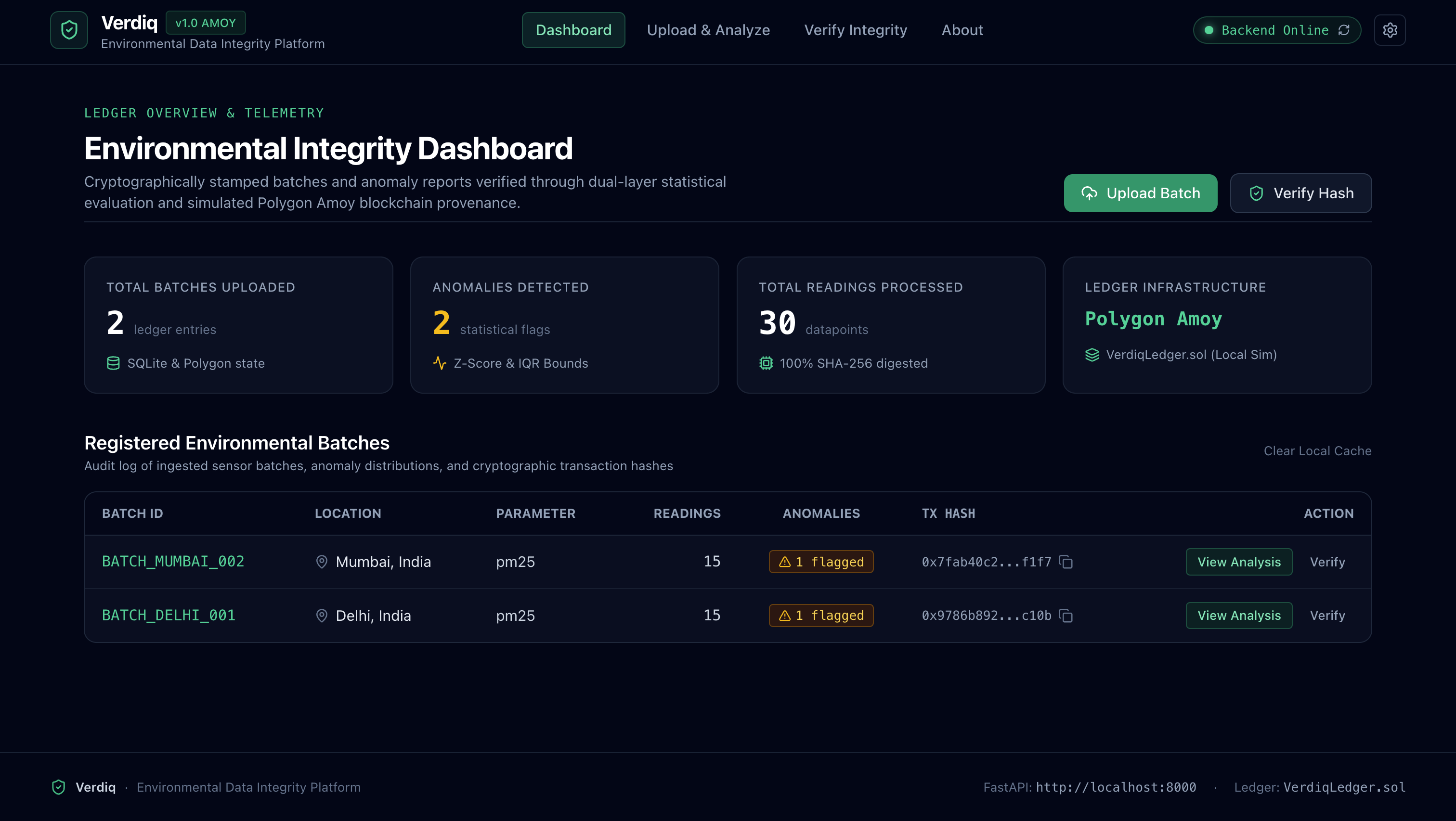
Verdiq is an AI-assisted environmental data integrity platform built around a two-part trust model.
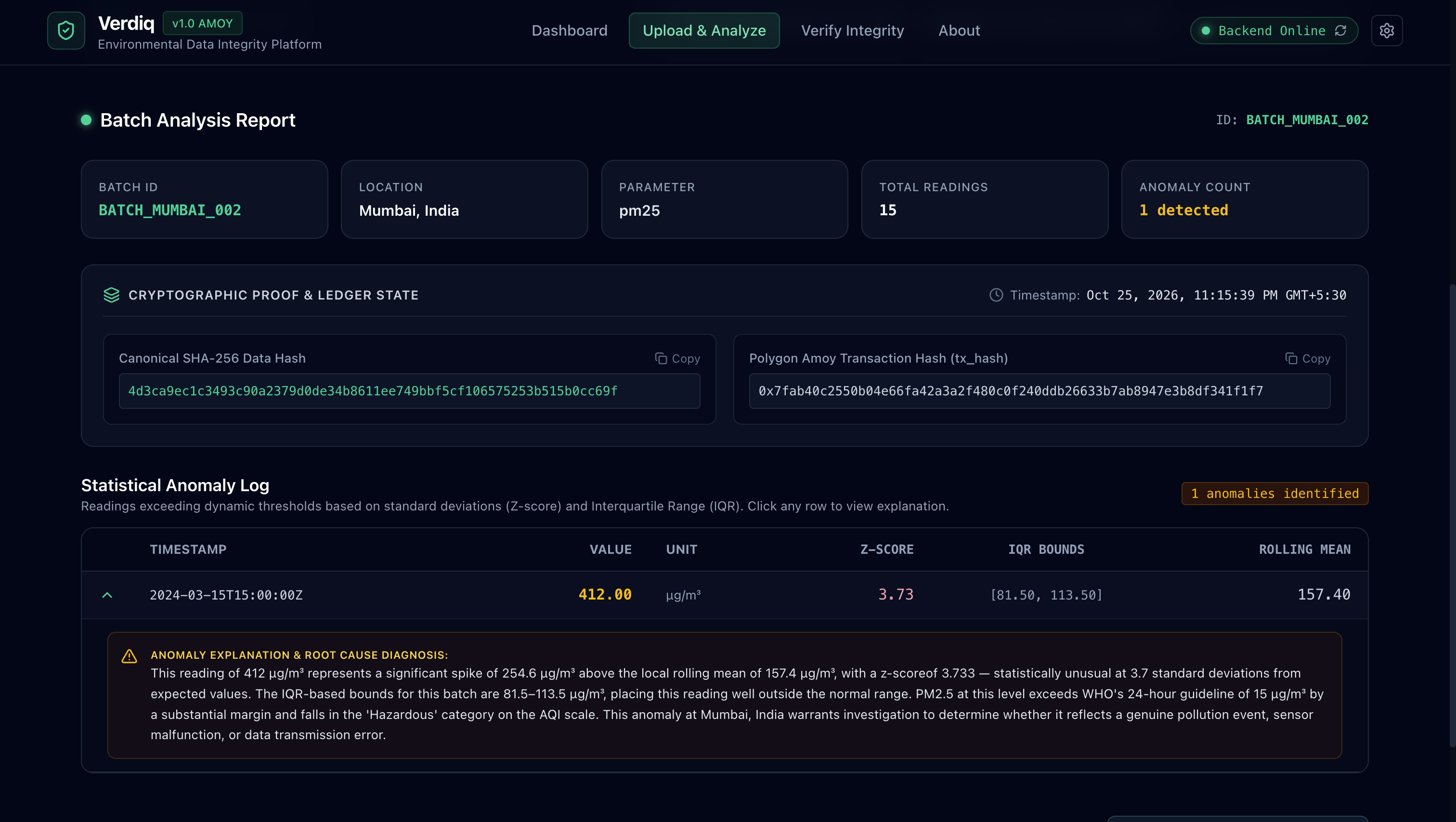
Layer 1 — AI validates plausibility Every ingested sensor batch is evaluated using z-score analysis and IQR bounds checking against a rolling statistical baseline. Anomalous readings are flagged with plain-language explanations citing the exact deviation, rolling mean, and AQI context.
Layer 2 — Blockchain ledger proves provenance
A canonical SHA-256 hash of every registered batch is committed to a
local simulation of VerdiqLedger.sol, a Solidity smart contract
engineered for the Polygon Amoy testnet. Any post-registration
alteration — even a single digit — produces a cryptographic mismatch
that Verdiq detects instantly.
The core insight is that these are different jobs. A blockchain cannot prove that a sensor measured the real world correctly. Statistical analysis cannot prove that recorded data was not altered after the fact. Verdiq does both.
How we built it
- Backend: Python + FastAPI handles batch ingestion, anomaly detection (Pandas + SciPy), SHA-256 hashing, and ledger registration. SQLite persists batch records and analysis results.
- Anomaly detection: Z-score thresholds (|z| > 2.5) and IQR 1.5× bounds checking on rolling windows. Explanations are generated deterministically from the statistical values — no black-box model.
- Ledger:
ledger.pysimulates the exact state interface ofVerdiqLedger.sol, producing transaction hashes and timestamped records consistent with an on-chain ledger architecture. - Smart contract:
VerdiqLedger.solimplementsregisterBatchandverifyBatchfunctions in Solidity, deployment-ready for Polygon Amoy testnet. - Frontend: React 19 + Tailwind CSS single-page app with four views: Dashboard, Upload & Analyze, Verify Integrity, and About.
Challenges we faced
The primary technical challenge was the Polygon Amoy testnet faucet
— all reliable faucets now require mainnet ETH or LINK balances to
prevent abuse, making live testnet deployment impractical within the
hackathon window. We resolved this by implementing a high-fidelity
local ledger simulation that reproduces the exact contract interface,
while keeping VerdiqLedger.sol deployment-ready for a live testnet.
A secondary challenge was Gemini API model deprecation mid-build. We resolved this by switching to deterministic rule-based explanations tied directly to the computed statistical values — which is actually more transparent and auditable than an LLM-generated explanation.
What we learned
Blockchain is not a data quality tool — it is a data integrity tool. The combination of statistical validation and cryptographic provenance is more defensible than either alone, and the distinction matters for real-world environmental compliance use cases.
What's next
- Live deployment on Polygon Amoy testnet with wallet-signed batch registration
- Support for additional environmental parameters (NO₂, CO, water quality indicators)
- Multi-source batch comparison to detect coordinated sensor manipulation across a monitoring network
- Integration with IoT data streams for real-time ingestion
Built With
- amoy
- api
- blockchain
- climate
- css
- environmental
- fastapi
- javascript
- monitoring
- node.js
- pandas
- polygon
- python
- react
- rest
- scipy
- sha-256
- solidity
- sqlite
- tailwind
- typescript
- uvicorn
- vite
- web3

Log in or sign up for Devpost to join the conversation.