Inspiration
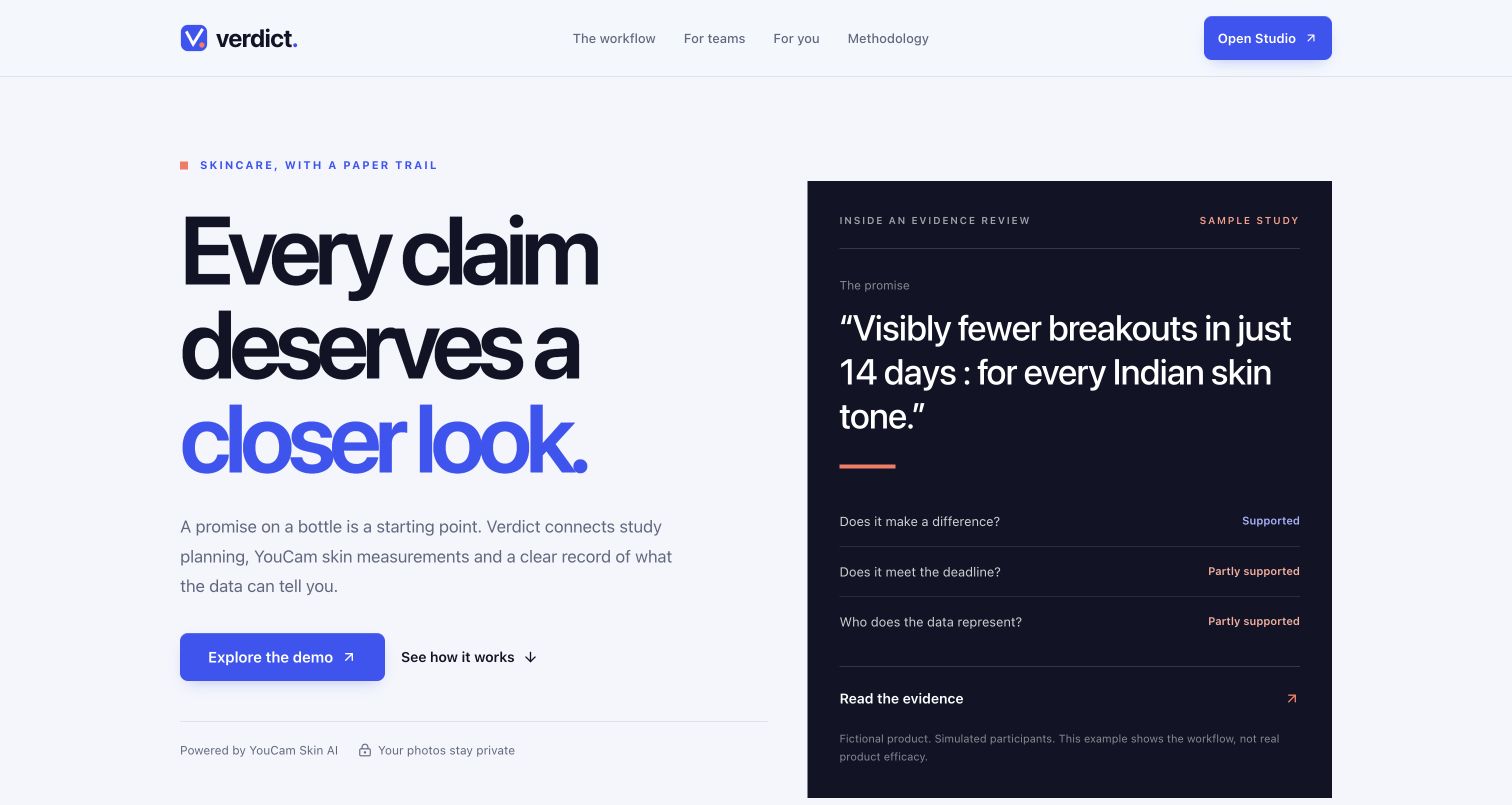
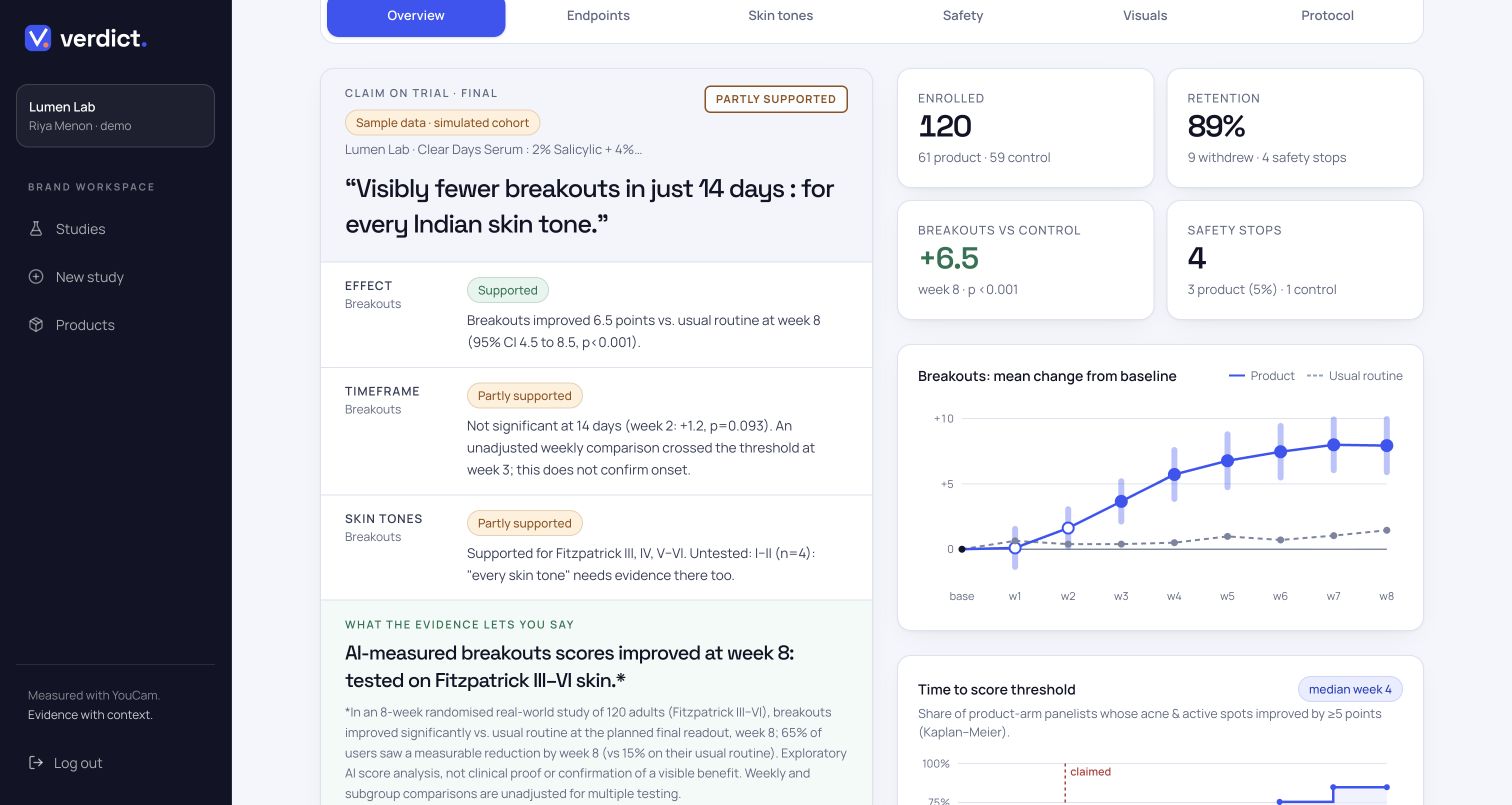
“Visibly fewer breakouts in fourteen days, for every skin tone.” It sounds like one promise. It is really several: what changed, how much, how quickly, and for whom.
That gap inspired Verdict. A shopper should be able to see what sits behind the words on a bottle. A small skincare team should be able to plan a useful study before committing to a claim. Both need more than a flattering before-and-after.
We chose to build the workflow between a skincare promise and the evidence needed to evaluate it. The starting point is simple: make the claim specific, make the process inspectable, and make uncertainty visible.
What it does
Verdict brings two connected experiences into one app.
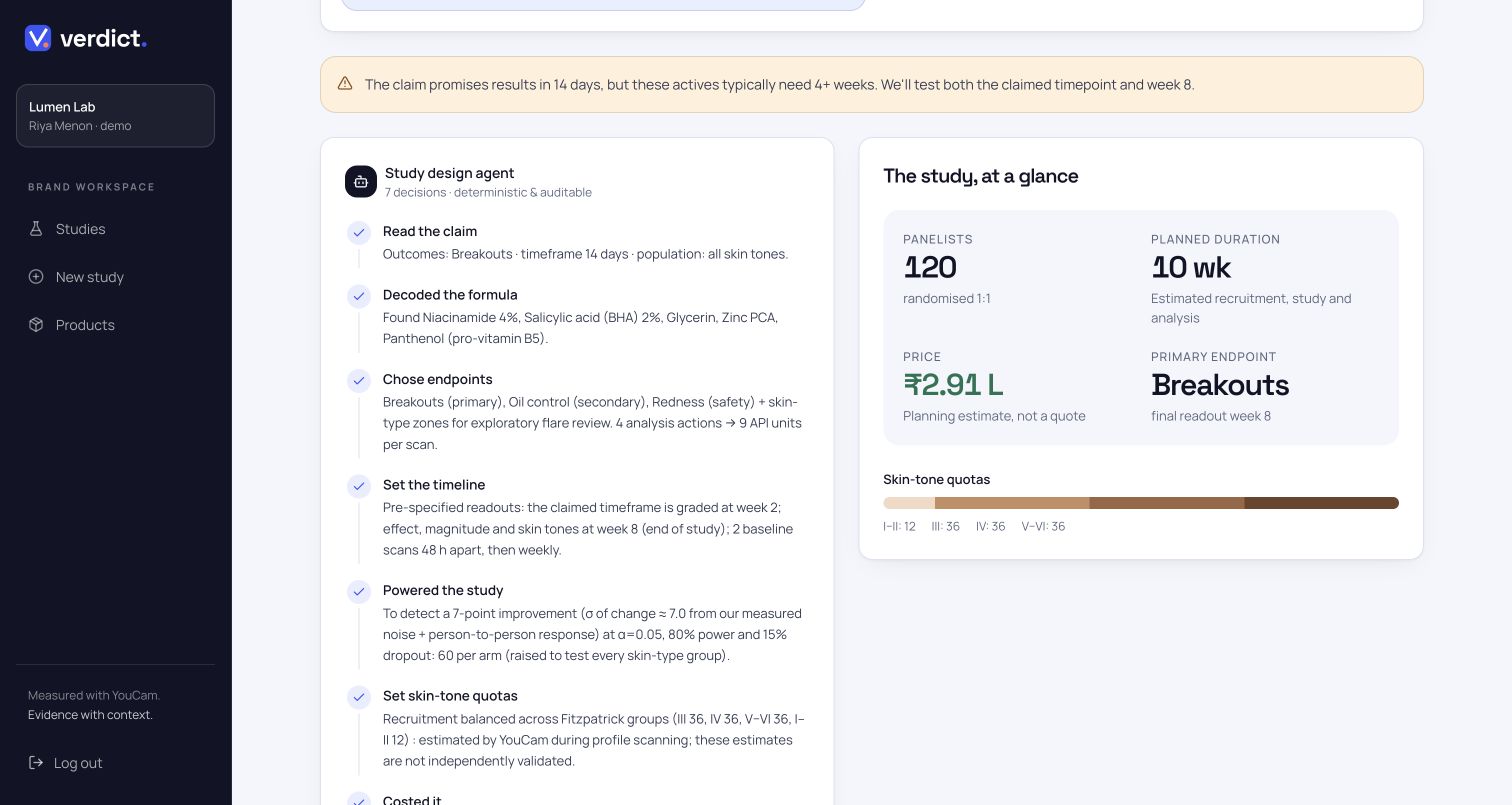
Brand Studio turns a proposed claim and ingredient list into a draft study plan. A rules-based assistant identifies endpoints, proposed timing, recruitment targets, safety checks and an estimated budget. A wording check flags phrases that deserve review. These are planning aids, not regulatory approval.
The results workspace compares changes between study arms, displays subgroup estimates, and separates a claim into effect, timeframe, magnitude and population. A positive overall result does not automatically support every word. The report, evidence page and storefront embed keep that context close to the result.
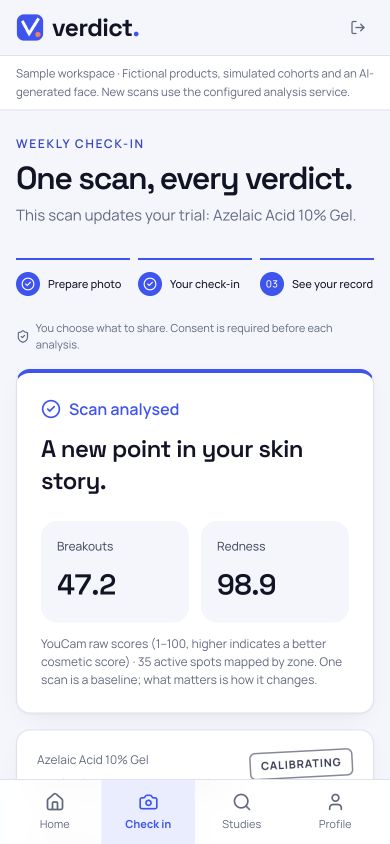
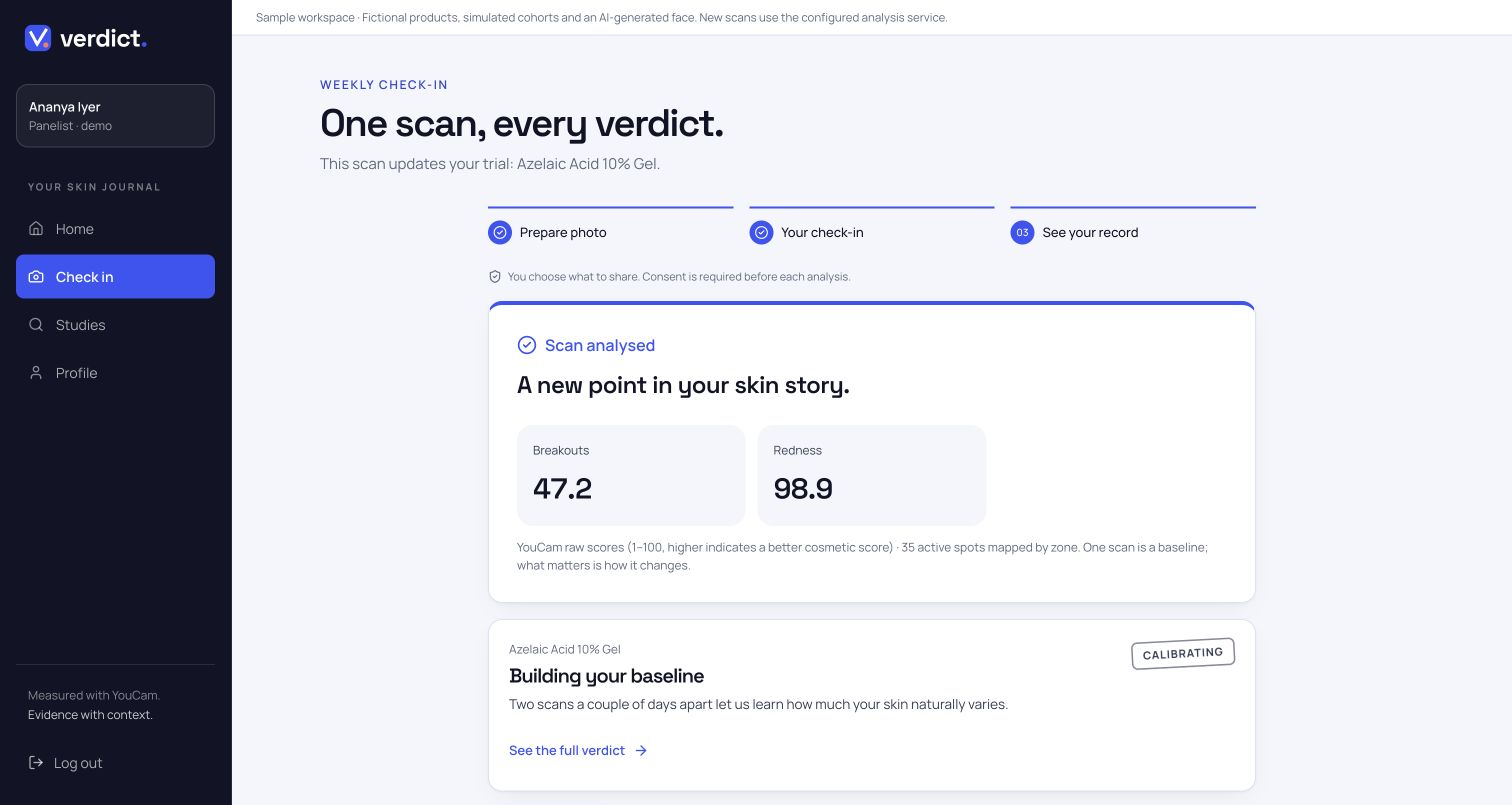
The participant app supports consent, accounts, guided capture, check-ins and personal trends. YouCam provides skin measurements; the app adds longitudinal context and flags changes for review. Image patterns cannot diagnose irritation or establish whether a product is safe to continue.
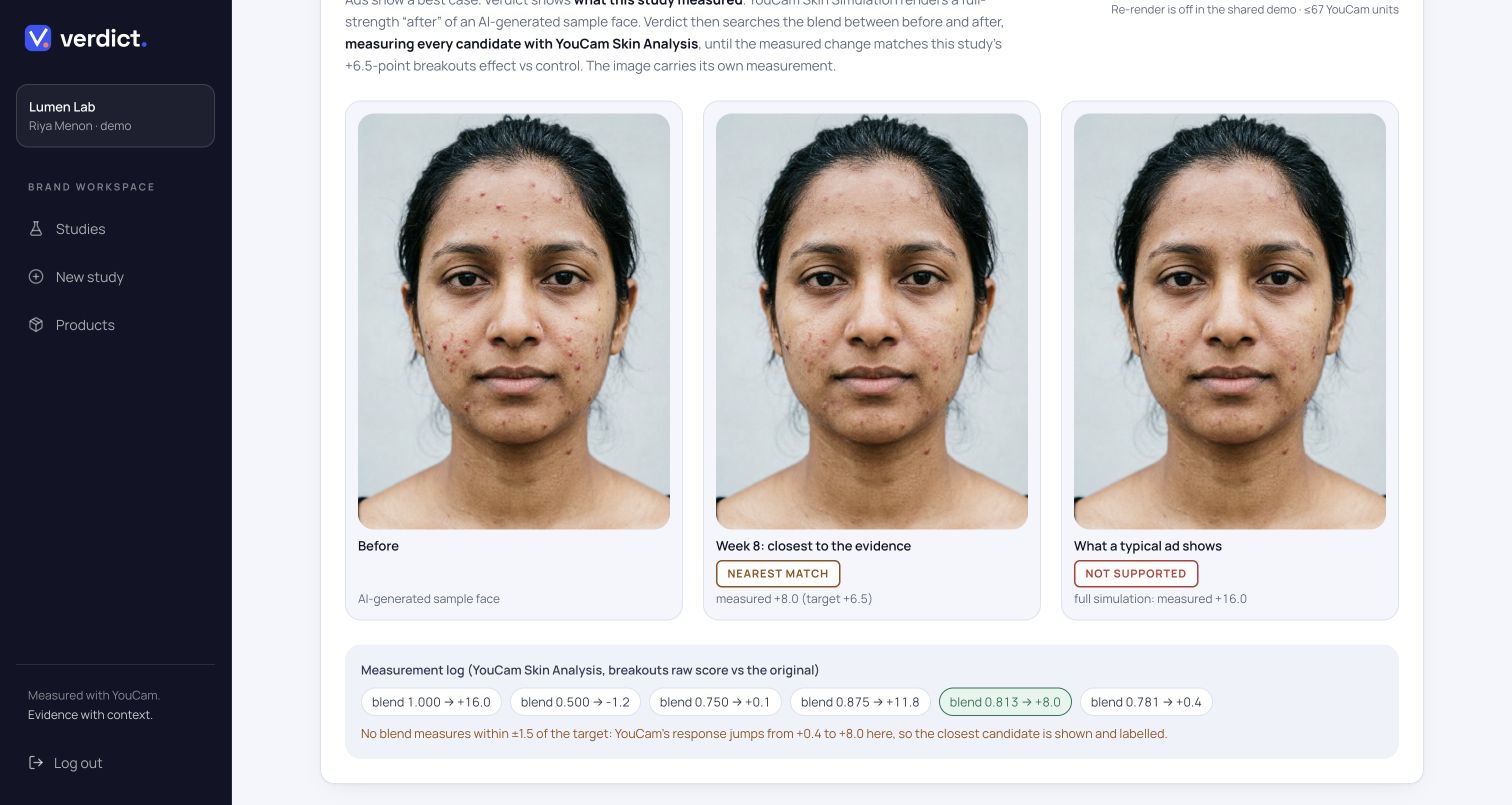
An additional visual workflow combines YouCam Skin Simulation with Skin Analysis. It measures candidate image blends and shows the measurement log. Matching an AI score is an illustration technique, not evidence that a real person will look like the generated image.
The demonstration uses fictional products, simulated cohorts and an AI-generated participant. Recorded YouCam outputs demonstrate the integration; the configured live scan path sends new images to YouCam. Sample results are not real product efficacy findings.
How we built it
Shivam Gupta built and iterated Verdict with AI development assistance. The app uses Next.js, React, TypeScript and Tailwind CSS, with Drizzle and libSQL for storage. Authentication uses password hashing, hashed session tokens and HTTP-only cookies.
The YouCam integration includes Skin Analysis v2.1, the Fitzpatrick analyzer, Skin Simulation and Camera Kit. Analysis scores and spatial masks feed the longitudinal workflow. API access stays server-side, with retries, polling, timeouts and unit budgets. A recorded-response mode allows repeatable automated tests without spending API credits.
The study planner is deterministic and inspectable. Statistical calculations and claim grading live in tested TypeScript modules, separate from the interface. A protocol fingerprint records the launch configuration. It helps detect changes, but is not independent study registration.
For the 5 October release, 56 unit tests, TypeScript and lint checks passed. All 16 browser tests also passed on the hosted app with live YouCam configured, covering account, studio, participant, privacy and responsive-layout flows. The repository includes local setup instructions and deployment configuration so the workflow can be reproduced.
Challenges we ran into
A changing image is not automatically changing skin. Early experiments on a synthetic face showed sensitivity to capture conditions. They helped expose software behavior, but cannot validate the measurement model for real people. We kept those experiments separate from claims of human efficacy.
Simulation is not a linear slider. A small change in a generation parameter did not reliably produce a proportional analysis-score change. We built a measured search over image blends and retained the candidate log, including imperfect matches.
A claim has several failure points. Supporting the overall effect is different from supporting a deadline or a statement about every skin type. We made those parts visible independently instead of hiding them inside one headline score.
A public demonstration needs privacy boundaries. Demo visitors receive isolated copies of the sample workflow. Private scans belong to their session rather than a shared public account.
Accomplishments that we're proud of
- A connected path from claim entry to study planning, participant check-in, results review and shareable evidence pages.
- Multiple YouCam capabilities used for concrete jobs, beyond a single scan-and-score screen.
- An inspectable claim breakdown that can say “not enough data.”
- A simulation measurement log that exposes the difference between an attractive image and a measured illustration.
- A repeatable demonstration that does not require a real person's photos or pretend synthetic participants are customers.
What we learned
The most useful output is often a better question. Which outcome are we measuring? At which planned time? Against what comparison? Who was actually represented?
We also learned to distinguish software correctness from scientific validity. A passing test suite does not validate a skin measurement across devices and populations. A statistically significant model output does not establish clinical benefit. A photo-based subgroup label does not prove equal performance across skin tones.
Those distinctions made the product more useful: the audit trail and its limits became part of the experience.
What's next for Verdict
The next milestone is a supervised pilot with a skincare team and qualified research partners. Before real efficacy claims, we need human test-retest validation across devices and skin tones, an independently reviewed protocol, an appropriate analysis plan, and participant safety oversight.
Commercially, the initial hypothesis is a paid study-planning and reporting workspace for small skincare teams. We will test willingness to pay and actual support costs before treating the pricing model as validated. Product shipping, payouts and partner recruitment remain operational work to establish.
The long-term opportunity is a trustworthy history of precisely defined claims and how they were evaluated. That history must be earned through real studies, rather than asserted as a data moat on day one.

Log in or sign up for Devpost to join the conversation.