-
-
Social post
-
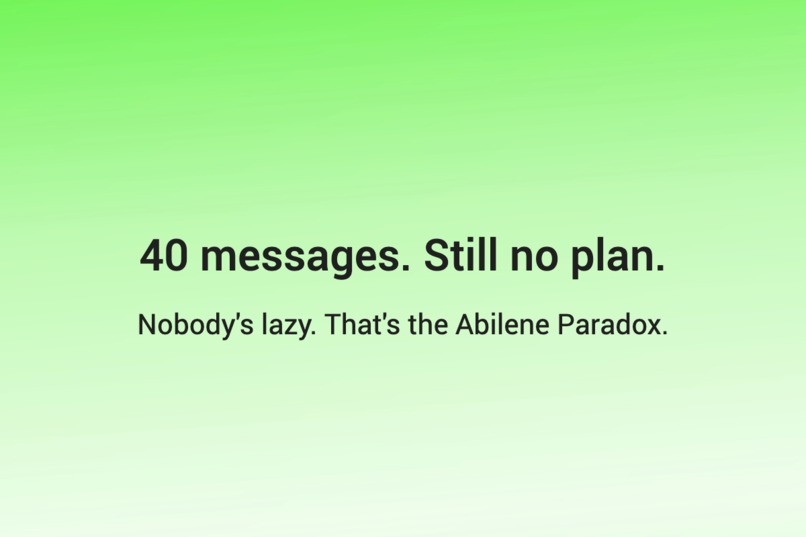
Problem poster
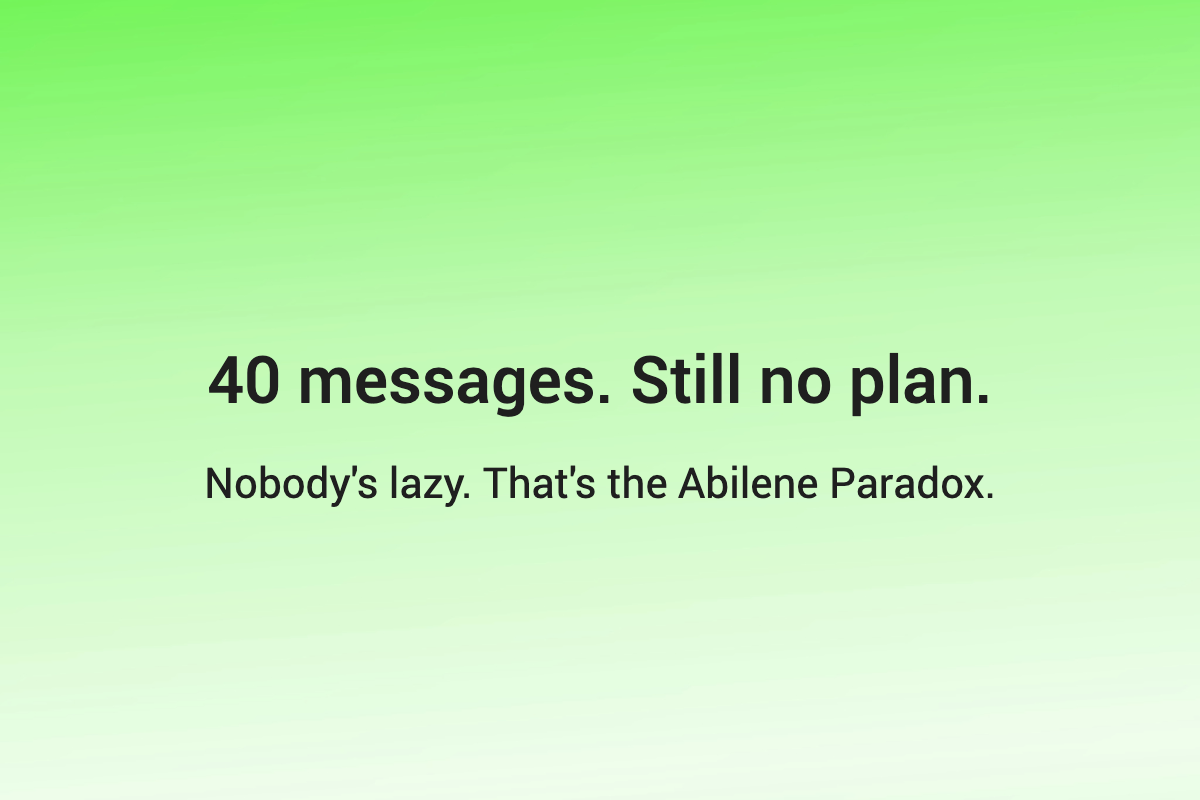
Verdict: The AI Agent for Zymix Group Chats
Inspiration
Every time we tried to plan something with friends, the group chat would spiral.
Not because nobody cared — because nobody wanted to be the one who decided.
Everyone says "I'm easy." Everyone says "you choose." But somehow, nothing happens.
We found three psychological phenomena that explain exactly why group chats get stuck:
- Decision Fatigue — everyone is too cognitively drained to evaluate options
- The Abilene Paradox — people hide what they actually want to avoid conflict
- Diffusion of Responsibility — everyone assumes someone else will sort it out
No poll, vote, or scheduling tool touches the real issue: the social pressure around deciding.
Verdict is built to turn messy group chat energy into one clear decision that feels fast, fair, and low-pressure.
Zymix is not just where close friends coordinate. It is where groups are still forming, which makes low-pressure decision-making especially important.
What It Does
Verdict is an AI agent native to Zymix group chats.
- A user selects a stalled message in the conversation and taps the ✦ @Verdict chip
- Verdict reads the conversation from that point forward, inferring explicit preferences, implicit signals, and hard constraints from each person's chat behavior and Profile
- The triggering user can add optional per-event preferences in a private sheet — for example vibe, budget under £20, location, or time (leave any field blank for no strong preference)
- After reading the thread, Verdict moves through a short reading phase, then opens the optional preference sheet if needed
- Verdict returns the final Decision Card: venue, vibe, time, key constraints, a one-line rationale, and hard limits respected
- The user taps Confirm to lock the plan, then optionally taps Share Location to close the loop into native location sharing
- To split the cost, a user types
@Verdict split billin the message box, opens the split sheet, and Verdict returns a mocked group collection breakdown
Each user has an optional personal Profile for stable preferences such as punctuality habit, dietary requirements, alcohol preference, and home area. This is accessible through the Verdict agent entry in Zymix's native + menu — as a lightweight profile with personal habits, hard limits, and an optional real-time chat reading toggle.
The AI brings this context in silently, so users do not have to fill out a new form every time they make a plan.
How We Built It
We anchored every decision to the real Zymix interface: the + attachment menu, message selection, Location sharing, and Split Bill.
Verdict had to feel native, not bolted on.
Architecture:
- Seeded group chat dataset modelling a real London university friend group
- Fixed activity dataset with student-friendly London venues, tagged by vibe, dietary fit, capacity, budget, and latecomer-friendliness
- Deterministic scenario state engine:
initial→reading→optional preference collection→final card→confirmed - AI reasoning layer using Z.AI's GLM API for unstructured chat → structured JSON verdict generation
- Fallback handling for demo stability
- Single-screen Zymix-skin UI rendering the Decision Card back into the chat
The deterministic layer keeps the demo stable. The AI layer handles preference inference, constraint reasoning, and verdict generation.
Challenges We Ran Into
- Keeping it simple. Every edge case tempted us to add another input, another screen, another option. We kept cutting back to the single killer journey:
select message→@Verdict→optional preferences→final card→confirm→location / split bill. One path. No dead ends. - Knowing what not to ask. The product only works if triggering it feels like less effort than continuing the spiral. That constraint ruled out onboarding-heavy flows, repeated preference surveys, and anything that front-loads friction before the AI has demonstrated its value.
- AI output reliability. We used the GLM API to turn messy, informal group chat into structured verdict data. To make that reliable, we used careful prompt design, strict JSON output requirements, and fallback handling.
Accomplishments That We're Proud Of
- The message-anchor trigger: zero new gestures, living entirely inside existing Zymix behavior
- The Profile architecture: a lightweight profile with personal habits, hard limits, and optional real-time chat reading — letting the AI make better decisions without asking again every time
- The psychological framing: grounding the product in Decision Fatigue, the Abilene Paradox, and Diffusion of Responsibility gave us a clear answer to every "why not just use a poll?" question
- Closing the loop natively into Location and Split Bill, turning social coordination into real-world action
What We Learned
The hardest design decision was the framing, not the feature.
"AI picks a restaurant" is forgettable. "AI turns messy group preferences into one decision that feels fair" is the actual value proposition.
We also learned that the most important UX question is not what should we show, but what should we never ask.
Every removed prompt is a removed barrier.
What's Next for Verdict
- Group habit layer: after several events, Verdict starts inferring group-level patterns, such as always going east or always starting late, without explicit input
- Feedback re-roll: if the group pushes back on the verdict, the AI produces a revised card and explains what changed
- Real Split Bill integration: connect to Zymix's native payment layer once the wallet supports it
- Expanding to other coordination jobs: not just where to go tonight, but holiday planning, group gift decisions, and flat scheduling
Built With
- claude
- claude-api-(anthropic)
- fotor-(marketing-assets)
- html/css
- javascript
- manus-(research-workflow)
- orbit
- react
- typescript
- vercel-(deployment)
- z.ai-/-glm-api

