-
-
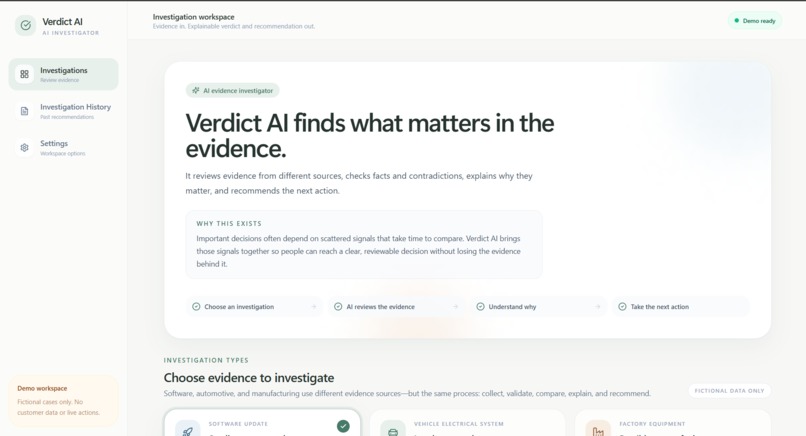
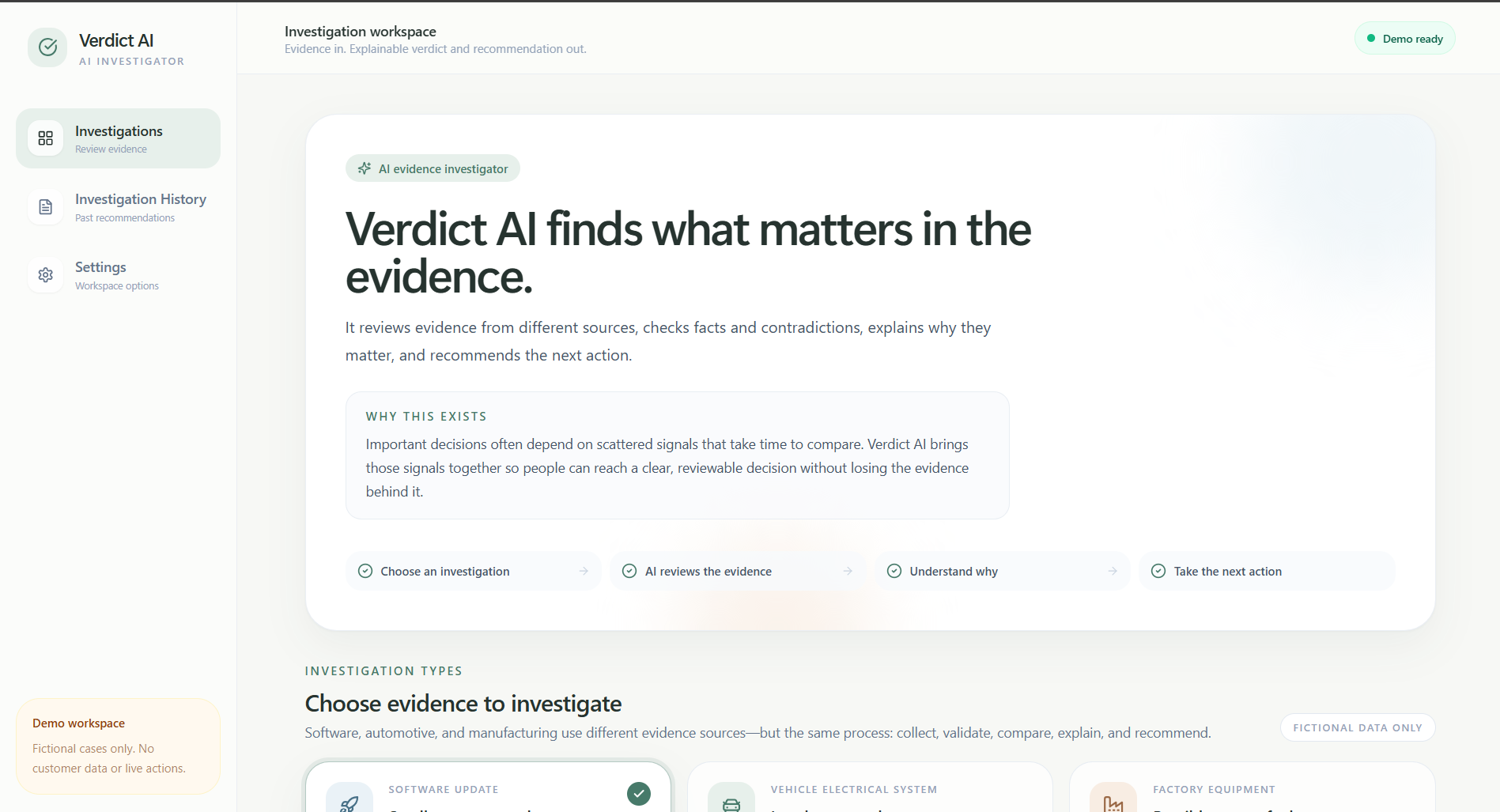
Homepage - Evidence-Based Decision Support
-
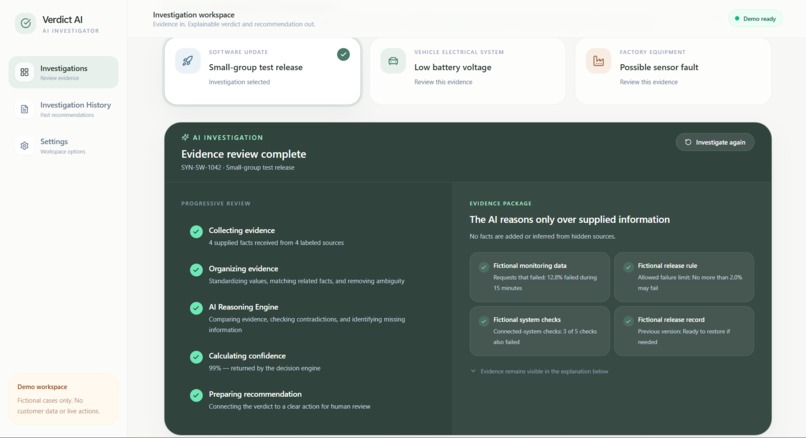
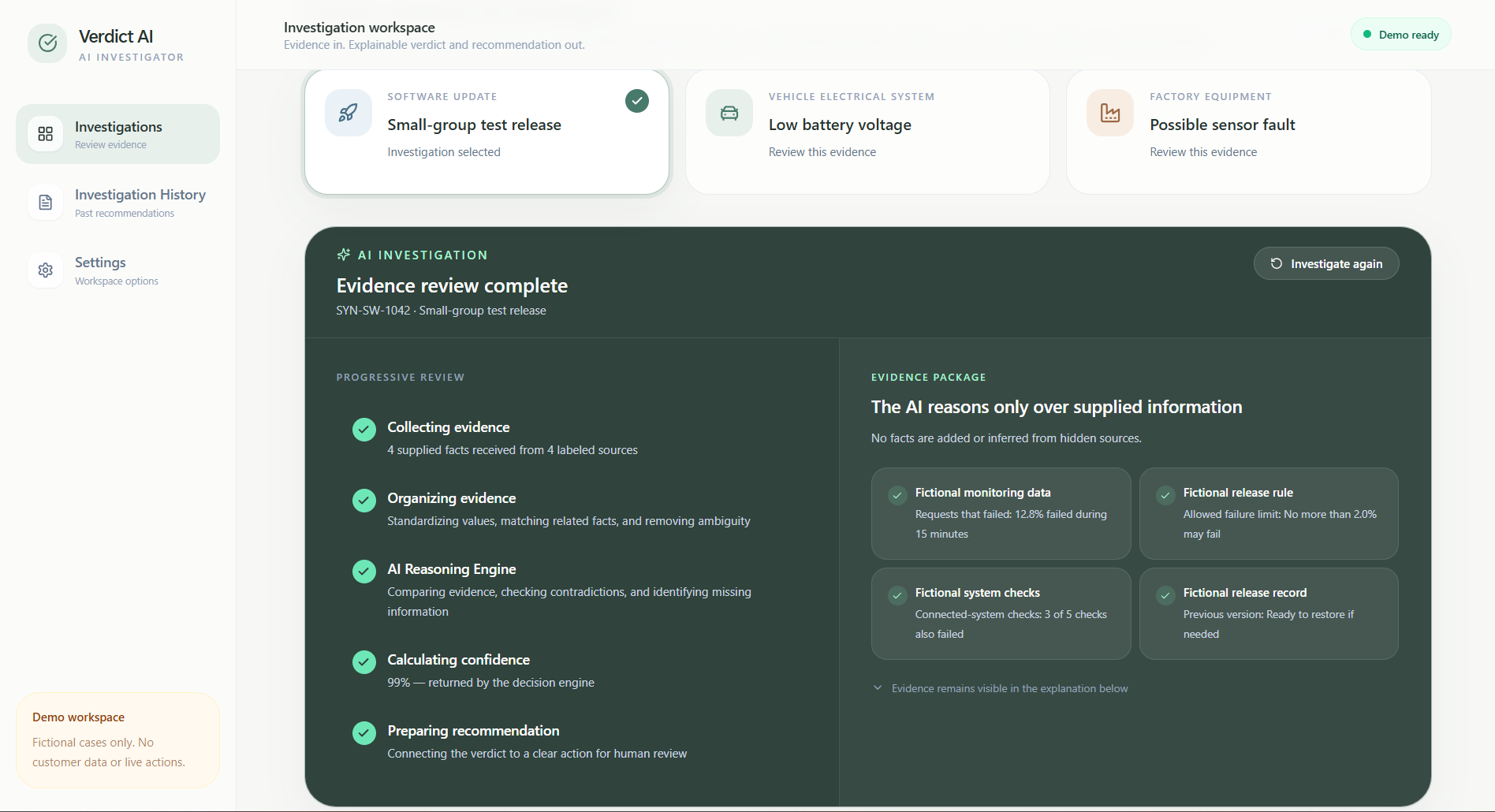
AI Investigation Pipeline
-
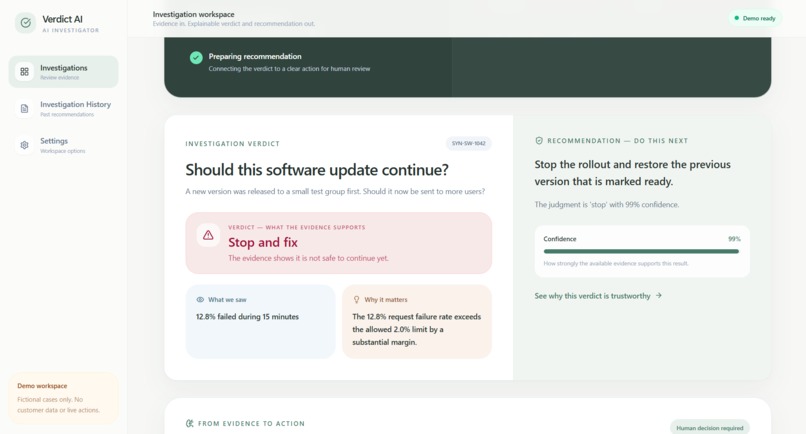
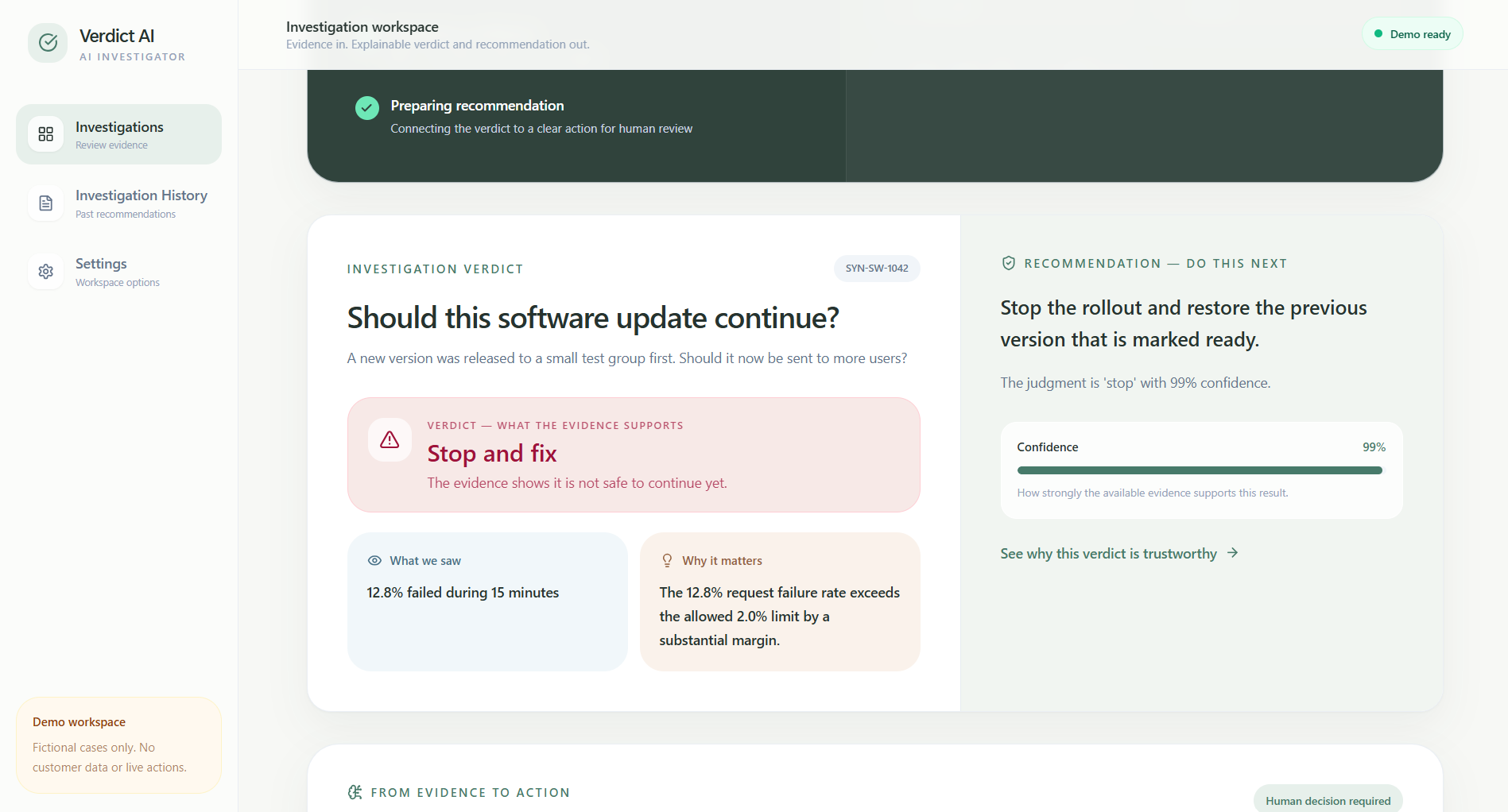
Explainable Verdict & Recommendation
-
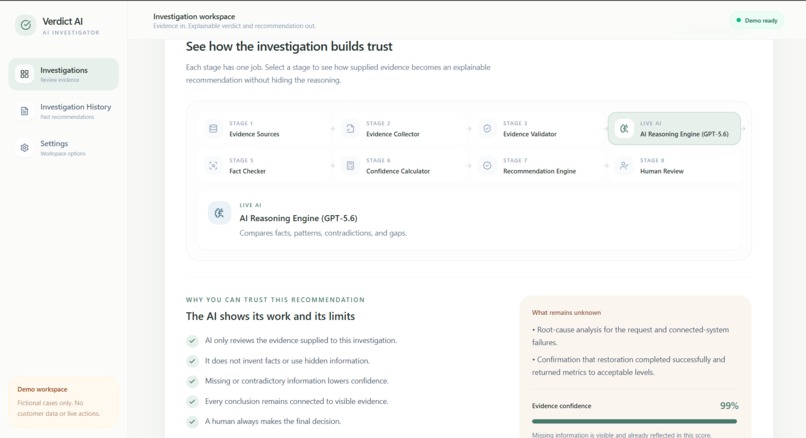
How Verdict AI Builds Trust
-
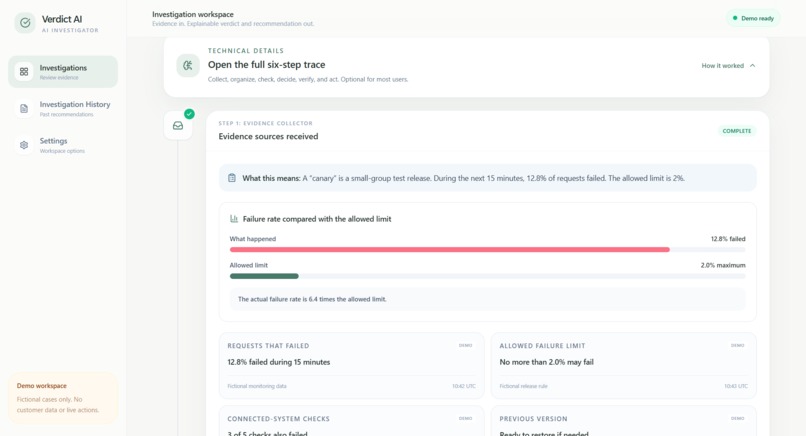
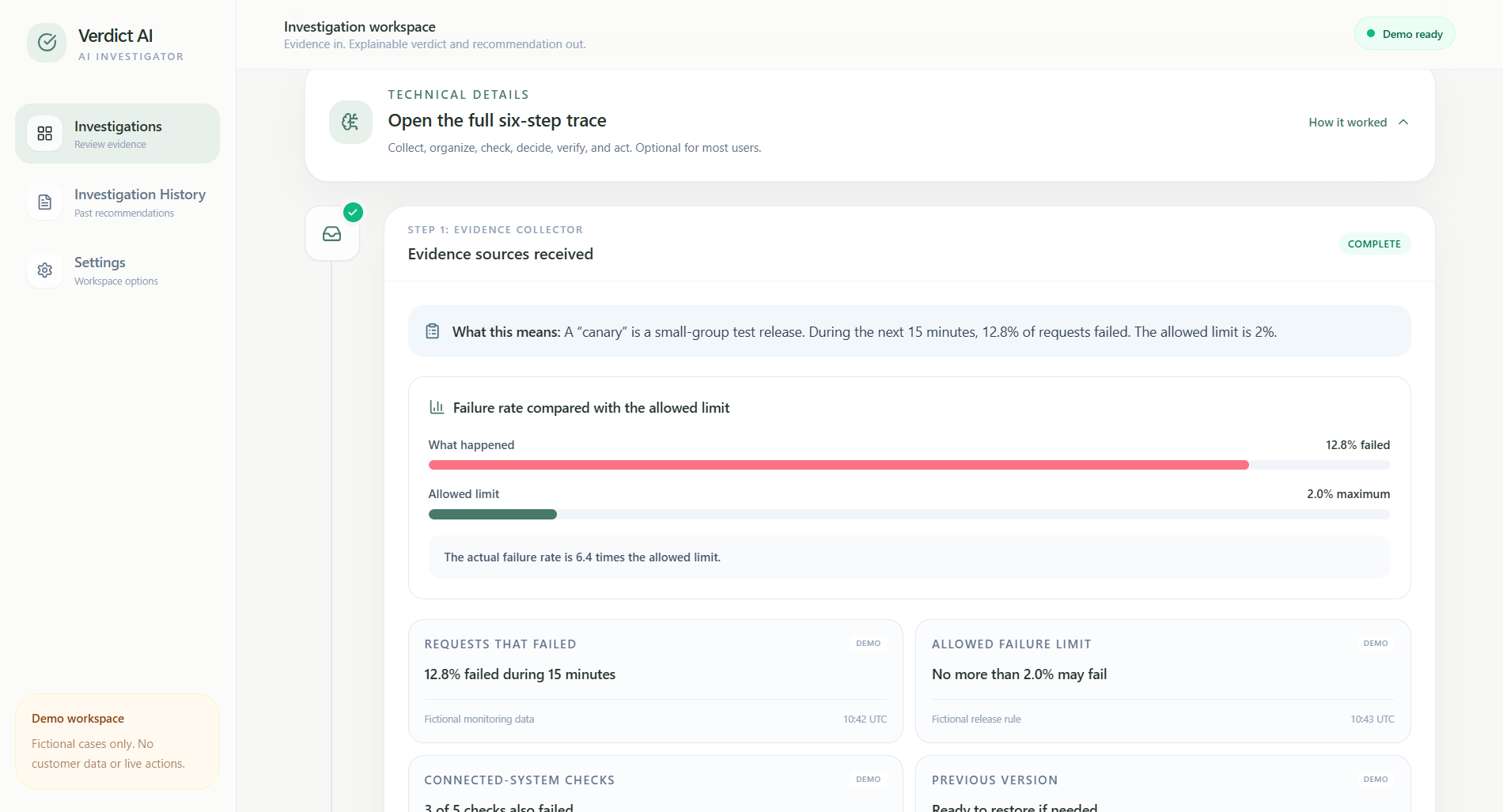
Evidence Trace & Technical Details
Inspiration
As AI systems become more capable, I believe they'll play a much larger role in helping people make important decisions. Whether it's software deployments, connected vehicles, manufacturing, healthcare, or finance, the amount of data available is growing much faster than a person can manually analyze.
That led me to a simple question:
How can AI help people make better decisions without becoming a black box?
Verdict AI was built to explore that future. Instead of replacing human judgment, it reviews structured evidence, explains its reasoning, highlights uncertainty, and recommends the next best action while keeping a human in control of the final decision.
What it does
Verdict AI is an explainable AI decision support system.
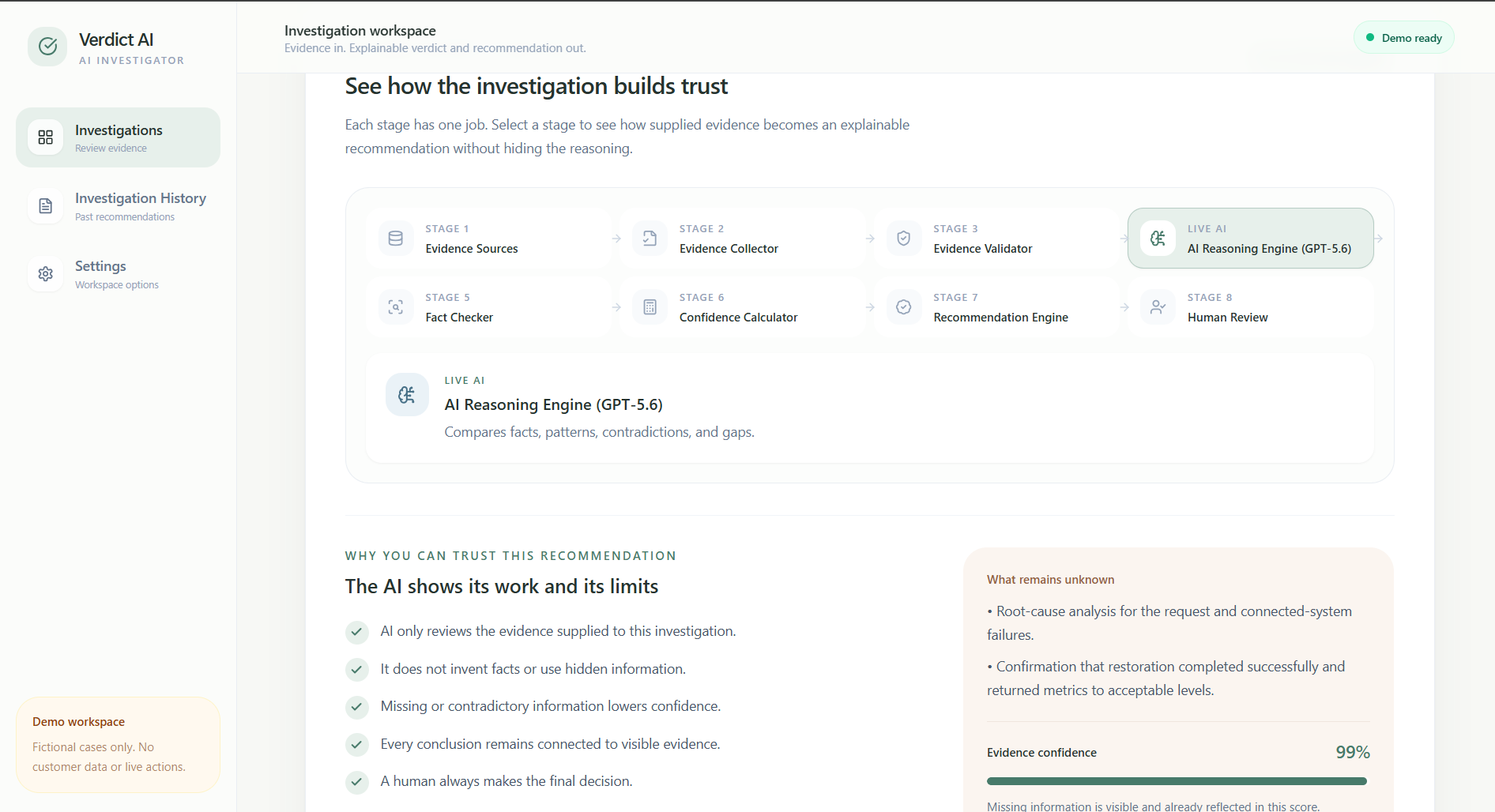
It collects evidence from multiple sources, validates it, sends structured information to GPT-5.6 for reasoning, calculates confidence, and returns a transparent recommendation together with its assumptions and missing evidence.
The same reasoning pipeline can be applied across multiple domains. The current demonstration includes:
- Software deployment investigations
- Connected vehicle investigations
- Manufacturing anomaly investigations
The goal is not anomaly detection itself, but transparent AI-assisted decision making.
How we built it
Verdict-AI consists of a React + TypeScript frontend and a FastAPI backend connected through the OpenAI Responses API.
The backend normalizes evidence, performs deterministic validation, invokes GPT-5.6 to generate structured reasoning, validates the response, calculates confidence, and produces recommendations. If AI is unavailable, the system automatically falls back to a deterministic decision engine to ensure reliability.
Codex played a significant role throughout development by helping accelerate implementation, debugging, refactoring, documentation, and repository organization.
Challenges we ran into
The biggest challenge wasn't implementing GPT-5.6, it was turning an idea into a product.
I didn't want to build another AI demo that simply generated answers. I wanted Verdict AI to feel like a real decision-support system with a clear user experience, explainable reasoning, confidence scoring, and human oversight.
Finding the right balance between automation and transparency took the most iteration. I wanted every recommendation to remain connected to the evidence that produced it, allowing users to understand not only the conclusion, but also its assumptions, uncertainty, and limitations.
Accomplishments that we're proud of
I'm proud that Verdict AI demonstrates a complete end-to-end workflow rather than just an AI prompt.
The project combines a production-style frontend, a FastAPI backend, GPT-5.6 reasoning through the OpenAI Responses API, deterministic fallback behavior, explainable recommendations, confidence scoring, and a polished user experience into a single application.
Most importantly, it reinforces the idea that AI should help people make better decisions, not replace them.
What we learned
Building Verdict-AI reinforced that the most valuable AI products aren't necessarily those that automate everything.
People are more likely to trust AI when it explains its reasoning, communicates uncertainty, and keeps humans involved in important decisions.
I also gained a much deeper understanding of designing AI systems that combine deterministic software engineering with large language models in a reliable and transparent way
What's next for Verdict AI
Verdict AI is currently a proof of concept, but I see it evolving into a production-ready decision support platform.
The next step is to pilot this approach within real enterprise workflows, where AI can assist teams in reviewing evidence, explaining its reasoning, and recommending the next best action while keeping humans responsible for the final decision.
I also want to expand the platform beyond the current software, automotive, and manufacturing scenarios by integrating live data sources, richer evidence pipelines, role-based collaboration, audit trails, and feedback loops that continuously improve recommendations over time.
Ultimately, my goal is to build AI systems that people can trust, not because they always have the right answer, but because they clearly explain how they reached it and make it easy for humans to make informed decisions.

Log in or sign up for Devpost to join the conversation.