-
-
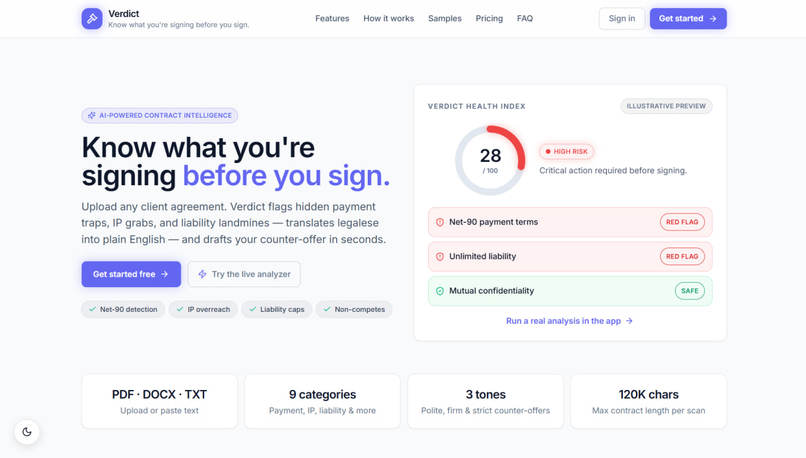
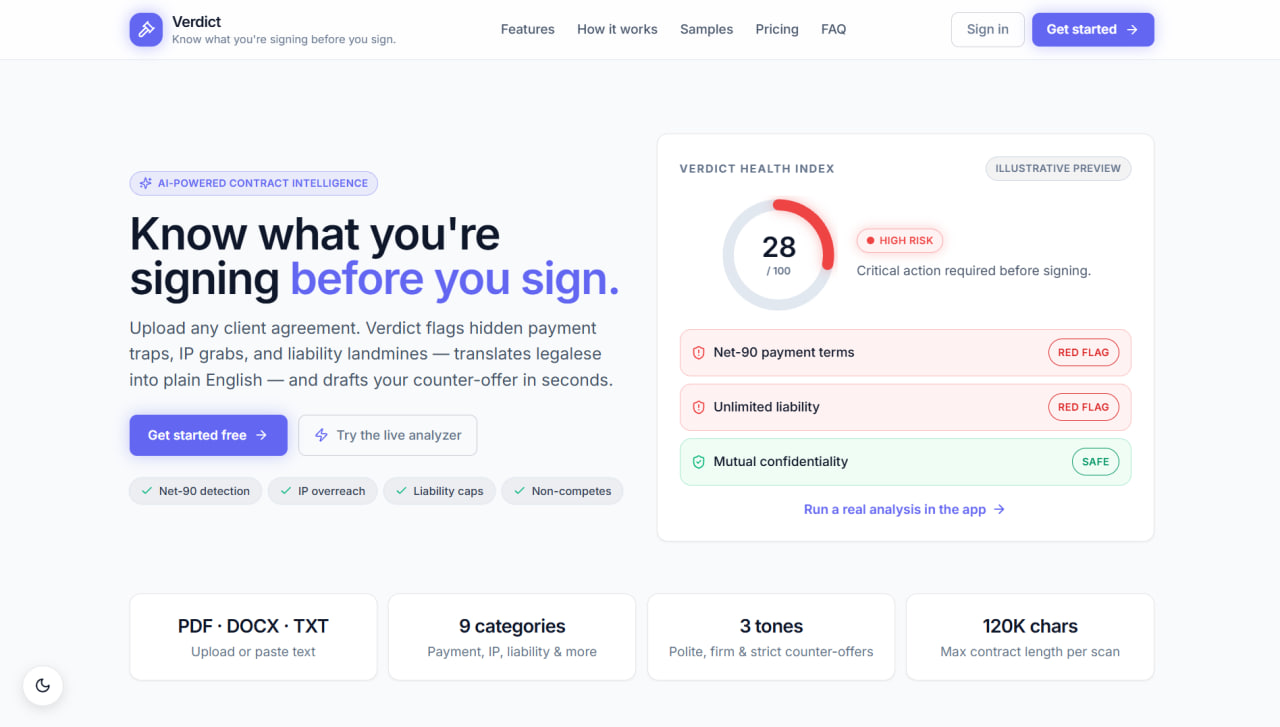
landing page hero
-
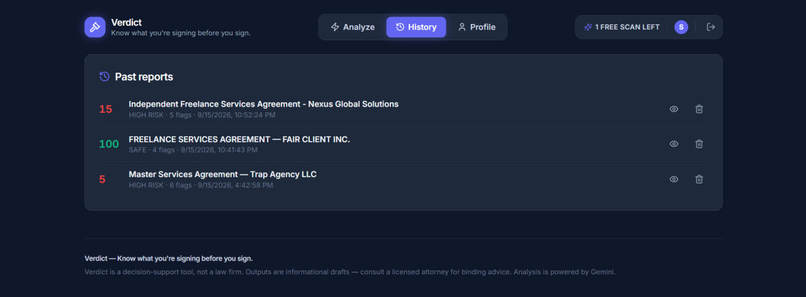
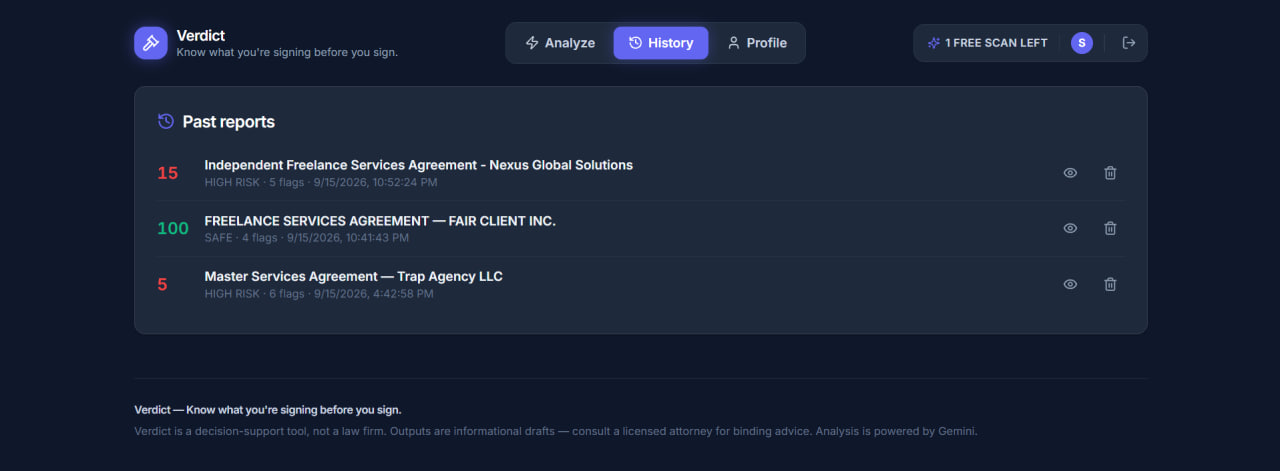
history
-
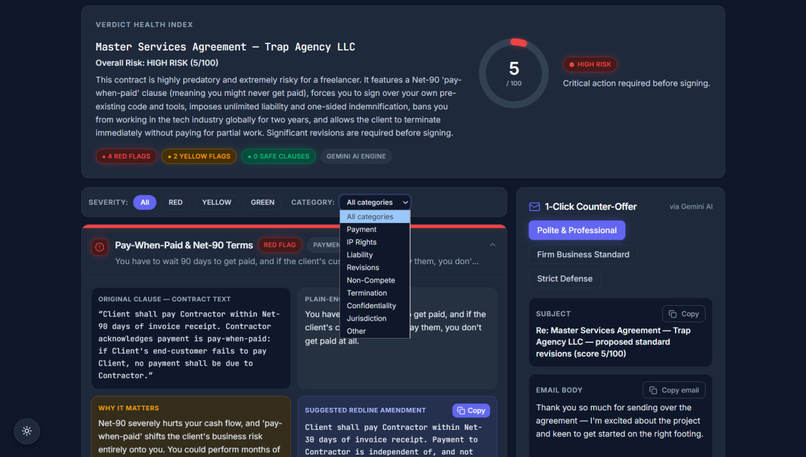
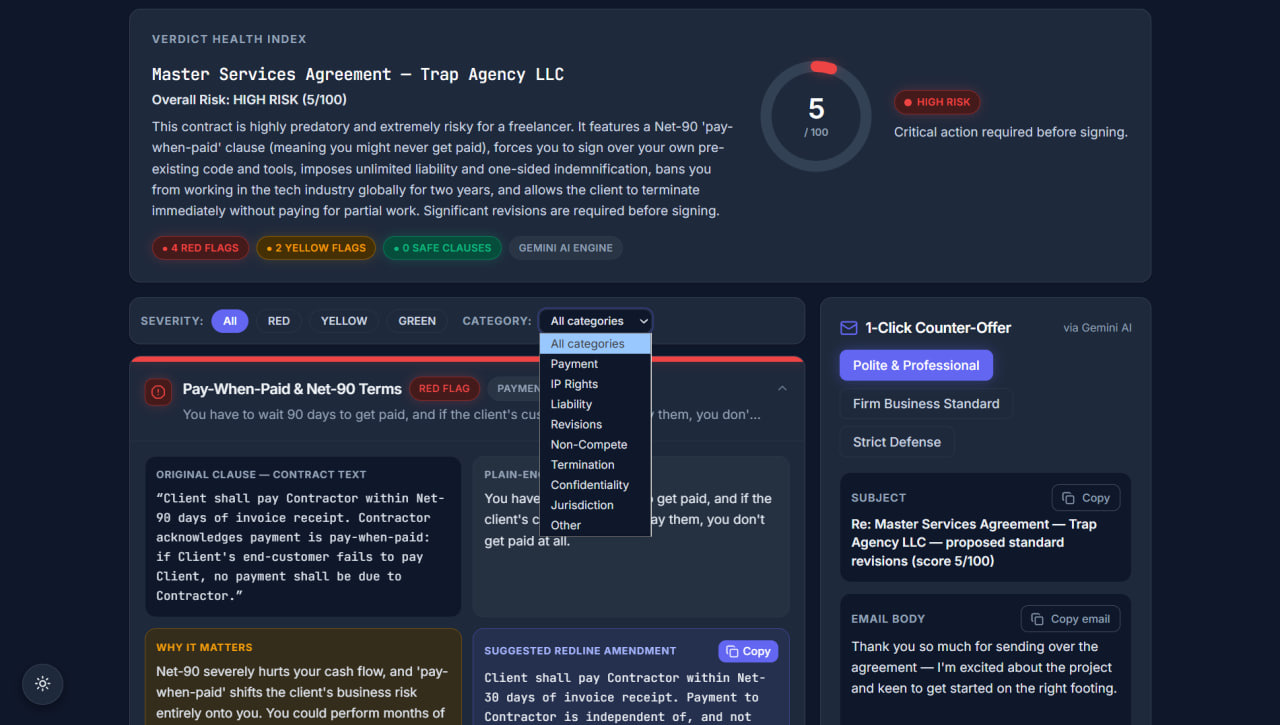
scorecard - Verdict Health Index
-
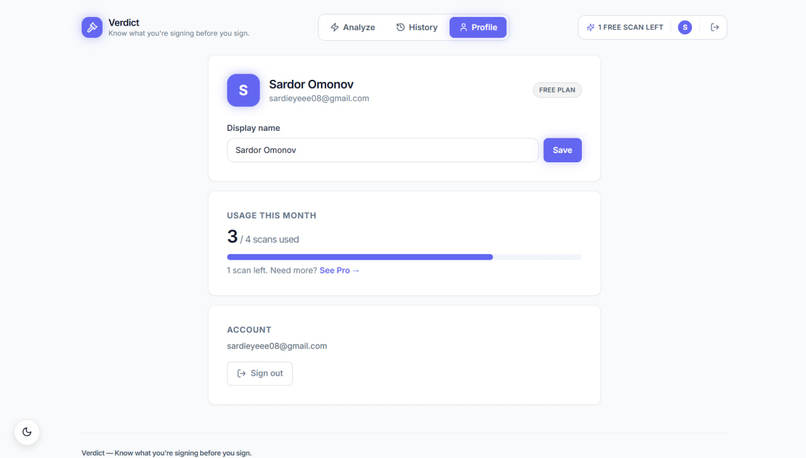
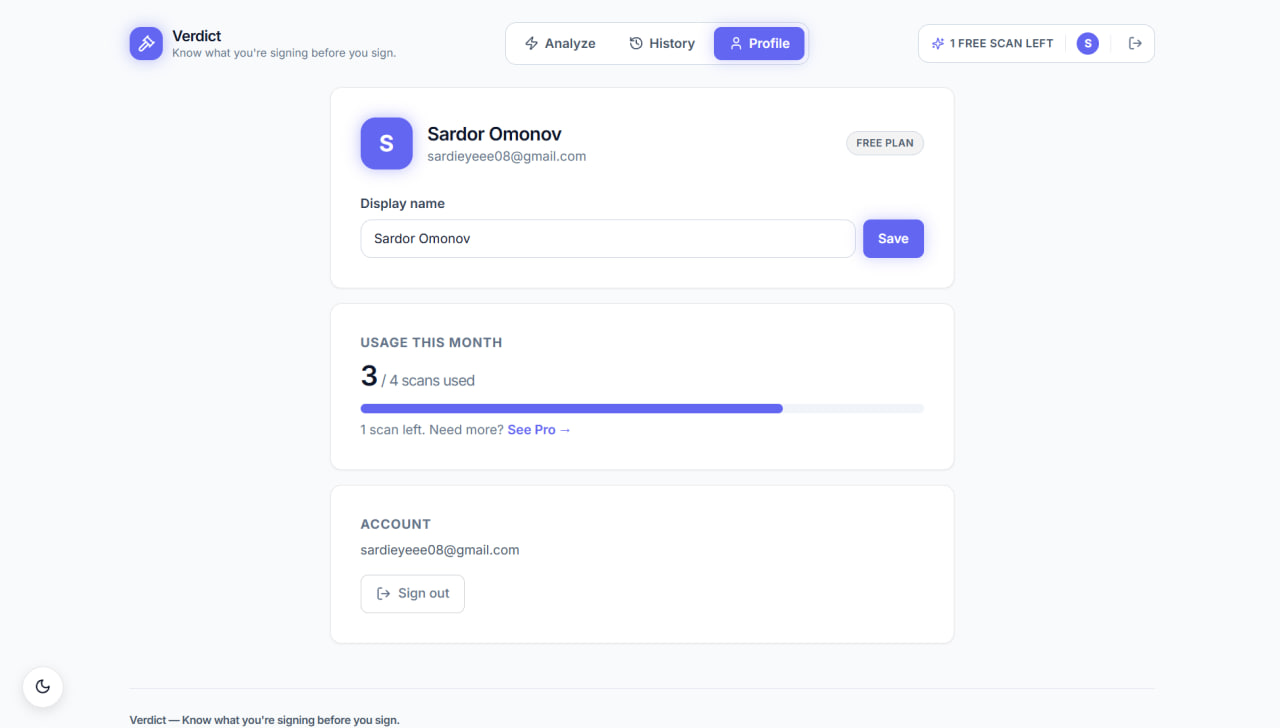
profile
Inspiration
As a beginner in freelancing, I haven't personally been burned by a bad contract yet, but I’ve seen countless freelancer friends and online communities fall into legal traps buried in fine print—from endless unpaid revisions to extreme payment delays. The legal information asymmetry between independent workers and corporate legal teams is a huge problem. I built Verdict to level the playing field, ensuring freelancers know exactly what they’re signing before they sign, and helping them protect their hard-earned income.
What it does
Verdict provides an instant, plain-English contract analysis that flags hidden risks before you sign. Users can upload or paste contracts (PDF, DOCX, TXT) and receive:
- Verdict Health Index: An overall safety score (0–100) paired with a high-contrast Red, Amber, and Green risk scorecard.
- Side-by-Side Translator: Breaks down complex legal jargon into straightforward human language, explaining why a specific clause matters and suggesting better terms.
- 1-Click Counter-Offer Generator: Automatically drafts a professional, copy-paste-ready email (with customizable negotiation tones like polite, firm, or strict) requesting changes or declining unfair clauses.
How we built it
Verdict was developed using Antigravity IDE with OpenCode CLI. The core stack includes:
- Frontend & Framework: Next.js 14 App Router, TypeScript, React, and Tailwind CSS.
- AI Engine: Integrated Gemini 3.5 Flash via
@google/generative-aifor high-speed, structured legal text analysis and response generation. - Backend & Security: Firebase Auth (Email/Password & Google) and Firestore for persistent scan history, secured with client/server-side App Check enforcement and Firestore security rules.
- Agentic Development: Connected a Firebase Model Context Protocol (MCP) server so the AI agent handled both frontend and backend integration seamlessly, guided by structured
AGENT.mdandPROJECT_CONTEXT.mdcontext files to save time and API credits.
Challenges we ran into
Connecting the Firebase MCP server wasn't smooth out of the box—I encountered persistent connection timeouts and -32000 closed-connection errors during setup. I overcame this by troubleshooting the MCP configuration and properly bridging it with the Gemini setup, enabling full backend manipulation directly through the CLI. Also, there were a lot of troubles with Gemini API - many models I tried were either under heavy usage or unavailable to me. Eventually, I sticked to lite models as they are fast and provide biggest context.
Accomplishments that we're proud of
I’m proud of building a fully functional, production-ready full-stack application end-to-end in less than 24 hours. Verdict features real user authentication, a persistent scan history dashboard, responsive dual-theme support (light/dark mode), and a complete risk-audit pipeline.
What we learned
I gained hands-on experience setting up Firebase Authentication (Google OAuth and Email/Password) and enforcing API security limits using Firebase App Check. I also learned how to leverage context files (PROJECT_CONTEXT.md) and MCP tools effectively to accelerate multi-tier full-stack development.
What's next for Verdict
- Branding & UX Polish: Developing a distinct visual mascot, adding micro-animations, and converting the Next.js app into a Progressive Web App (PWA).
- Automated Email Integration: Adding native Gmail API integration to send structured counter-offer letters directly from the dashboard.
- Model Upgrades & Outreach: Upgrading to advanced next-gen LLM engines for higher legal accuracy and launching free trial campaigns on X (Twitter) and LinkedIn to onboard independent workers.
Built With
- antigravity-ide
- app-check
- firebase
- firebase-auth
- firestore
- gemini-api
- javascript
- mcp
- next-js
- node.js
- pdf.js
- react
- tailwind-css
- typescript
- vercel
- zod


Log in or sign up for Devpost to join the conversation.