Inspiration
I was going through the starter sheets from Regeneron and found a paper that caught my attention - structural reasoning AI for trial prediction. What pulled me in is that two of the main problems the industry faces are exactly the problems I've lived before. I trained a small LLM on Mongolian, an underrepresented language, so I know how hard it is to find data to train on and make something useful out of very little.
The video demo has its own story. I made it with HyperFrames, a programmable code-based video generator. It lacks spatial understanding, which is literally what I've been trying to teach LLMs. If you watch closely, there are small abnormalities in the video. That's not a rendering bug but lack of spatial understanding of llm
What Verdia does
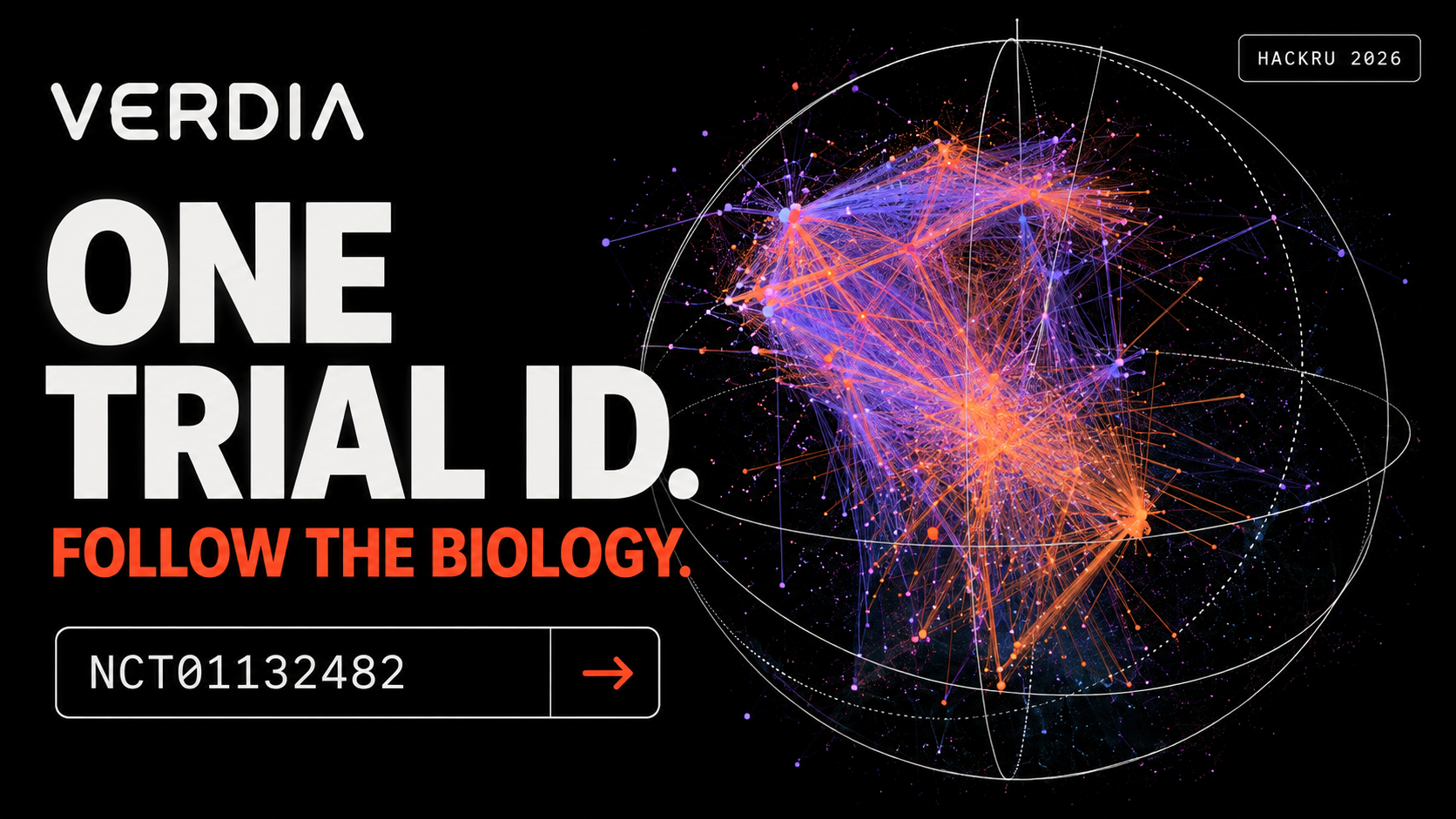
You give it an NCT number from ClinicalTrials.gov. It pulls the trial's intervention and disease, maps them into PrimeKG, and lights up the connections in a 3D graph(live). For supported Phase II trials it also runs my fine-tuned HINT model next to the original as a matched control - both scores, and the exact inputs behind them, are shown and downloadable. (1/2)
How I built it
Honestly the timeline was too short to build anything valuable the careful way. After playing with a lot of models and 300 million wasted tokens, I finally got the gist of it. The project on GitHub came together in the last 10 hours - most of the time went into finding the right project to build.
I used Paperclip as a harness and worked across models in a cmux window - GPT-6 Astra, Opus 5.5, GLM 5.3 (I used a lot of models, they don't really matter). The hard part was never the models. It was keeping the agents from stepping on each other, tracking their changes, and checking what they actually produced. The HINT replication and benchmarks ran through the Colab CLI.
Challenges
Learning the research while building under a hard deadline. Crashed runs, overlapping training jobs, evaluation details that forced me to stop and ask what I was even measuring.
And the honest one - my modification didn't beat the control. 0.6323 ROC-AUC vs 0.6320. Having a reasonable idea and proving it works are two different things.
Even the video took several attempts, and the abnormalities are still in there.
What I learned
How HINT works, how to run a fair comparison, why reproducibility matters. And that AI agents don't remove the need to understand your own project - 300 million tokens of agents still can't tell you what you measured. Only you can.
Built With
- azure
- biobert
- caddy
- clinicaltrials.gov-api
- colab
- css
- express.js
- github
- google-colab
- harness
- hint
- html
- hugging-face-transformers
- javascript
- node.js
- numpy
- primekg
- pubchem-api
- python
- pytorch
- rdkit
- scikit-learn
- three.js
- ubuntu
- vite

Log in or sign up for Devpost to join the conversation.