-
-
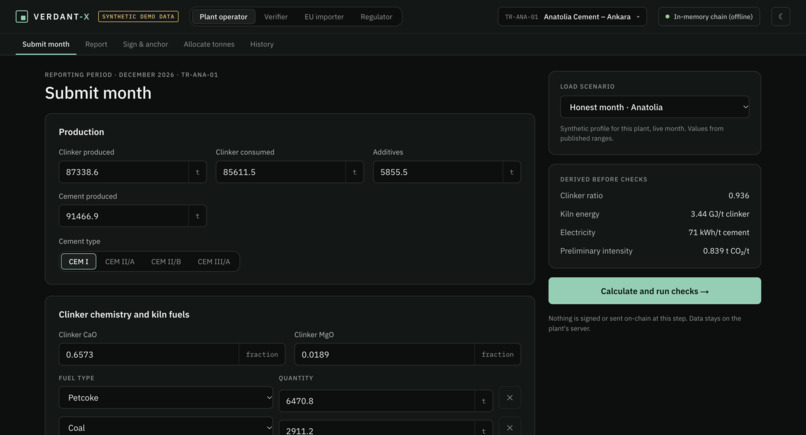
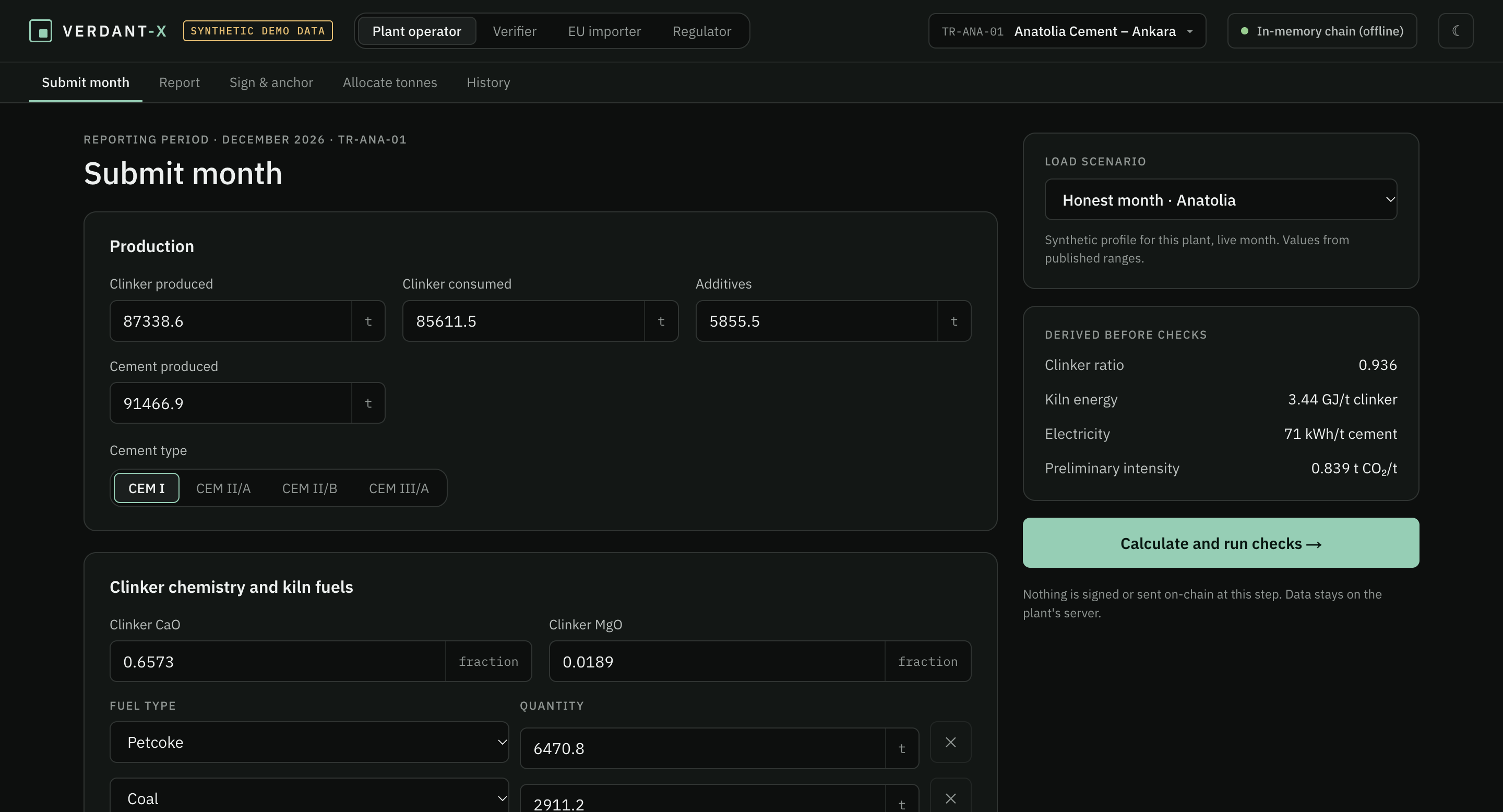
Plant operator page
-
-
-
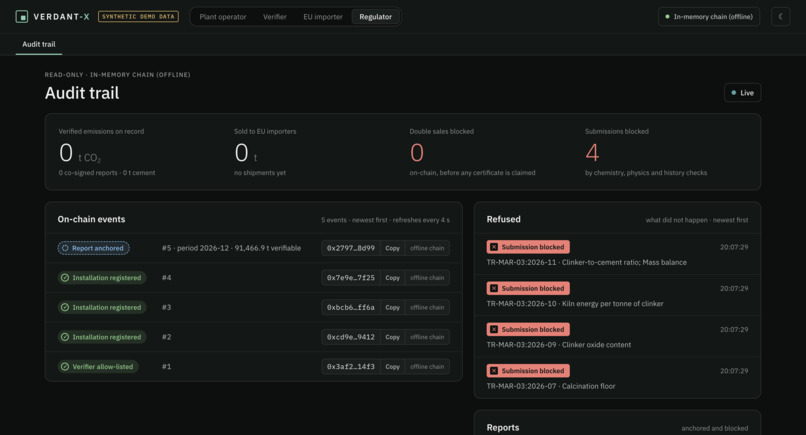
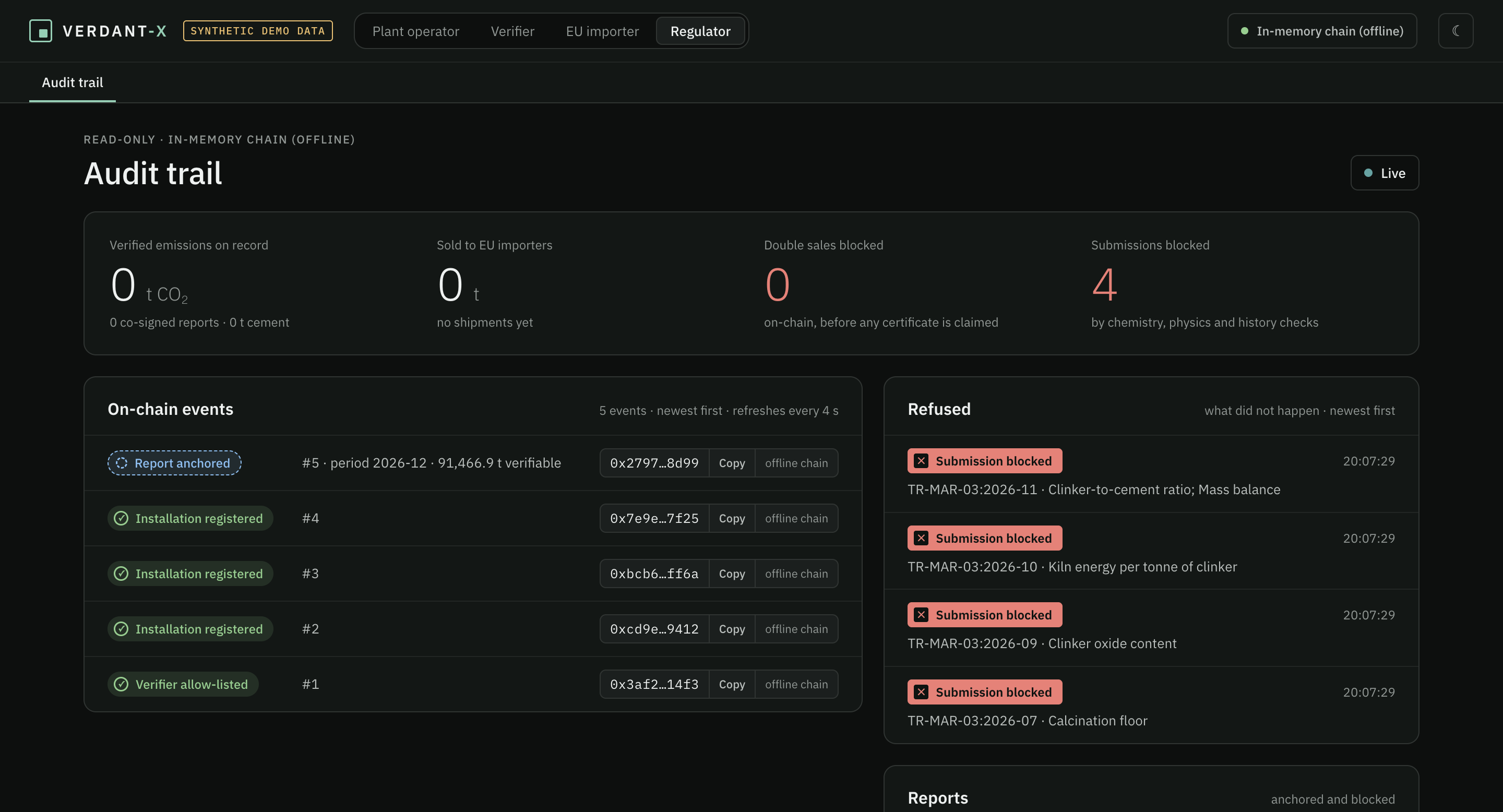
Regulator page
Inspiration
Since 1 January 2026, EU importers have paid a carbon price on the cement they import under the EU's Carbon Border Adjustment Mechanism (CBAM). Türkiye supplies 42.9% of the EU's cement and clinker imports, yet exporters face a costly problem: if they cannot prove their actual emissions, they are charged the EU's default emission values.
For grey cement, the 2026 default is 1.584 t CO₂ per tonne, rising to 1.872 from 2028. Turkish plants report actual emissions of approximately 0.82 t CO₂ per tonne. The gap can cost the industry around €330 million annually.
Worse, default values eliminate the financial incentive to decarbonise. A plant that invests in cleaner production pays the same carbon cost as one that does not.
The real emissions data already exists. What is missing is a trusted way to prove it that:
- Builds trust between importers, accredited verifiers and customs authorities that do not necessarily trust one another.
- Preserves privacy, keeping production recipes, fuel mixes and energy contracts confidential.
- Prevents double counting, ensuring a verified low-carbon tonne cannot be allocated to multiple importers.
- Remains secure for decades, protecting declarations that may be audited well into the era of quantum computers.
We built VERDANT-X, a privacy-preserving, blockchain-backed, post-quantum-ready proof layer that turns verified industrial emissions into a commercially valuable asset.
What it does
VERDANT-X enables cement plants to prove their actual embedded emissions to EU importers without exposing sensitive operational data.
1. Calculates emissions using CBAM methodology
Our sector-specific emissions engine calculates embedded emissions for cement, including clinker as a precursor:
$$ E_{clk}=m_{clk}(0.785w_{CaO}+1.092w_{MgO}) $$
$$ +\sum_f Q_f\cdot NCV_f\cdot EF_f(1-b_f) $$
$$ +P_{kiln}\cdot EF_{grid} $$
The engine uses configurable regulatory factors and supports future expansion into other CBAM sectors.
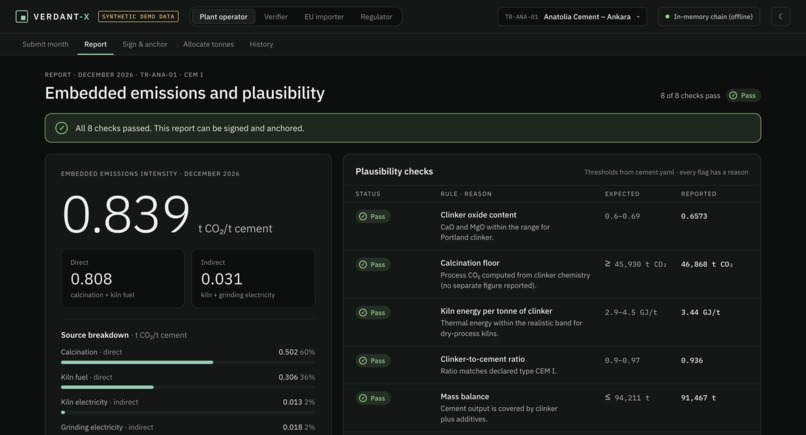
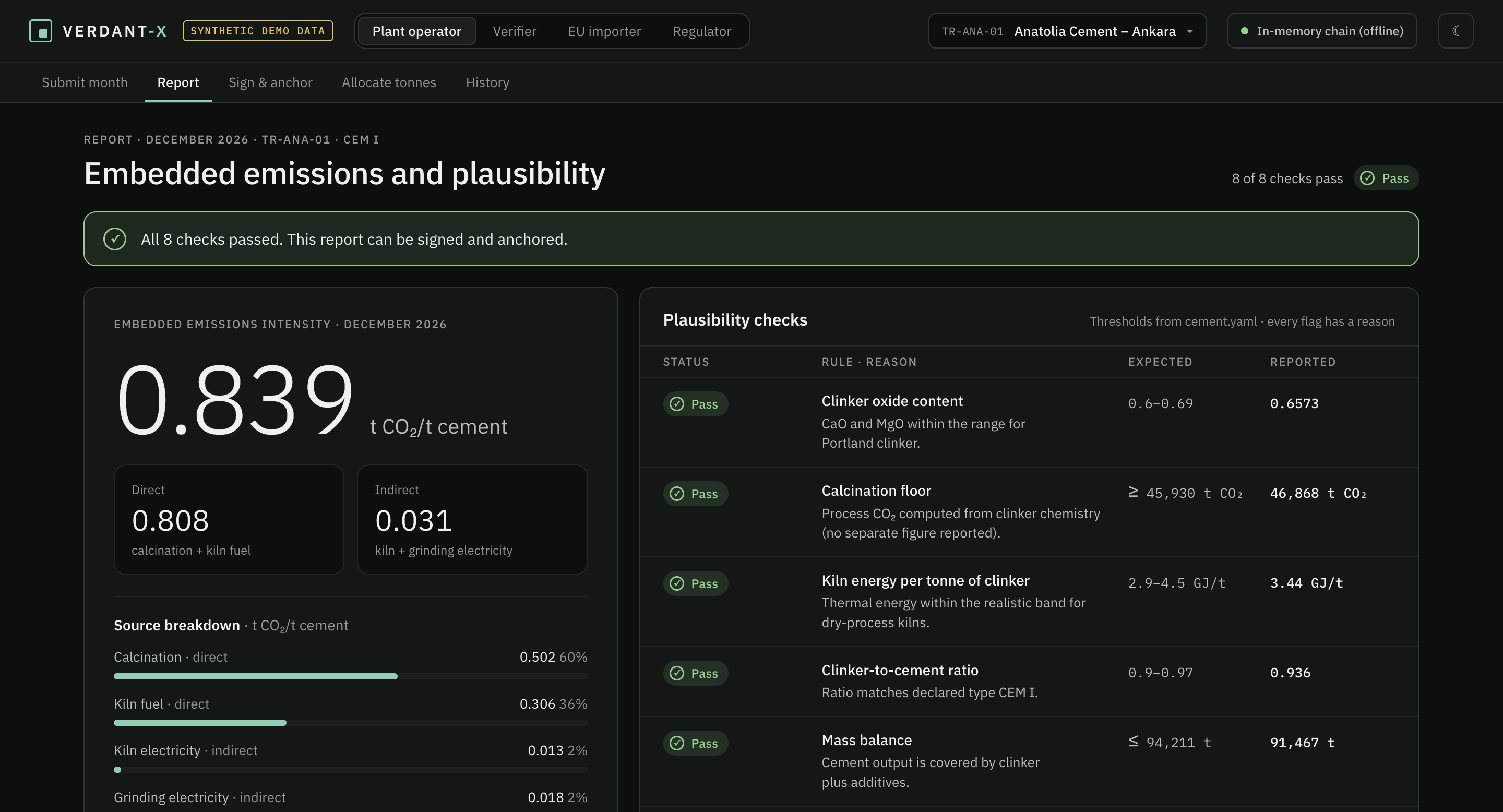
2. Validates data before it can be trusted
VERDANT-X checks reported data against chemistry, physics, mass balance, kiln energy ranges, clinker ratios and historical plant performance. Impossible values are rejected, while unusual values are flagged for human verification. An Isolation Forest model, explained using SHAP, helps identify and explain potential anomalies.
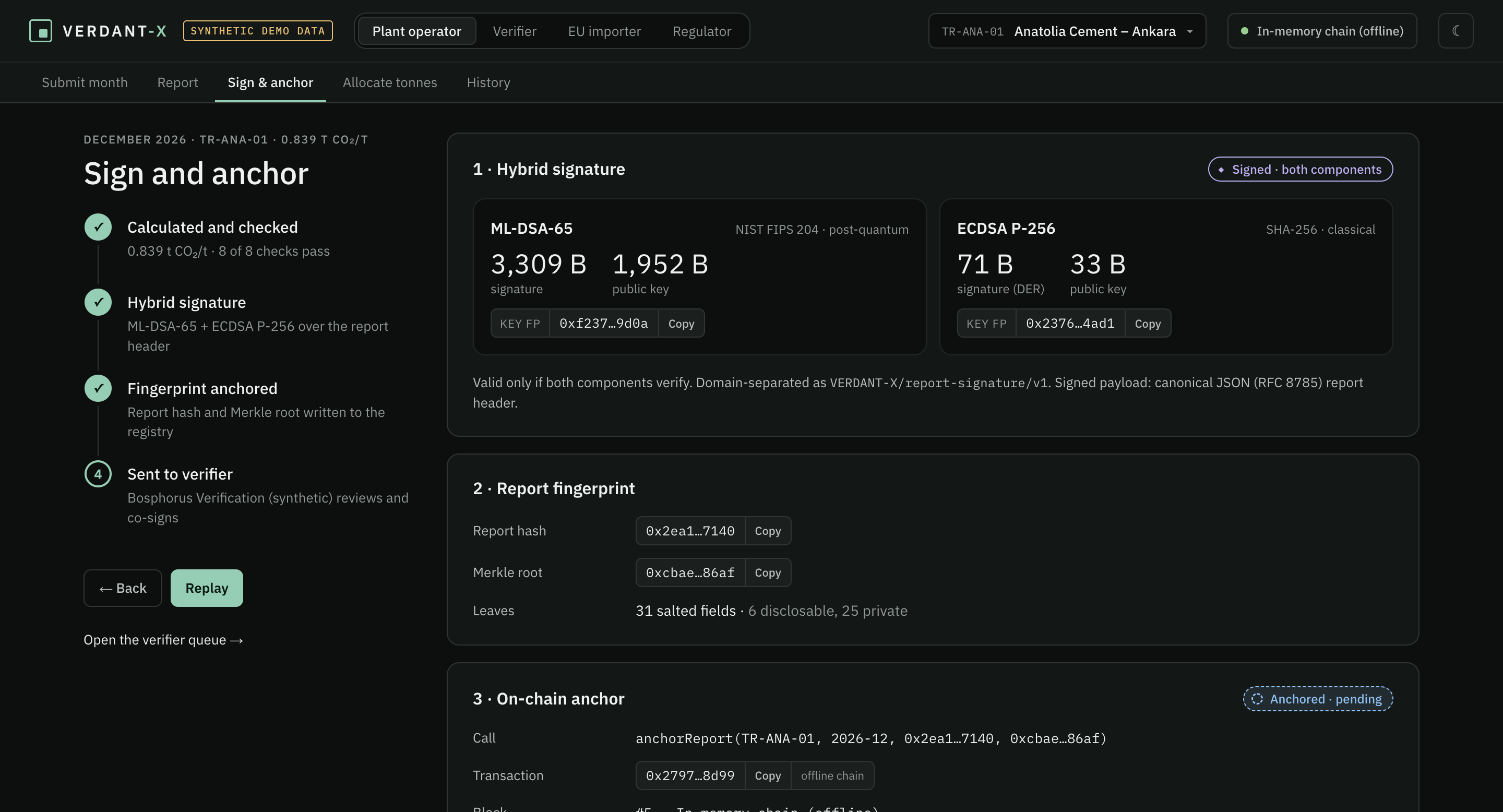
3. Secures reports against future quantum threats
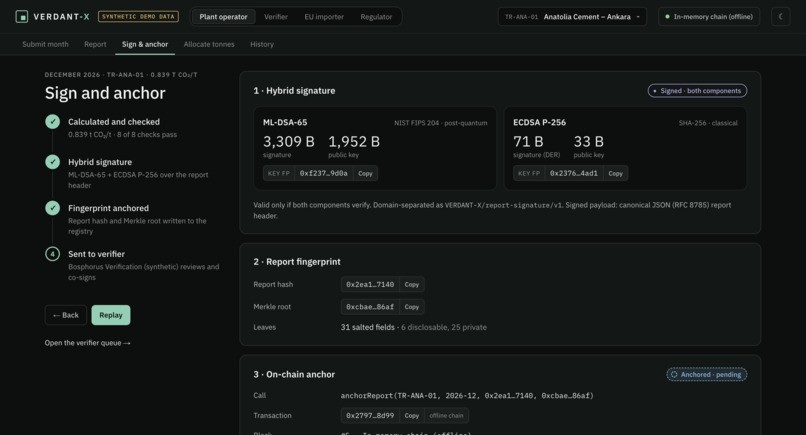
Every report is protected by a hybrid digital signature combining ML-DSA-65 (NIST FIPS 204) and ECDSA P-256. Both signatures must verify, providing post-quantum protection alongside established elliptic-curve cryptography.
4. Establishes independently verifiable trust
Report fingerprints are anchored on Polygon. An accredited verifier must co-sign the report on-chain, and the smart contract prevents an installation from verifying its own report.
5. Makes double counting impossible by design
Verified emissions are linked to shipment allocations on-chain. Any allocation exceeding the verified quantity reverts with an OverAllocation error. One verified tonne cannot be allocated twice.
6. Protects industrial privacy through selective disclosure
Importers receive a link containing the emissions intensity and a Merkle proof, rather than the plant's complete operational dataset. Their browser independently verifies both signatures, the cryptographic proofs and the registry directly on-chain, without relying on our server for trust.
Twenty-five private fields remain with the plant.
7. Quantifies the financial value of decarbonisation
For each shipment, VERDANT-X compares the CBAM cost calculated using default emissions values with the cost calculated using verified data. It accounts for the applicable benchmark and the annual free-allocation phase-out through 2034.
$$ \text{Cost}=t\cdot\max(0,SEE-B\cdot CF_{year})\cdot P_{CBAM} $$
On a synthetic 40,000-tonne shipment, the model reduces the estimated 2026 CBAM bill from approximately €2.9 million to €0.3 million.
Most importantly, verified emissions make decarbonisation financially rewarding: every tonne of CO₂ avoided can translate into approximately €77.65 of value at the border under our model's assumptions.
8. Provides a transparent audit trail
Regulators can inspect a live record of verified reports, verifier approvals, shipment allocations and rejected attempts, creating an auditable history of the system's activity.
How we built it
Backend and architecture
- Python and FastAPI, organised around a shared service layer.
- Role-based access for plants, verifiers, importers and regulators.
- YAML configuration files containing emission factors, thresholds, prices and their sources.
- A modular sector interface that allows new CBAM sectors to be added without rewriting the trust infrastructure.
Emissions engine and fraud detection
We implemented a cement-specific emissions module and a plausibility guard with individual rules for calcination floors, kiln energy bands, clinker ratios, mass balance, electricity history and sudden improvements.
An Isolation Forest model detects anomalous submissions, with SHAP explanations to help verifiers understand suspicious patterns.
Cryptographic trust layer
- RFC 8785 canonical JSON for consistent report representation.
- Salted Merkle commitments, with leaves defined as (H(0x00\ |\ salt\ |\ jcs(k,v))).
- ML-DSA-65 signatures through
liboqs. - ECDSA signatures through Python's
cryptographylibrary. - Domain-separated hybrid signatures requiring both algorithms to verify.
Smart contracts and blockchain
We developed VerdantRegistry.sol using Solidity 0.8.24 and Hardhat. The contract manages installations, verifier authorisations, report anchoring, co-signing and shipment allocations, with custom errors and events.
The contract is deployed on the Polygon Amoy testnet, and its source code is verified on Polygonscan. A complete plant-month with one shipment costs approximately 354,000 gas.
Frontend and independent verification
The frontend uses Next.js and Tailwind CSS. The importer's browser verifies signatures and cryptographic proofs using independent @noble libraries and reads the registry directly through a public blockchain RPC.
Official regulatory data
We incorporated CBAM default values from Implementing Regulation (EU) 2025/2621, as corrected by 2026/1740; benchmarks from Implementing Regulation 2025/2620; the free-allocation phase-out from CBAM Guidance No. 4; and official 2026 CBAM certificate prices.
Challenges we ran into
1. Resolving conflicting regulatory figures
Sources quoted both 1.584 and 1.551 as the Turkish cement default. Examining the European Commission's own spreadsheets revealed the distinction: 1.584 applies to grey cement, while 1.551 applies to clinker, with both figures incorporating the 2026 mark-up. Getting this distinction right was essential because every financial estimate depends on it.
2. Implementing the CBAM benchmark correctly
For cement using actual emissions data, the benchmark applies through the clinker precursor using the clinker ratio, rather than as a simple flat deduction. We implemented the calculation accordingly while keeping the plant's clinker ratio private and computing costs server-side.
3. Making post-quantum cryptography practical on-chain
An ML-DSA-65 signature is 3,309 bytes, making direct on-chain signature verification expensive. Instead, we anchor report fingerprints on-chain and verify signatures off-chain using two independent implementations: liboqs on the server and @noble in the browser.
This preserves independent verification without imposing the full cost of post-quantum signature verification on the blockchain.
4. Making trustlessness genuine
Our initial importer interface verified signatures and Merkle proofs but relied on server-provided blockchain receipts. That left a potential trust gap.
We closed it by making the browser read the registry directly from the blockchain. A server cannot simply provide a self-consistent package signed with its own keys and have it accepted as a valid registry-backed report.
5. Handling public RPC limitations
Polygon Amoy's public RPC limits log queries to 10,000 blocks. Scanning the entire audit history on every refresh would have required approximately 225 calls.
We implemented incremental, run-scoped event scanning to make audit-trail updates more efficient.
6. Measuring fraud detection honestly
The Isolation Forest model alone detected only 46% of injected fraud cases. Rather than hiding this limitation, we evaluated the complete validation system.
The combined guard caught all 216 injected fraud cases, with no honest month blocked in our evaluation. These results apply to our test dataset and do not imply that every possible real-world fraud can be detected.
Accomplishments that we're proud of
- Built a working end-to-end system deployed on a public blockchain testnet, with a contract anyone can inspect on Polygonscan.
- Made double counting impossible through smart-contract enforcement rather than relying on policy or manual checks.
- Implemented hybrid post-quantum signatures verified by two independent implementations, including directly in the importer's browser.
- Preserved industrial privacy: importers receive a verifiable emissions figure while 25 private fields remain confidential.
- Integrated official regulatory values and CBAM pricing rules instead of relying on placeholder assumptions.
- Built an extensible emissions engine that separates sector-specific calculations from the shared trust infrastructure.
- Implemented 41 automated tests: 32 backend tests and 9 smart-contract tests.
- Created a reproducible fraud-detection evaluation runnable using
make eval. - Documented the problem statement, climate impact assessment, system architecture, 21-threat security assessment and development roadmap.
Above all, we demonstrated that industrial emissions data can be private, independently verifiable, resistant to double counting and protected against future quantum threats while remaining useful for real commercial decisions.
What we learned
Blockchain does not make data true. It makes records tamper-evident and enforces rules between parties that may never directly interact. Trustworthy emissions claims still require physical plausibility checks, reliable measurements and accredited verifiers.
Climate incentives matter. Default emission values can erase the financial reward for cleaner production. Verified data can restore that incentive by connecting lower emissions to lower carbon-border costs.
Regulation is part of the engineering. Some of our hardest problems were not software bugs but subtle distinctions in regulatory definitions, benchmarks and phase-out calculations. A technically correct implementation is not useful if its regulatory interpretation is wrong.
Privacy and transparency can coexist. Importers do not need access to an entire factory's operational data to verify a specific emissions claim. Cryptographic commitments and selective disclosure can provide confidence without exposing commercially sensitive information.
Measure before making claims. Our anomaly model's limitations showed why a complete evaluation matters more than an impressive headline metric. Testing the combined guard and documenting its weaknesses made our results more credible.
What's next for VERDANT-X
1. Pilot with real cement plants
Work with Turkish cement producers and accredited verifiers to validate the system against real operational data and practical verification workflows.
2. Integrate with the EU CBAM Registry
Support exports in the appropriate CBAM reporting format so verified emissions data can be incorporated into importers' declarations with minimal friction.
3. Expand to other CBAM sectors
Add steel, aluminium, fertilisers and hydrogen through sector-specific calculation modules, while reusing the same verification, privacy and anti-double-counting infrastructure.
4. Introduce zero-knowledge proofs
Enable claims such as “emissions intensity is below a specified threshold” without disclosing even the exact emissions value.
5. Harden the production infrastructure
Introduce hardware security modules or key-management services, persistent storage, multisignature registry administration and a production-ready mainnet deployment.
Our vision: to make independently verified emissions a standard part of international trade, so every product crossing the EU carbon border can carry a trustworthy, privacy-preserving proof of its climate impact—and every tonne of CO₂ avoided can have measurable economic value.
Built With
- blockchain
- ecdsa
- ethers.js
- fastapi
- hardhat
- liboqs
- merkle-tree
- ml-dsa
- next.js
- noble-cryptography
- numpy
- polygon
- post-quantum-cryptography
- pydantic
- python
- react
- scikit-learn
- shap
- smart-contracts
- solidity
- tailwindcss
- typescript
- web3.py


Log in or sign up for Devpost to join the conversation.