-
-
cover
-
architecture
-
screen 1
-
screen 2
Inspiration
Misinformation has emerged as one of the most critical challenges of our time, threatening the fabric of informed societies and public discourse. With the growth of false news, distinguishing facts from fake information has become increasingly complex. The rapid spread of false information, coupled with sophisticated techniques for creating and distributing misleading content, demands innovative solutions leveraging artificial intelligence.
Our vision for Factos addresses this challenge through a multi-agent system designed to combat misinformation. We built an asynchronous multi-agent pipeline in which each autonomous agent performs a specific stage of the fact-checking process—starting with URL validation and article scraping, then claim extraction, semantic matching, misinformation scoring, and finally formatting the result for UI consumption. These agents collaborate to verify information, cross-reference multiple trusted sources ( some of the most respected fact checkers), and provide users with clear, accessible insights about the veracity of news articles and online content
What it does
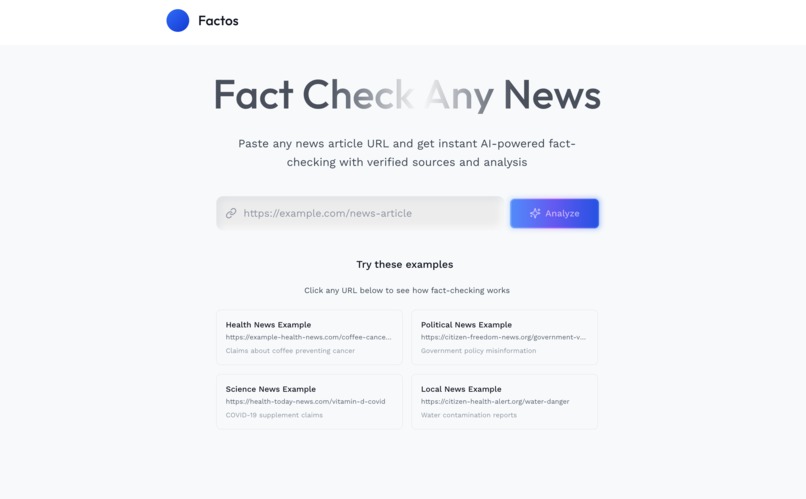
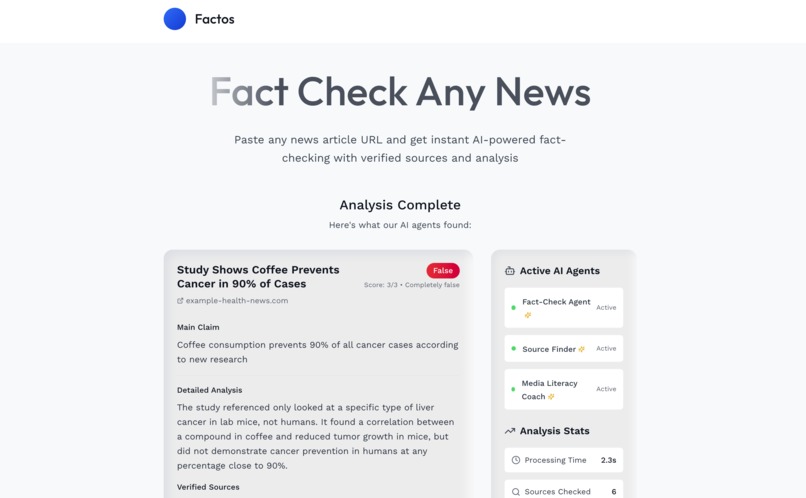
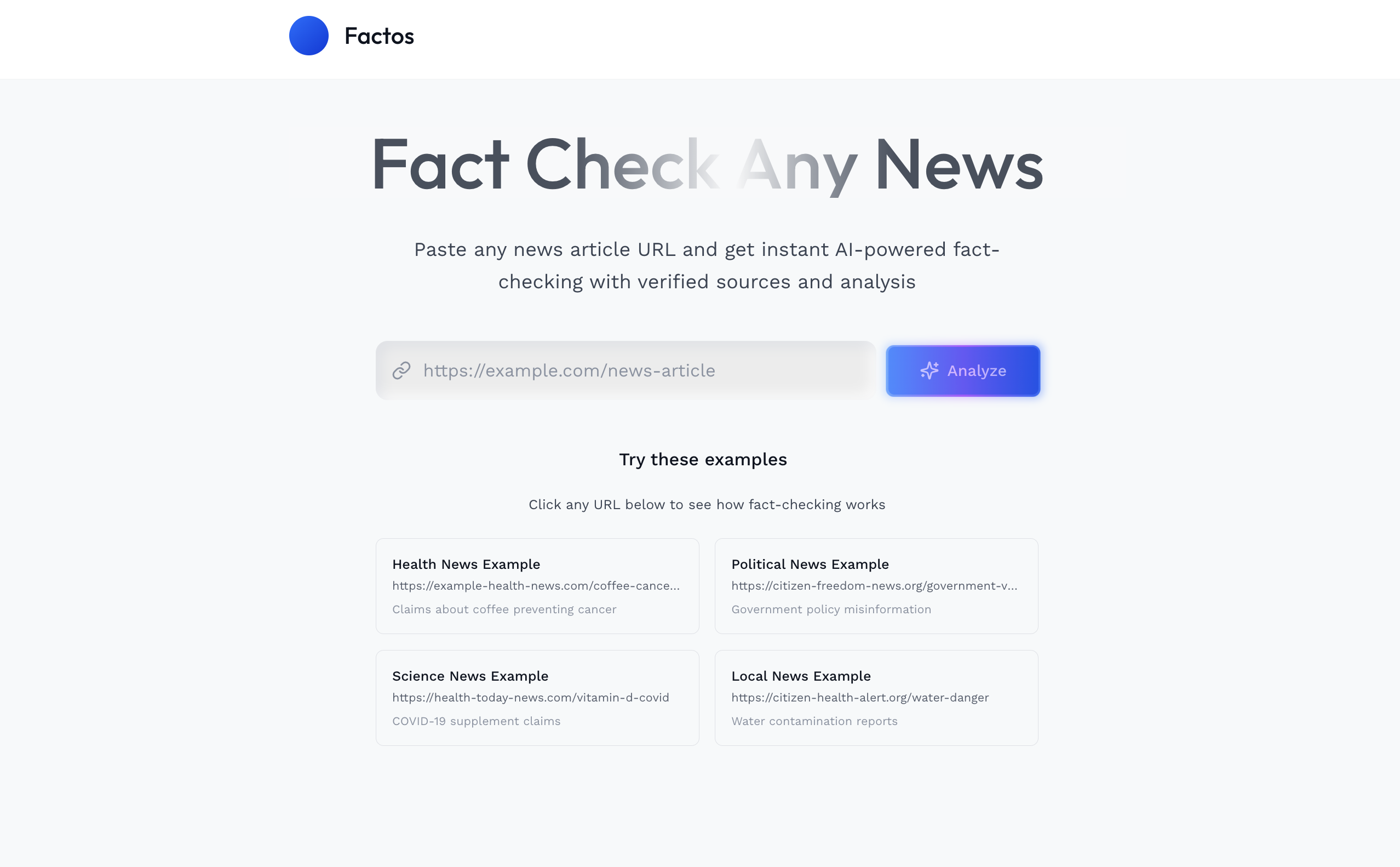
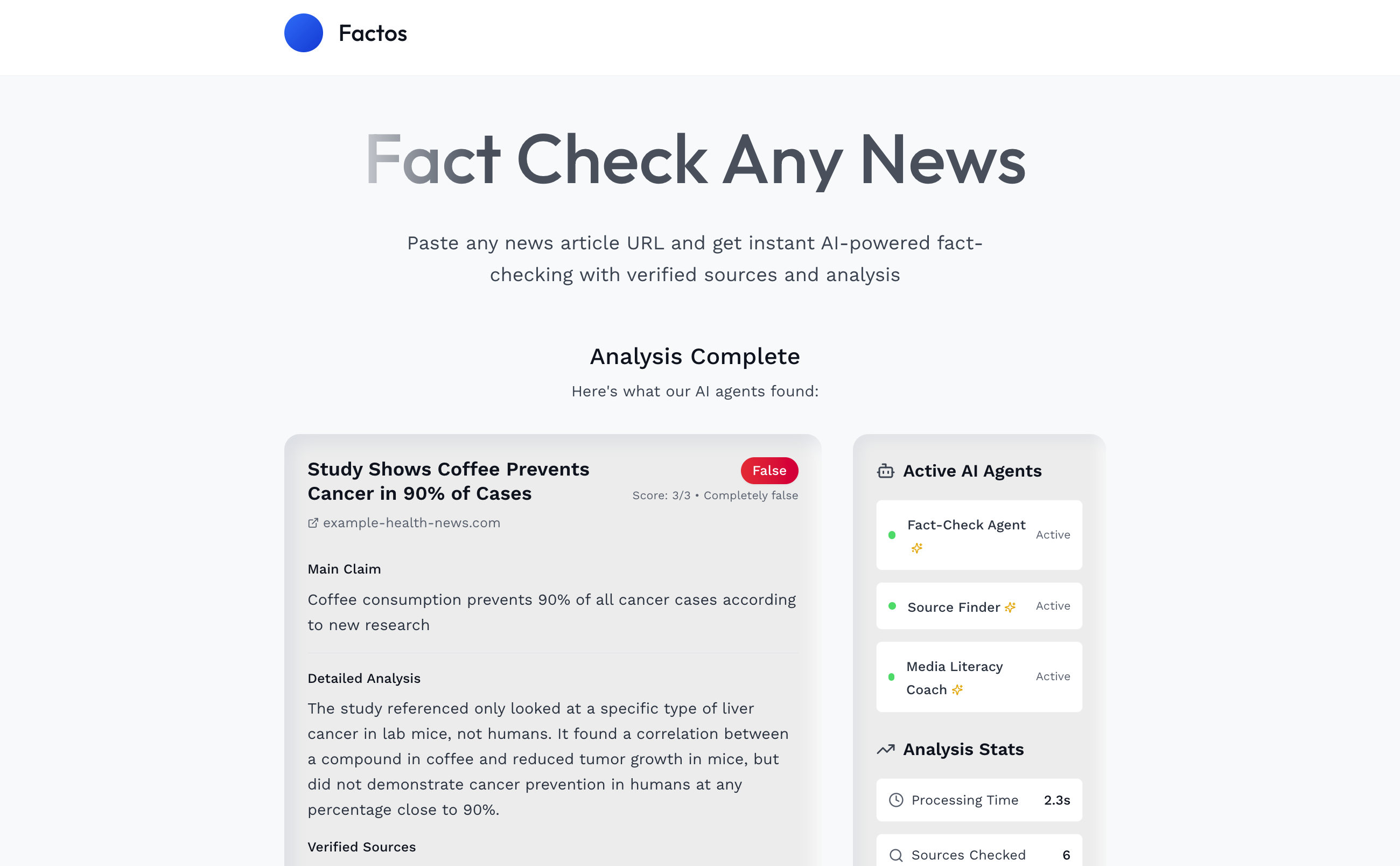
Factos: Multi-Agent Shield Against Misinformation is a multi-agent system that allows users to paste a single news article link, verifies whether it’s a legitimate news piece, then scrapes and analyzes its core claims. It cross-references the claim with trusted fact-checking sources like Snopes, FactCheck.org, Reuters Fact Check, AP Fact Check, and others to determine its accuracy and provide a clear, structured evaluation of how close the content is to the truth. Factos Assigns a Misinformation Score based on alignment with verified sources and presents the findings visually and clearly using a frontend AG-UI component.
How we built it
We are making an integration of different tools and frameworks like Google ADK (Agent Development Kit) to orchestrate agent workflows and memory, A2A (Agent-to-Agent protocol) to connect specialized agents (Validator, Scraper, Search, Analyzer), AG-UI for real-time, user-facing output, Firecrawl MCP to scrape structured article content, Vertex AI Agent Builder for logic and task coordination, Next.js + TypeScript frontend for a clean interface and fast performance.
Multi-Agent Architecture
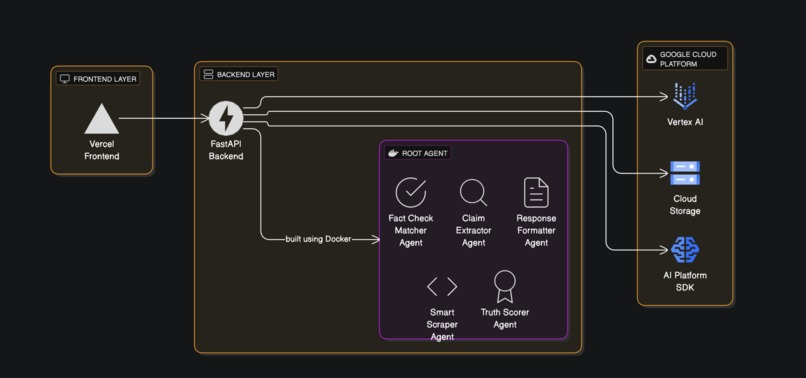
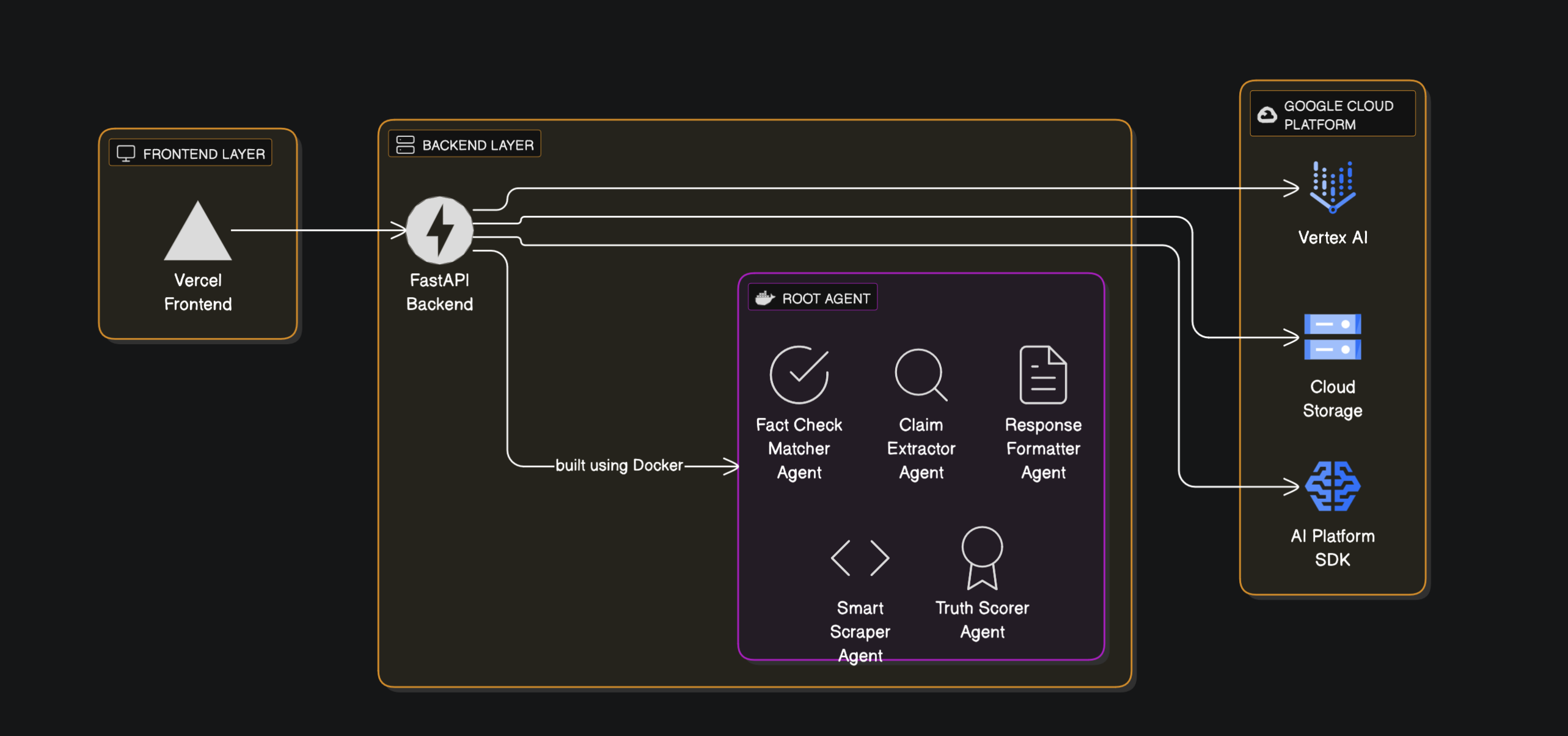
The Factos is an asynchronous multi-agent pipeline in which each autonomous agent performs a specific stage of the fact-checking process—starting with URL validation and article scraping, then claim extraction, semantic matching, misinformation scoring, and finally formatting the result for UI consumption. Although the logical data flow is sequential, the architecture is event-driven: agents communicate via structured message allowing each agent to process tasks independently as messages arrive, making it highly adaptable for real-time, explainable misinformation detection.
Agents:
SmartScraperAgent
- Validates input URLs (HTTPS, accessible, known domains)
- Uses Firecrawl to extract structured article metadata and content
- Outputs: headline, byline, publish date, and article body
- Validates input URLs (HTTPS, accessible, known domains)
ClaimExtractorAgent
- Applies NLP to extract a concise, token-limited factual claim
- Uses transformer-based sentence ranking
- Applies NLP to extract a concise, token-limited factual claim
FactCheckMatcherAgent
- Matches the extracted claim to verified claims using vector search
- referring some of the most respected fact checkers Snopes, FactCheck.org, Reuters Fact Check, AP Fact Check
- Supports optional integration with real-time fact-checking APIs
- Matches the extracted claim to verified claims using vector search
TruthScorerAgent
- Assigns a misinformation score (0 = True, 3 = False)
- Adds label (e.g., Misleading, Context Needed), source links, and rationale
- Assigns a misinformation score (0 = True, 3 = False)
ResponseFormatterAgent
- Formats the complete result for compatibility with the AG-UI protocol
- Ensures structured response for display or downstream use fact-checkers:
- Formats the complete result for compatibility with the AG-UI protocol
Web app architecture:
Challenges we ran into
The novelty of Google ADK, AG-UI, and Vertex Agent Builder meant we were working with emerging, experimental frameworks. Many features were recently documented or rapidly evolving, making integration difficult but exciting. Designing a resilient, multi-agent pipeline under these conditions was a challenge, but also a valuable experience.
Accomplishments that we're proud of
We're proud to create a functional, public-facing tool that addresses one of the most urgent issues in modern media: misinformation. This system detects, but also explains and quantifies the problem in a way that people can use right now.
What we learned
We learned the importance of building adaptive and modular AI systems, especially when working with frameworks that are still evolving. Flexibility, fallback logic, and robust agent communication are incredibly relevant to resilience and real-world deployment.
What's next for Factos: Anti-Misinformation Watchdog MultiAgent
The current version accepts one article link at a time(due to token costs and web crawling efficiency), but the next phase is focused on scaling to identify and analyze autonomously the top 15 high-impact news stories each day based on virality and relevance. This way, users can quickly verify trending headlines from mainstream media autonomously and create a newsletter subscription to email the Factos verified news. Other possibility is building a chrome extension for a smoother user experience and straightforward use.
Upcoming features also include:
Some features we would like to integrate are: saving and sharing reports via AG-UI, historical misinformation tracking, showing trends in repeated false claims, personalised alerts based on topics the user follows (e.g. health, politics, science)
Built With
- a2a
- adk
- ag-ui
- agentbuilder
- firecrawl
- gcp
- googlefactchecking
- mcp
- nextjs
- python
- typescript
- vertex


Log in or sign up for Devpost to join the conversation.