-
-
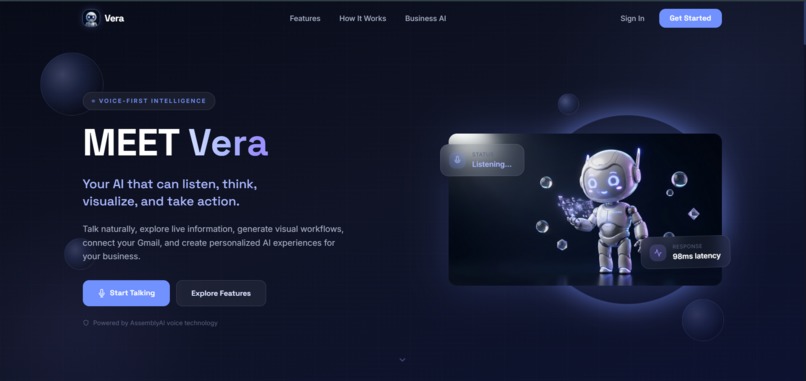
Home page
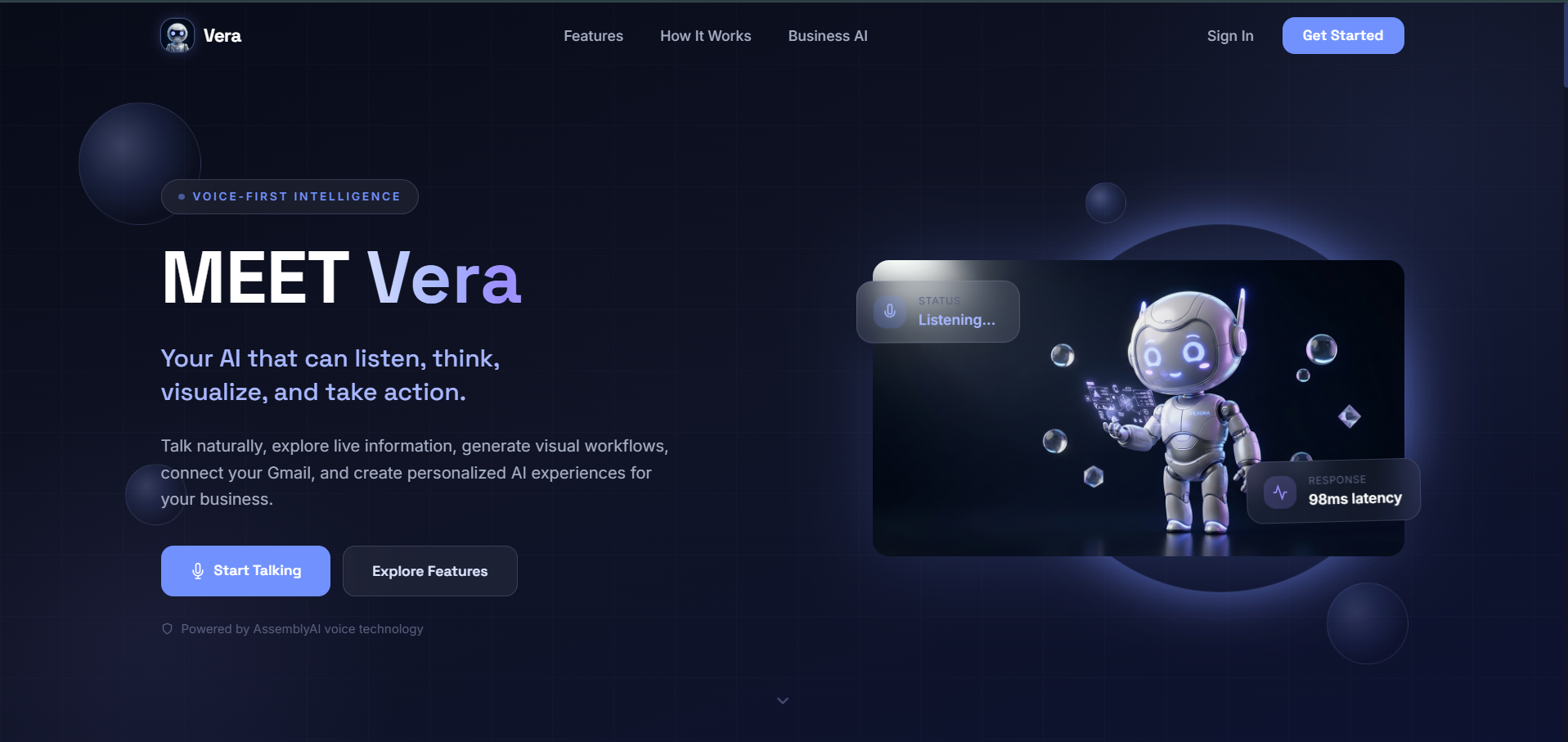
Inspiration
VERA started with a simple question: what if an AI assistant could do more than just answer questions? We wanted to build something that feels closer to a real assistant — something that can understand what a user needs, respond naturally, and actually help them complete tasks.
While building the initial chatbot, we started adding capabilities such as voice interaction, maps, visual explanations and workflow generation. This made us realize that an AI assistant does not always have to respond with only text. Depending on the request, it can show a location, explain something visually, or help turn a conversation into an actual action.
We also saw an opportunity beyond individual users. Many businesses want an AI assistant for their website and customer support, but creating and maintaining a customized AI system can be complicated. That became the motivation behind the business side of VERA.
What it does
VERA is a multimodal AI assistant that can communicate through both text and voice. Its voice capabilities are powered by AssemblyAI, allowing users to interact with the assistant in a more natural way.
VERA can dynamically respond with different types of information depending on the user's request. If someone asks for a location or nearby place, it can display an interactive map with relevant locations. When a concept is better explained visually, VERA can generate diagrams and workflow-style explanations instead of relying only on text.
The business version takes this further by allowing companies to create their own customized AI assistant. Businesses can provide their own knowledge base, business information and support details so that VERA can answer customer questions specifically about their business.
The assistant can also be embedded into a business website. If a customer has an issue that needs to be reported, VERA can collect the required information, prepare the support email and send it to the configured business email through Gmail integration.
So, instead of being just a chatbot, VERA is designed to understand, explain and take action.
How we built it
We built VERA as a full-stack AI application with a React-based frontend and a backend responsible for the AI pipeline, integrations and application logic.
The system combines conversational AI with voice processing, Google OAuth authentication, Gmail integration, mapping and location services, knowledge-base functionality and dynamic visual responses.
AssemblyAI is used for the voice interaction layer. Google OAuth handles authentication, while Gmail integration allows the assistant to send support emails after collecting the necessary information from the user.
For businesses, we designed the system around configurable knowledge rather than hardcoded answers. This allows different businesses to provide their own information and create personalized assistants using the same underlying platform.
We also focused heavily on the frontend experience so that maps, diagrams and other visual elements appear when they are relevant instead of constantly occupying the interface.
Challenges we ran into
One of our biggest challenges was bringing many different capabilities together into one smooth experience. Voice interaction, maps, diagrams, authentication, business knowledge and email actions all require different integrations and workflows.
Gmail integration was another challenge because the system needs to work with Google's authentication and permissions before it can send emails. We also had to design the conversation flow carefully so that VERA collects the necessary information from a user before creating and sending a support request.
Another challenge was making the system dynamic. We did not want business responses to be hardcoded, or maps and visual elements to appear unnecessarily. The assistant needed to understand the context of the request and provide the appropriate type of response.
As the project grew from a basic chatbot into a larger platform, keeping existing functionality stable while introducing new features was also an important part of development.
Accomplishments that we're proud of
We are proud that VERA evolved from a simple conversational assistant into a platform with multiple capabilities working together.
The combination of voice interaction, dynamic maps, visual explanations, workflow generation, business-specific knowledge and Gmail-powered support gives VERA a much broader purpose than a traditional chatbot.
We are especially proud of the business concept. A company can provide its knowledge and information, configure its assistant and embed it into its website instead of having to build an AI support system from the ground up.
We also wanted the project to demonstrate that AI can move beyond generating an answer. VERA can take information from a conversation and connect it to an actual workflow, such as preparing and sending a customer support email.
What we learned
Building VERA taught us that creating an AI product is much more than simply connecting a language model to a chat interface.
We learned how different APIs and services can be combined into one application and how authentication, voice processing, email integrations and external services fit into a real-world AI system.
We also learned the importance of designing AI interactions around the user. A user should not have to understand which API is being used or how the system works internally. They should simply be able to ask for something naturally and receive the right type of response.
Most importantly, we learned that the real value of an AI assistant comes from what it can do with a conversation, not just what it can say.
What's next for VERA — Voice-Powered AI Assistance
Our next goal is to take VERA further as a complete AI assistance platform for businesses.
We want to expand the business dashboard with features such as conversation analytics, multiple AI assistants, team management, advanced knowledge-base management, CRM and helpdesk integrations, custom branding and usage analytics.
We also see opportunities to make VERA more capable of handling complete customer-support workflows, where a conversation can move naturally from understanding a customer's question to finding information, collecting details and taking the appropriate action.
Our long-term vision is simple: businesses should not have to build an AI assistant from scratch. They should be able to bring their knowledge, configure their business and let VERA handle the intelligence and interaction.
VERA — Your Business. Your Knowledge. Your AI.


Log in or sign up for Devpost to join the conversation.