-
-
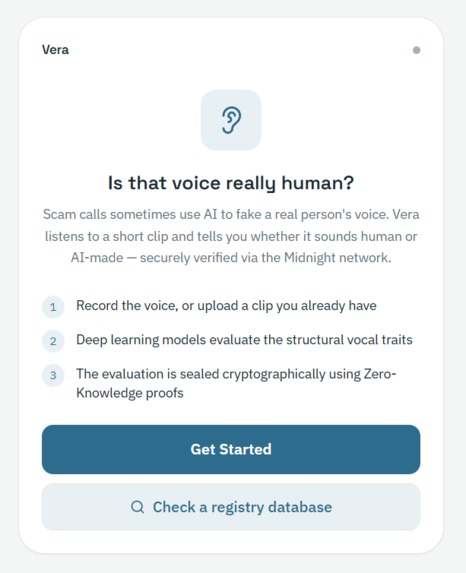
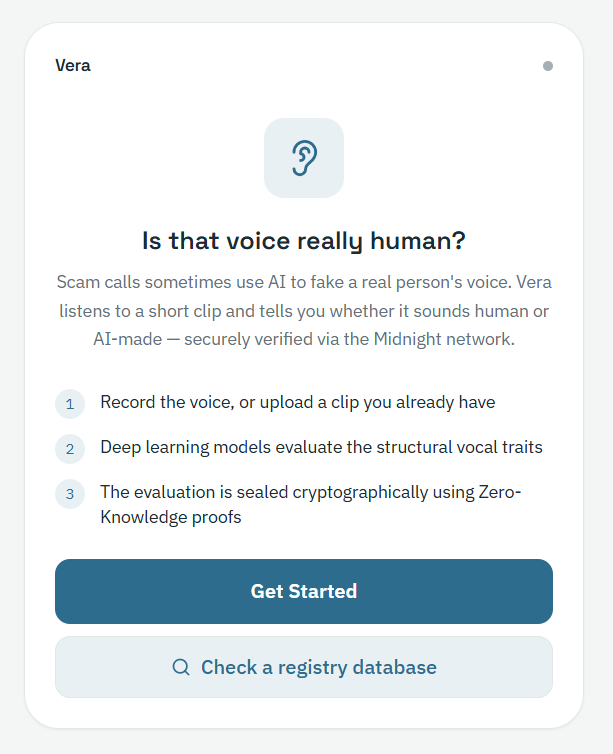
The intro. Record or upload a voice clip, Vera tells you in seconds if it's human or AI-generated, no audio ever stored.
-
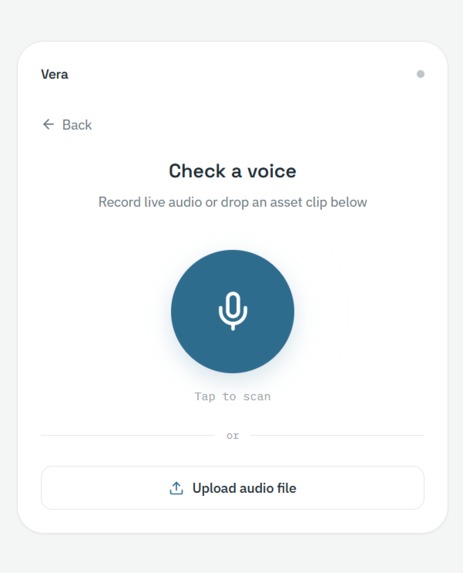
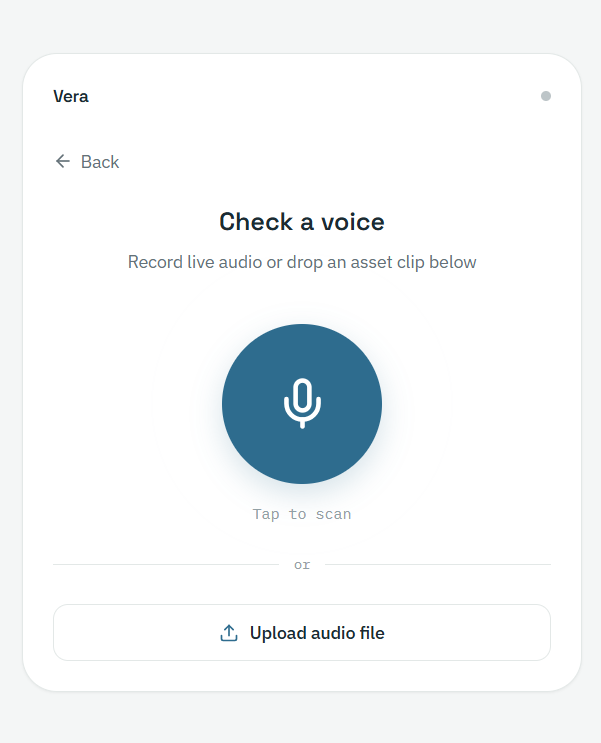
One tap to start. Record live or upload a clip you already have, your choice!
-
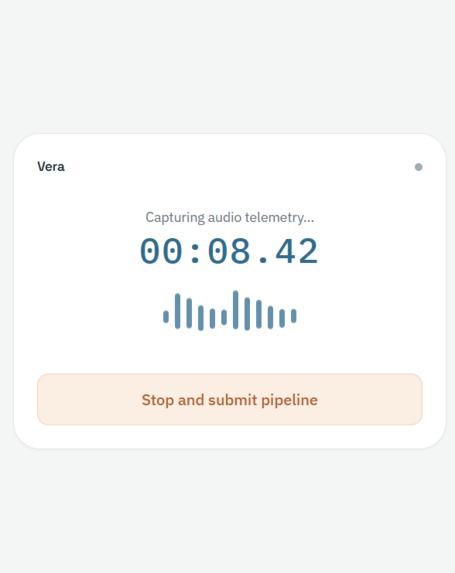
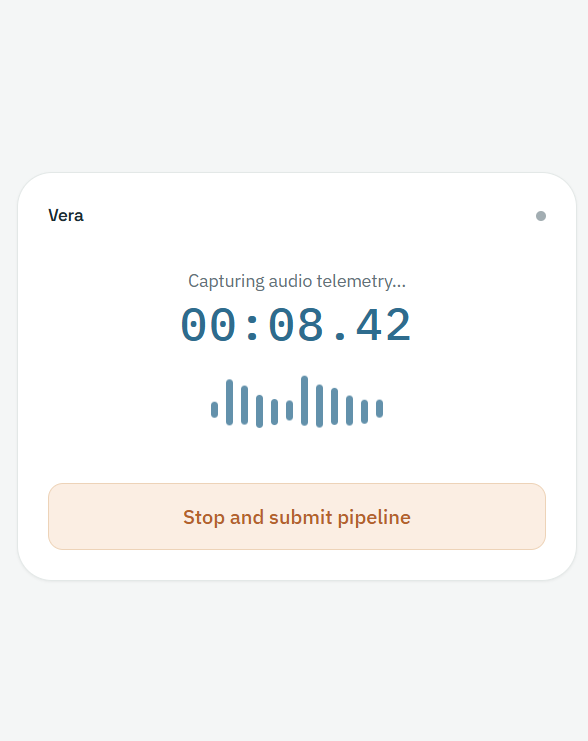
Listening in real time. Recording auto-stops at 25 seconds, just enough to get an accurate read, nothing more.
-

Analyzing the voice now, classification, hashing, and sealing all happen in seconds, with nothing saved to disk.
-
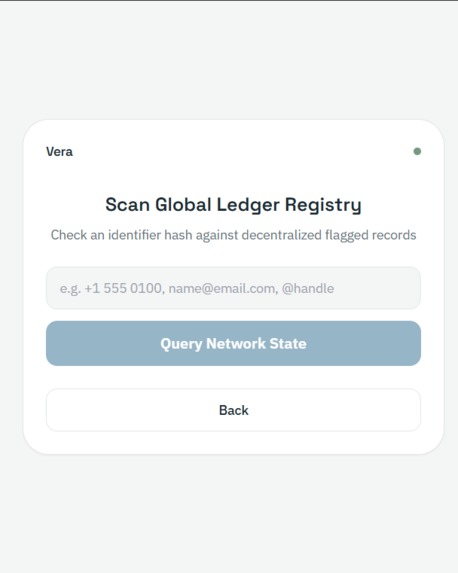
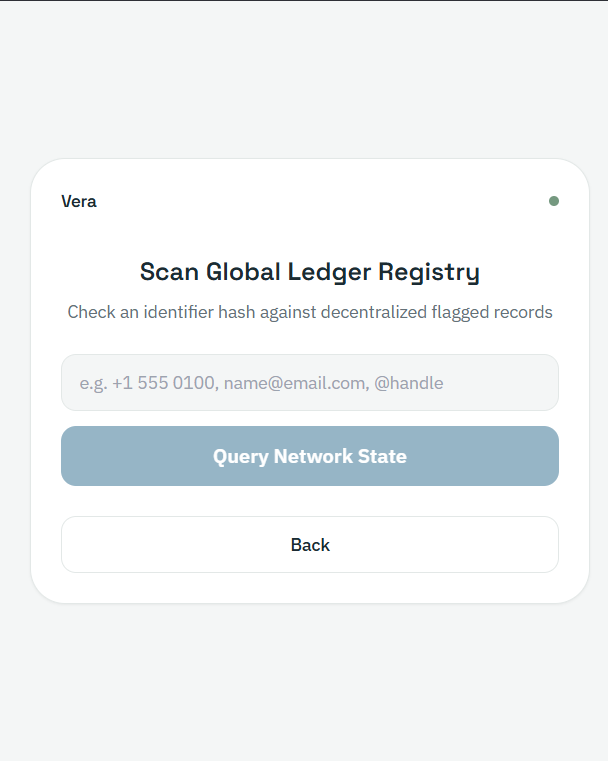
Check a number, email, or handle before you even answer, see if others already flagged it, no recording required.
-
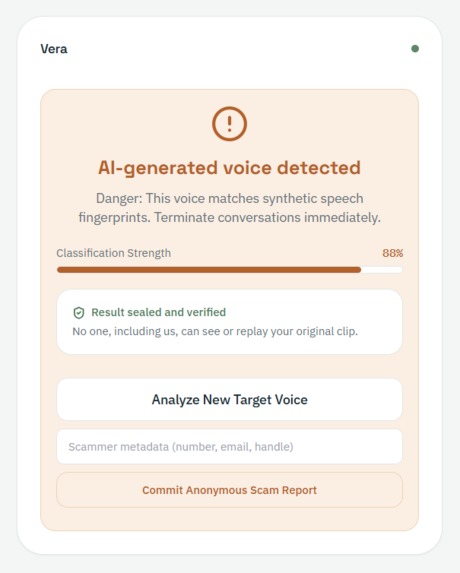
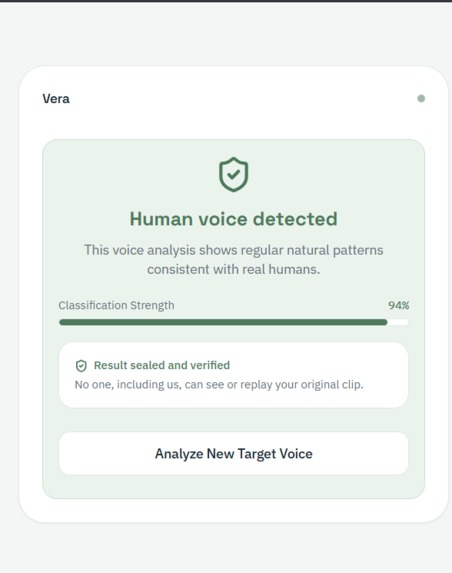
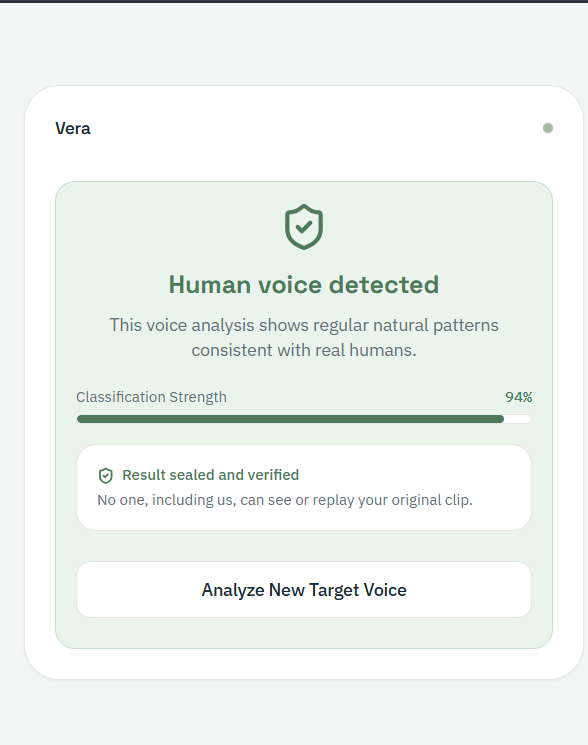
A clear, confident verdict, plus a sealed, tamper-proof record of the check that never touches your original audio.
-
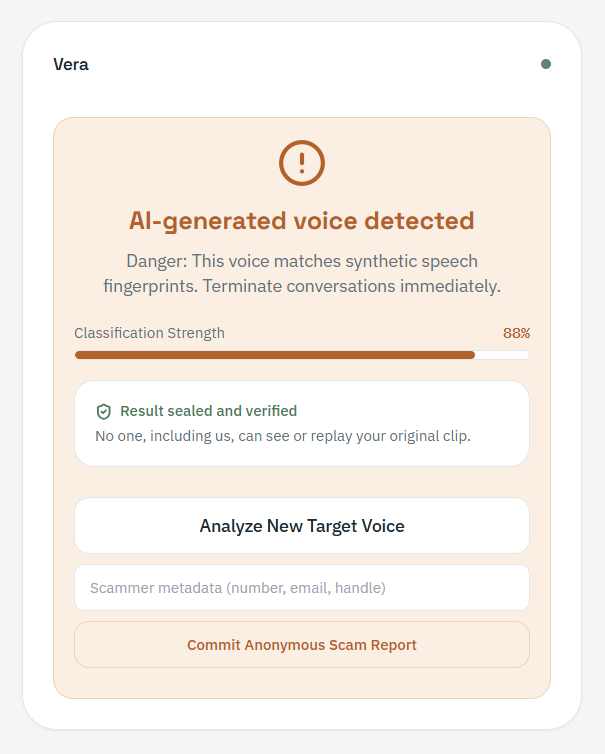
Catches synthetic voices in seconds, so you can hang up before a scammer gets what they're after.

The Problem We Couldn't Ignore
The idea behind Vera came from a problem that already exists. We live in an era where AI is used for incredible things but, unfortunately, also for terrible ones. Someone with bad intentions can clone the voice of your mother, your brother, or your best friend and hit you where you're most vulnerable with just three words:
"I need help."
And that's it.
A few minutes later, your savings are gone. Your personal information is somewhere on the internet. Maybe you've even told a stranger where you keep your spare keys.
Not your proudest day.
Today, AI voice cloning can recreate someone's voice from just a few seconds of audio. This has opened the door to a new generation of scams, including family emergency fraud, executive impersonation, and AI-powered social engineering.
We wanted to build a tool that helps people tell the difference between a real human voice and an AI-generated one and, hopefully, make phone scam less successful without creating another privacy problem.
How Vera Protects You
Vera detects whether an audio sample comes from a real human or an AI-generated voice.
The user provides a short voice recording, and Vera analyzes it using a machine learning model to determine:
- whether the voice is human or AI-generated;
- the confidence level of the prediction;
- a privacy-preserving verification result.
But Vera doesn't stop there.
If a voice is identified as AI-generated, the user can optionally report the phone number, email address, or other contact information associated with the call. Instead of storing the actual contact, Vera creates a cryptographic fingerprint (hash) and shares only that fingerprint across the network. This allows other users to check whether a caller has already been reported without ever exposing the original phone number or personal information.
From Idea to Reality
Vera was built as a modular system combining AI, application development, and privacy-preserving technology. We split the roles between each other: ML module programmer, Midnight Security Manager, Backend and Frontend developers, and worked in parallel.
Machine Learning
The ML pipeline uses a pretrained voice spoofing detection model based on research in AI-generated voice detection.
The model:
- receives an audio sample;
- processes the audio features;
- classifies the voice as human or AI-generated;
- returns a confidence score in percentage.
Backend
The backend connects the voice analysis system with the application layer.
It handles:
- communication between frontend and ML components
- processing requests;
- passing verification results through the system.
Frontend
The frontend provides a simple interface where users can interact with Vera and understand the result without needing technical knowledge.
The focus was on making AI security accessible: the user doesn’t need to understand machine learning to know whether a voice can be trusted.
Midnight Integration
Midnight provides the privacy layer behind Vera.
Instead of storing raw audio or personal information, Vera uses privacy-preserving verification concepts to prove that an analysis was performed while minimizing exposure of sensitive data and providing safety for all the users.
Behind Vera
Building Vera wasn't just about creating a product but also about constantly stepping into the unknown. None of us started this hackathon as experts in every technology we ended up using. Some of us had never worked with Midnight before but still took on the challenge of building the project's privacy layer. Others had never integrated machine learning models into a real application but decided to learn along the way instead of avoiding the difficult part. Every team member found themselves outside their comfort zone. Surprisingly, that became our biggest advantage.
Of course, not every obstacle was something we could solve ourselves. One of the biggest setbacks came from the Midnight ecosystem: Lace Wallet remained stuck in the pending state, even though our code was working correctly. Since the issue was caused by the service rather than our implementation, we had to pause part of the integration, while support channels remained unavailable during the hackathon.
Looking back, we're proud as of Vera as of our teamwork. Everyone brought different experience to the table, everyone had to learn something completely new, adapt to unexpected turnsout and somehow all those pieces came together into one project.
What's next for Vera
Vera is only the first step.
Future versions could include:
- real-time protection during phone calls;
- browser and messaging integration;
- enterprise protection against voice impersonation;
- private voice identity verification.
We want to make sure that the user knows who's really speaking.
Built With
- javascript
- midnight
- python
- react
- tailwind
- vite


Log in or sign up for Devpost to join the conversation.