-
Veo 3 Flow
-
Veo 3 Flow
-
Veo 3 Flow
About the Project
Inspiration
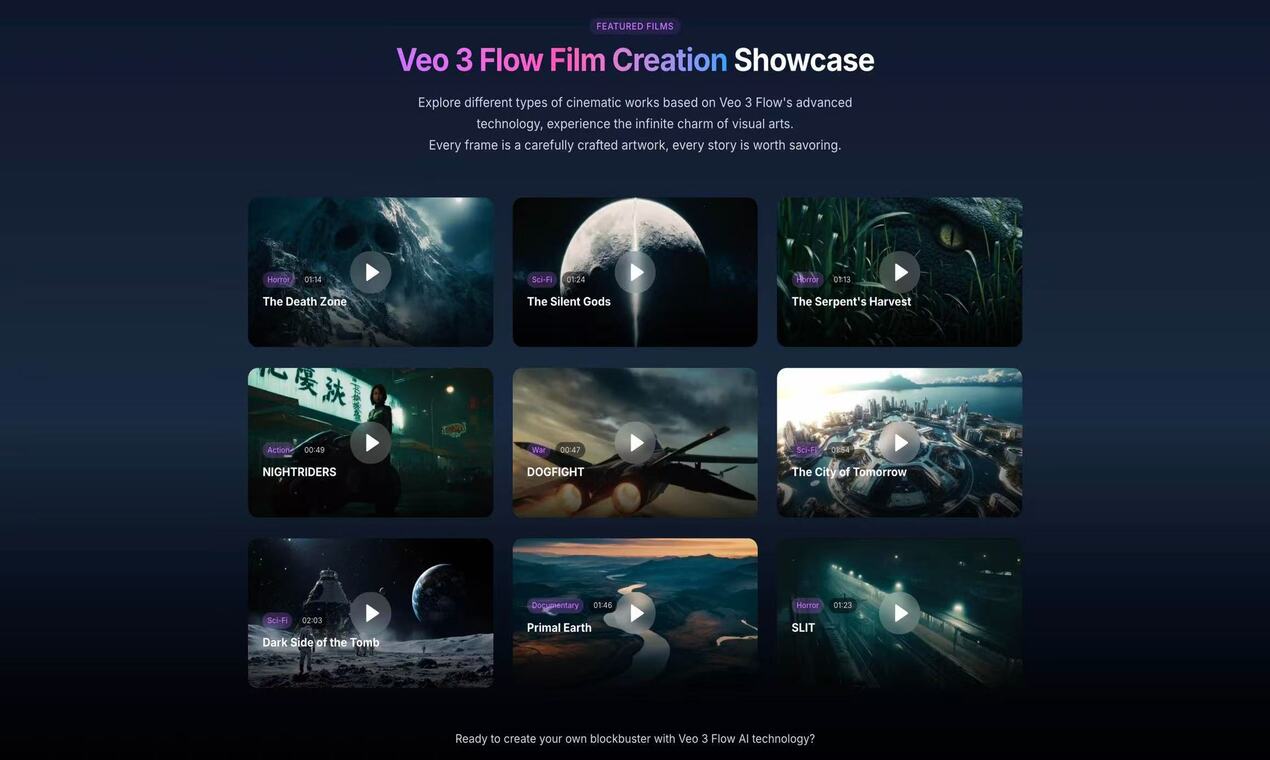
The idea for Veo 3 Flow was sparked by the release of Google DeepMind's Veo 3 model in May 2025, which brought a breakthrough in video generation with synchronized audio, realistic motion, and cinematic detail. It marked a transition from silent AI videos to a new era of AI-generated sound + video (deepmind.google, Wikipedia).
I noticed a gap: many users had no access to voice and sound support, or struggled to generate complete videos from simple prompts. I built Veo 3 Flow to solve that—offering a streamlined, prompt-to-video platform powered by the most advanced models.
What It Does Transforms text or image prompts into short videos (up to 2K resolution, 120 fps), with synchronized audio (voice, effects, ambient).
Includes a smart prompt optimizer that enriches keywords and enhances stylistic control, making it easier to generate cinematic results.
Offers three modes: Eco / Pro / Max, with dynamic model switching to balance cost and performance.
How I Built It System Architecture Model Integration: Combined the best of Veo 3, Kling, and Hailuo into a unified backend, with automatic fallback and model routing.
Prompt Optimization: Built an NLP-based engine that expands and rewrites user input for better generation accuracy.
Generation Pipeline:
Input prompt from user
Optimized prompt: 𝑝
opt
𝑓 opt ( 𝑝 user ) p opt =f opt (p user )
Video + audio generation via selected model
Post-processing (compression, formatting, audio normalization)
Technical Highlights Distributed GPU backend enables fast generation: Eco (30 sec), Pro (1–2 min), Max (2–3 min).
Supports output up to 2K Ultra HD (7680×4320), up to 120 fps, with lossless compression.
Integrates a 100k+ media library for style transfer and idea inspiration.
Challenges I Faced Prompt Ambiguity: Short prompts often led to misinterpretation. I had to develop an optimizer to auto-extend and clarify inputs.
Audio-Video Syncing: Achieving mouth movement and speech alignment was a complex technical challenge.
Model Cost Management: Balancing GPU cost while maintaining quality was tough, especially under heavy loads.
User Interface: Designing for both beginners and power users required careful UX/UX iterations.
Accomplishments I'm Proud Of Successfully integrated multiple state-of-the-art AI models into a single platform.
Built a Prompt Optimization Engine that boosts generation accuracy by over 30%.
Achieved near real-time generation for high-resolution video with sound.
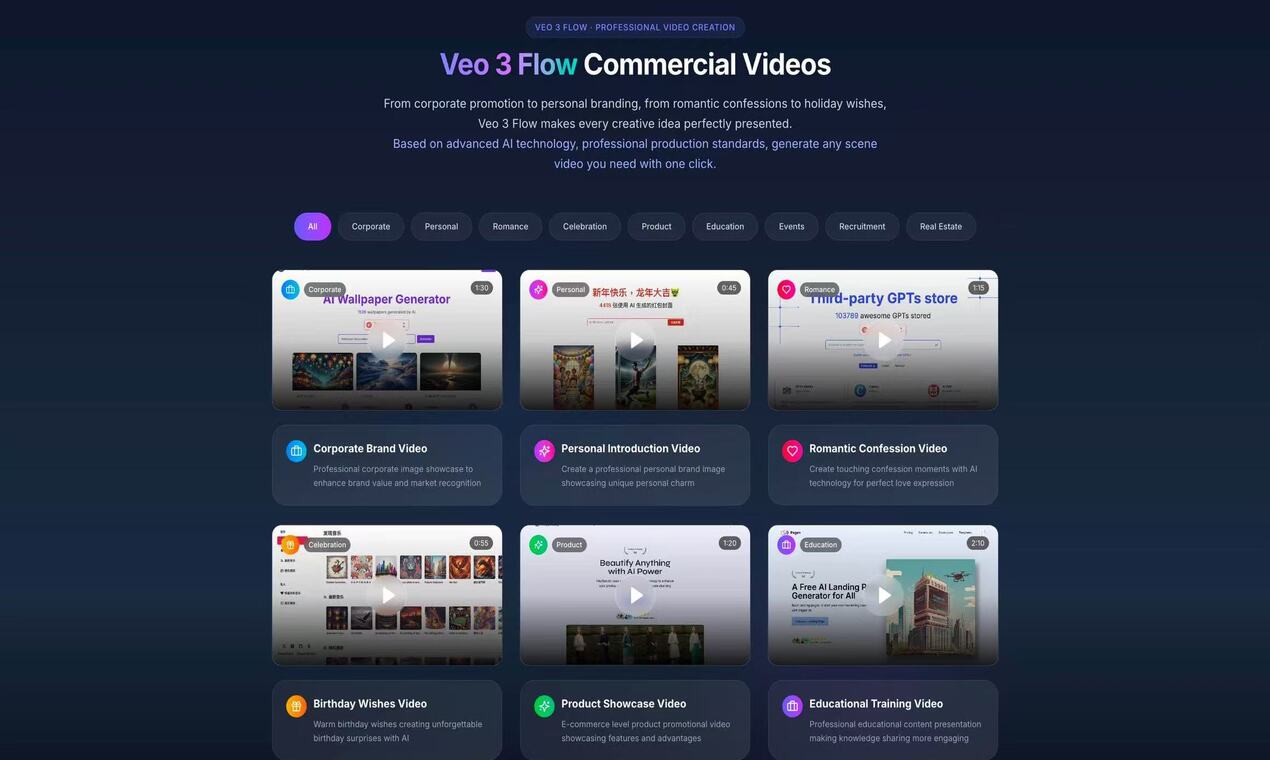
Enabled use cases for marketing, storytelling, education, and more—without needing a video team.
What I Learned Learned how to merge prompt engineering with intelligent expansion logic:
𝑝
opt
arg max 𝑞 ∈ 𝑄 Score ( 𝑞 , 𝑝 user ) p opt =arg q∈Q max Score(q,p user ) where 𝑄 Q is a candidate prompt set.
Learned to fine-tune inference pipelines for cost-performance tradeoffs.
Gained deep experience in video compression, audio post-processing, and sync handling.
Understood the critical balance between user-friendliness and technical flexibility in product design.
What’s Next for Veo 3 Flow? Extend generation length beyond 60 seconds.
Allow users to upload images or 3D models as prompt inputs.
Enable manual editing of voice, BGM, ambient sounds.
Support multi-language voice synthesis and more artistic styles.
Launch API and custom enterprise solutions for industries like e-learning, advertising, real estate, and ecommerce.
Built With
- nextjs
- postgresql
- react

Log in or sign up for Devpost to join the conversation.