VentureVerse Nexus AI — Autonomous Venture Intelligence
Inspiration
Starting a business is one of the most exciting yet uncertain journeys an entrepreneur can undertake. However, many promising startups fail not necessarily because their ideas lack potential, but because founders make critical decisions without sufficient market intelligence, reliable evidence, or a structured understanding of the competitive landscape.
Market research is often fragmented across multiple platforms, expensive consulting services, spreadsheets, reports, and disconnected analytical tools. Early-stage founders, particularly those operating in emerging markets, may lack access to the resources and intelligence needed to validate their ideas before investing significant time and capital.
We envisioned a different approach: What if every entrepreneur had access to an autonomous venture intelligence team capable of researching, challenging, evaluating, and validating a business idea before it entered the market?
That question inspired VentureVerse Nexus AI.
We wanted to move beyond conventional AI chatbots that simply generate business plans or provide generic recommendations. Instead, we designed an interactive, mission-driven intelligence platform where specialized AI agents collaborate to investigate a founder's idea, examine market opportunities, analyze available evidence, evaluate business claims, and deliver structured recommendations.
Our vision was to transform market validation into an intelligent, transparent, and interactive experience in which founders are not passive recipients of AI-generated answers but active decision-makers.
We also wanted the platform to reflect the realities of African entrepreneurship. By emphasizing Nairobi as an initial market anchor while visualizing other relevant Kenyan cities and towns, VentureVerse demonstrates how venture opportunities can be investigated within a geographically grounded market context.
Ultimately, our inspiration was simple:
Give every founder the intelligence, research capabilities, and decision-support infrastructure needed to make better entrepreneurial decisions before taking the leap.
What it does
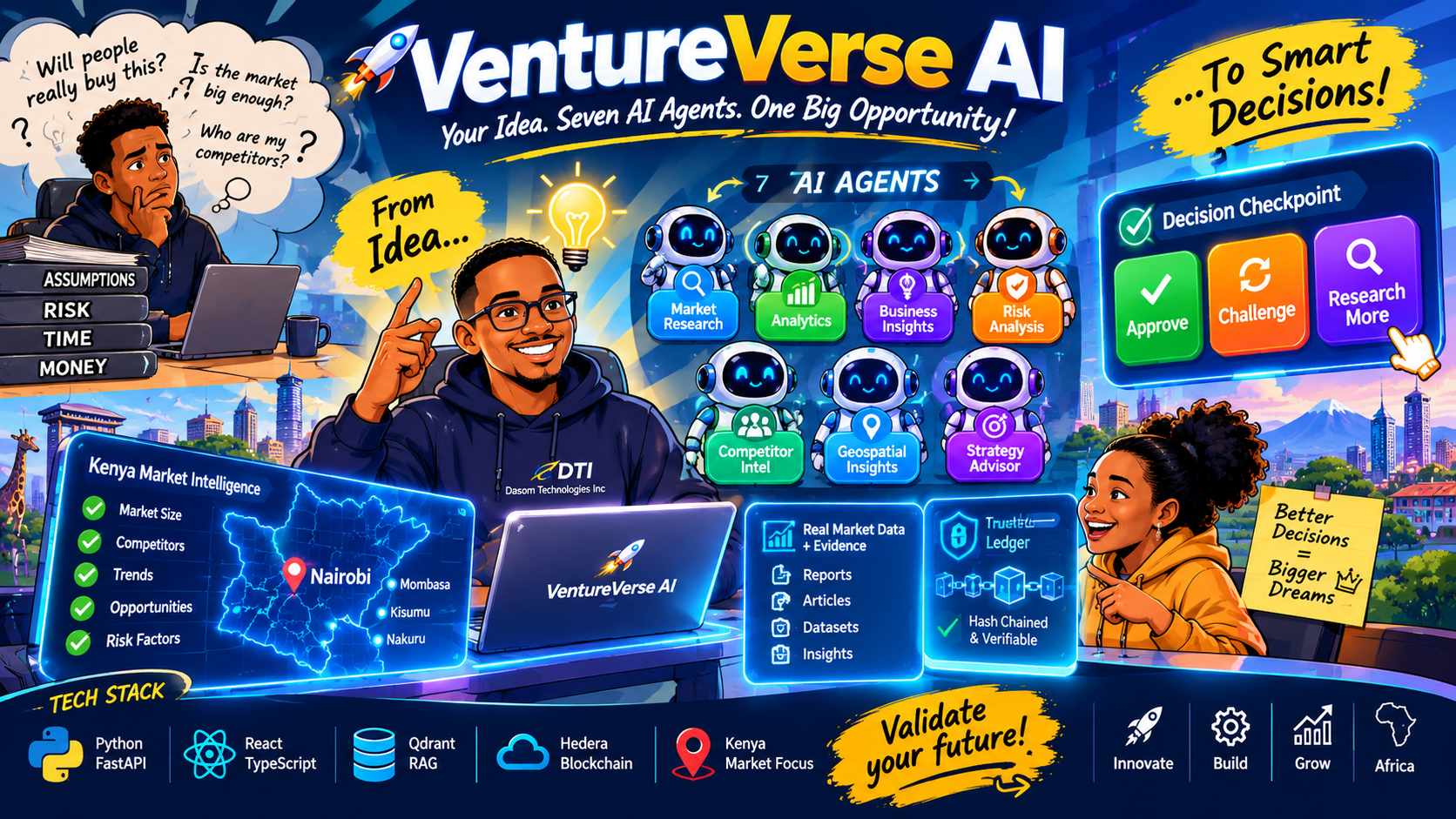
VentureVerse Nexus AI is an autonomous, multi-agent venture intelligence and market validation platform that transforms an initial business idea into a structured research mission.
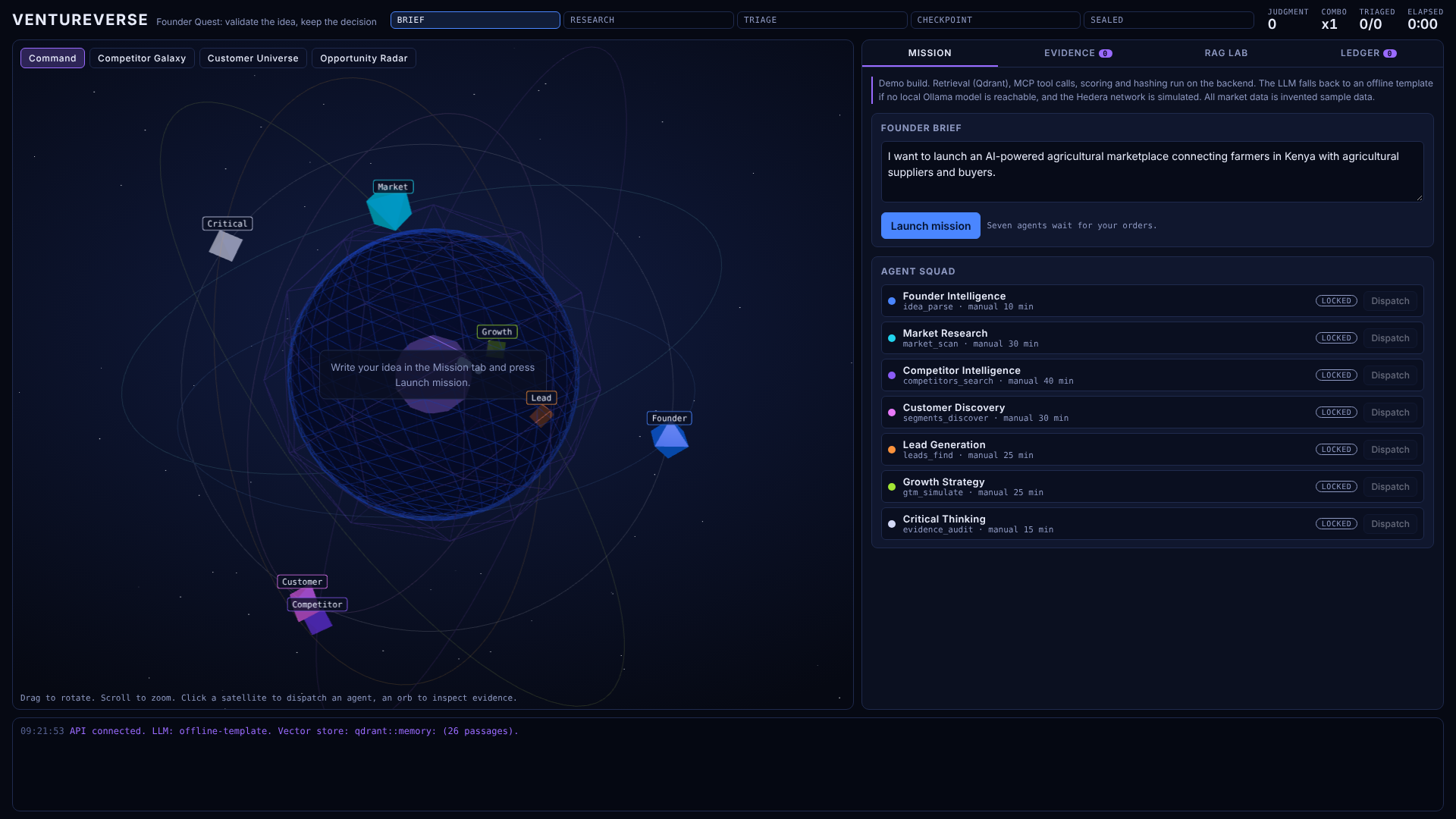
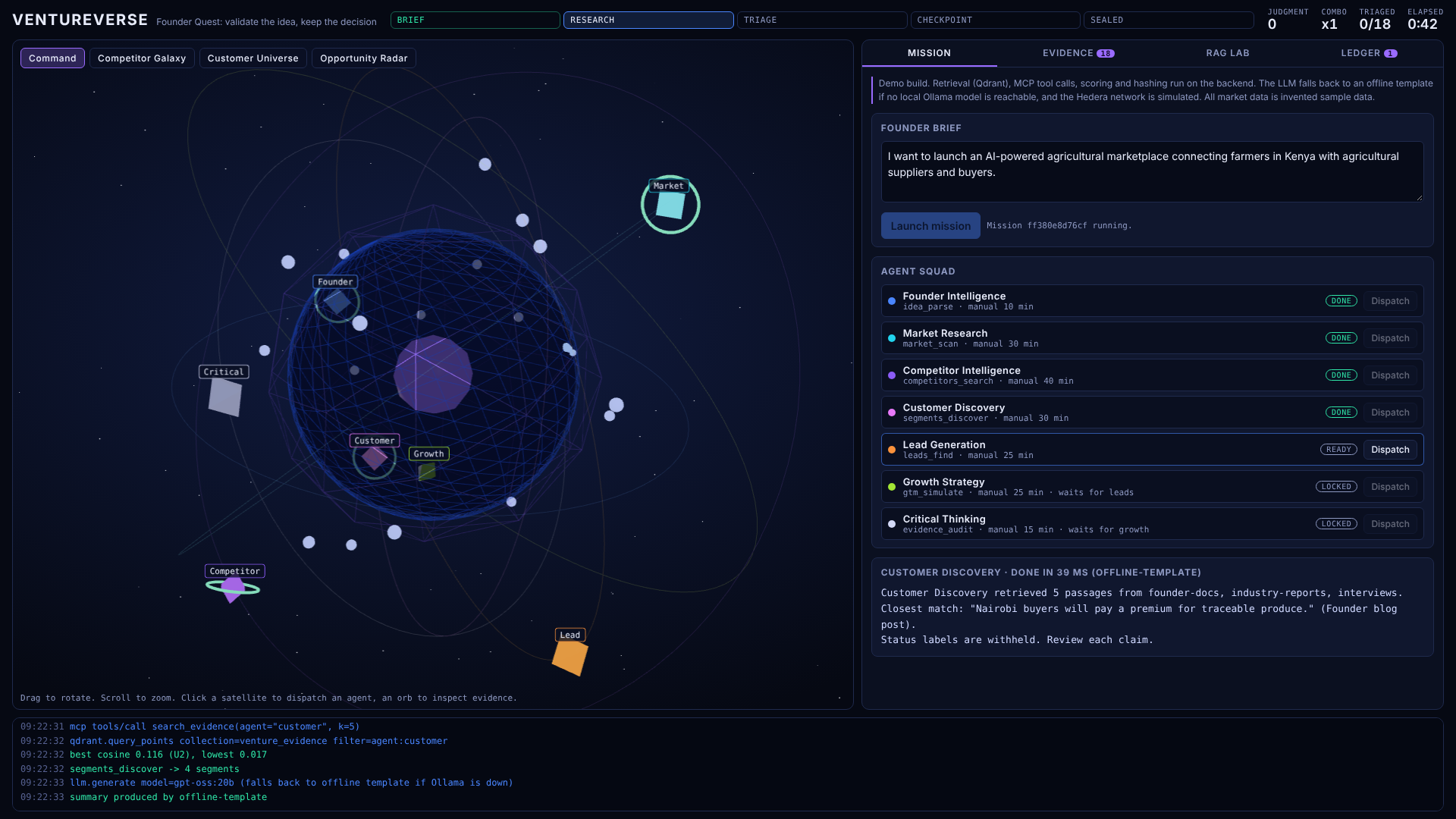
A founder submits a business concept, and the platform initiates a coordinated intelligence workflow in which seven specialized agents execute research tasks sequentially, evaluate available evidence, generate insights, and contribute to an overall venture assessment.
Rather than relying on a single AI response, VentureVerse organizes the process into an interactive command center where founders can monitor missions, inspect findings, challenge claims, request additional research, and make informed decisions.
Core capabilities include:
1. Autonomous Multi-Agent Intelligence
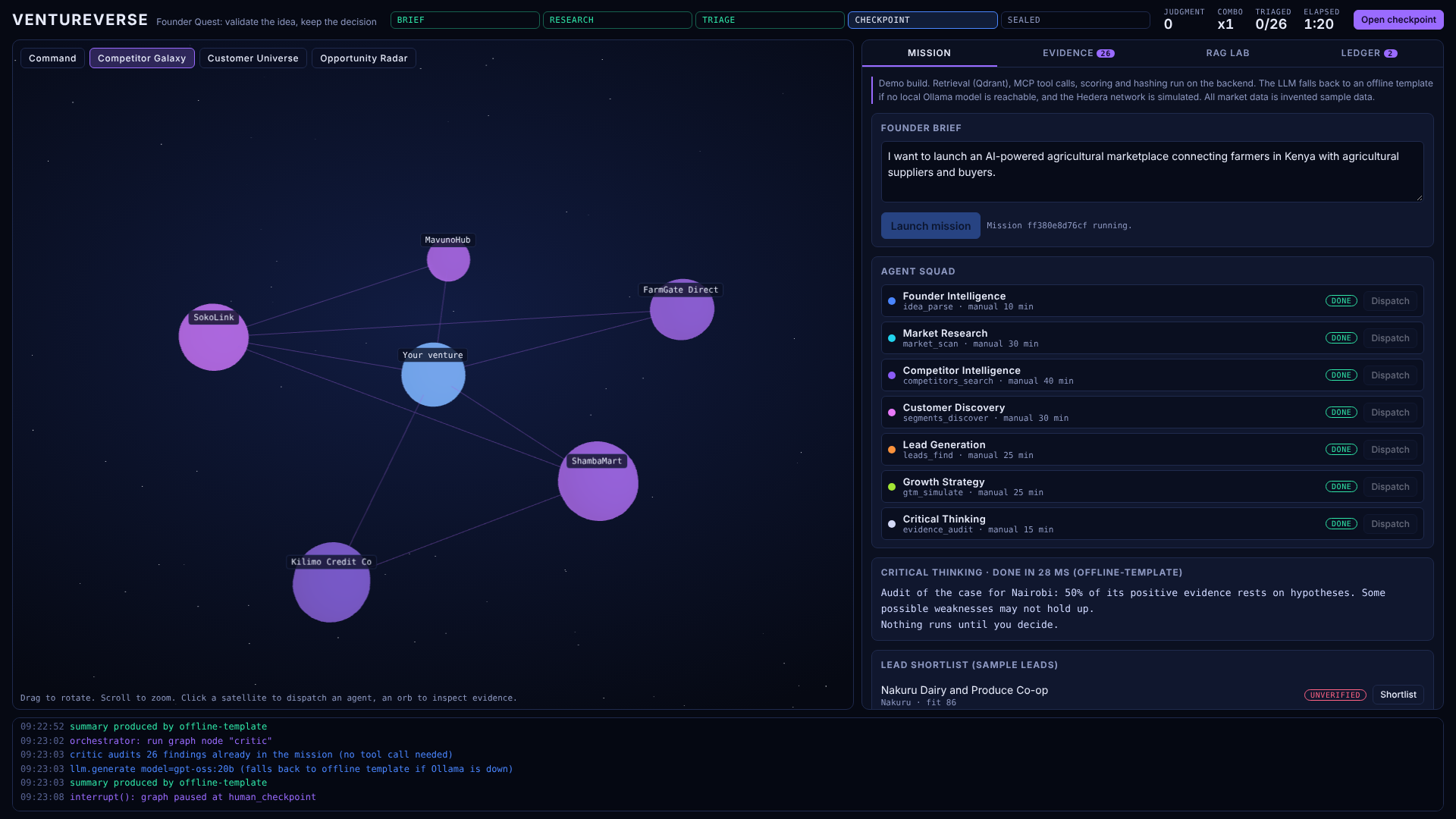
The platform coordinates seven specialized research agents through an orchestration layer. Each agent contributes to the mission workflow, enabling a structured investigation rather than a single unverified AI-generated response.
The orchestration system manages agent execution, mission progression, research outputs, and summaries.
2. AI-Powered Market Validation
VentureVerse evaluates submitted business ideas through a structured scoring and research workflow. It combines venture information, market intelligence, evidence passages, and analytical outputs to help founders assess the attractiveness and potential risks of an opportunity.
3. Evidence-Based Research and RAG
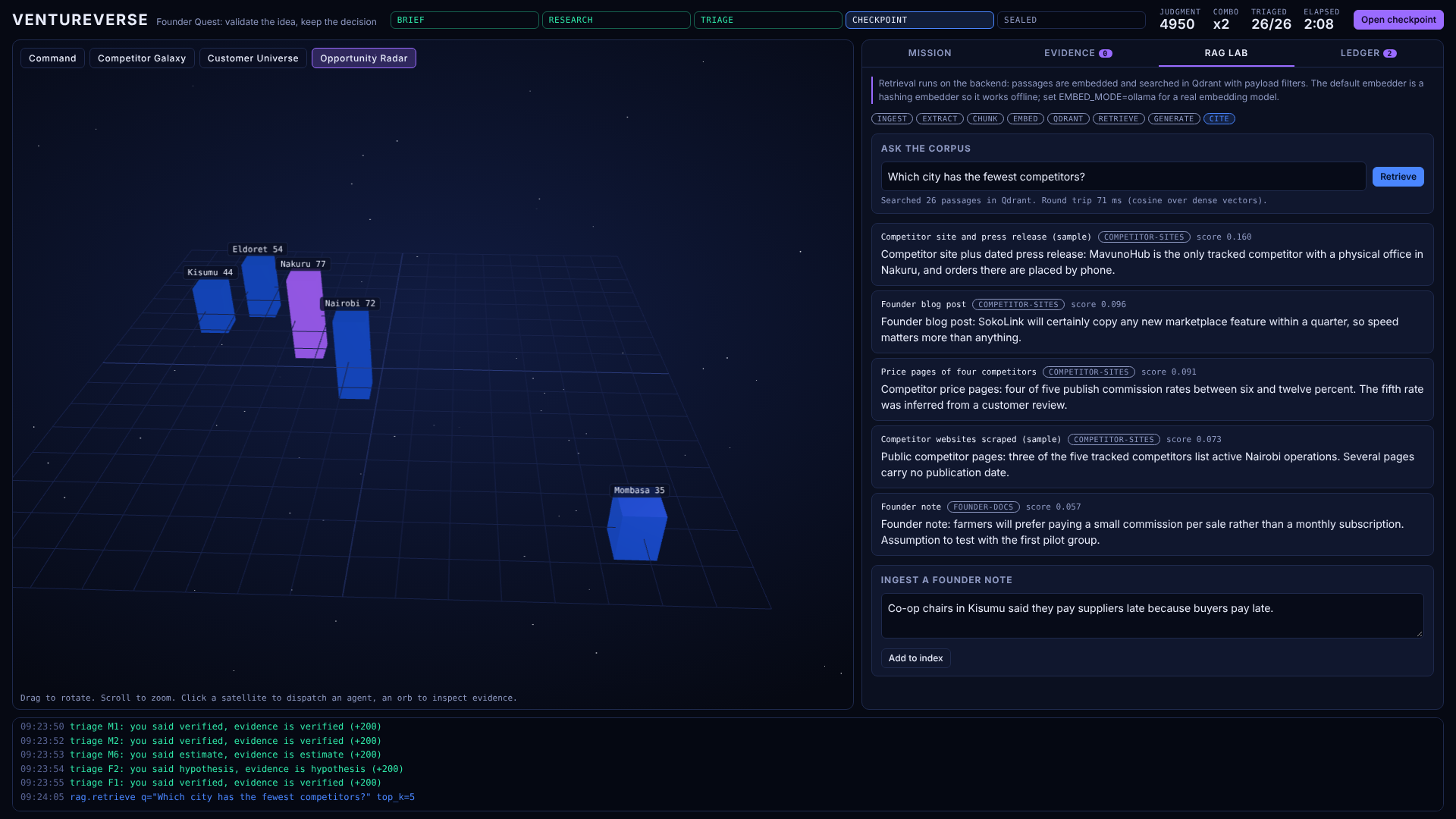
The platform incorporates Retrieval-Augmented Generation (RAG) capabilities supported by Qdrant-backed evidence retrieval.
Founders can:
- Search relevant evidence passages.
- Inspect supporting claims.
- Ingest their own research notes.
- Review information associated with their venture mission.
- Examine the relationship between research evidence and generated recommendations.
This makes the validation process more transparent and provides a foundation for evidence-informed decisions.
4. Interactive Venture Intelligence Command Center
The React-based dashboard provides a centralized environment for managing venture research missions.
It includes:
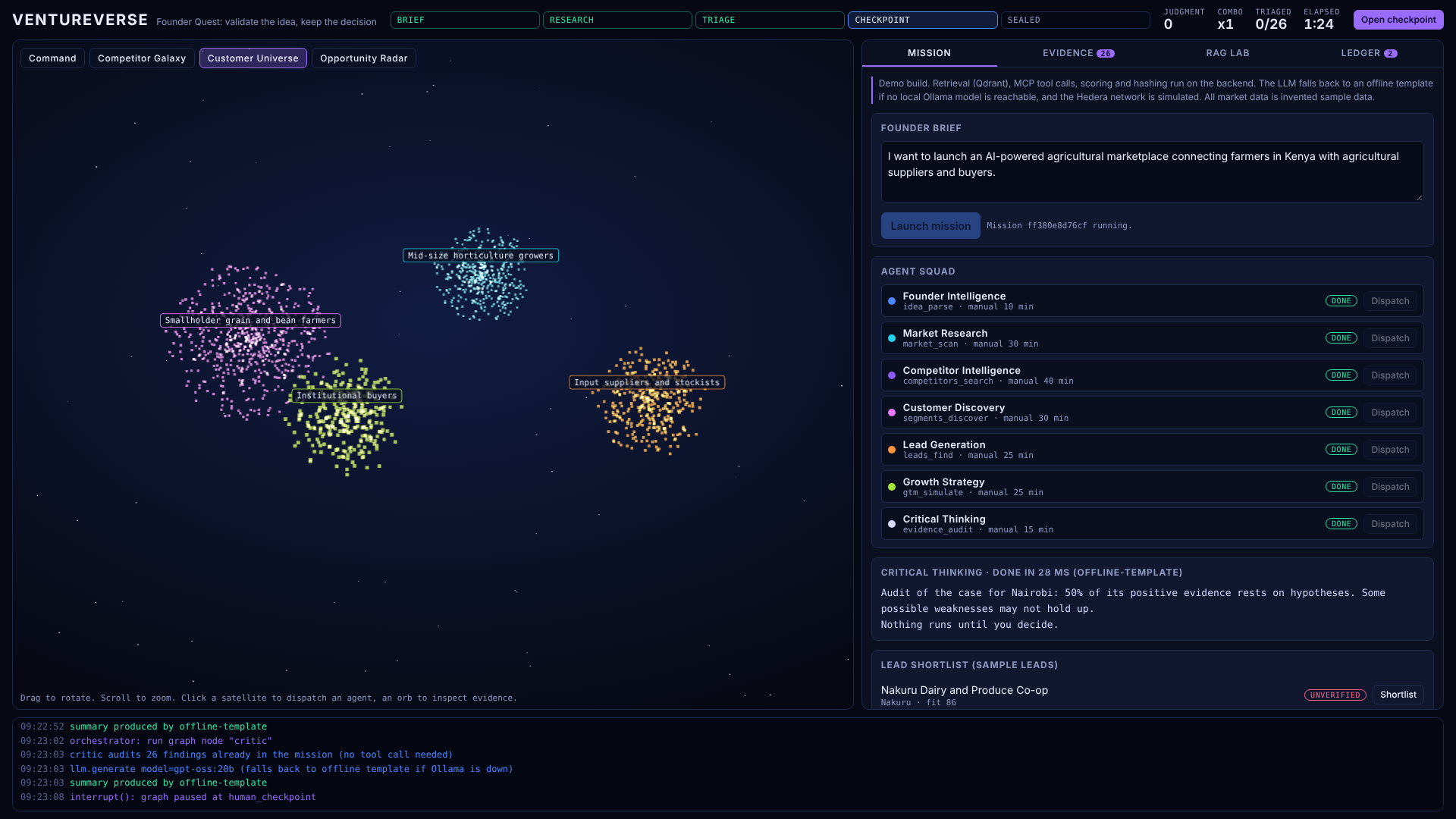
- An interactive command-center interface.
- A 3D visualization stage.
- A mission management panel.
- An agent execution queue.
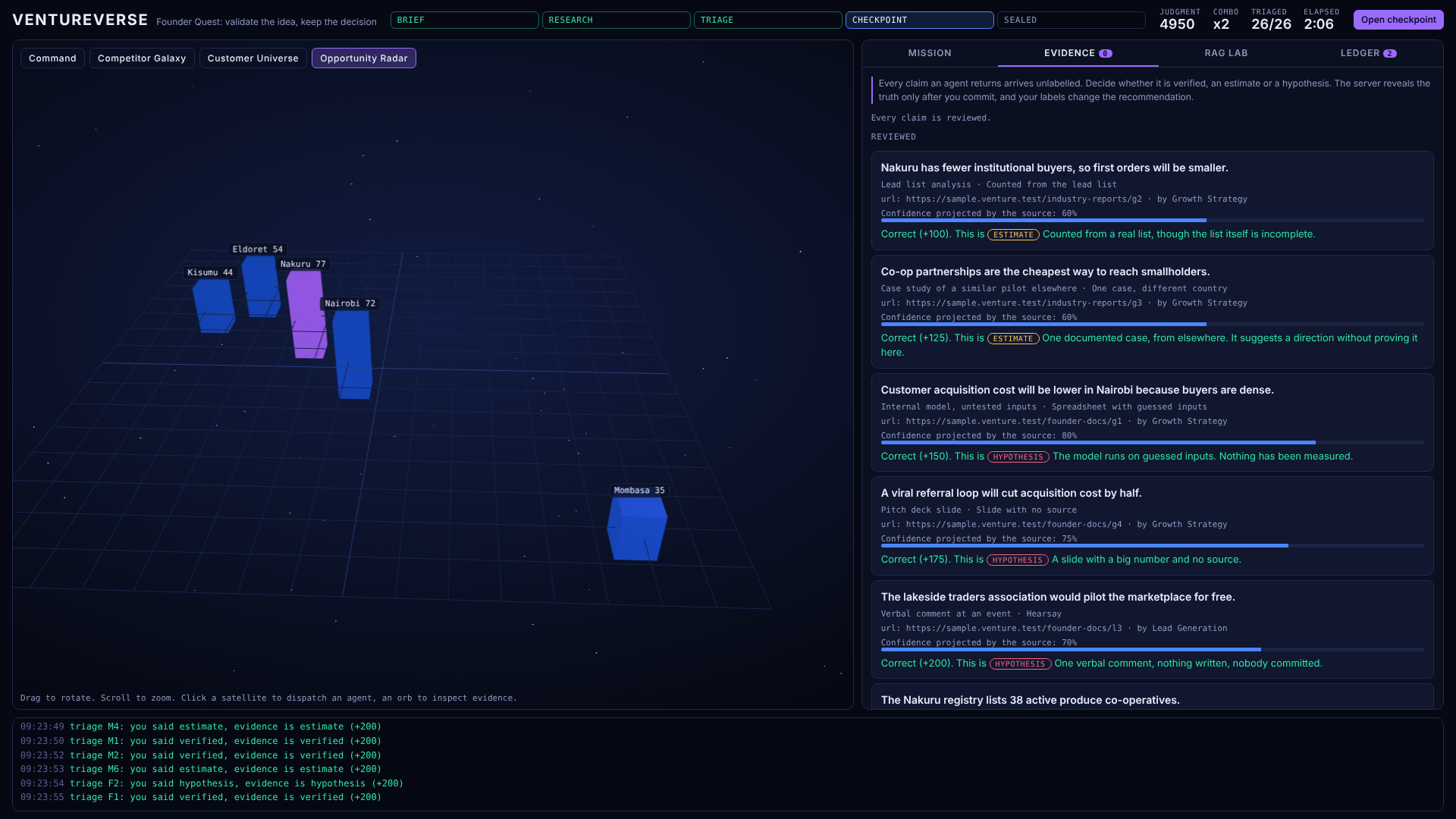
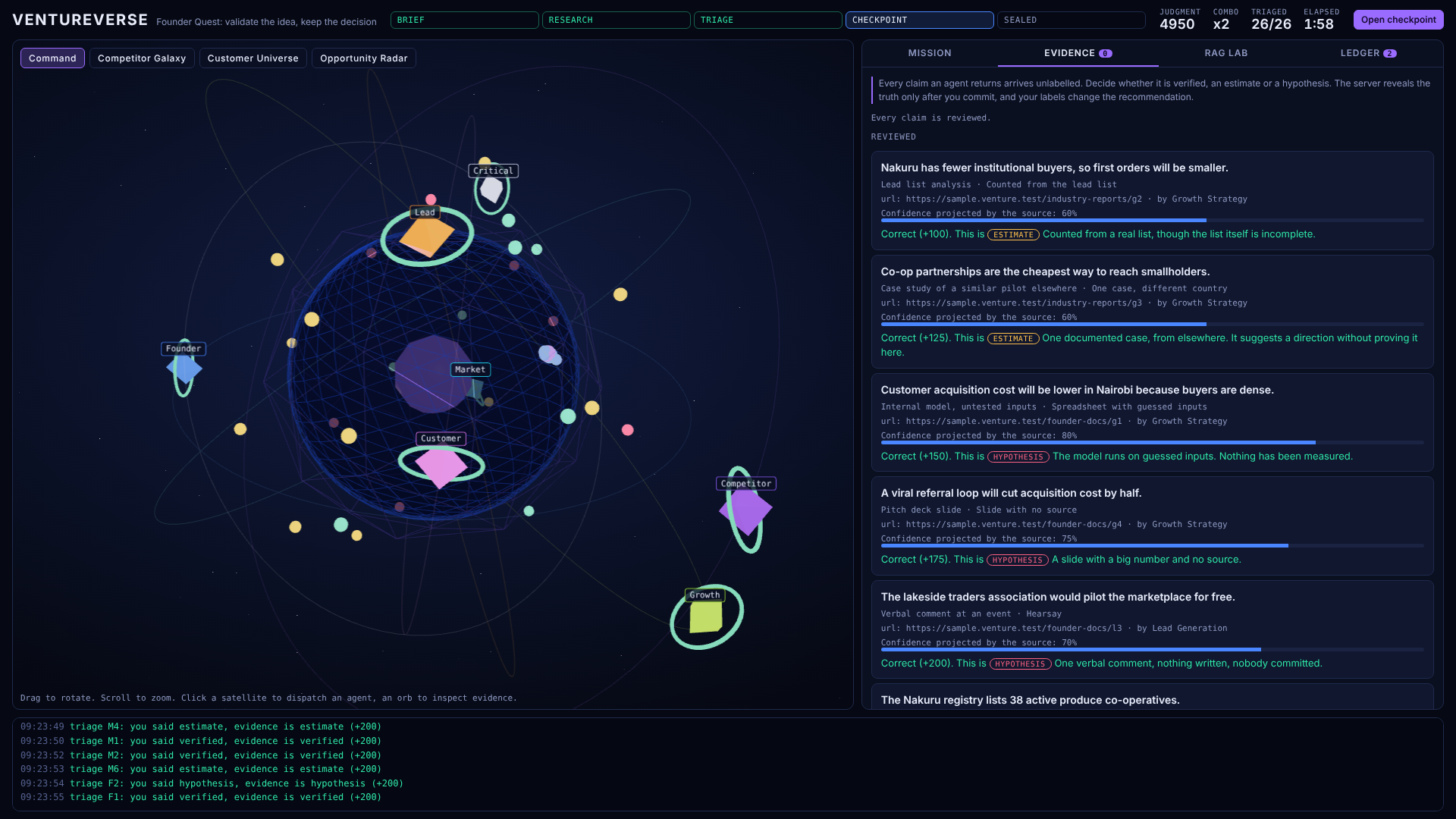
- Evidence exploration panels.
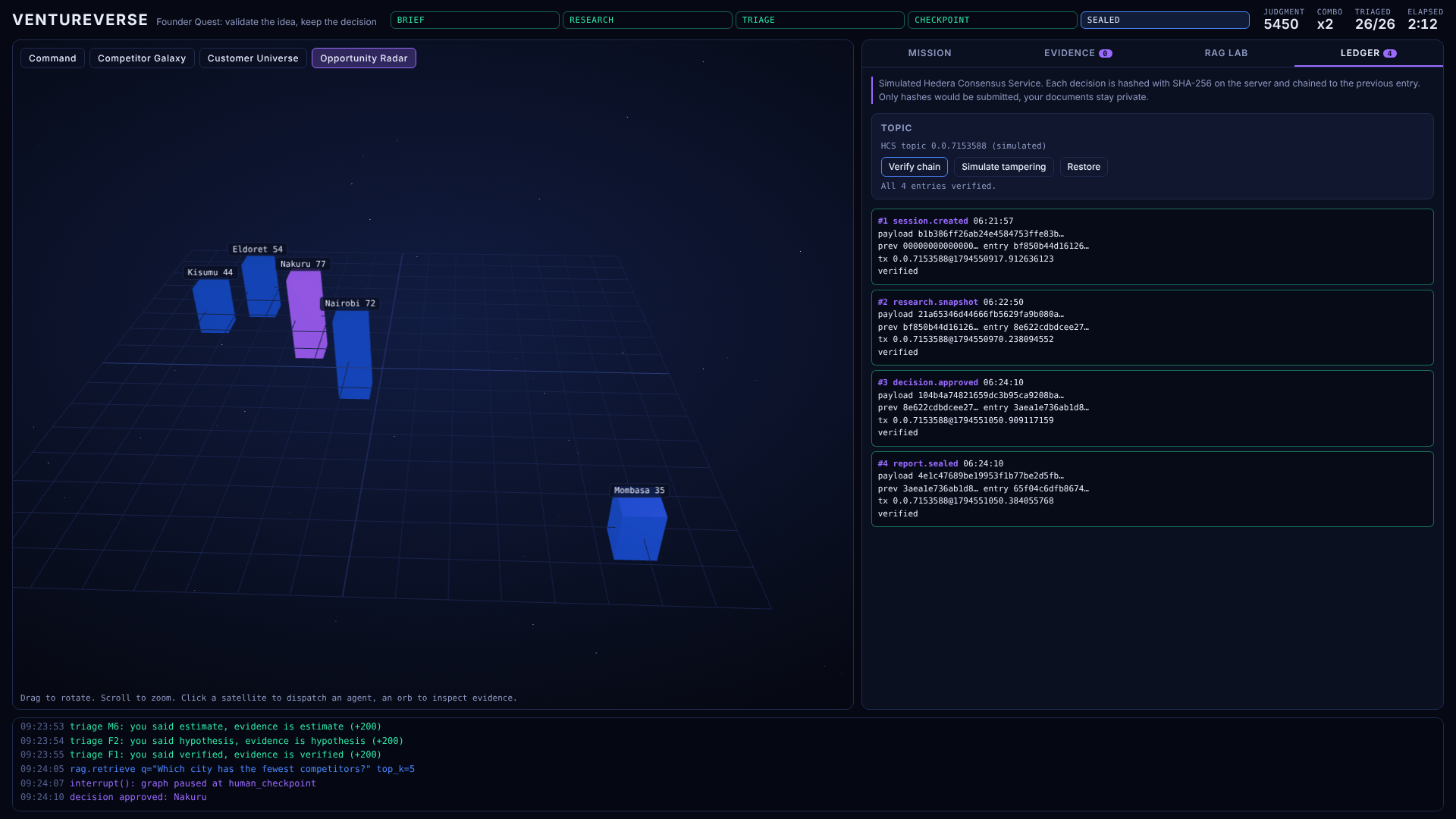
- Ledger history and verification.
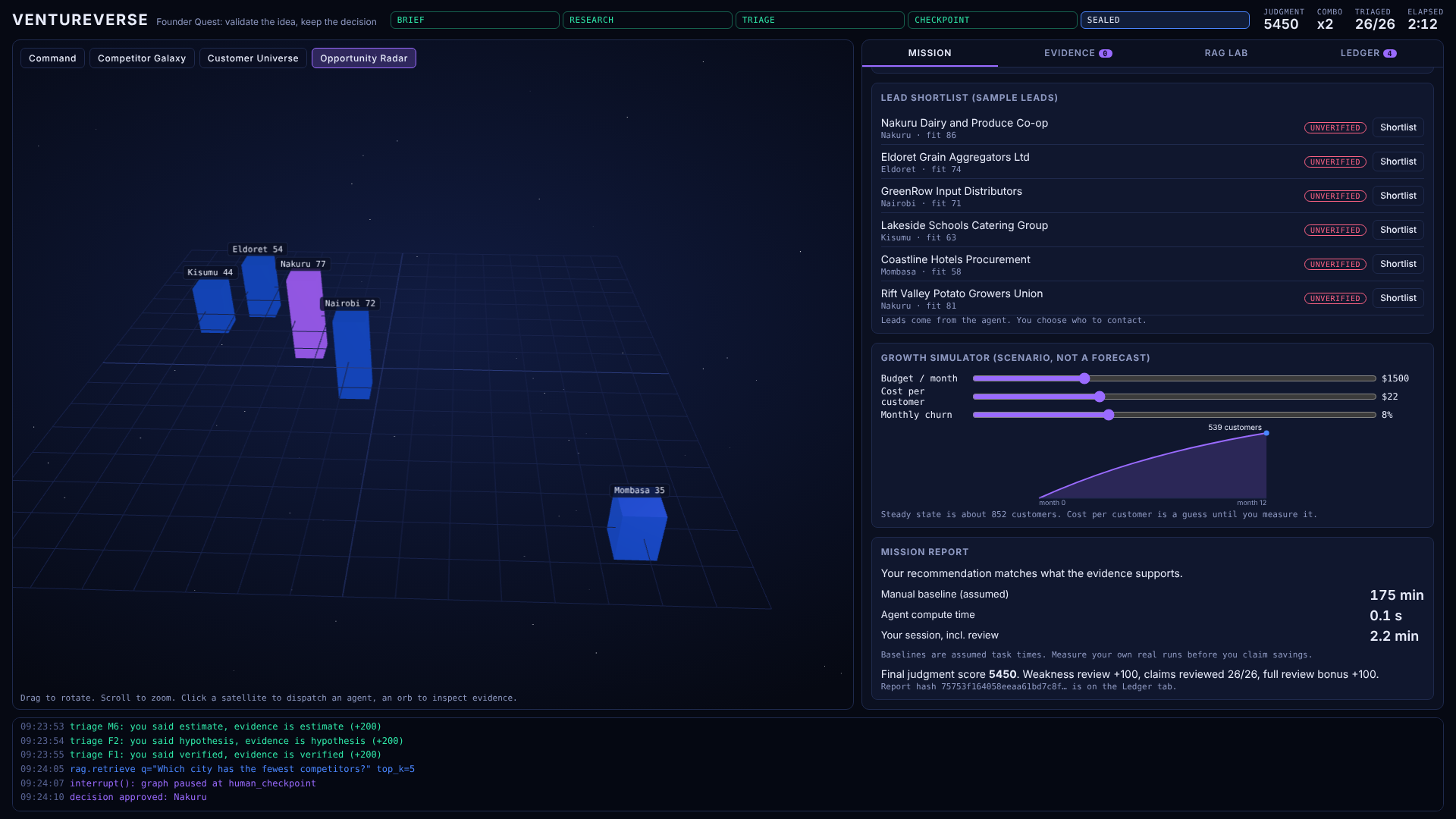
- Interactive recommendation checkpoints.
5. Geospatial Market Intelligence
VentureVerse includes an interactive map designed to emphasize Nairobi as the initial market anchor while displaying other relevant Kenyan cities and towns within the same geographical context.
This enables founders to visualize market locations and understand the broader regional footprint of their venture research.
6. Human-in-the-Loop Decision Intelligence
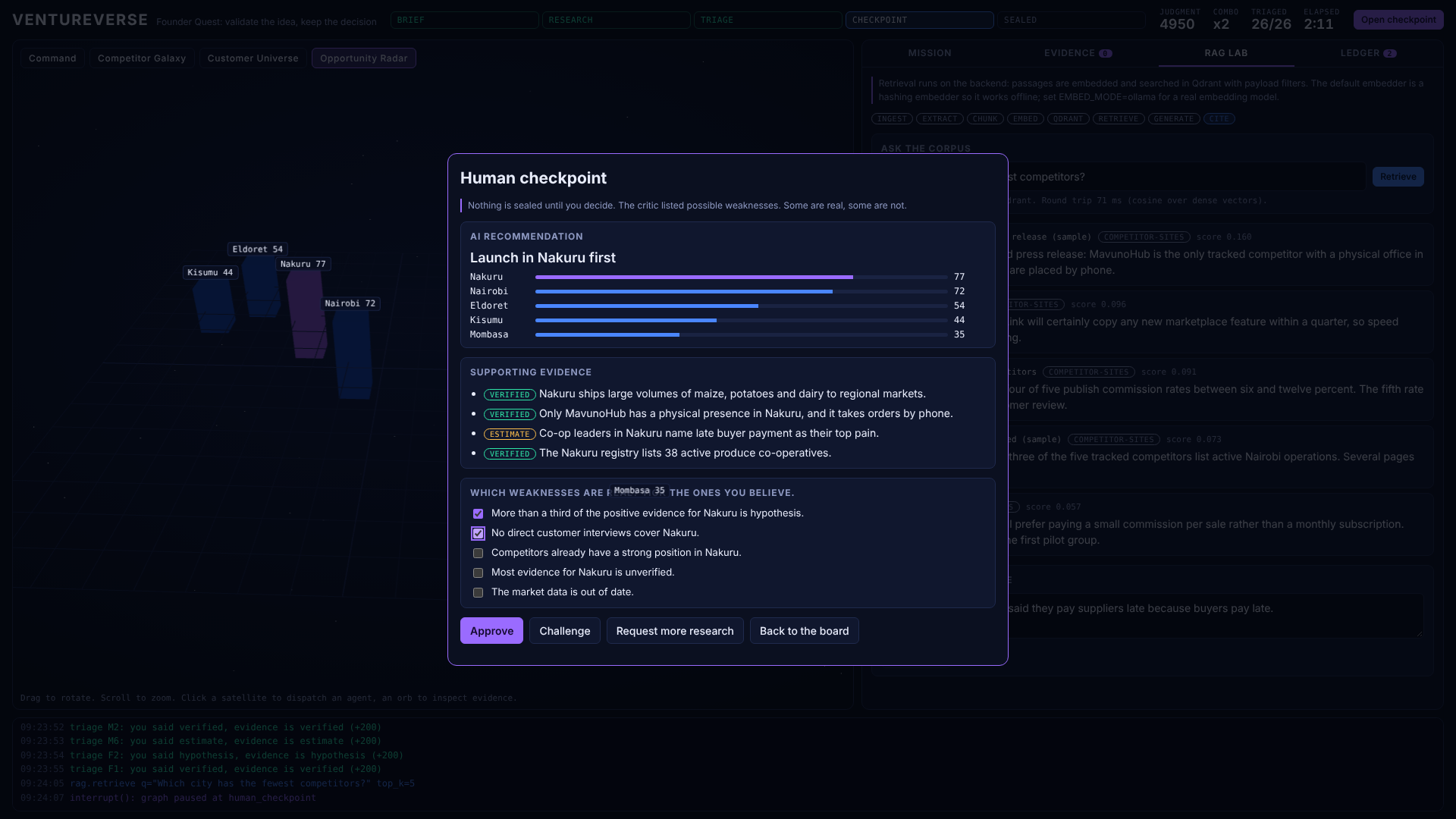
One of the platform's defining capabilities is its recommendation checkpoint.
After the research mission progresses, founders can review the findings and choose to:
- Approve: Accept the current recommendation and proceed.
- Challenge: Question the findings or challenge the underlying claims.
- Request More Research: Return the mission for additional investigation.
This ensures that AI supports entrepreneurial decision-making without removing the founder's authority.
7. Tamper-Evident Research History
The platform implements a hash-chained ledger that records mission-related activity and supports verification of ledger integrity.
Founders can inspect ledger history and verify the hash chain, providing an additional layer of transparency and accountability throughout the challenge workflow.
The current implementation uses a simulated ledger and Hedera-style anchoring for demonstration purposes rather than production blockchain anchoring.
8. Scenario Simulation
A dedicated scenario endpoint enables the platform to execute venture scenario simulations, extending the validation workflow beyond static research outputs.
9. MCP-Based Tool Integration
The project incorporates Model Context Protocol (MCP) client/server integration, providing a structured approach to connecting AI agents with tools and external capabilities.
10. Resilient AI Execution
VentureVerse supports local Ollama inference when available. When a local model is unavailable, it falls back to deterministic offline templates.
This allows the platform to maintain a functional demonstration experience without making its operation entirely dependent on external AI model availability.
The result: A unified venture intelligence environment that helps founders investigate opportunities, evaluate evidence, challenge assumptions, and make more informed decisions.
How we built it
We built VentureVerse Nexus AI as a full-stack, modular application using a Python-based intelligence backend and a modern React frontend. The architecture separates AI orchestration, research retrieval, mission management, scoring, visualization, and verification into dedicated components.
Our objective was to create an extensible platform where multiple AI agents could collaborate through a coordinated workflow while maintaining transparency, reliability, and human oversight.
Backend architecture
The backend was developed using Python 3.11 and FastAPI, providing the API infrastructure responsible for managing missions, coordinating agents, evaluating venture opportunities, and processing research requests.
Key backend components include:
- Agent Orchestrator: Coordinates the execution of the seven research agents and manages their mission workflow.
- Scoring Engine: Processes venture assessment logic and generates structured opportunity scores.
- Mission Management: Creates missions, tracks their state, and manages the progression of research activities.
- RAG Engine: Retrieves relevant evidence passages and supports contextual research using Qdrant.
- LLM Integration: Connects to locally available Ollama models while maintaining a deterministic fallback for offline operation.
- MCP Gateway and Registry: Provides the integration infrastructure for connecting agents to tools and managing tool capabilities.
- Ledger Engine: Maintains a hash-chained history of mission activity and supports integrity verification.
- Scenario Engine: Provides an API endpoint for running venture scenario simulations.
Frontend and user experience
The frontend was developed using React 18, TypeScript, and Vite.
We designed an interactive command-center experience rather than a conventional business analytics dashboard.
The interface incorporates:
- React Three Fiber for the interactive 3D visualization stage.
- Leaflet and React Leaflet for geographical market visualization.
- Mission panels for monitoring venture research.
- Agent queues for tracking execution.
- Evidence panels for reviewing research findings.
- RAG panels for exploring retrieved information.
- Ledger panels for inspecting verification history.
- Checkpoint modals for founder approval, challenges, and additional research requests.
Data and intelligent retrieval
We integrated Qdrant as the vector retrieval infrastructure for storing and searching evidence passages.
The platform also supports the ingestion of founder-provided research notes, allowing the evidence store to incorporate additional venture-specific context.
Mission state is maintained in memory in the current implementation, while Qdrant supports evidence retrieval.
AI and model infrastructure
Our AI infrastructure supports two execution paths:
- Local inference through Ollama when a compatible local model is available.
- Deterministic offline-template execution when the local model is unavailable.
This approach allows the platform to demonstrate its mission workflow without requiring continuous access to an external model provider.
MCP integration
We incorporated Model Context Protocol through a dedicated MCP server and client integration layer.
This establishes a structured foundation for agent-to-tool communication and future expansion of the platform's research capabilities.
Integrity and trust architecture
We implemented a hash-chained ledger that records mission history and allows the system to verify the integrity of the recorded chain.
For the demonstration, we included a simulated Hedera-style ledger anchoring experience. This is explicitly a simulation rather than a production Hedera network integration.
Testing and deployment
We structured the project as a full-stack monorepo containing:
- Backend application.
- Frontend application.
- MCP server.
- Automated backend tests.
- End-to-end smoke testing.
- Docker configuration.
- Docker Compose configuration.
- Makefile-based development and deployment commands.
The backend test suite covers API functionality, scoring, ledger verification, LLM behavior, and MCP interactions. Playwright-based end-to-end smoke testing is also configured.
This architecture provides a modular foundation for evolving VentureVerse from a demonstration platform into a more comprehensive venture intelligence ecosystem.
Challenges we ran into
Developing VentureVerse Nexus AI required solving several architectural and engineering challenges associated with coordinating multiple AI agents, managing evidence, maintaining application reliability, and presenting complex intelligence workflows through an intuitive interface.
1. Coordinating multiple autonomous agents
One of our primary challenges was designing a structured execution workflow for seven specialized agents.
A multi-agent system introduces coordination complexity: missions need to progress in a predictable sequence, outputs must be organized, and the overall research experience must remain understandable to the founder.
We addressed this by implementing a centralized agent orchestration layer and mission-management infrastructure.
2. Maintaining evidence traceability
AI-generated market assessments are only useful when founders can examine the information behind them.
We needed to move beyond presenting recommendations without context.
Our solution was to incorporate Qdrant-backed retrieval, evidence exploration panels, claim inspection, and a research-note ingestion mechanism.
3. Balancing AI intelligence with reliability
Local AI models are not always available, and a demonstration platform should not become unusable because a model service is unavailable.
We addressed this through an Ollama integration with a deterministic offline-template fallback.
This allowed the platform to maintain its core demonstration workflow under different execution conditions.
4. Designing meaningful human oversight
We wanted the platform to be autonomous in research execution without allowing AI to make final entrepreneurial decisions on behalf of founders.
Designing the checkpoint workflow required balancing automated recommendations with meaningful user control.
We implemented three explicit decision paths: approve, challenge, and request more research.
5. Making complex intelligence accessible
Multi-agent orchestration, evidence retrieval, geographical data, and ledger verification can become overwhelming when presented as conventional technical outputs.
We addressed this through a mission-driven command-center interface with dedicated panels, agent queues, evidence views, a 3D stage, and an interactive map.
6. Building a geographically relevant market experience
We wanted the platform to reflect the realities of entrepreneurship in Kenya rather than present market research as an abstract global concept.
We designed the map to emphasize Nairobi while preserving visibility of other relevant Kenyan cities and towns within the same geographical scene.
7. Demonstrating trust without overstating blockchain integration
Another challenge was communicating the importance of transparent research history while distinguishing a working integrity-verification mechanism from a production blockchain deployment.
We implemented a hash-chained ledger with verification functionality and a simulated Hedera-style anchoring experience, keeping the demonstration's technical boundaries explicit.
Accomplishments that we're proud of
Building VentureVerse Nexus AI has been an opportunity to combine multi-agent AI, market intelligence, evidence retrieval, interactive visualization, and human-centered decision support into one integrated application.
Some of our most important accomplishments include:
1. Building a seven-agent venture research workflow
We successfully developed an orchestration architecture capable of coordinating seven research agents through a structured mission workflow.
2. Creating an integrated venture intelligence platform
Instead of building isolated AI tools, we brought mission management, opportunity scoring, evidence retrieval, scenario simulation, geographical visualization, and verification into one application.
3. Implementing evidence-oriented intelligence
The integration of Qdrant-backed retrieval, evidence inspection, claim labeling, and founder research-note ingestion creates a foundation for more transparent venture assessments.
4. Putting founders in control of AI recommendations
We are particularly proud of the recommendation checkpoint, which allows founders to approve findings, challenge claims, or request additional investigation.
This reinforces our philosophy that AI should strengthen human judgment rather than replace it.
5. Developing an interactive 3D command center
The combination of React Three Fiber, mission panels, agent queues, and geospatial visualization gives VentureVerse a distinctive interface for interacting with venture intelligence.
6. Bringing an African market perspective into venture intelligence
By centering Nairobi and incorporating other relevant Kenyan cities and towns, we created a geographically grounded starting point for investigating entrepreneurial opportunities in the region.
7. Implementing verifiable mission history
We developed a hash-chained ledger with a verification endpoint, allowing mission history integrity to be examined rather than treating research records as opaque outputs.
8. Engineering resilience into the AI experience
The Ollama integration and deterministic offline fallback demonstrate our commitment to building an application that remains demonstrable even when local model infrastructure is unavailable.
9. Building a modular, testable full-stack architecture
We are proud of the separation of responsibilities across the backend, frontend, MCP server, retrieval infrastructure, testing suite, and deployment configuration.
10. Establishing a foundation for scalable expansion
VentureVerse is not simply a business-plan generator. It is a foundation for an extensible venture intelligence ecosystem in which additional agents, tools, evidence sources, market datasets, and analytical capabilities can be incorporated over time.
Our biggest accomplishment is bringing these capabilities together around one central mission: helping entrepreneurs make better decisions through structured intelligence and verifiable evidence.
What we learned
Building VentureVerse Nexus AI taught us that developing an effective AI-powered platform involves much more than connecting a language model to an application.
We learned several important lessons:
Multi-agent systems require orchestration, not just multiple models.
Creating specialized agents is only one part of the problem. The real engineering challenge is coordinating their responsibilities, managing execution order, structuring outputs, and ensuring that the complete workflow produces useful results.
AI recommendations should be supported by inspectable evidence.
A confident AI-generated recommendation does not automatically make it reliable. Integrating retrieval and evidence inspection helped us appreciate the importance of making research traceable and allowing users to challenge claims.
Human oversight is essential in consequential decisions.
Entrepreneurial decisions involve financial commitments, personal ambitions, and significant uncertainty. AI can help investigate opportunities, but founders should retain authority over important decisions.
Resilience should be designed into AI infrastructure.
Dependence on a single model or external service can make an application fragile. Supporting local inference and offline fallbacks helped us understand the value of designing for different execution environments.
Good visualization improves the accessibility of complex technology.
A well-designed interface can make sophisticated backend processes easier to understand. The command-center approach helped translate agent activity, evidence, and research progress into an interactive experience.
Trust must be engineered, not merely advertised.
The hash-chained ledger reinforced an important lesson: transparency requires mechanisms that users can inspect and verify. We also learned to distinguish simulated integrations from production-grade infrastructure.
Emerging markets deserve intelligent, context-aware technology.
Market intelligence should reflect local realities, geography, business environments, and regional opportunities. Our Nairobi-centered approach reinforced the importance of developing technology with its intended users and markets in mind.
Ultimately, we learned that the most valuable AI systems are not necessarily those that generate the most content, but those that help people understand complex problems, evaluate evidence, and make better decisions.
What's next for VentureVerse Nexus AI: Autonomous Venture Intelligence
Our vision is to evolve VentureVerse Nexus AI into a comprehensive autonomous venture intelligence ecosystem that supports entrepreneurs from the earliest stages of idea discovery through market validation, strategic planning, and business growth.
The current platform establishes the foundation. Our next phase will focus on expanding its intelligence capabilities, strengthening real-world data integrations, improving analytical depth, and making venture validation more accessible across emerging and global markets.
Our roadmap includes:
1. Expanding the Multi-Agent Intelligence Network
We plan to evolve the existing seven-agent architecture with additional specialized agents covering:
- Customer discovery and sentiment intelligence.
- Competitor intelligence and positioning.
- Market sizing and opportunity assessment.
- Financial forecasting and unit economics.
- Business model evaluation.
- Regulatory and compliance research.
- Investment readiness and fundraising intelligence.
- Risk assessment and mitigation strategies.
The objective is to create a collaborative network of specialized intelligence agents capable of investigating different dimensions of a business opportunity.
2. Real-Time Market Intelligence
We aim to integrate reliable external data sources, business databases, industry reports, economic indicators, and market intelligence services.
This will allow founders to move beyond sample demonstration datasets toward continuously updated, evidence-backed market assessments.
3. Advanced Financial and Business Simulation
We plan to introduce more comprehensive financial modelling capabilities, including:
- Revenue and expense projections.
- Customer acquisition cost (CAC).
- Customer lifetime value (LTV).
- Break-even analysis.
- Cash-flow forecasting.
- Pricing optimization.
- Scenario-based financial projections.
- Best-case, expected-case, and worst-case modelling.
These capabilities will help founders evaluate the financial sustainability of their ideas before committing resources.
4. Stronger RAG and Knowledge Intelligence
We intend to expand the existing Qdrant-backed retrieval architecture with richer document ingestion, improved evidence ranking, source attribution, and more comprehensive research knowledge bases.
Our goal is to ensure that every important recommendation can be examined against relevant supporting information.
5. Production-Grade Blockchain Verification
We plan to explore actual Hedera network integration to move beyond the current simulated anchoring demonstration.
This would provide a foundation for independently verifiable research records, mission checkpoints, and evidence integrity proofs.
6. Pan-African Market Intelligence
We intend to expand the geographical intelligence capabilities beyond the initial Nairobi-centered Kenyan market view.
Future coverage will include additional African cities and markets, helping entrepreneurs understand regional opportunities, competitive landscapes, and market expansion possibilities.
7. Advanced Interactive Venture Simulation
We plan to enhance the existing scenario simulation capabilities with more sophisticated market-entry scenarios, competitive response modelling, sensitivity analysis, and business growth simulations.
Founders will be able to explore hypothetical decisions and examine how different assumptions could influence their venture outcomes.
8. Personalized Founder Intelligence
We envision a personalized workspace where founders can maintain venture profiles, track research progress, revisit previous decisions, compare market assessments, and continuously improve their business strategies.
9. Collaborative Venture Ecosystem
Future development will explore collaboration between founders, mentors, investors, research institutions, and startup support organizations.
This could transform VentureVerse into a shared intelligence environment connecting entrepreneurial ideas with relevant expertise and opportunities.
10. From Validation to Venture Growth
Our long-term objective is to move beyond evaluating whether a business idea is worth pursuing.
We want VentureVerse to support the entire entrepreneurial journey:
- Discover opportunities.
- Validate business ideas.
- Understand customers.
- Evaluate competition.
- Develop sustainable business models.
- Assess financial viability.
- Identify risks.
- Prepare for investment.
- Monitor market changes.
- Support strategic growth.
Our ultimate vision
We believe access to high-quality venture intelligence should not be limited to large corporations, established investors, or entrepreneurs with expensive consulting resources.
VentureVerse Nexus AI aims to democratize access to intelligent market research and structured business validation by giving founders an autonomous intelligence team that works alongside them.
We are building more than a business idea evaluation tool. We are building an intelligent decision-support ecosystem for the next generation of entrepreneurs.
VentureVerse Nexus AI — Transforming Ideas into Evidence, Evidence into Decisions, and Decisions into Ventures.
Built With
- docker
- docker-compose
- fastapi
- git
- github
- javascript
- leaflet.js
- model-context-protocol-(mcp)
- node.js
- ollama
- openapi
- playwright
- pytest
- python
- qdrant
- react-18
- react-leaflet
- react-three-fiber
- rest-api
- retrieval-augmented-generation-(rag)
- typescript
- uvicorn
- vite

