-
-
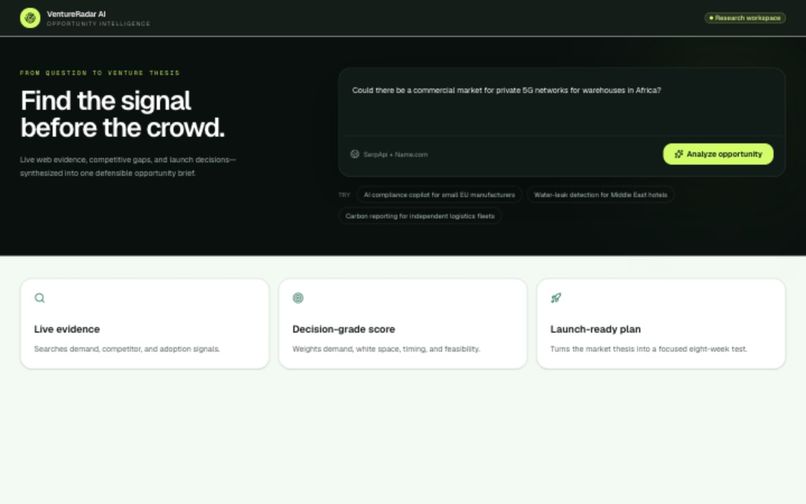
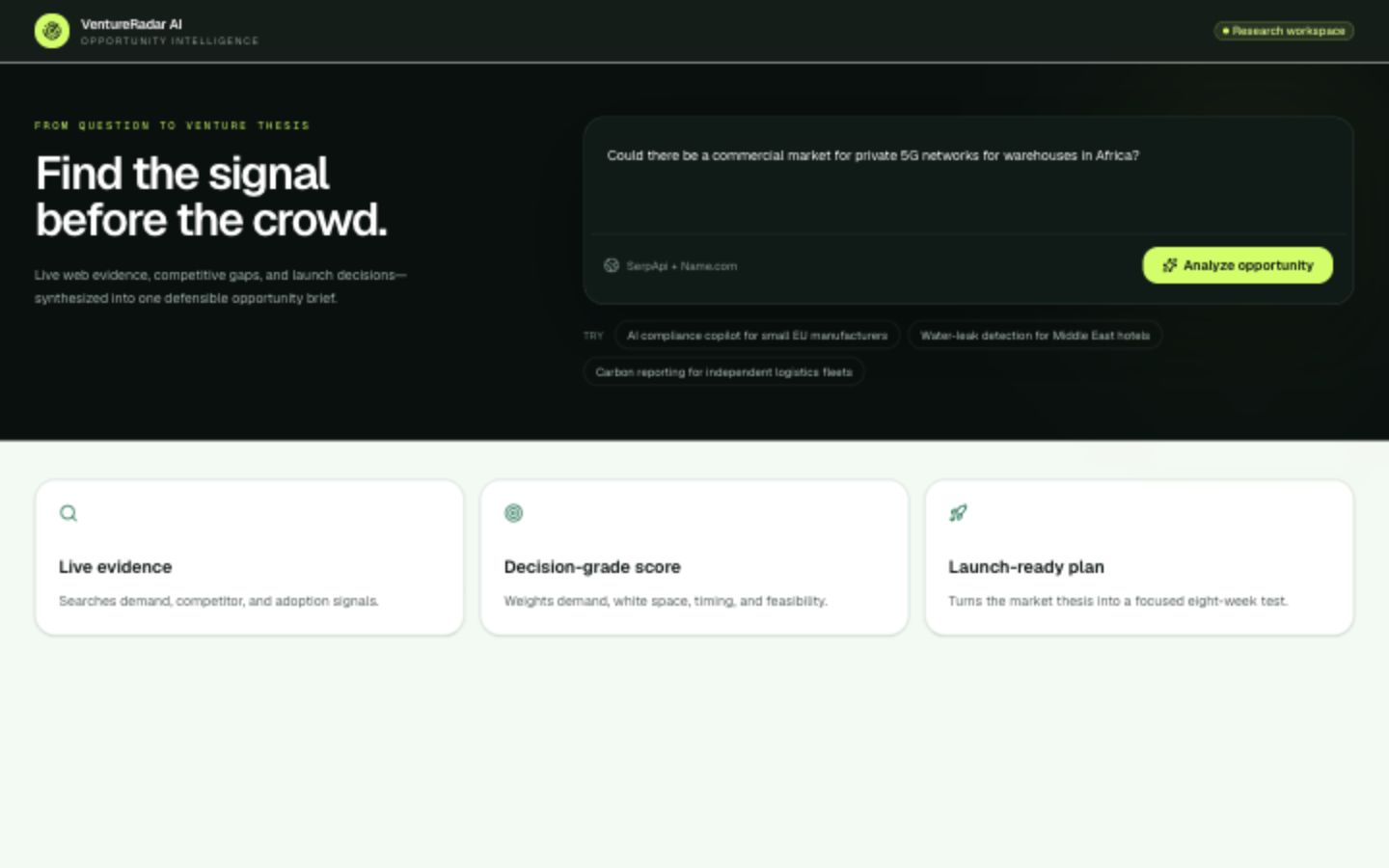
Ask one focused business or technology question.
-
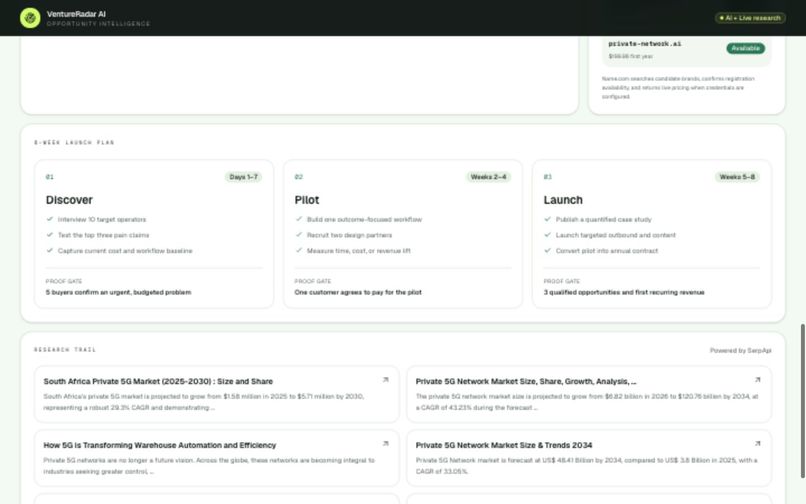
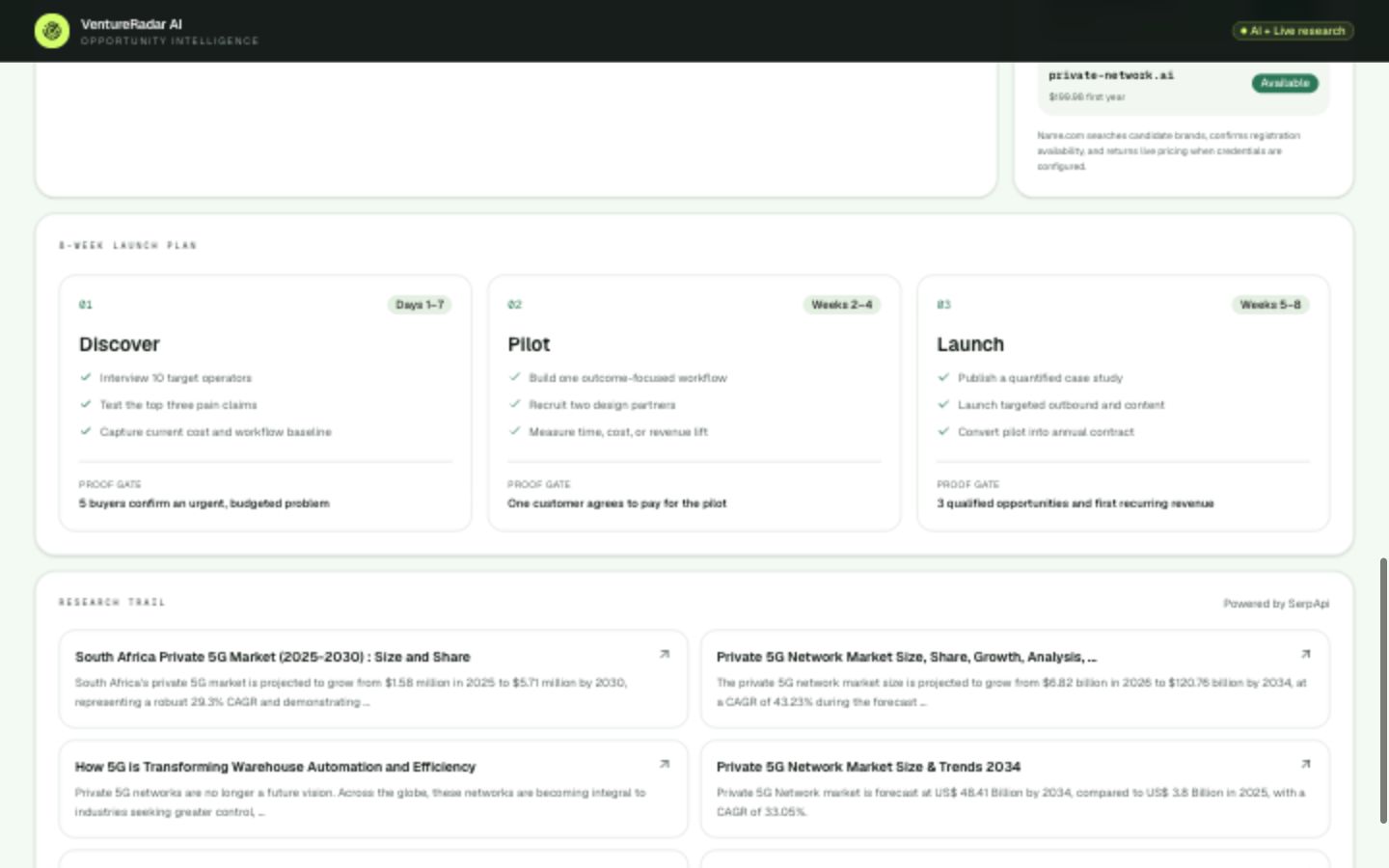
An eight-week launch plan turns the thesis into measurable proof.
-
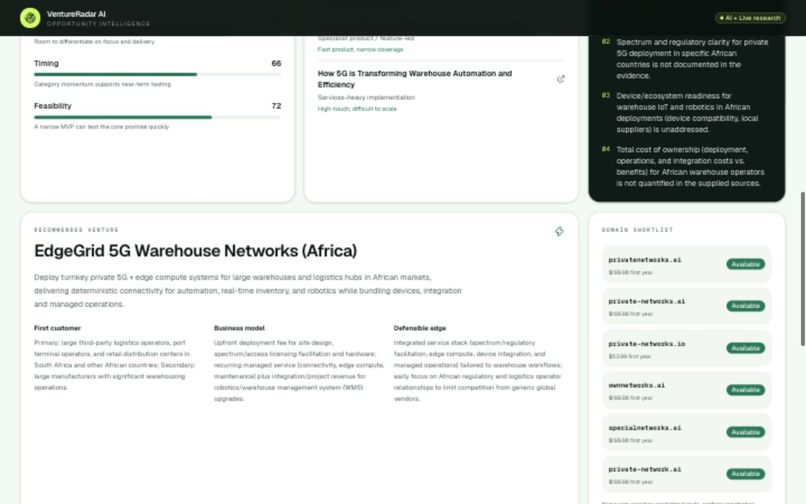
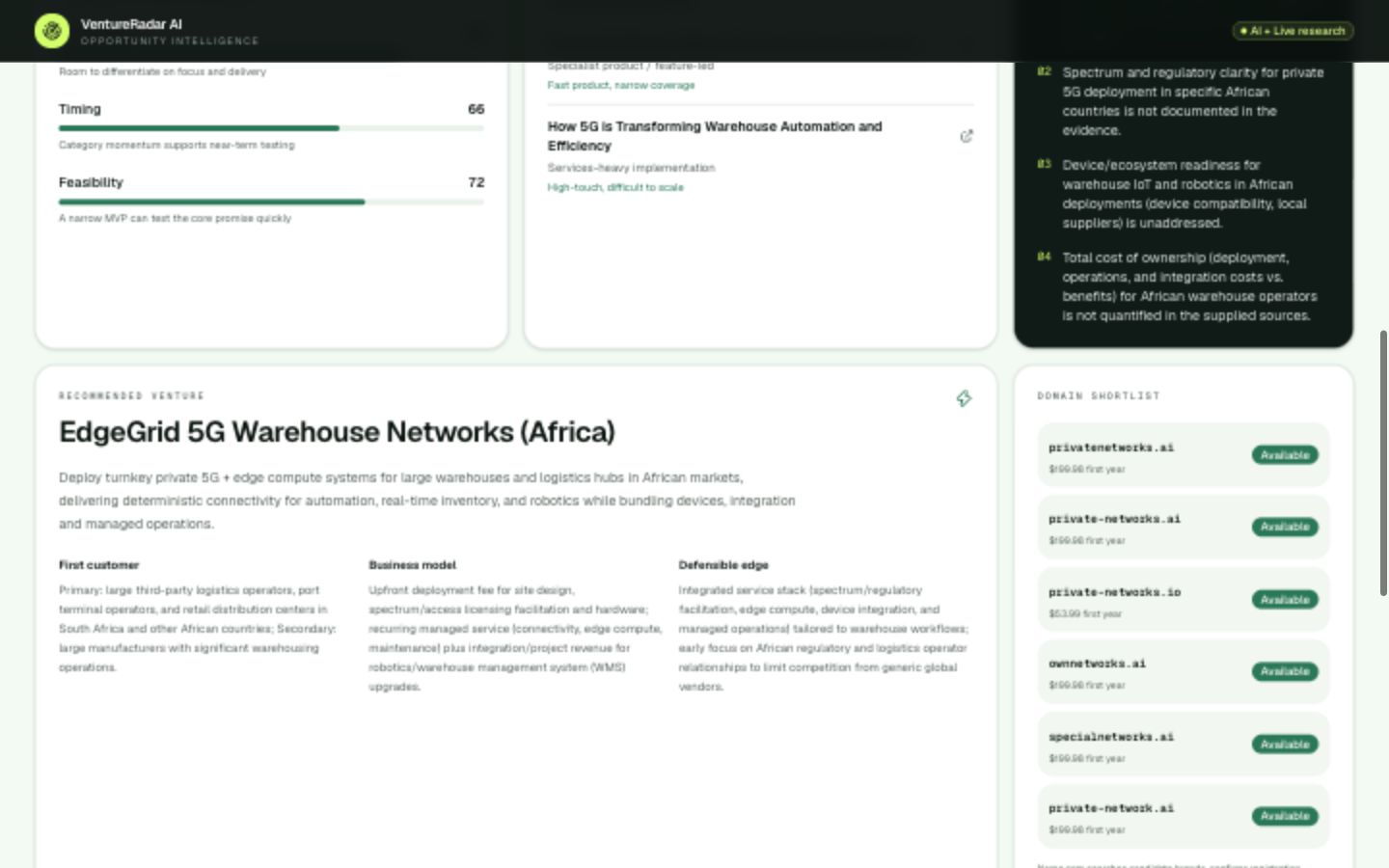
Market gaps become a focused venture and available domain shortlist.
-
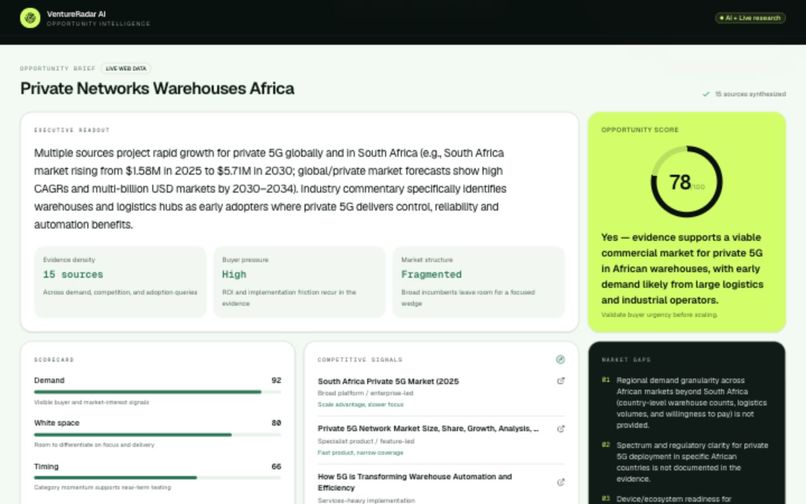
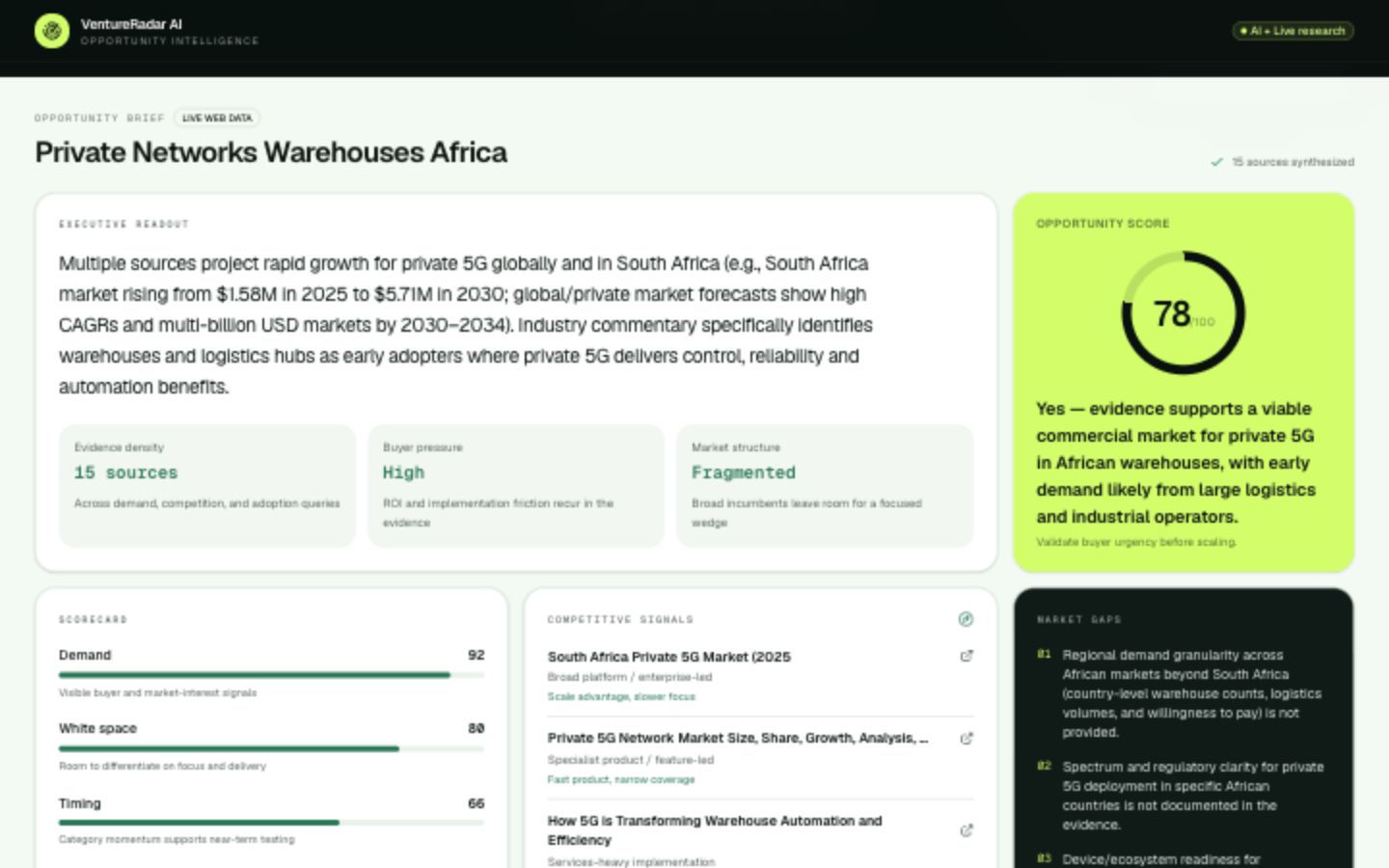
Live web evidence becomes an explainable opportunity score.
Inspiration
What it does
How we built it
Challenges we ran into
Accomplishments that we're proud of
What we learned
What's next for VentureRadar AI
Inspiration
Founders rarely lack ideas; they lack fast, trustworthy evidence. Early market research is scattered across search results, analyst pages, competitor sites, and disconnected spreadsheets. VentureRadar AI compresses that uncertainty into one decision-ready brief.
What it does
A founder asks one concrete market question. VentureRadar runs live research across demand, competition, and adoption barriers; shows the evidence trail; identifies competitive white space; scores the opportunity; proposes a focused venture; checks launchable domains; and maps the fastest route to customer proof.
The report includes:
- market and buyer signals
- competitor positioning
- an explainable score across demand, white space, timing, and feasibility
- specific underserved gaps
- a beachhead customer, business model, and defensible venture concept
- live domain availability and registration pricing
- an eight-week launch plan with measurable proof gates
How we built it
The responsive web application uses React, TypeScript, Vinext, Tailwind CSS, and Cloudflare-compatible server routes. SerpApi is the primary real-time intelligence layer. The OpenAI Responses API synthesizes only the collected evidence. Name.com's Core API performs keyword-based domain discovery and final availability and pricing checks. The app is deployed on OpenAI Sites.
Challenges we ran into
The hardest design problem was balancing speed with trust. A confident narrative is easy to generate, but a useful market brief needs inspectable evidence and graceful uncertainty. We kept scoring transparent, preserved the source trail, constrained AI synthesis to retrieved evidence, and isolated every integration so one provider cannot take down the workflow.
Domain discovery also needed to be more than decoration. The market thesis shapes the brand term, Name.com expands it into candidates, and availability plus pricing determines which names are realistically launchable.
Accomplishments we're proud of
- A complete question-to-launch workflow in one focused interface
- Parallel, real-time research rather than static training-data answers
- Evidence-grounded AI synthesis with visible sources
- Two meaningful Name.com operations: search plus availability and pricing validation
- A reliable demonstration path with transparent fallbacks
- A new project built from scratch during the hackathon
What we learned
Opportunity scoring is most useful when it starts a conversation rather than pretending to end one. Showing the dimensions behind the score, and attaching explicit proof gates to the launch plan, turns the report into a falsifiable thesis that a founder can test.
What's next
Saved research workspaces, collaborative annotations, longitudinal signal tracking, customer-interview evidence, and one-click domain registration plus DNS setup. We would also evaluate the opportunity score against outcomes from real startup validation experiments.
Built With
- cloudflare-workers
- name.com
- openai-api
- openai-sites
- react
- serpapi
- tailwind-css
- typescript
- vinext


Log in or sign up for Devpost to join the conversation.