-
-
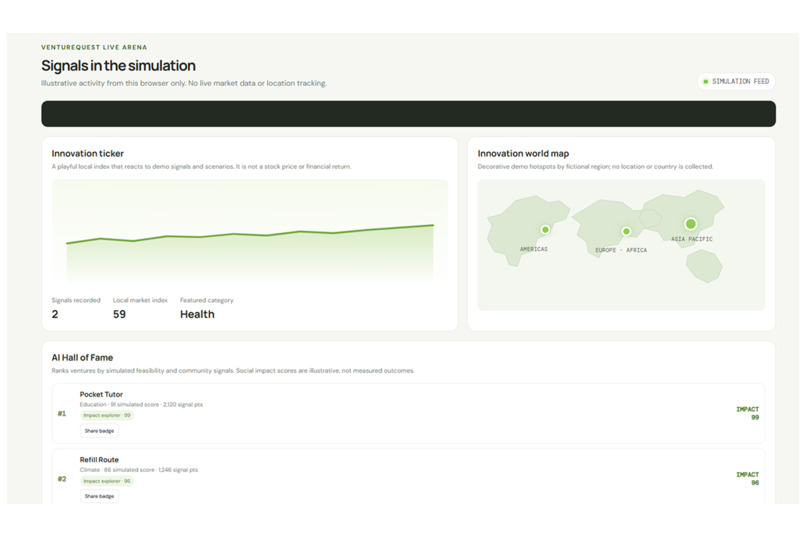
Live Arena
-
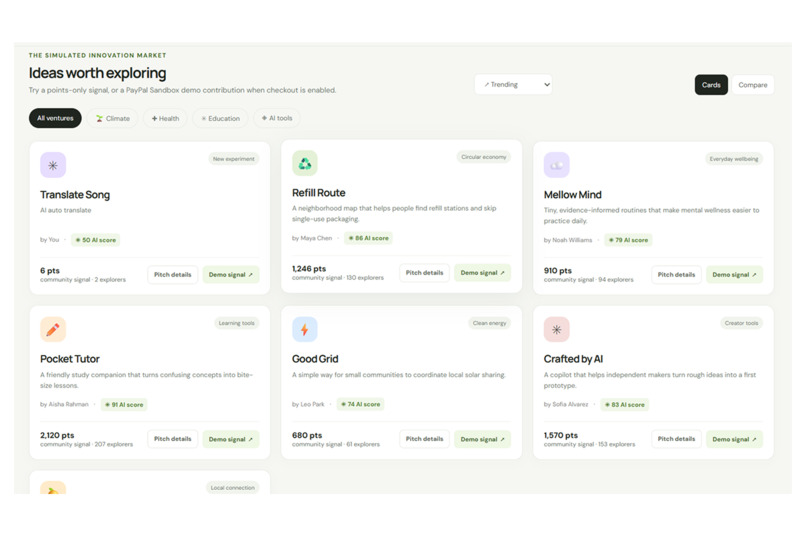
Exploring
-
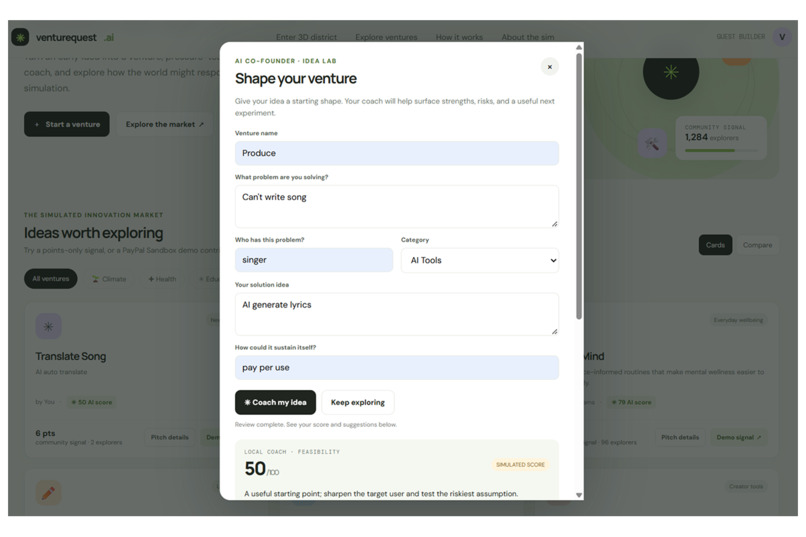
AI Coach
-
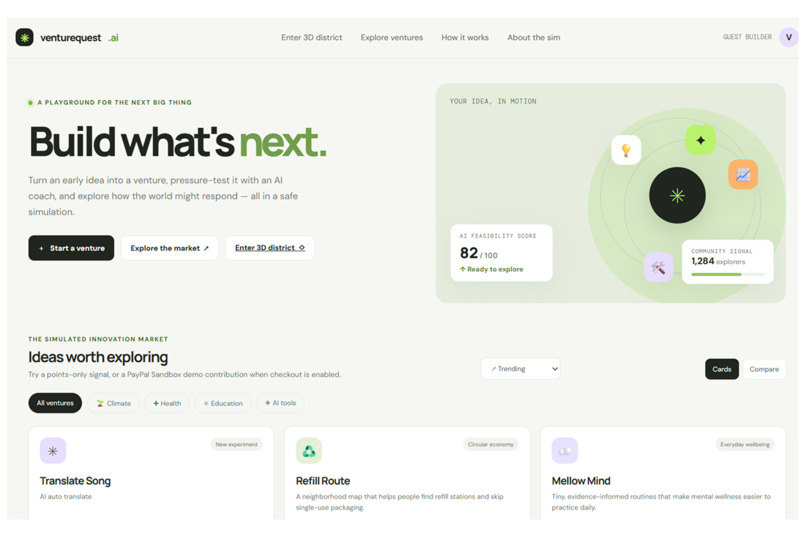
VentureQuest AI
-
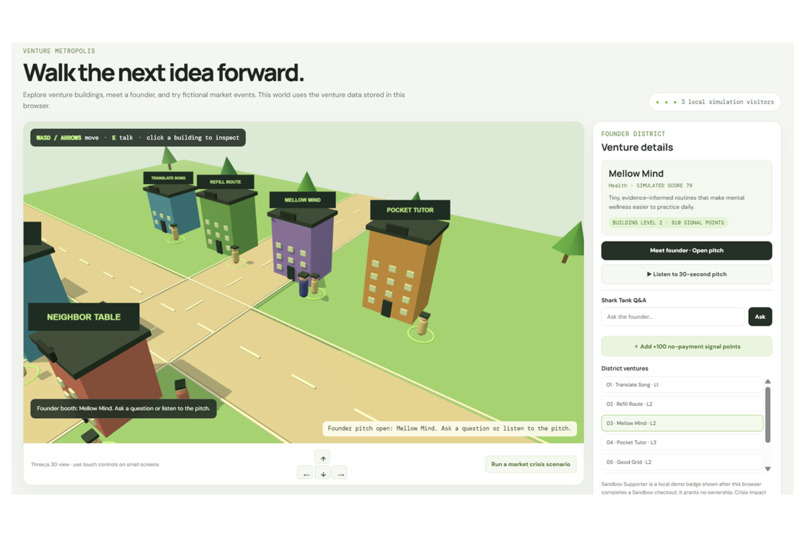
3D Innovation District
-
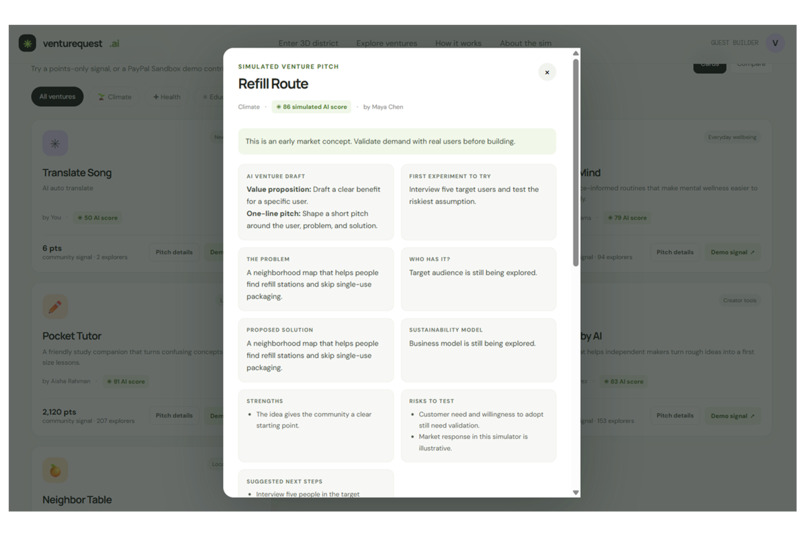
Pitch
-
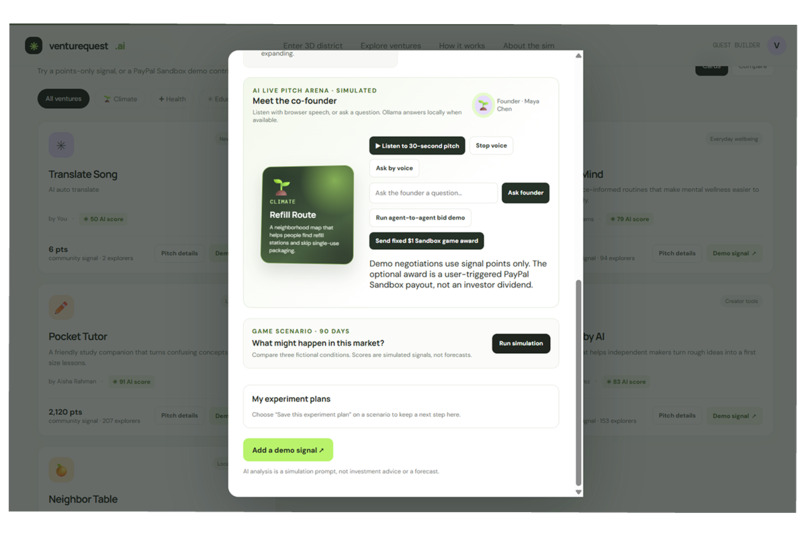
Pitch Arena
-
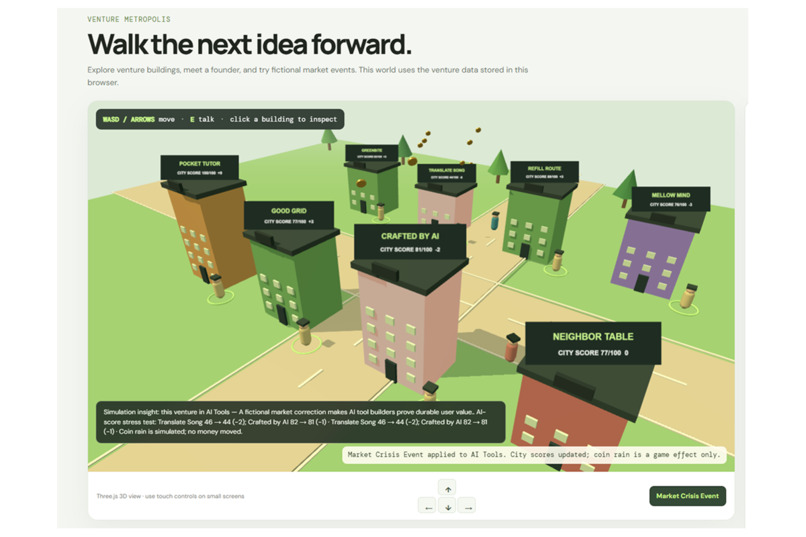
Crisis Event
Inspiration
Many people have promising ideas but lack the funding, startup network, or experience to test them. We wanted to make the first steps of venture building more approachable: describe a problem, get structured feedback, try a small experiment, and see how a fictional market might respond. We also wanted the PayPal integration to be part of the experience rather than a disconnected payment button, so the prototype connects an AI-guided demo contribution to a visible game-state update.
What it does
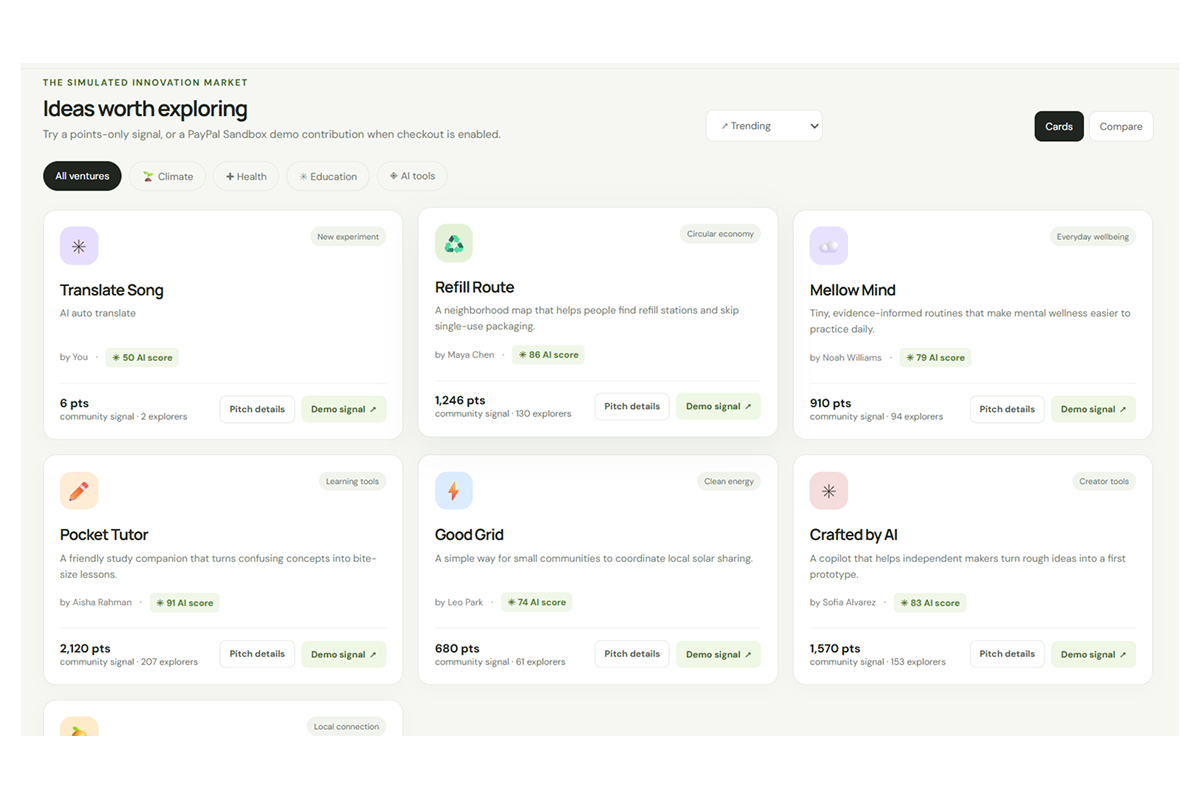
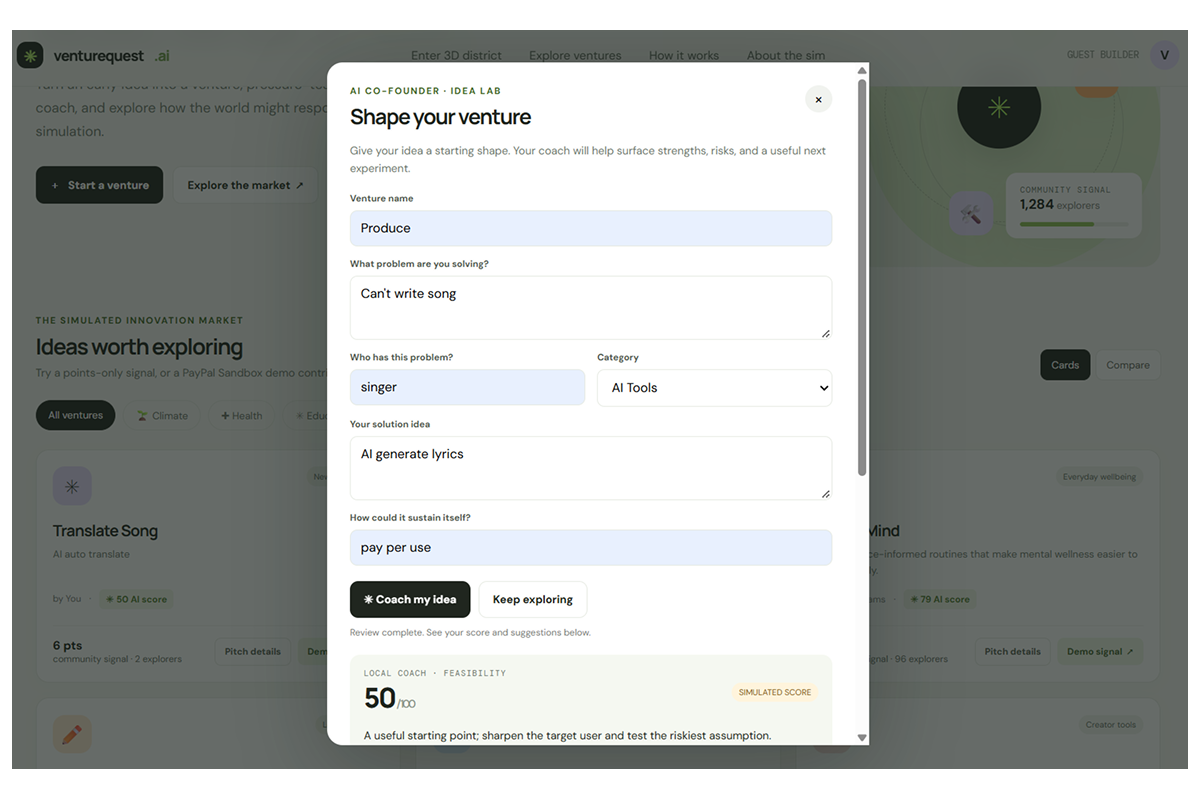
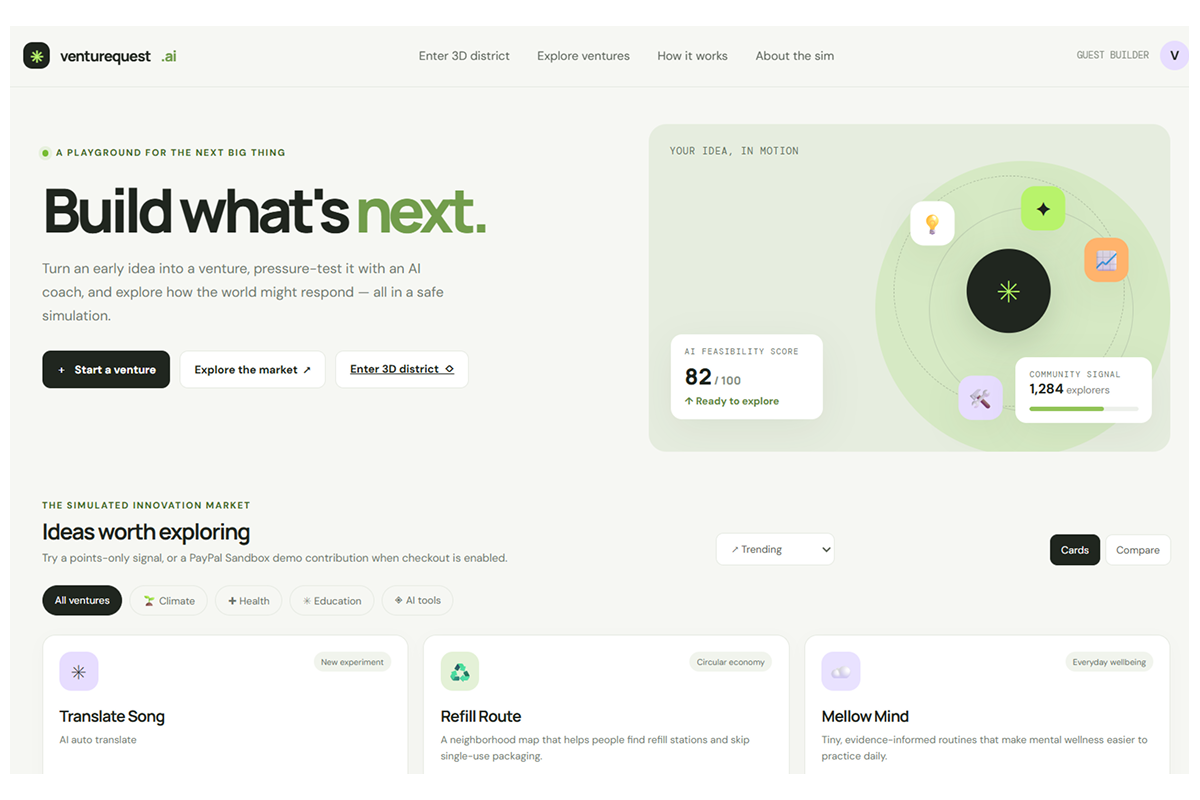
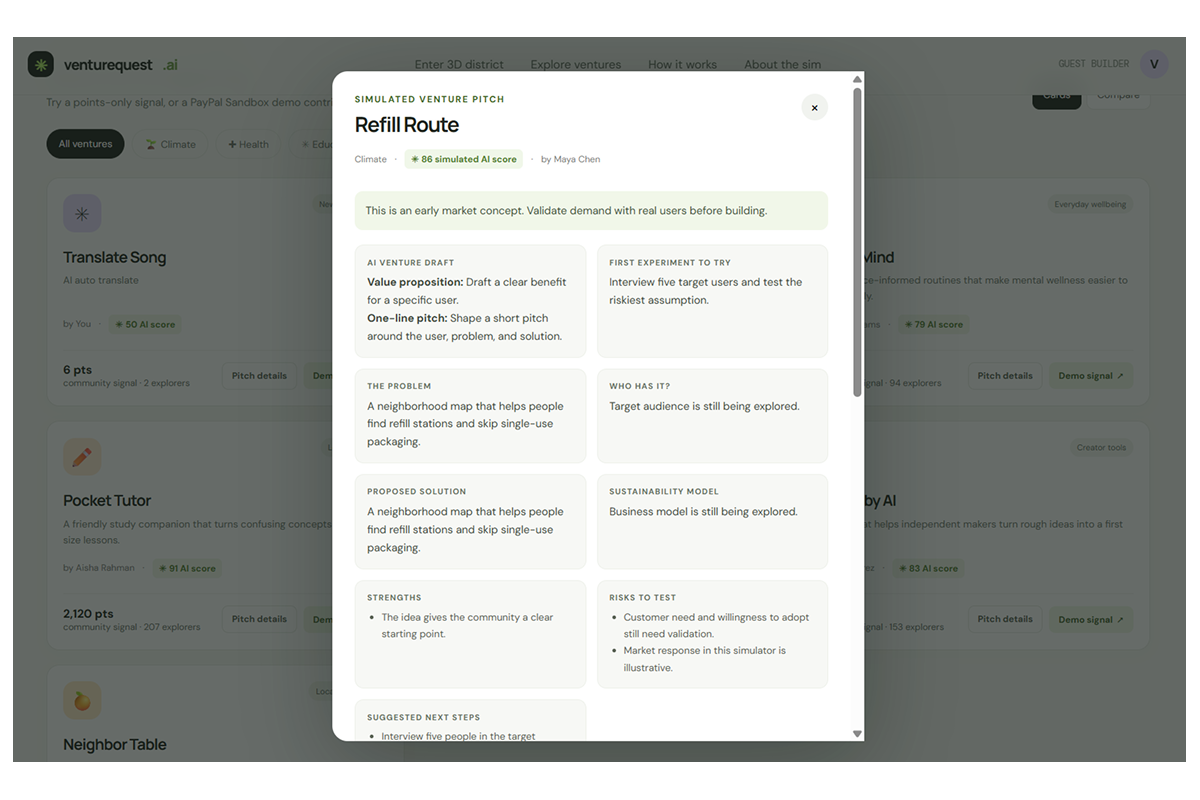
VentureQuest AI lets a builder describe a venture and receive an AI-assisted feasibility review, including a simulated score, strengths, risks, a value proposition, target audience, business-model hypothesis, short pitch, and suggested first experiment. The builder can publish the draft to a simulated market, review pitch details, compare ventures, and explore illustrative market scenarios. Try the working demo or browse the public source repository.
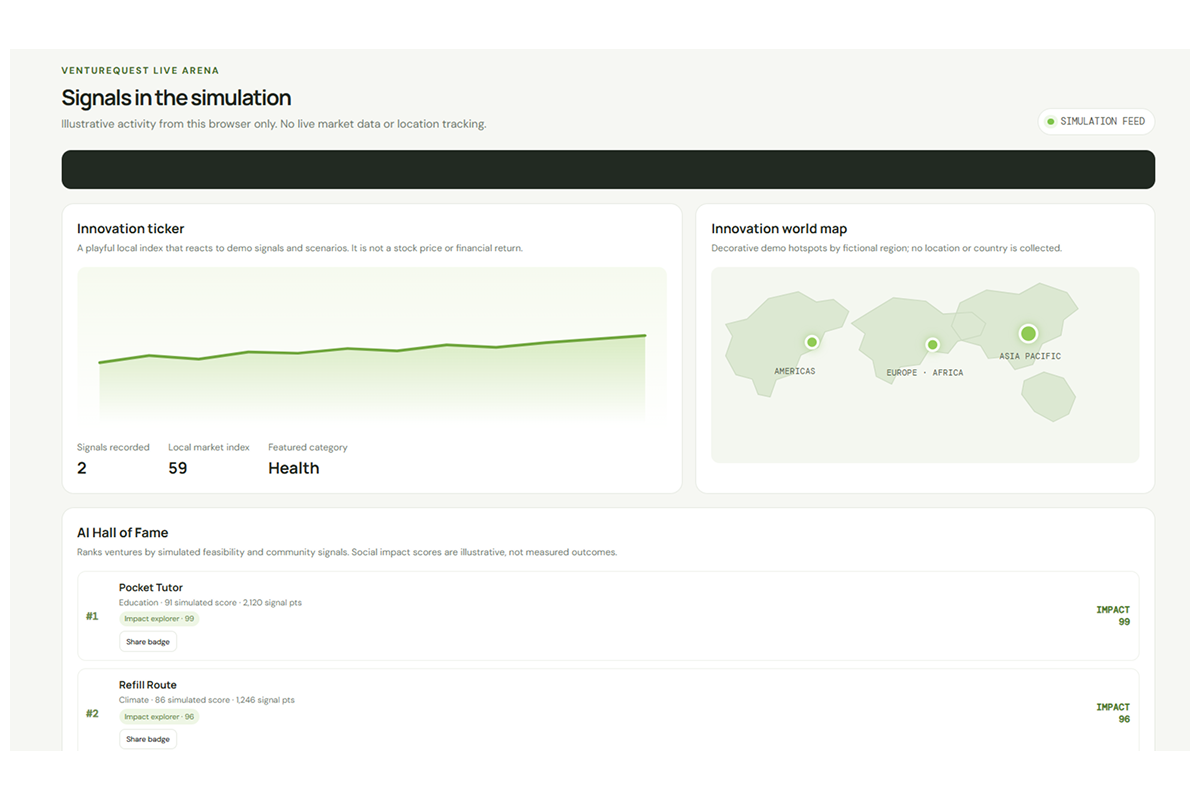
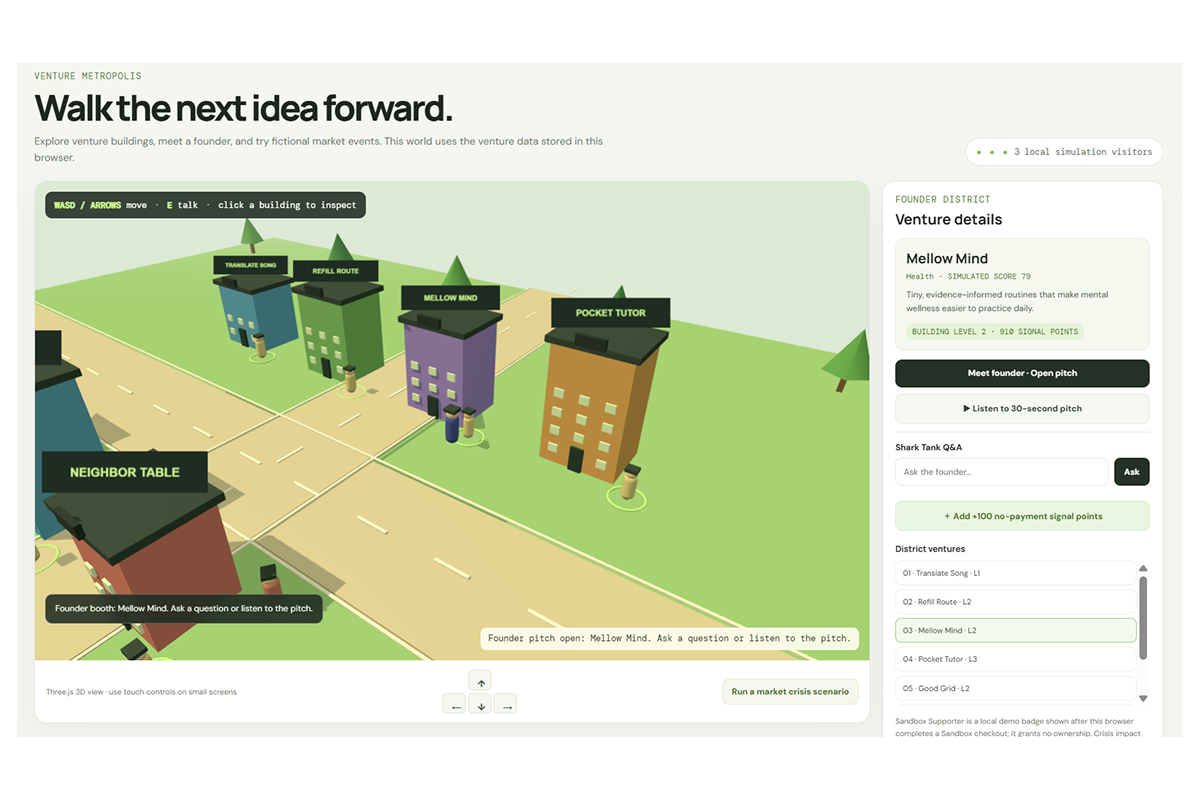
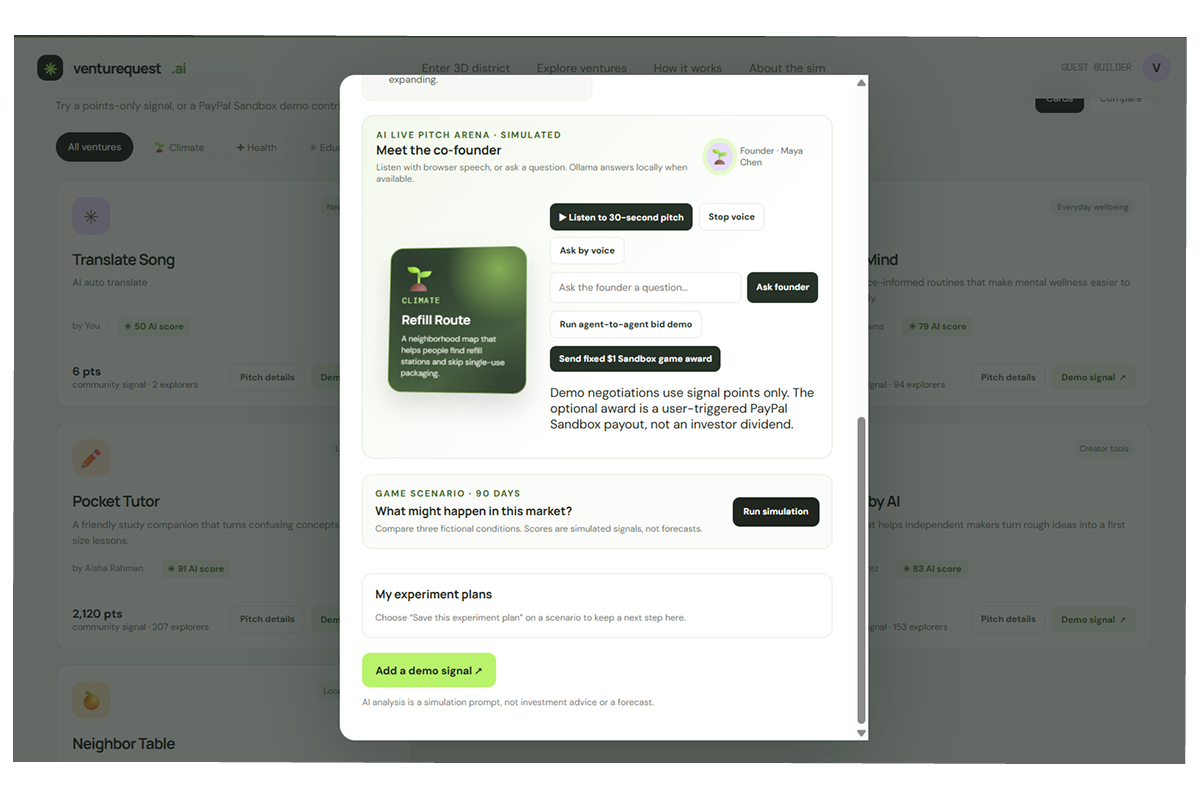
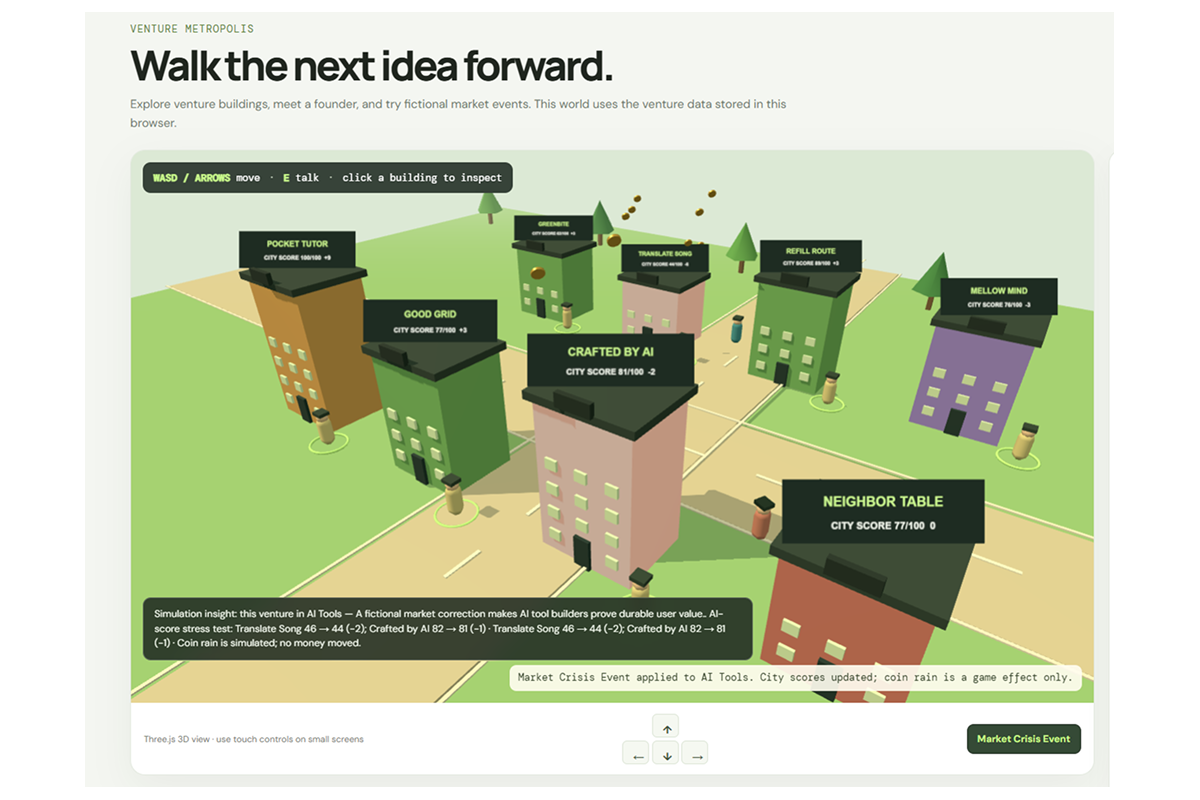
The /world page adds a Three.js innovation district. Visitors can move around, approach venture buildings, meet founders, listen to browser-spoken pitches, ask questions, and run fictional market stress events. The event engine applies deterministic game rules informed by each venture's simulated AI score. Positive results can trigger a visual coin-rain effect; it does not move money.
When configured with PayPal Sandbox credentials, a visitor can approve a small test Checkout. A completed capture updates the demo market signal and can unlock a local Sandbox Supporter badge in that browser. An optional webhook endpoint verifies PayPal events and sends updates to open sessions. The optional Payouts route is a manually triggered fixed USD $1 Sandbox game award to one recipient configured by the app operator. It is not an investor dividend or an automatic payout.
How we built it
We built the prototype with a dependency-free Node.js HTTP server and browser-native HTML, CSS, and JavaScript. This keeps the app easy to run locally without a build step or package installation. The main dashboard contains the venture builder, market cards, pitch details, AI review, and scenario simulation. AG Grid Community provides an optional sortable and filterable comparison table. The /world page loads Three.js from a CDN only when the 3D district is opened.
For AI, the app can call a local Ollama instance using Qwen2.5 1.5B for venture drafting, founder Q&A, and fictional market-event narration. A built-in heuristic and contextual fallbacks keep the prototype usable without a hosted AI API key. The hosted Render demo uses the fallback unless a local model is separately available to that server. The concept card is made with CSS; the project does not use an image-generation model.
For payments, the browser uses the PayPal JavaScript SDK v6 in Sandbox mode, while the Node server creates and captures Orders v2 transactions. The webhook route verifies event signatures with PayPal before sending market updates over Server-Sent Events. A separate optional Payouts v1 route supports a manually initiated fixed Sandbox award. Secrets are intended to stay in server environment variables, not in browser code or the public repository.
Challenges we ran into
One challenge was making AI useful while keeping the demo free and usable on a machine without cloud credentials. We addressed this with optional local Ollama support and a transparent fallback. Another challenge was connecting payment events to a game loop without implying that a Sandbox contribution buys ownership or earns a return. We made the Checkout optional, require the visitor to approve it, label the result as a demo signal, and keep crisis-event rewards visual only.
The 3D world also needed to remain lightweight and separate from the dashboard. We load Three.js only on the dedicated /world page. Finally, the prototype has no shared database or user accounts, so we clearly label venture data, badges, and visitor characters as local to the browser rather than presenting them as a global multiplayer market.
Accomplishments that we're proud of
- Built an end-to-end venture-creation flow from idea entry to AI-assisted review, simulated-market publishing, pitch details, and scenario experiments.
- Integrated an optional PayPal Sandbox Checkout and server-side order capture into the market experience.
- Implemented an optional signature-verified PayPal webhook path and real-time browser updates using Server-Sent Events.
- Created a playable 3D innovation district with founder interactions, AI-assisted Q&A, score-informed fictional market impacts, and a local Sandbox Supporter badge.
- Kept the core prototype free to run, with no package installation, database, paid AI service, or image-generation API required.
- Documented the project's current limitations so judges can distinguish implemented features from future ideas.
What we learned
We learned how to connect AI-generated drafts and analysis with a user-controlled PayPal Sandbox checkout, server-side capture, webhook verification, and browser game-state updates. We also learned that AI scores and generated narratives need clear limits: without real research data, they should be presented as hypotheses and simulations rather than predictions. Building the 3D city reinforced the value of isolating resource-heavy features and making the fallback experience work when optional services are unavailable.
What's next for VentureQuest AI
The roadmap below is aspirational. These items are future work and are not part of the current working prototype unless explicitly described elsewhere in this submission.
Near-term improvements
- Make AI scores more explainable by showing which idea details influenced the review, separating model-generated feedback from deterministic game rules, and identifying assumptions that still need testing.
- Add an event history and clearer transaction-status trail so builders and judges can see how a confirmed Sandbox capture changes the demo state.
- Improve the judge demo path with guided sample ventures, accessible controls, and a simple walkthrough that works even when optional services are not configured.
Next product stage
- Add user accounts and a shared database so venture drafts, community signals, supporter badges, and verified Sandbox events can synchronize across browsers.
- Turn the 3D district into an opt-in multiplayer innovation city with visible player presence, founder booths, collaborative challenges, and a community showcase.
- Add a transparent innovation map that aggregates opt-in participation without exposing precise personal location or presenting illustrative activity as real global investment.
- Expand the AI Venture Studio with optional concept-art generation and safe prototype scaffolding that builders can inspect, edit, and export.
Longer-term vision
VentureQuest could grow into an accessible digital campus where people learn by building, founders receive structured feedback, and communities help decide which ideas deserve a real-world user experiment. An evidence-aware AI market analyst could compare explicit scenarios and cite trustworthy sources when data is available, while clearly labeling uncertainty and keeping simulations separate from real outcomes.
PayPal could support a transparent, user-controlled money-movement layer for eligible creator or community programs, with clear receipts, event verification, and consent-based recipient onboarding. Before any recipient-specific reward or real-money flow, the product would need a durable ledger, fraud and privacy controls, explicit user consent, and legal/compliance review. The simulation will not promise investment returns, and market events will not autonomously send investor payouts.
