-
-
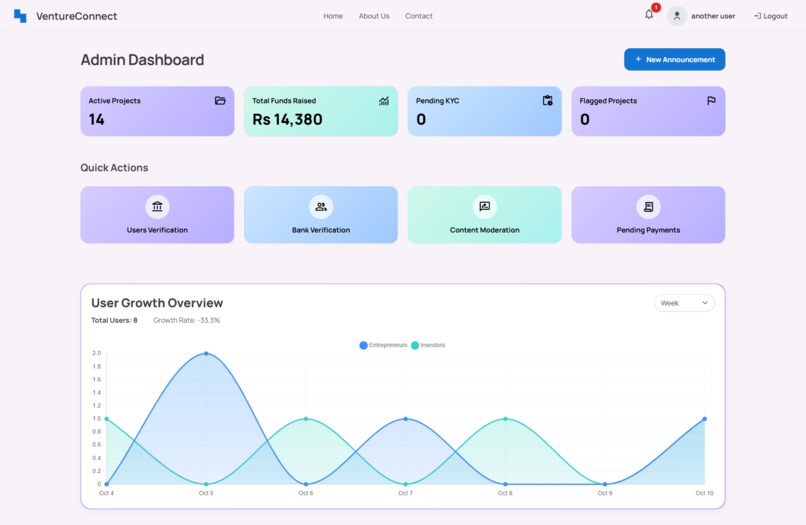
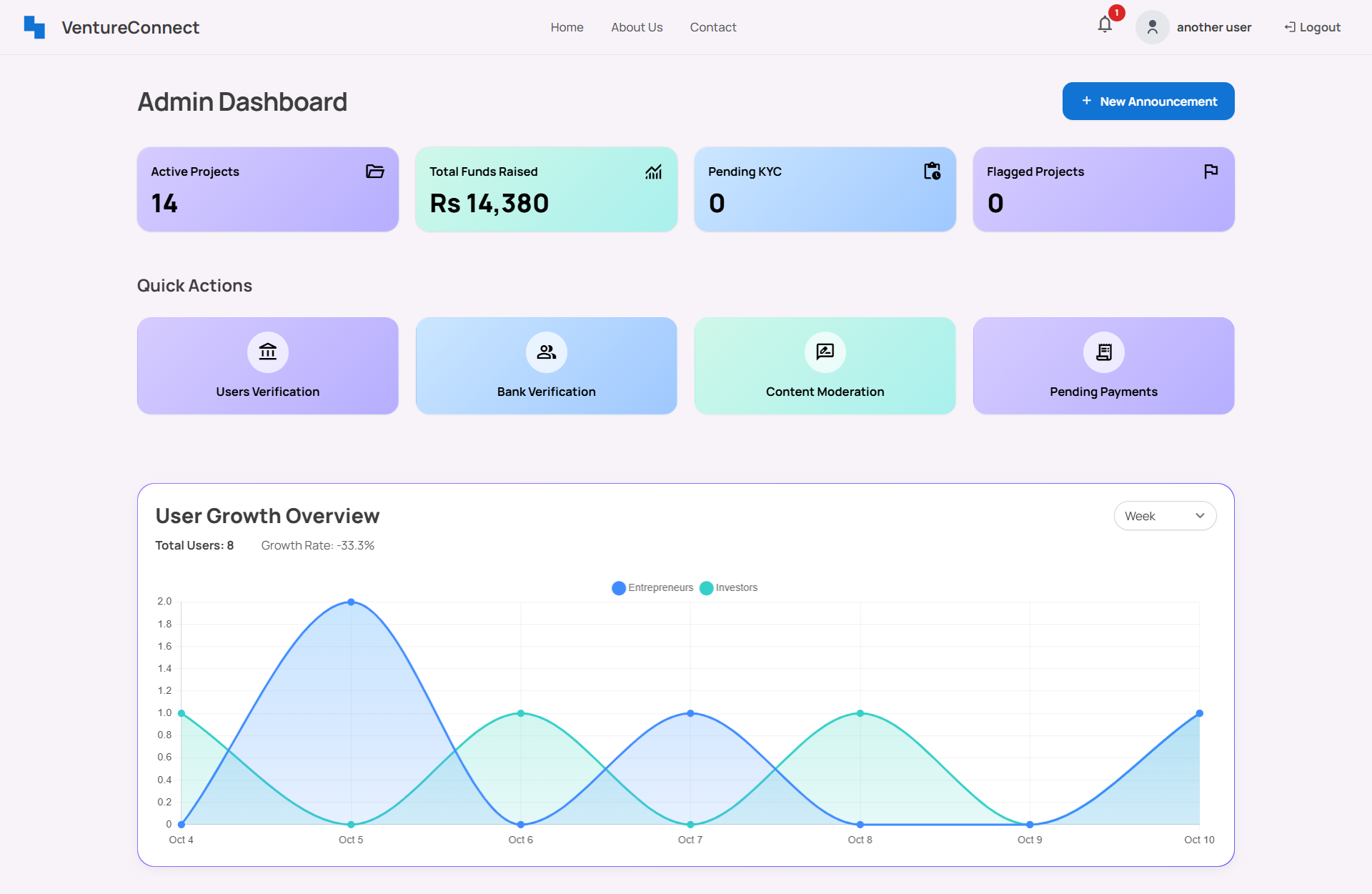
This is the Admin Dashboard for managing users, payments, announcements, and platform activity.
-
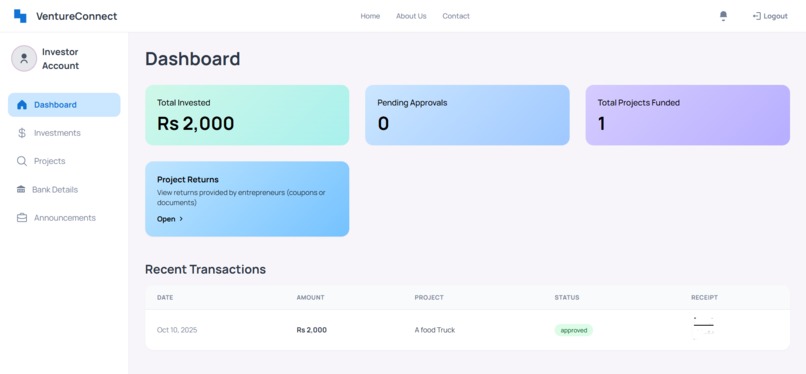
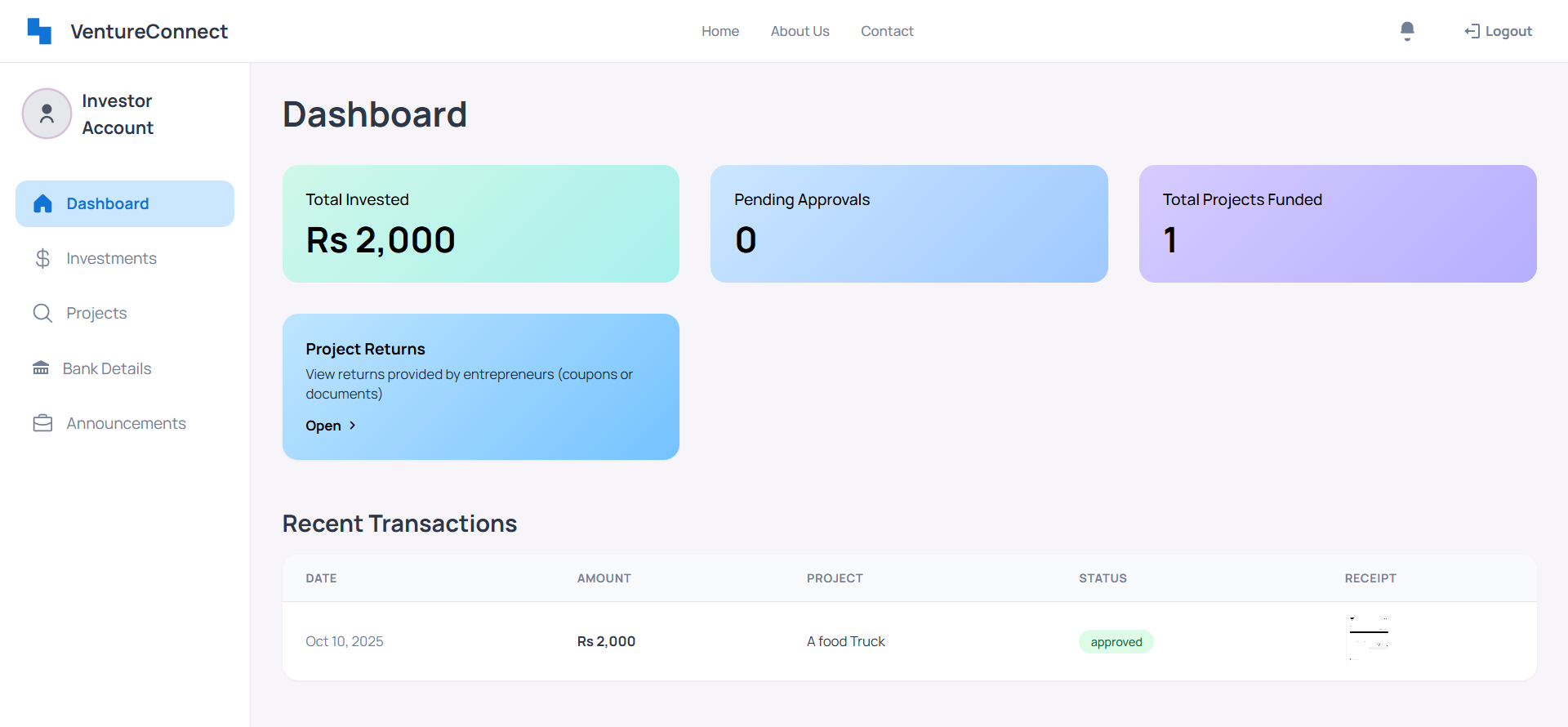
This is Investor Dashboard to displays total invested amount, approved transactions, project returns, and investment progress.
-
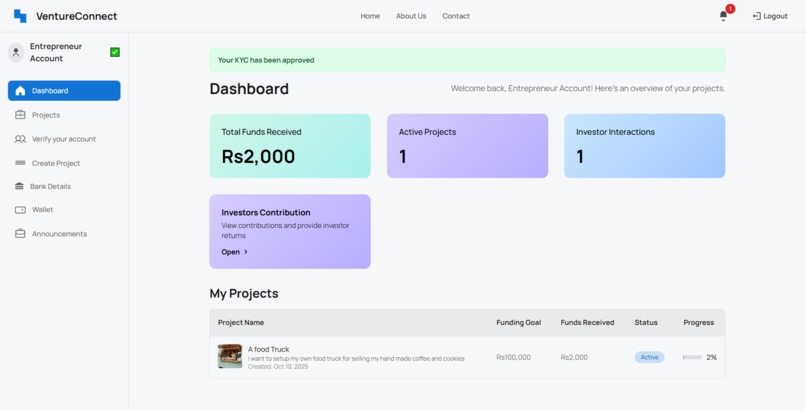
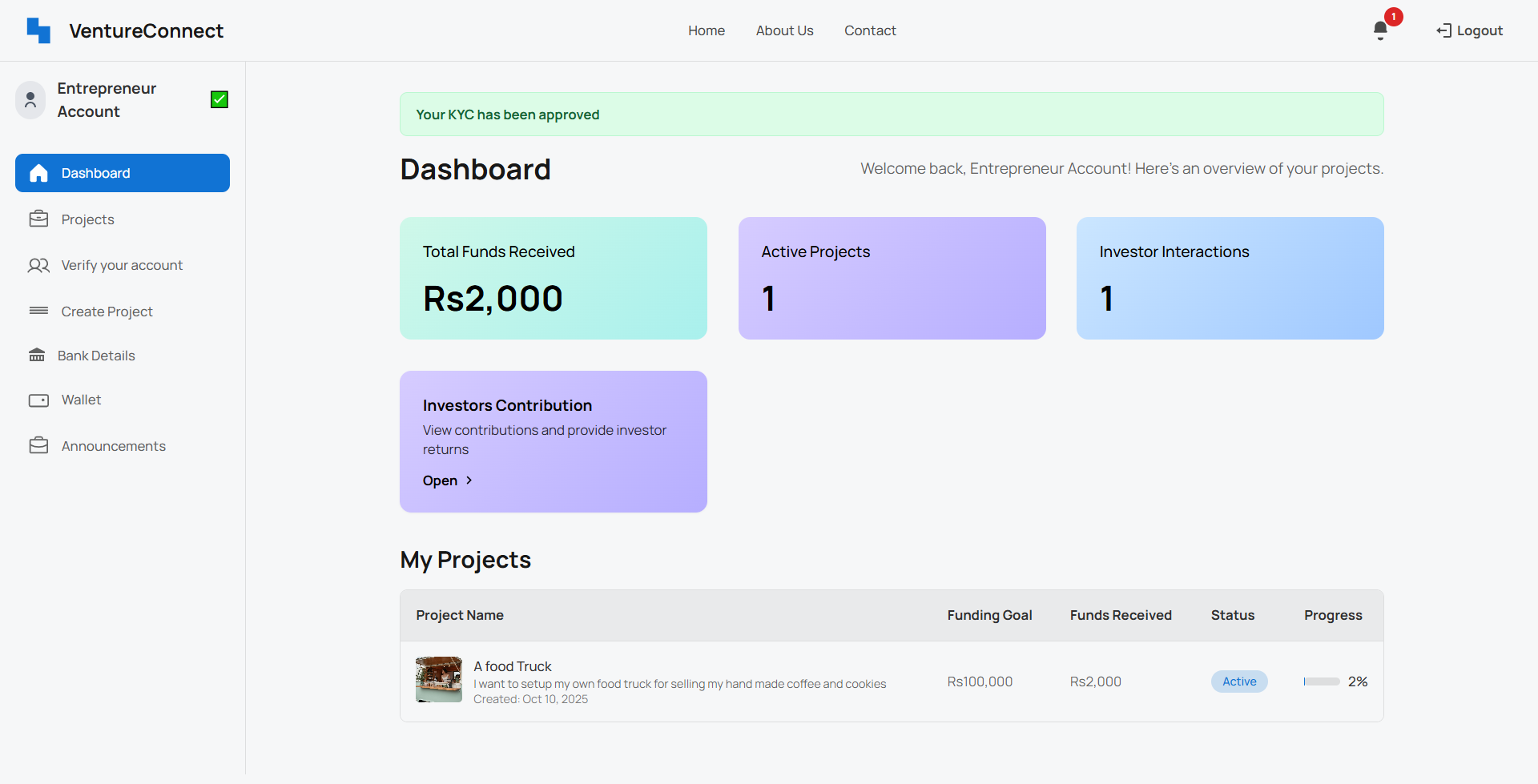
This is Entrepreneur Dashboard to create projects, track funding, and handle verifications and project returns.
-

Explore projects with search filters and invest in promising projects that match your goals.
-
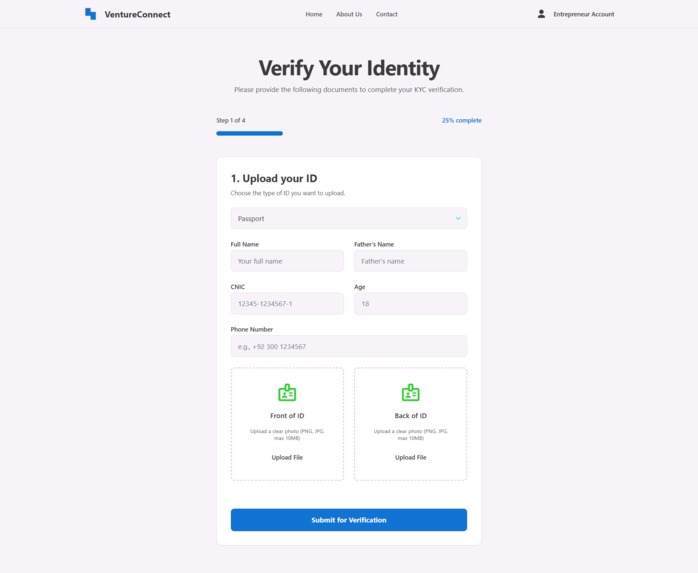
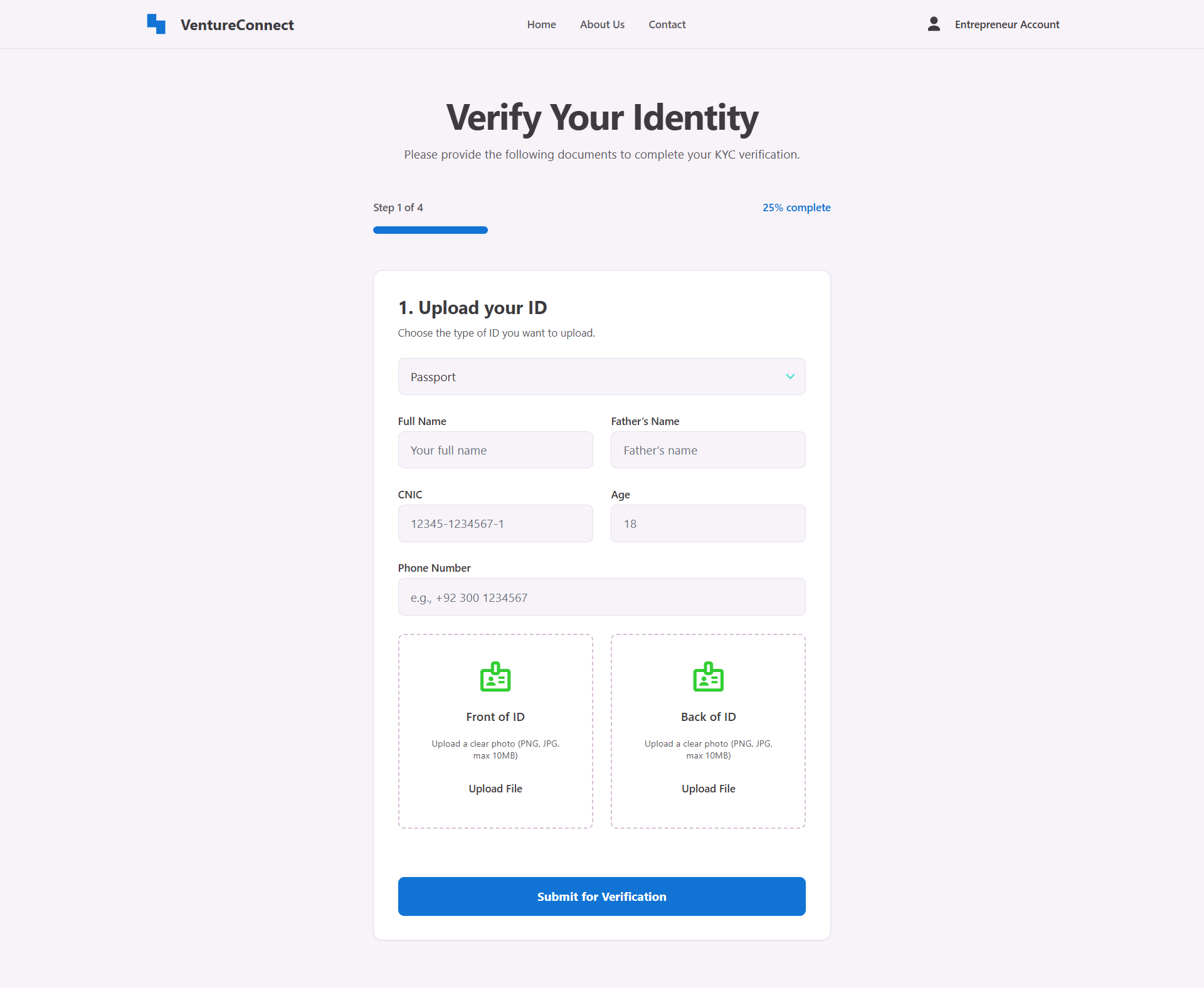
Upload your KYC documents to complete verification.
-
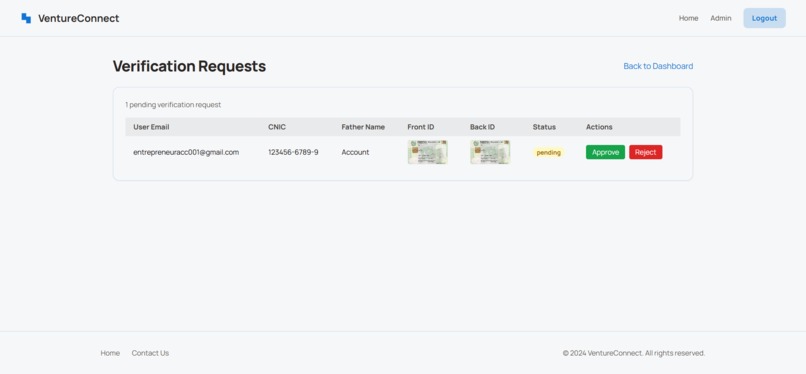
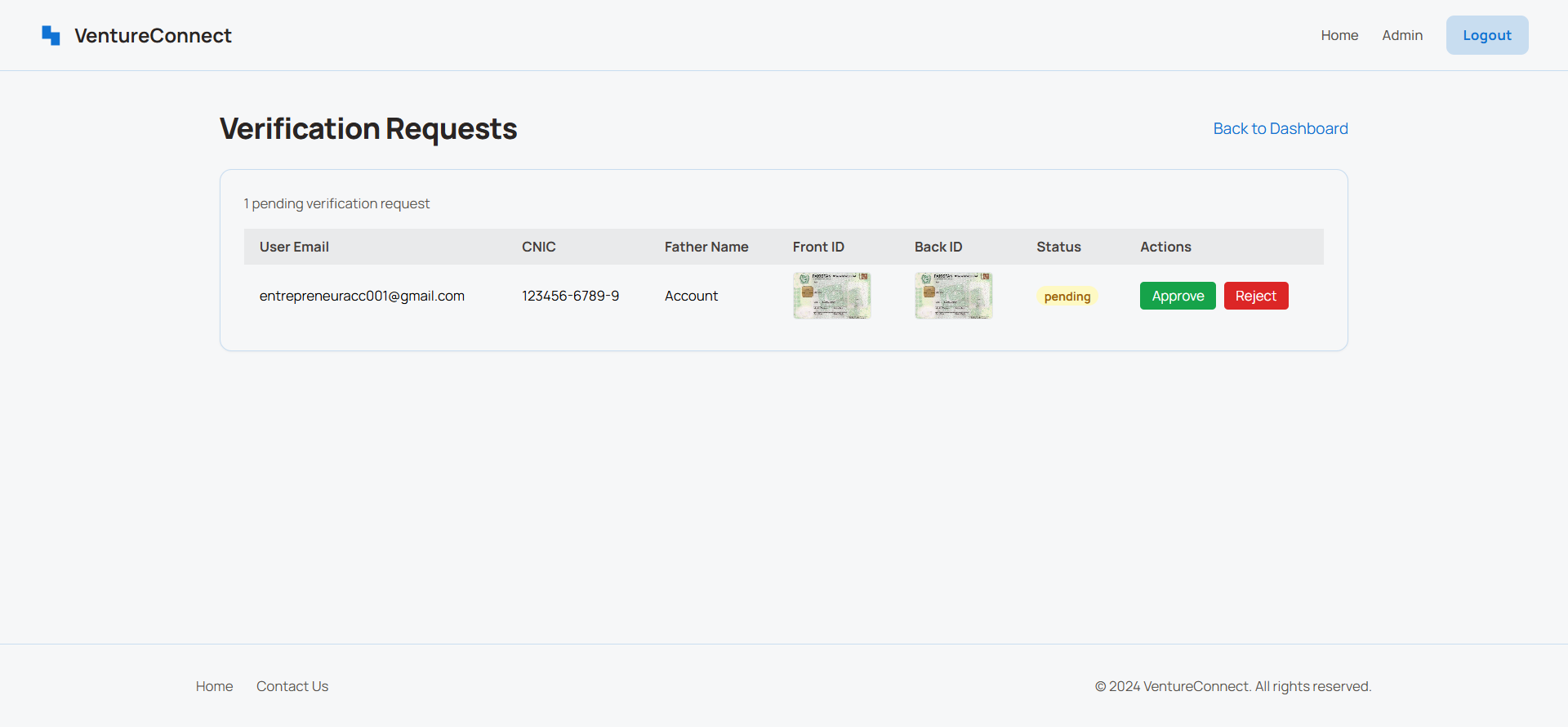
In admin panel, review all user verification requests carefully and choose to approve or reject each submission.

VentureConnect
Inspiration
Starting a business in Pakistan is never easy especially for first-time or small scale entrepreneurs. Many individuals have creative ideas and the drive to succeed, but the path to launching a sustainable venture is full of obstacles. Studies show that over 90% of startups fail, often because they misread market demand (42%) or lack proper funding (29%).
For entrepreneurs from low-income or underrepresented areas, these challenges are even tougher. Access to early, trustworthy capital and basic business mentorship is often limited, leaving many with solid ideas but no means to bring them to life.
In Pakistan, traditional business incubators usually support high-tech or high growth startups that already have some traction or funding. On the other hand, crowdfunding platforms are often unreliable or inaccessible for local users, and informal lending systems lack structure and transparency.
As a result, countless small scale entrepreneurs from local shop owners to rural innovators remain stuck between ambition and opportunity.
That’s why we created Venture Connect, a micro-business incubator platform built specifically for Pakistan’s emerging entrepreneurs and impact-driven investors. It’s a transparent bridge that connects small entrepreneurs with investors who genuinely believe in their vision.
Entrepreneurs can launch verified, milestone-based projects, attract micro-funding from multiple backers, and track progress transparently.
Investors can confidently fund projects aligned with their interests, choosing from different return models like equity, revenue sharing, or discount-based rewards.
Admins ensure fairness and trust through KYC verification, fraud detection, and real-time oversight of all transactions and projects.
This model doesn’t just help individuals; it strengthens the micro-business ecosystem of Pakistan. By empowering entrepreneurs at the grassroots level, Venture Connect creates sustainable income sources, encourages innovation, and allows investors to directly participate in real economic impact. It’s a step toward a more inclusive entrepreneurial future, where great ideas from every corner of Pakistan get the support, funding, and visibility they deserve.
What it does
The VentureConnect Micro-Business Incubator is designed to bridge the gap between emerging entrepreneurs and everyday investors. It provides a transparent and secure digital ecosystem where small business ideas can grow with the right support and visibility. The platform simplifies project discovery, funding, verification, and tracking, ensuring that every stakeholder, from entrepreneurs to admins, has the tools they need to contribute effectively. Below is an overview of the core features that make this system work seamlessly.
Project Discovery and Search
Entrepreneurs can post their business ideas as verified projects, and investors can explore these through a clean and categorized interface. Each project displays its funding progress, type of return (equity, revenue share, or discount), and verification status, helping investors make informed decisions.
Role-Based Dashboards
The platform offers three distinct dashboards, each tailored to the user’s role:
Entrepreneur Dashboard: Manage created projects, view funding progress, receive updates on KYC or bank verification, and upload proof of transactions.
Investor Dashboard: View investment portfolio, track returns, and explore new projects with filters and analytics.
Admin Dashboard: Monitor all users and projects, verify KYC and bank details, approve or reject payments, and ensure a secure platform environment.
Investor Portfolio and Returns
Investors can view all their active and completed investments in one place. Each entry displays project details, invested amount, and expected returns, providing a clear overview of performance and funding impact.
Project Returns
- Defines how investors receive value for supporting a project through Discount Coupons, Equity, or Revenue Sharing.
- Entrepreneurs select the return type during project creation.
- If Equity is chosen, a specific percentage is defined.
- Investors can filter and explore projects based on the selected return model.
- After investor contributions, entrepreneurs submit coupon codes or upload proof documents (for equity or revenue sharing).
- Real-time notifications inform investors when a return is issued and entrepreneurs when a payment is approved.
- Ensures transparency, accountability, and smooth tracking of project progress and investor benefits.
Secure Verification
Both entrepreneurs and investors undergo KYC (Know Your Customer) and bank verification flows. This step ensures legitimacy, prevents fraudulent projects, and builds trust across the platform.
Admin Oversight and Control
Admins play a vital role in maintaining platform transparency. They can:
- Review and verify new users.
- Approve or reject payment proofs.
- Manage flagged or suspicious projects.
- Monitor overall platform activity with charts and analytics.
Wallet and Transactions
Whenever a payment is approved, the system automatically updates the user’s wallet, reflecting credit or debit transactions with accurate records. This ensures that all financial activity remains traceable and auditable.
Proof and Media Uploads
To enhance credibility, entrepreneurs can upload receipts, bank proofs, or project images through Cloudinary integration. This keeps all evidence secure, accessible, and well-organized.
Real-Time Notifications
Users receive instant notifications about:
- KYC or bank verification status.
- Payment updates or rejections.
- Admin announcements or requests.
- Fundings received for their projects.
- Project returns on invested projects.
This keeps the platform dynamic, interactive, and transparent.
Growth Analytics
Admins can visualize platform performance using Chart.js, tracking metrics such as:
- Number of new users per week or month.
- Total funded projects.
- Investor and entrepreneur activity trends.
How we built it
Frontend
- Static HTML5 pages styled with Tailwind CSS (custom palette + gradients, responsive layout).
- Vanilla JavaScript (ES6+) modules embedded per page; shared navigation & dropdown logic via
public/js/nav.js. - Chart.js line visualization for user growth (real-time Firestore listener + aggregation logic).
Backend / Platform
- Firebase Authentication for session & role claims (including admin custom claim).
- Cloud Firestore as the primary datastore:
- Collections:
users,projects,payments,users_verification,bank_details,notifications, per‑usertransactionssubcollections.
- Collections:
- Added a return type selector (Discount Coupon, Equity, Revenue Sharing) in
create-project.html, stored asprojects.return_model. - Displayed return info on project pages and enabled filtering by return type for investors.
- Built an “Investors Contribution” panel where entrepreneurs upload coupon codes or proof images (via Cloudinary) after funding.
- Created a
project_returnscollection to log return details with timestamps. - Set up real-time notifications for both investors and entrepreneurs using Firestore listeners.
- Applied Firestore security rules to ensure data privacy and restricted access.
- Real-time notifications alert both investors and entrepreneurs about updates and returns.
- Real‑time listeners: funding progress, total funds raised, pending operational queues, user growth.
- Firebase Cloud Functions (referenced for admin callable functions like
adminListUsers,setUserBlocked). - Firestore Security Rules & composite indexes (scalable filtered queries & role gating).
- Cloudinary for image / receipt uploads (client‑side upload + secure URL usage).
Build & Ops
- Tailwind CLI build pipeline (
npx tailwindcss ...->public/assets/tailwind.css).
Challenges we ran into
- Role resolution: Harmonizing admin claims with user document
rolevalues (investor / entrepreneur / variants) for consistent dashboard routing. - Project Returns: Managing multiple return types smoothly within Firestore.
- Ensuring secure uploads for proof documents.
- Maintaining consistent real-time updates without duplication.
- Keeping visibility clear for both investors and entrepreneurs.
- Data normalization: Handling multiple legacy field names (
ownerId,userId,createdBy, etc.) to reliably attribute project ownership and verification status. - Real-time aggregation: Computing funding progress & total funds raised without expensive server-side joins; solved with client listeners and incremental updates on payment approval.
- KYC + Bank verification mapping: Some bank docs used mismatched IDs requiring normalization (backfill utilities added).
- Duplicate avatar triggers: Ensuring the global account dropdown reuses existing avatars while avoiding double bindings across pages.
- Edge timestamps: Supporting varying timestamp formats and ensuring safe Date parsing for analytics & relative time.
- Responsive consistency: Aligning headers, brand palette, and spacing across heterogeneous initial page designs.
Accomplishments that we're proud of
- Robust, fault-tolerant funding progress calculation that gracefully handles missing / variant numeric fields.
- Real-time operational visibility (payments, verifications) with immediate admin action flows.
- Clean user growth analytics transforming raw user documents into weekly & monthly trend insights.
- Maintainability helpers (backfill / normalization scripts) reducing future data drift.
- Unified UX (consistent header, account dropdown, color system) across all user types.
- Security-conscious approach: verifying claims before privileged reads and minimizing over-fetching.
What we learned
- Design upfront conventions for ownership & status fields to avoid multi-name reconciliation later.
- Small UX affordances (global dropdown, soft gradients, consistent spacing) significantly improve perceived product maturity.
- Real-time listeners + lightweight aggregation can replace premature server-side batch logic for early-stage analytics.
- Providing admin maintenance utilities early reduces manual database intervention.
- User role & permission mapping is clearer when centralized in one helper (used for both dropdown and explicit buttons).
What's next for Micro-Business Incubator
- In-app Escrow / Managed Wallets: Migrate from external receipt-based funding to integrated payment rails (Stripe / PSP) with escrow release logic.
- Milestone-Based Disbursements: Automate partial fund releases tied to verified project milestones.
- Advanced Analytics: Cohort retention, conversion funnels (views → investments), and risk scoring.
- Notification Channels: Expand from in-app to email / push (Firebase Cloud Messaging) with subscription preferences.
- Reputation Layer: Public entrepreneur credibility metrics (verified ratio, funding success rate, reinvestment stats for investors).
- Project Templates & Playbooks: Guided setup flows with reusable milestone kits for common micro-venture types.
- Internationalization: Multi-currency normalization, localized number/date formatting, language packs.
- Access Controls / Teams: Allow multiple collaborators per project with scoped permissions.
- Automated Compliance Checks: Basic fraud anomaly detection & duplicate project flagging.
- Progressive Web App (PWA): Offline caching for dashboards and push-driven rehydration.
Built With
- chart.js
- cloudfirestore
- cloudfunctions
- cloudinary
- firebase
- firebaseauthentication
- html5
- node.jstoolchain
- tailwindcss
- vanillajavascript(es6+)


Log in or sign up for Devpost to join the conversation.