-
-
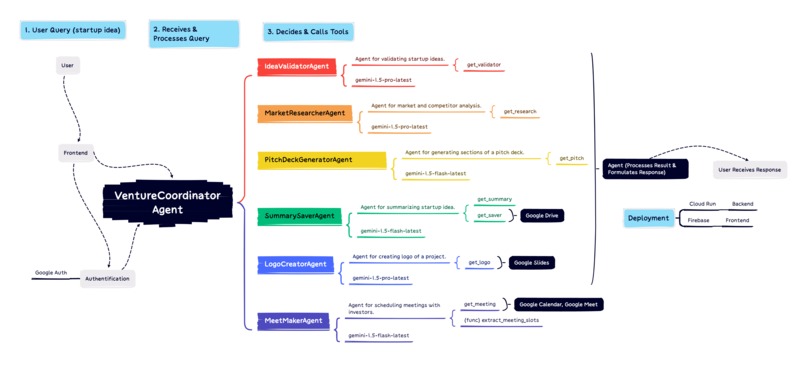
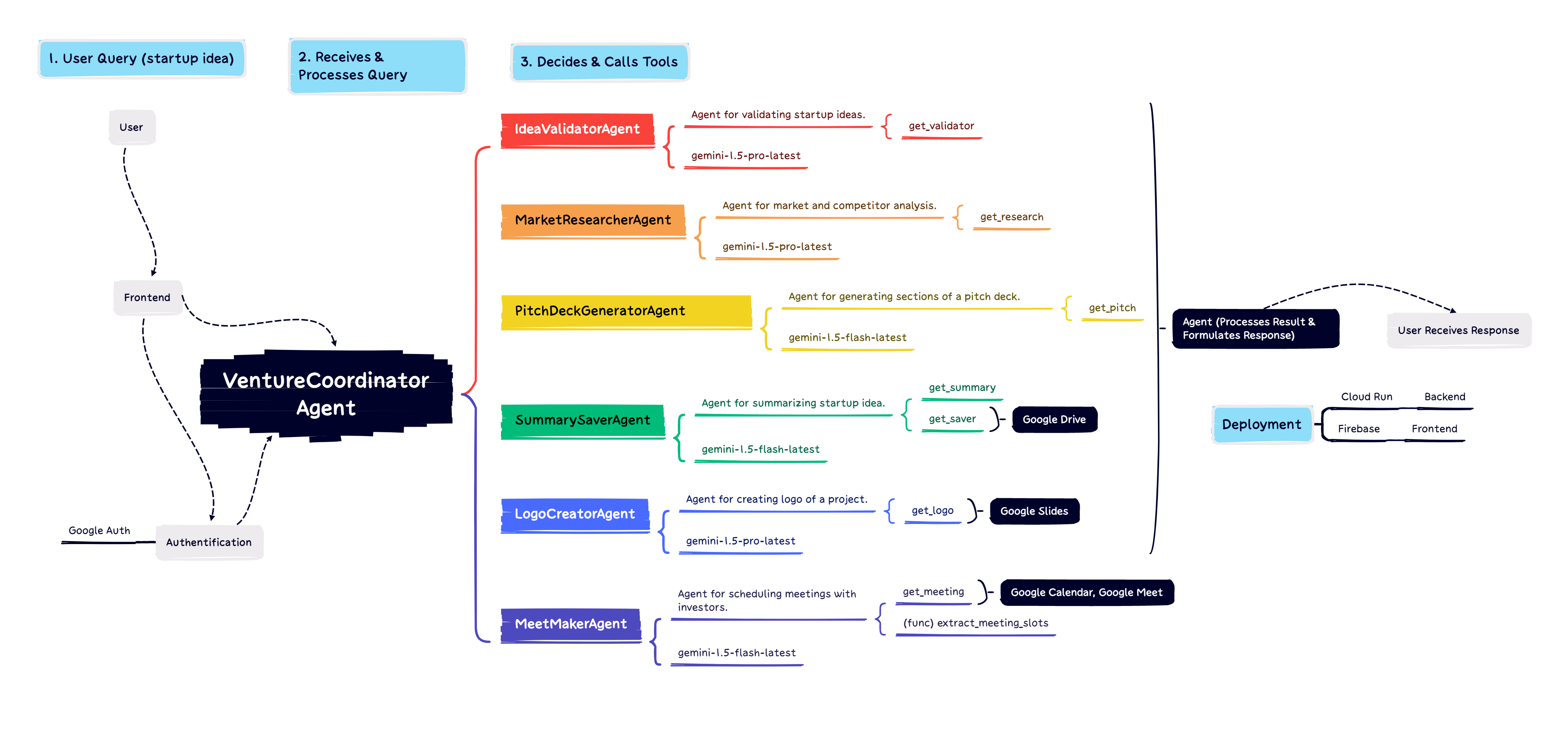
Architecture Diagram
About the project
Venture Assist AI is an intelligent, multi-agent AI system designed to empower startup founders and entrepreneurs by streamlining their daily operations. Leveraging the cutting-edge Google Agent Development Kit (ADK) and Gemini Pro, my project automates critical tasks across Google Workspace, freeing up valuable time for innovation and strategic growth.
Venture Assist AI is specifically designed for early-stage founders, solopreneurs, and startup teams who want to validate their ideas quickly, define their market strategy, and generate a compelling pitch — all without needing a full product or extensive team yet.
This initiative was directly inspired by the "AI Agent Development Kit Hackathon with Google Cloud", where the focus on multi-agent collaboration to tackle complex tasks perfectly aligned with my vision of comprehensive startup support.
Inspiration
The primary inspiration stemmed from the pervasive challenge faced by startup founders: managing a multitude of administrative and strategic tasks while trying to focus on their core product or service. I envisioned an AI assistant that could intelligently offload these burdens, from validating initial ideas to preparing for investor meetings. The Google Agent Development Kit provided the ideal framework to build such a system, allowing me to orchestrate specialized AI agents for diverse functionalities within the Google Cloud ecosystem.
What it does
Venture Assist AI acts as a central hub for various startup-related needs. It orchestrates a team of specialized agents, each designed for a specific purpose. Crucially, these agents don't just execute tools; they leverage their LLM capabilities to interpret tool outputs, provide contextualized responses, and intelligently suggest next steps or delegate tasks to other specialized agents. This ensures a fluid, human-like interaction and guidance.
Here's a breakdown of what each agent accomplishes:
- Idea Validation: Provides intelligent analysis and detailed feedback on new startup concepts.
- Market Research: Generates comprehensive reports on market size, competitors, and trends.
- Pitch Deck Generation: Creates compelling draft content for key sections of a startup's pitch deck.
- Summary & Save: Summarizes lengthy texts and securely saves them to Google Drive.
- Logo Creation: Generates creative logo concepts and visualizes them directly within Google Slides.
- Meeting Scheduling: Organizes meetings with specified participants, extracts dates, and writes events to Google Calendar, automatically enabling Google Meet conferencing.
My venture_coordinator_agent employs a Coordinator/Dispatcher pattern to seamlessly redirect user requests to the most appropriate sub-agent.
How I built it
The project's backend is a Python application built with the Google Agent Development Kit (ADK) and utilizes the Gemini Pro large language model for its core intelligence. I integrated extensively with Google Workspace APIs including Google Drive, Google Calendar, and Google Slides to enable direct interaction with user's Google accounts.
The backend is containerized using Docker and deployed as a scalable, serverless service on Google Cloud Run. The deployment pipeline is fully automated using Google Cloud Build, with Docker images stored in Artifact Registry. Sensitive data (like API keys) is securely managed via Google Secret Manager.
The frontend is a modern, responsive single-page application developed with React and Vite, styled using TailwindCSS, and hosted reliably on Firebase Hosting. Google's OAuth 2.0 was implemented to handle user authentication.
Challenges I ran into
Developing a multi-agent system with deep Google Workspace integration involved several aspects that demanded particular focus and effort:
- API Integration Nuances: Each Google Workspace API (Drive, Slides, Calendar) has its own specific requirements and data structures, necessitating careful parsing of responses and formatting of requests. For instance, obtaining the correct
presentationIdand utilizing it for Google Slides links required precise debugging. - Agent Orchestration: Designing an effective
Coordinator/Dispatcherpattern to ensure theventure_coordinator_agentcould reliably route complex user queries to the appropriate specialized sub-agent was a significant design challenge. - Cloud Deployment: Orchestrating various Google Cloud services (Cloud Build, Artifact Registry, Cloud Run, Secret Manager), particularly managing environment variables and secrets, required meticulous configuration and troubleshooting.
- Getting Started with ADK and Multi-agents: Challenges arose in understanding how to run an agent beyond the standard ADK web interface, as well as how to create and manage multiple agents and their interactions. However, the ADK Tutorial - Progressive Weather Bot (ADK Tools Version) GitHub repository proved to be an invaluable resource, providing the necessary examples and solutions.
Accomplishments that I'm proud of
I am proud to have built a fully functional multi-agent AI system capable of real-world productivity enhancements for entrepreneurs. Key accomplishments include:
- Seamless Google Workspace Integration: Successfully integrating with Google Drive, Calendar, and Slides to provide tangible automation benefits.
- Robust Multi-Agent Architecture: Implementing a clear Coordinator/Dispatcher pattern that efficiently directs user requests to the appropriate specialized agents.
- Automated Cloud Deployment: Establishing a robust and scalable deployment infrastructure on Google Cloud Run with automated builds.
- User-Friendly Experience: Despite the complex backend, the frontend offers an intuitive interface for interacting with the AI assistant.
- Innovative Features: Especially proud of the dynamic logo concept generation visualized in Google Slides and the intelligent summarization with Drive saving.
- Deep Dive into Cutting-Edge AI: This project was my chance to dive deep into cutting-edge AI, showcase my skills, and contribute to the future of agent development.
- Understanding Multi-agent Architecture: Gained profound insights into designing and orchestrating interactions between multiple AI agents.
- Hands-on Google Cloud Experience: Acquired practical experience across a wide range of Google Cloud services.
- Ready MVP (Minimum Viable Product): Successfully delivered a functional Minimum Viable Product that demonstrates core capabilities.
- Participation in an International Hackathon: Proud to have taken part in the "AI Agent Development Kit Hackathon with Google Cloud", a significant international event.
What I learned
This project was an incredible learning experience in several areas:
- Deep Dive into Google ADK: Gained extensive practical experience with the Agent Development Kit, understanding its capabilities for multi-agent system design and tool integration.
- Google Cloud Ecosystem Mastery: Enhanced proficiency in deploying and managing applications across various Google Cloud services like Cloud Run, Cloud Build, Secret Manager, and Firebase Hosting.
- Advanced API Interactions: Developed a strong understanding of best practices for interacting with Google Workspace APIs, including OAuth 2.0 authentication and data manipulation.
- Prompt Engineering & Agent Design: Improved skills in crafting effective prompts for LLMs (Gemini Pro) and designing intelligent agents capable of performing specific tasks.
- Debugging Complex Systems: Learned valuable debugging techniques for distributed systems involving frontend, backend, and external APIs.
What's next for Venture Assist AI
For the future of Venture Assist AI, I envision:
- Prepare for Production: Moving beyond the Minimum Viable Product (MVP) state, a key next step is to prepare the entire project for a production environment, focusing on robustness, security, and scalability.
- Persistent User Sessions: Implementing persistent storage for user OAuth tokens and agent memory (e.g., using Google Cloud Firestore) to maintain context across sessions.
- Broader Google Workspace Integration: Expanding capabilities to include Gmail integration for email automation (e.g., drafting emails, analyzing inbox).
- Enhanced Customization: Allowing users to customize agent behaviors or add their own specialized tools.
- Advanced UI Features: Developing a more interactive and dynamic frontend for better user engagement.
- Voice Integration: Exploring voice input capabilities for a more natural interaction experience.


Log in or sign up for Devpost to join the conversation.