-
-
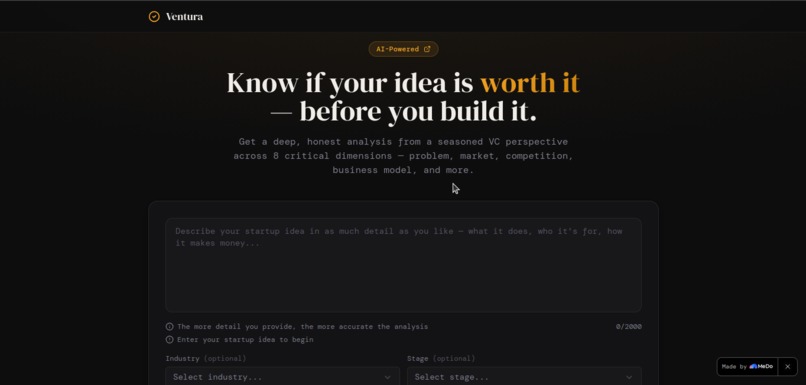
Project Landing page
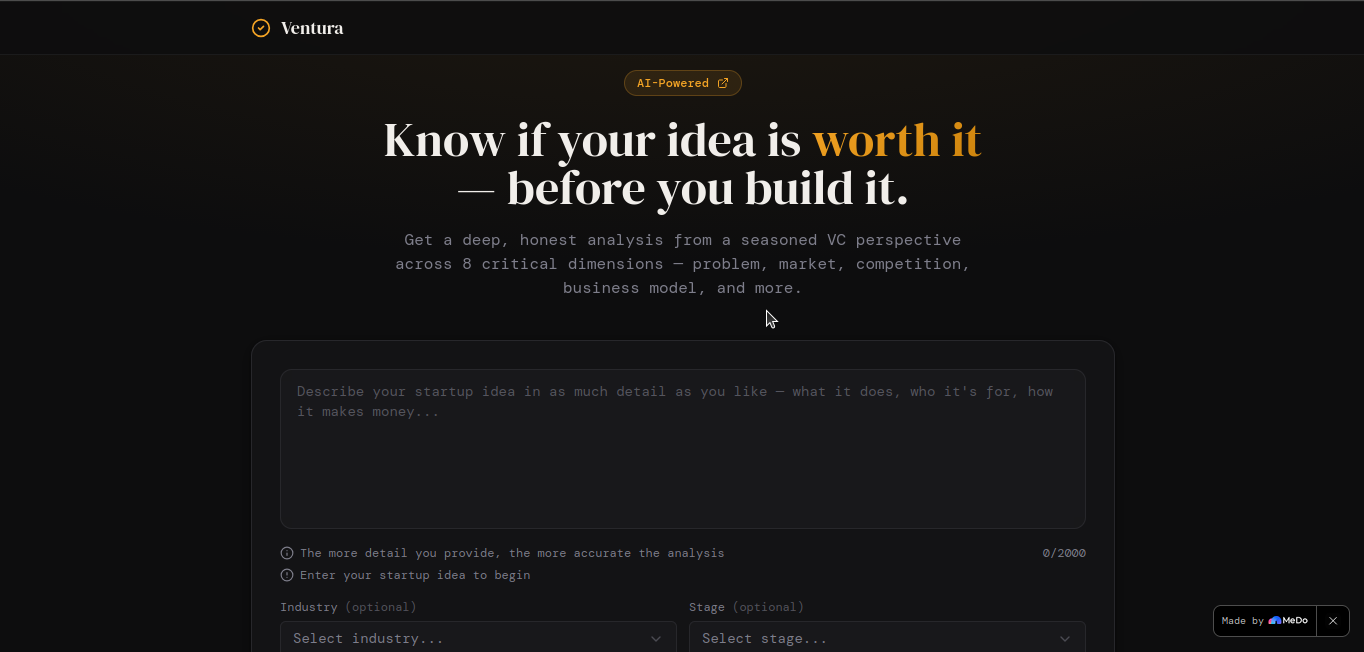
Ventura — Project Story
Inspiration
Every week, thousands of founders across Africa and the world pour their savings, evenings, and emotional energy into startup ideas that were never validated. They skip the hard questions — Is this market big enough? Who are my real competitors? Does my business model actually work? — and jump straight to building. We've seen it firsthand. A friend spends six months building a logistics app, only to discover three funded competitors already own the space. A developer quits their job to build a "revolutionary" invoicing tool for a market that doesn't want to pay for software. The painful truth is that most founders don't fail at execution — they fail at validation. And the ones who do validate usually can't afford a McKinsey consultant or a VC advisor to stress-test their thinking. That gap is what inspired Ventura We wanted to give every founder — whether they're in Lagos, Nairobi, Jakarta, or São Paulo — access to the kind of rigorous, honest startup analysis that Silicon Valley insiders take for granted.
What it does
Ventura is an AI-powered startup idea validator that gives founders a VC-grade analysis report in under 30 seconds. A user describes their startup idea in plain language — no pitch deck, no slides, no jargon required. Ventura then scores the idea across 8 critical dimensions: Dimension: What it measures🎯 Problem Strength: How real, painful, and widespread the problem is📈 Market Opportunity: TAM estimate, market timing, and growth trajectory⚔️ Competition: Competitive landscape, known rivals, moat potential💰 Business Model: Monetization clarity and unit economics outlook⚠️ Execution Risk:Technical, regulatory, team, and operational risks🔒 Unfair Advantage: Network effects, proprietary data, switching costs🚀 Go-To-Market: Ideal customer segments and acquisition channels🏆 Overall Verdict: Proceed / Pivot / Pass + investor appeal rating Each dimension gets a score from 1–10, a risk badge (🟢 Low / 🟡 Medium / 🔴 High), and a detailed written analysis. The final verdict panel surfaces the top 3 strengths, top 3 weaknesses, and 3 concrete next steps — all generated by Claude AI. The overall score is calculated as a weighted average across dimensions: Soverall=∑i=1nwi⋅si∑i=1nwiS_{overall} = \frac{\sum_{i=1}^{n} w_i \cdot s_i}{\sum_{i=1}^{n} w_i}Soverall=∑i=1nwi∑i=1nwi⋅si Where sis_i si is the score for dimension ii i and wiw_i wi is its weight — with Problem and Market weighted slightly higher, as these are the dimensions investors scrutinize most.
How we built it
Ventura was built entirely through MeDo's AI editor using a natural language requirements document as the blueprint. The process:
Requirements First — We wrote a detailed requirements.md covering UI design, the AI system prompt, edge case handling, state management, and component structure. This became the single source of truth we fed to MeDo. AI System Prompt Engineering — The heart of the app is a carefully crafted system prompt that instructs Claude to return a strict JSON object across 8 dimensions. Getting the model to return only valid JSON — no markdown fences, no preamble — required several iterations of prompt tuning. API Integration — We used the FreeModel API (https://cc.freemodel.dev) as an Anthropic-native proxy, calling claude-sonnet-4-20250514 via the /v1/messages endpoint. This gave us full access to Claude's reasoning capability with a straightforward REST interface. UI Build via MeDo — MeDo scaffolded the full React frontend from our requirements: the dark editorial design, the score grid, expandable analysis panels, skeleton loaders, and the verdict card — all generated through multi-turn conversation with the AI editor. One-click Deploy — MeDo deployed the finished app to a public URL instantly, no DevOps required.
Tech stack:
Frontend: React + Tailwind CSS AI: Claude Sonnet 4 via FreeModel (Anthropic-native format) Builder: MeDo AI editor Fonts: DM Serif Display + DM Mono (Google Fonts) Deployment: MeDo hosting
Challenges we ran into
- JSON reliability from the LLM Getting Claude to return consistently well-structured JSON across wildly different idea inputs was harder than expected. Vague ideas, non-English inputs, and single-word submissions all produced edge cases where the JSON structure was incomplete or malformed. We solved this with defensive parsing — optional chaining (?.) on every field access, score clamping between 1–10, and a graceful error state when parsing fails entirely.
- Prompt calibration — honesty vs. usefulness Early versions of the system prompt were too harsh. A one-line idea like "Uber for Ghana" would get brutally low scores with little actionable feedback. We tuned the prompt to be honest but constructive — the way a good mentor would be, not a dismissive investor.
- Latency UX Claude's analysis takes 8–15 seconds for a thorough response. Without careful UX handling, this felt broken. We added a pulsing skeleton loader with a rotating message — "Analyzing market opportunity… Stress-testing your business model…" — to keep users engaged during the wait.
- API key security in a client-side app Since MeDo apps run client-side, the API key is technically exposed in the network tab. We mitigated this by using FreeModel's key (which has usage caps) rather than a raw Anthropic key, and documented the risk clearly. For a production version, this would route through a backend proxy.
- Scope discipline MeDo makes it tempting to keep adding features mid-build — PDF export, idea history, sharing links. We had to consciously freeze scope at the MVP and ship. Shipping beats perfect.
Accomplishments that we're proud of
The system prompt — 8-dimension JSON schema that reliably produces structured, honest, actionable analysis across virtually any startup idea, in any industry, at any stage. The design — A dark, editorial UI that feels premium and trustworthy — not like a generic AI toy. Founders take the output seriously because it looks serious. Edge case coverage — 15 documented edge cases handled gracefully: network failures, malformed JSON, rate limits, empty inputs, mid-request resubmission, and more. Speed of build — The entire app — from requirements to deployed URL — was built in a single session using MeDo. No backend. No DevOps. No boilerplate. Real utility — We tested it on real startup ideas and the output is genuinely useful. It surfaces things founders hadn't considered.
What we learned
Prompt engineering is product design. The quality of the AI output is entirely determined by the quality of the system prompt. Writing the prompt felt more like writing a product spec than writing code — every word choice matters. MeDo collapses the idea-to-product gap. What would have taken a team of 2–3 developers a week to scaffold, style, and deploy was done in hours through natural language. The bottleneck shifted from building to thinking clearly about what to build. Validation is itself a product. Founders are hungry for honest feedback. The #1 thing they lack isn't funding or code — it's an objective, knowledgeable voice that tells them the truth about their idea early enough to matter. JSON as an API contract between humans and LLMs works remarkably well when the schema is explicit and the prompt is strict. The structured output pattern — ask the model to return only JSON, parse defensively — is a pattern worth using in every AI-powered app.
What's next for Ventura
The MVP validates the core hypothesis: founders will use an AI tool that gives them honest, structured feedback on their ideas. Here's where we take it next: Short term
Add a Competitor Deep-Dive mode — paste a competitor's URL and get a SWOT analysis automatically PDF export of the validation report, branded and shareable with co-founders or advisors Idea history — save past validations and track how an idea evolves through iterations
Medium term
Cohort benchmarking — "Your market opportunity score is in the top 15% of ideas we've analyzed in HealthTech" Follow-up Q&A — after the initial report, founders can ask the AI follow-up questions: "How would I validate the market size assumption?" Investor lens mode — reframe the analysis from the perspective of a specific fund type (pre-seed angel, Series A VC, impact investor)
Long term
A community layer — founders submit ideas anonymously and get votes + comments from other entrepreneurs Accelerator partnerships — white-label Ventura as a pre-screening tool for startup programs and pitch competitions across Africa and emerging markets
The vision is simple: no founder should ever waste a year building something the market doesn't want — not when 30 seconds of honest AI analysis could have told them to pivot.
Built With
- freemodel
- medo
- react
- supabase

Log in or sign up for Devpost to join the conversation.