-
Cover (V.1)
Inspiration Be real: most tower defense games in the mobile space just aren’t as engaging or have you holding your device in an uncomfortable posture that doesn’t reflect the way people actually use their phones. Rather than go down the traditional path of randomly placing towers with passive circular ranges, we decided to create a mobile game design that would take full advantage of the Meta Horizon Worlds mobile layout. Our focus is on developing a portrait strategy experience, where the player takes on an engaging geometric battle puzzle.
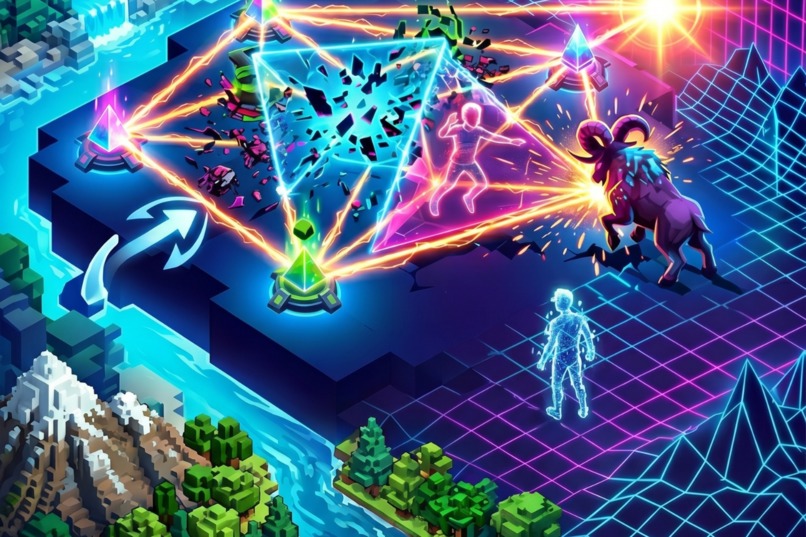
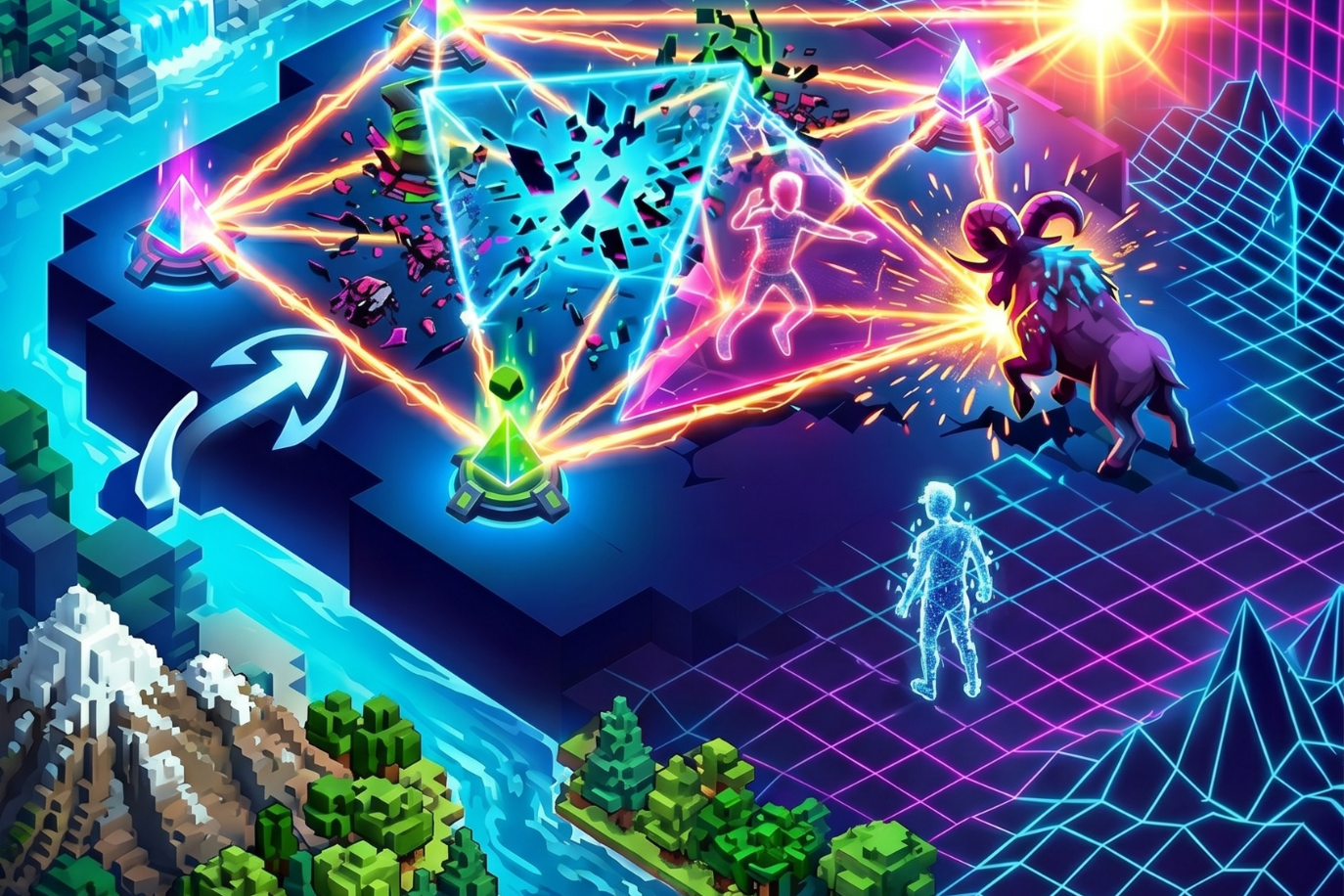
What it does To put it simply, the objective of Nexus Weavers: Spatial Tactics is to protect the core, the Horizon Core, from being overrun by "Aetheric Glitches," bugs that attack through corrupting and shredding through code. Here is how the game’s magic works: The Tether Defense Matrix: Rather than using point-and-click turret placements, you set down Anchor Nodes and swipe between them to build instant, intelligent laser walls. Tactical Geometry: Victory comes from playing in lines and angles; connecting three or more nodes into a "Tether Triangle" creates a deadly crossfire pattern that destroys enemies recursively. Your Avatar, In the Heat of Battle: The unique aspect of your Horizon character was made part of the play itself, as your "Avatar Echo" traverses the laser walls and blocks the big, elite rifts.
How we built it We realized this project in an extremely condensed production process consisting of four phases, with each stage solely geared towards perfecting our MVP design. Get the basics right: In Phases 1 and 2, we defined the grid-based character portrait design, implemented responsive touch raycasting, and programmed our own system for detecting swipes to allow us to do mathematically sound drawing of lines based on coordinate changes. Getting the polish down: In Phases 3 and 4, we incorporated the waves of enemies, connected the Health pool in the Core, and created an elegant "Neon Cyber-Minimalist" style interface complete with HUD telemetry and glowing particles. Economy: We established an economics model based on a mathematical principle that makes placing nodes very risky, ensuring that players had no choice but to use their brains as spamming defenses would not work ($C_{Node} = B \times (1.4)^N$).
Challenges we ran into Creating an action strategy game using mobile technology involved having to work around a number of incredibly challenging technical obstacles: Touch Input Inaccuracy Problem: When it comes to isometric fields in mobile gaming, they are notoriously inaccurate. To solve this problem, we engineered a more efficient way to convert the screen coordinates to their corresponding world coordinates using screen-to-world bounding boxes. Frame Rate Problem: Rendering multiple glow effects for each individual laser fence can certainly cause a mid-level mobile processor to crash. We solved this problem by replacing expensive mesh creation with vector lines rendered using pre-made shaders. Pathfinding Overload Problem: The ability of players to totally change map positions in real time required a special solution that would prevent pathfinding from slowing down the game.
Accomplishments that we're proud of Perfect Synergy for All Four Documents: Our team is immensely proud of how flawlessly our designs work across all four documents we were required to submit for the competition (GDD, PJM, VCP, and Production Plan), without any design conflicts at all. Real One-Thumb Comfortable: We showed how a turn-based strategy game could include an enormous amount of complexity while being completely comfortable to play using one thumb while standing in the middle of a crowded subway. Pure Game-Play Tension: We succeeded in capturing that tension which made people want just one more round, that pure terror of watching the enemy elite player destroy your anchor point defense wall and force you to draw another wall.
What we learned Be Ruthless with Your Scope: We were taught that the only way to create something truly amazing was to be mercilessly harsh with our scope. Getting rid of huge features like multiple elevations, composite trees, and live co-op helped us create the perfect swiping mechanics. Art as Information Tool: It turns out on a small mobile screen where everything is bathed in direct sunlight, art needs to do its job of communicating information. Our color matrix system (Slate for neutral environments, Cyan for good internet connections, Rose for incoming danger, and Gold for hero abilities) helps keep the game fully readable at one glance.
What's next for NEXUS WEAVERS: SPATIAL TACTICS With the core MVP cycle established, it’s time to take this idea to the next level and turn it into something huge: Evolving Environments: Expanding on our planned campaign worlds, adding challenging split-path choices in Cyber-Glitch Crags and multi-tier elevation maps in Neon Grid-Spire. Asynchronous Live PvP: Developing an “Echo Glitch Architect Mode” where competitive gamers play the role of the virus, using funds to create dynamic layout anomalies and spawn glitch waves for a defender. Cooperative Laser Weaving: Introducing a new live cooperative mode, allowing two gamers to play on one grid together while talking to each other in order to weave a compound tether from various elements. Horizon Avatar SDK Sync: Integrating our system further by having it read the selected equipment items and translating them to Echo’s signature and ultimate skills.


Log in or sign up for Devpost to join the conversation.