-
-
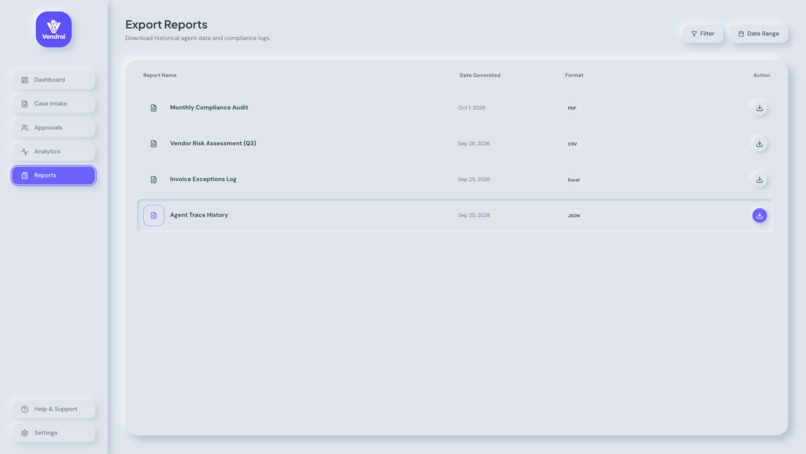
Reports
-
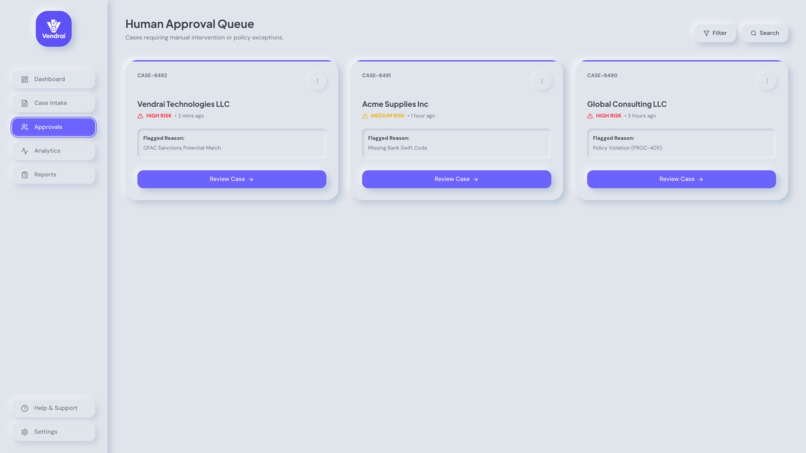
Task cases
-
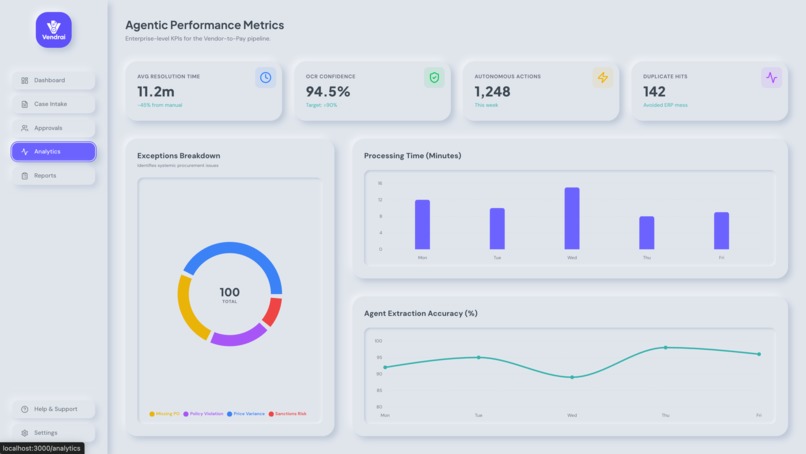
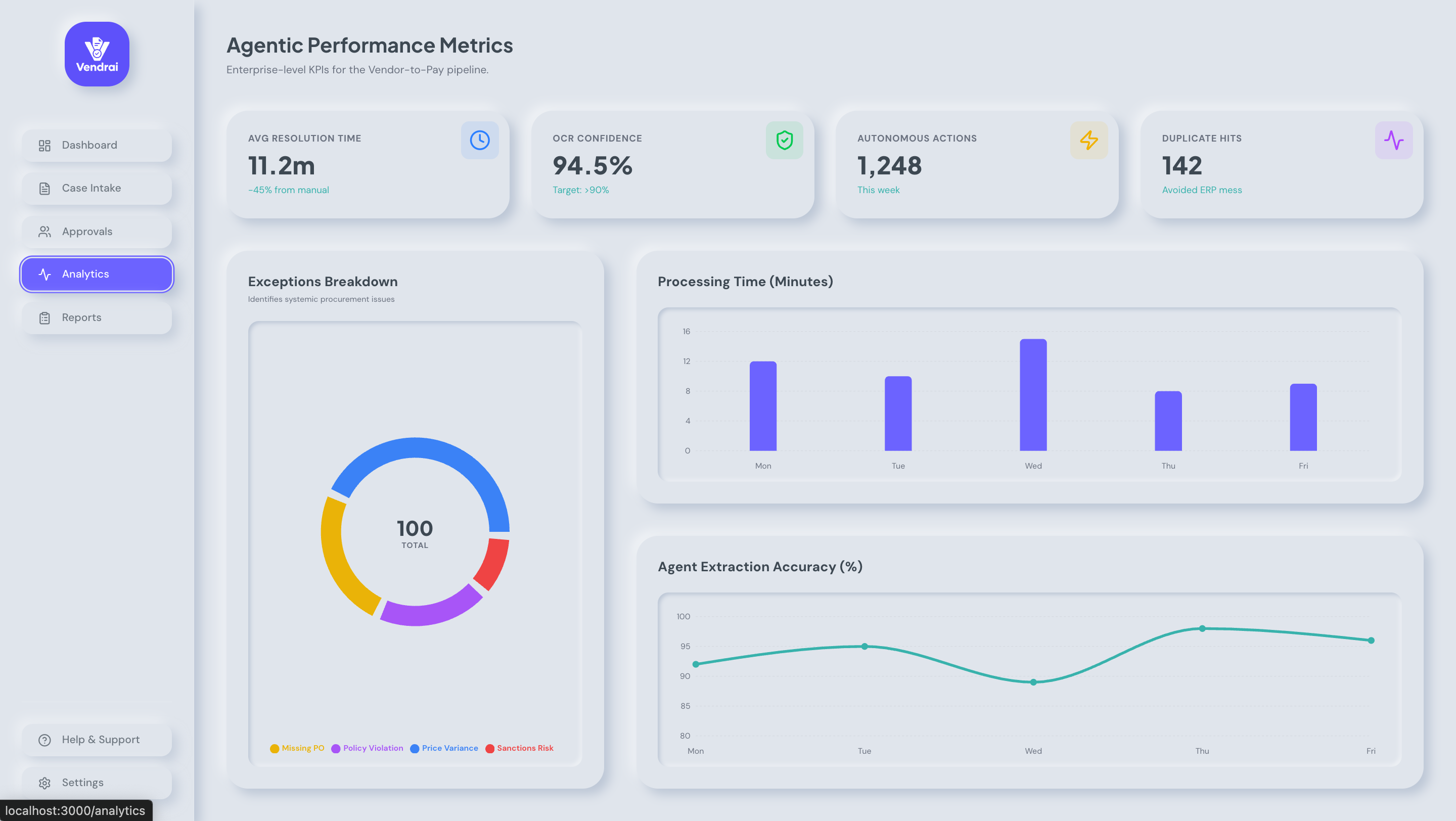
Analytics
-
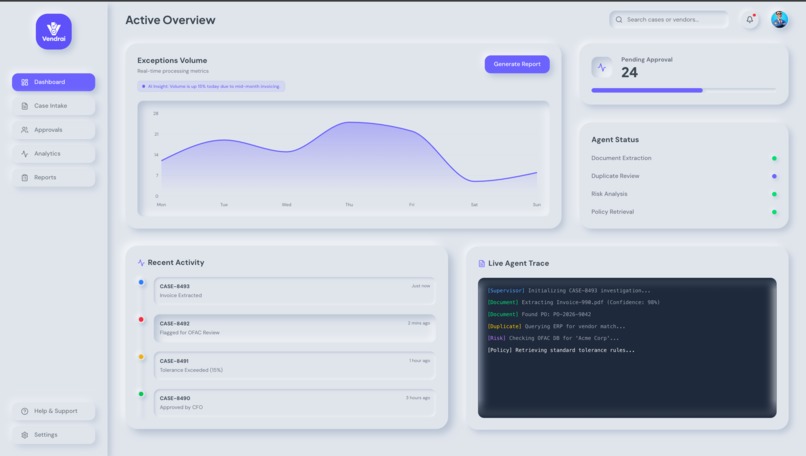
Dashboard
-
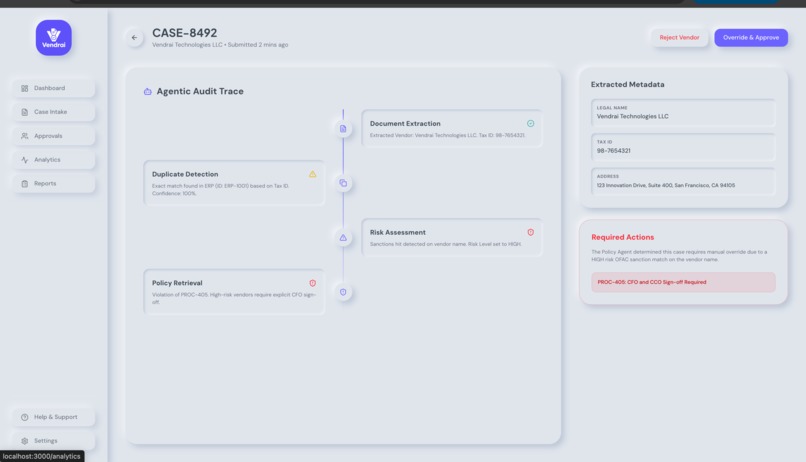
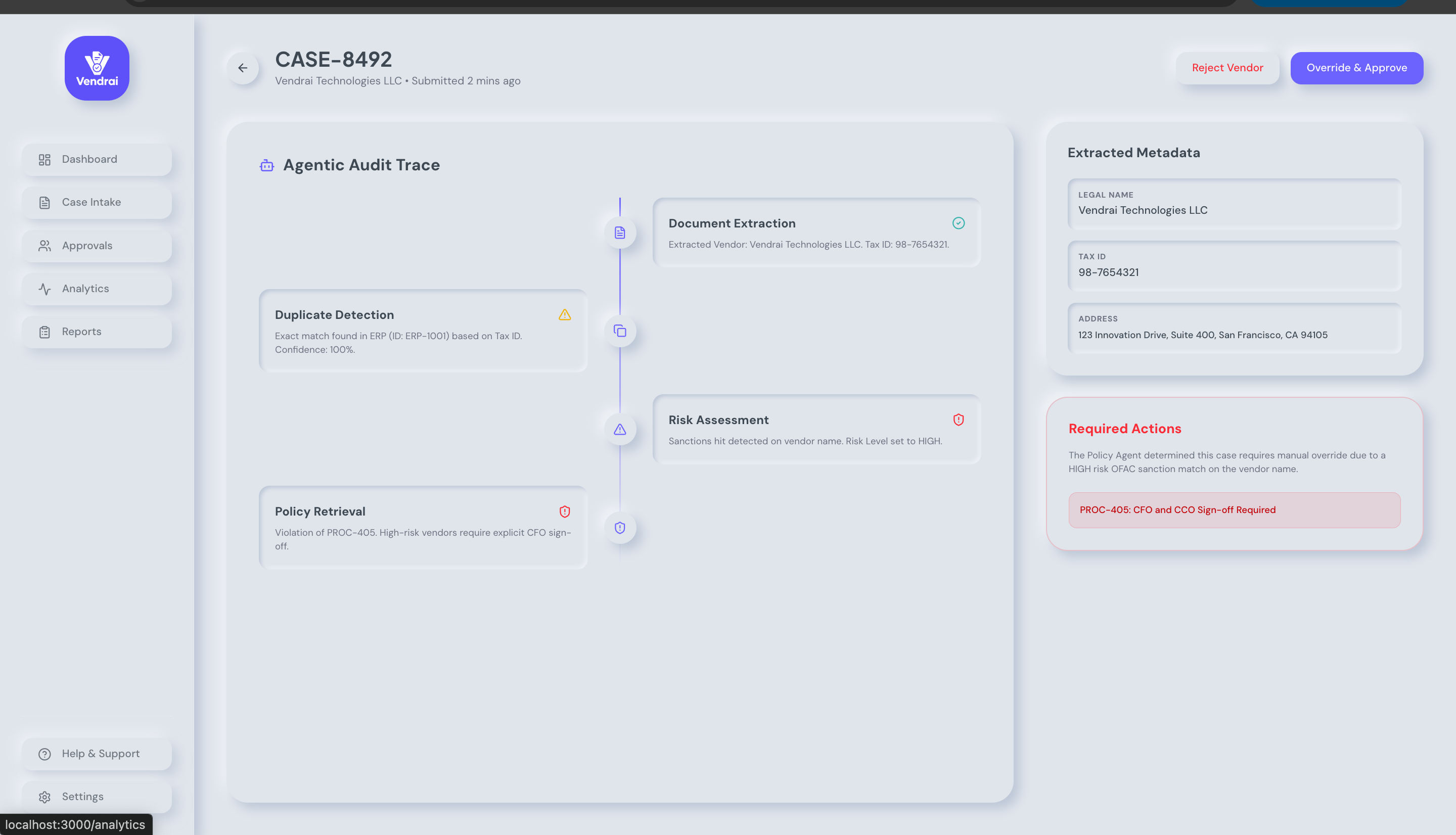
Agentic Audit trace
-
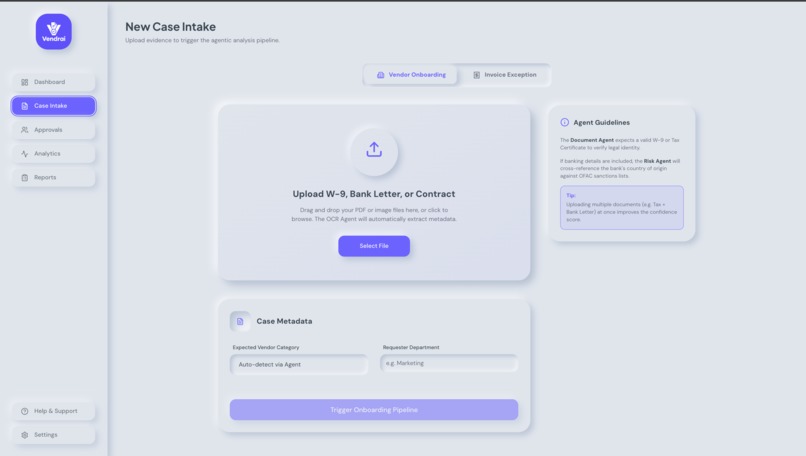
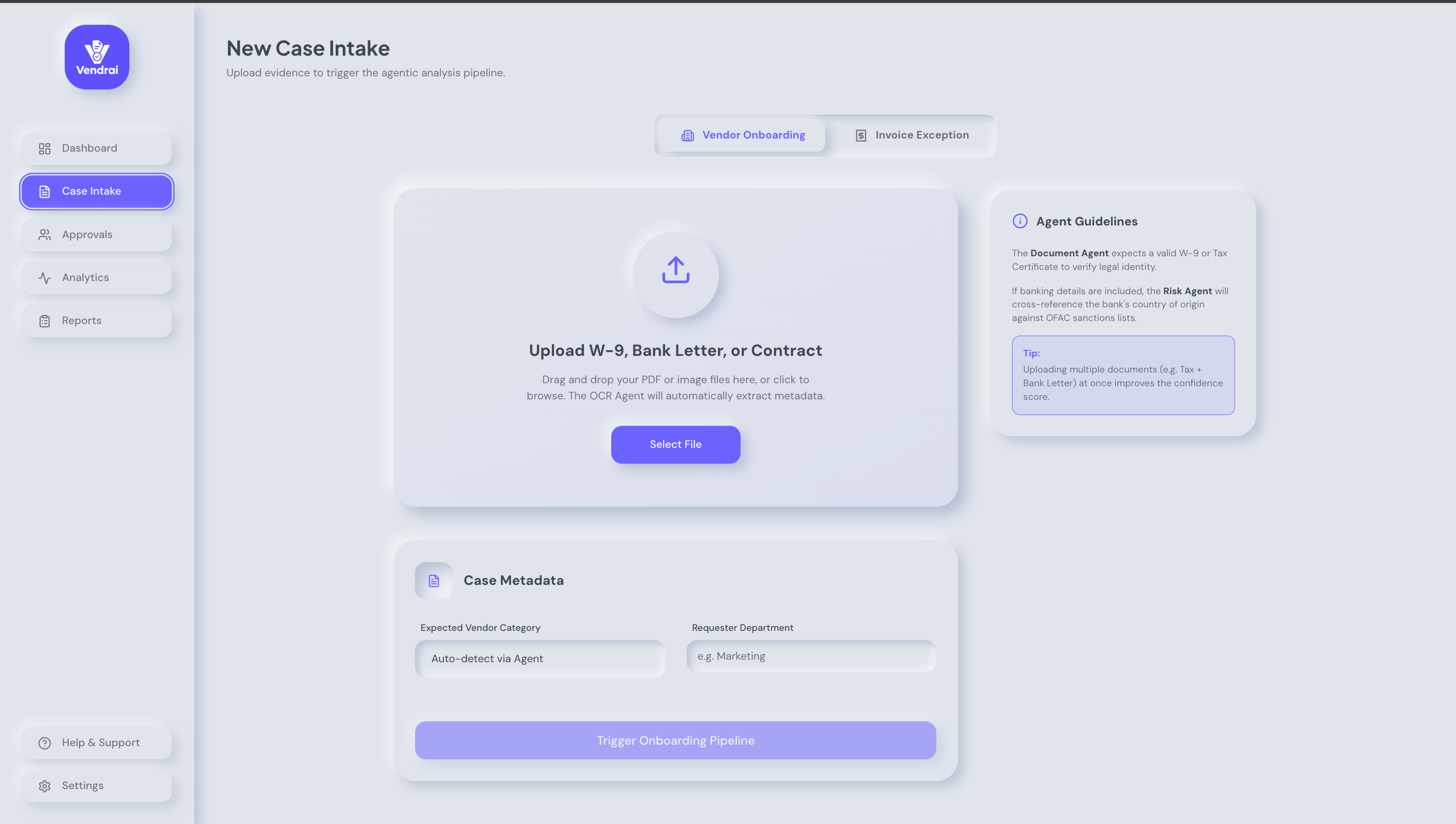
Vendor onboarding
-
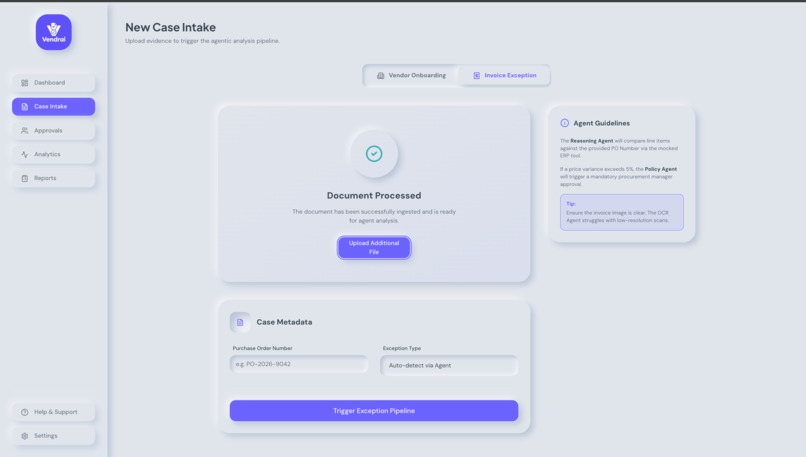
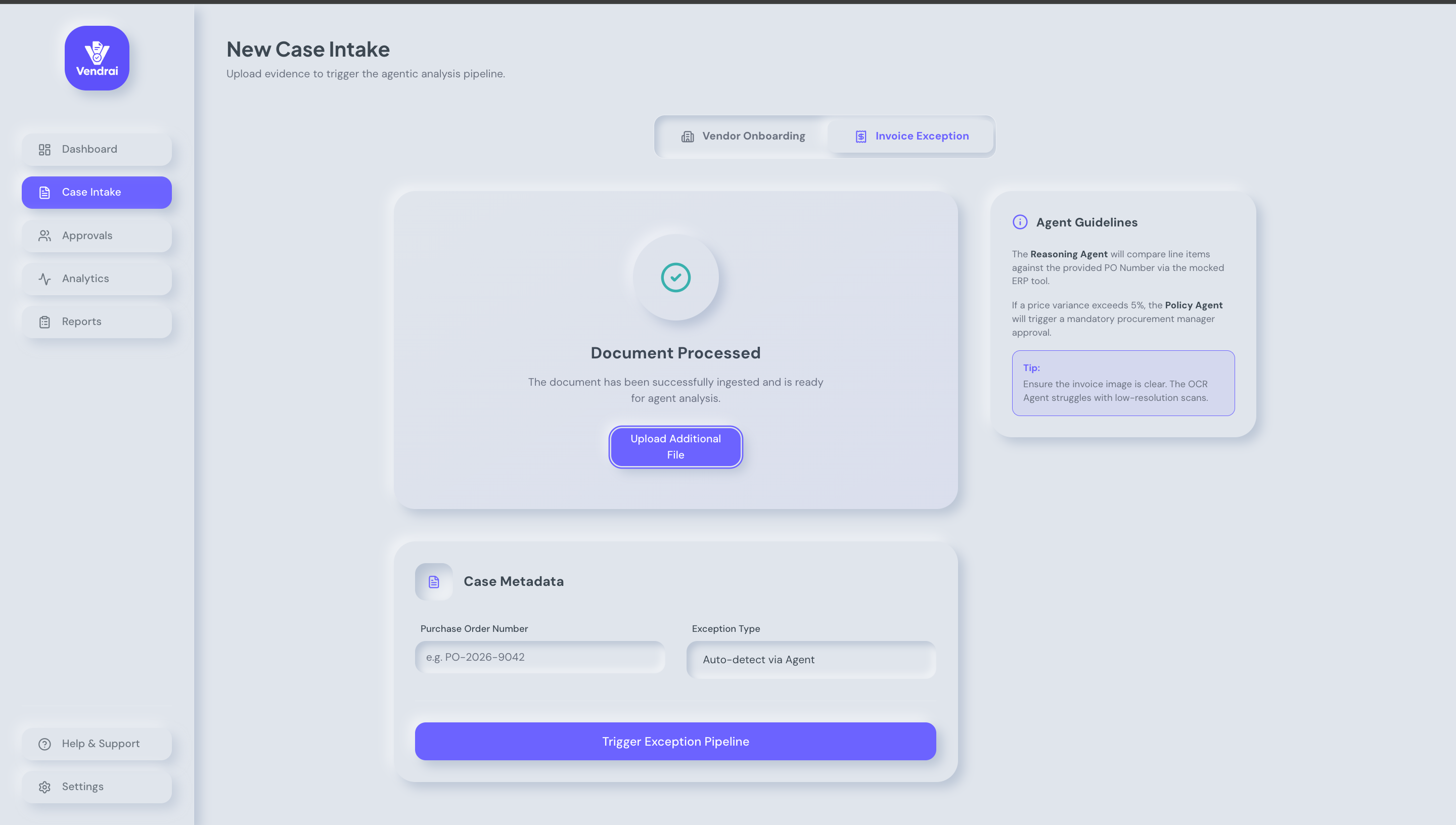
Invoice Execution
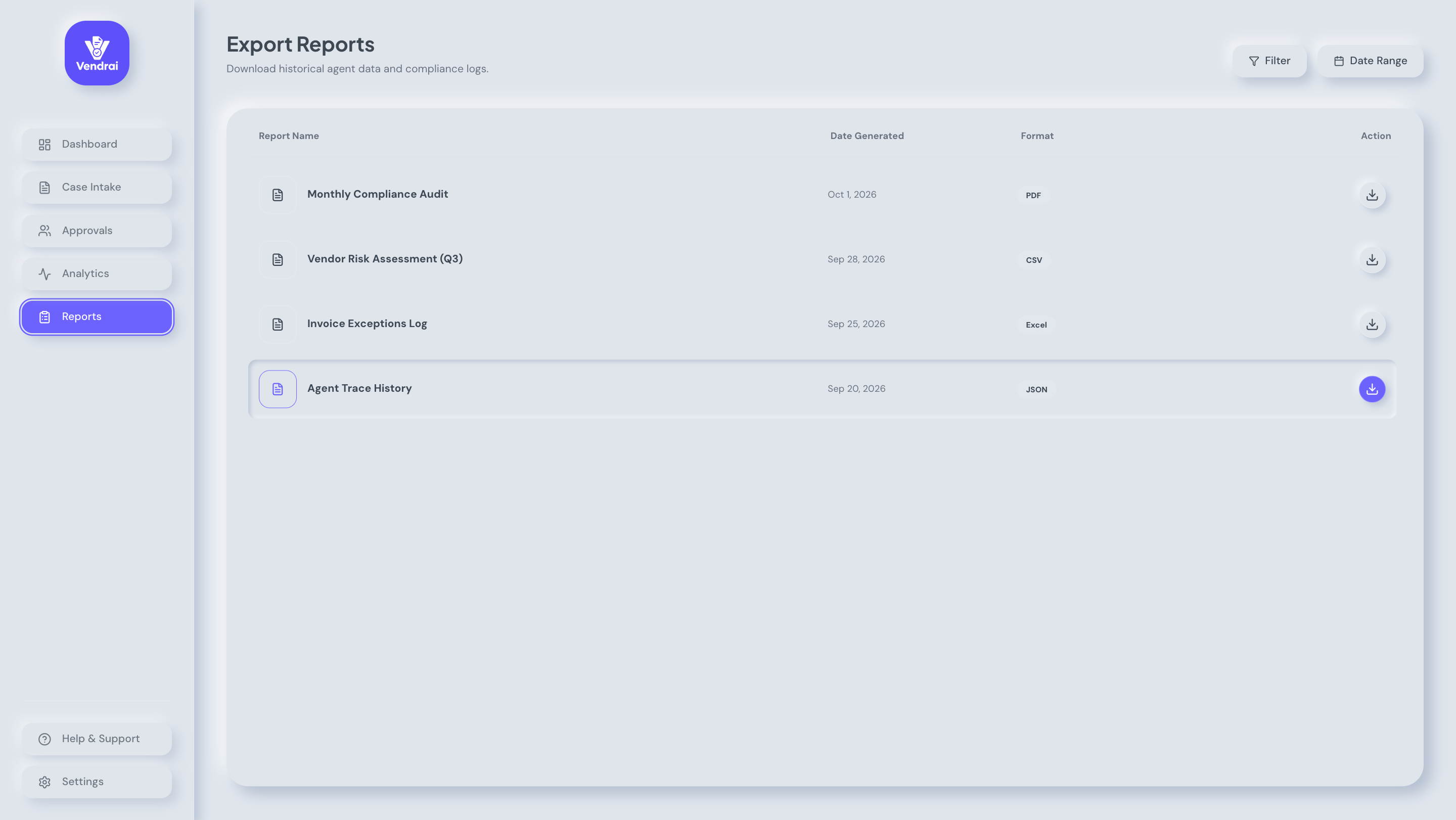
Vendrai: Agentic Vendor Operations for Procurement and Finance
About the Project
Vendrai is a B2B agentic AI system designed to help procurement and finance teams handle vendor onboarding and invoice exception workflows with less manual effort, better evidence, and stronger human control.
The idea came from observing how many business workflows are still handled through emails, spreadsheets, PDFs, ERP screens, and manual approvals. In procurement and finance, a simple task like onboarding a new vendor can become a long investigation. A team member has to collect tax certificates, bank letters, contracts, supplier questionnaires, and approval documents. Then they must check whether the vendor already exists in the ERP system, whether the bank details are safe, whether sanctions or risk checks are required, and whether the correct approval path has been followed.
The same issue appears in invoice exception handling. If an invoice does not match the purchase order or goods receipt, an AP specialist must manually identify the reason. It could be a price mismatch, quantity mismatch, missing PO, duplicate invoice, tax issue, or vendor name mismatch. These are not just data-entry problems. They require judgment, evidence checking, policy understanding, and human approval.
That inspired us to build Vendrai: a multi-agent system that automates the investigation work while keeping humans in control of high-risk business decisions.
Inspiration - The Problem We Identified
Vendor-to-Pay workflows are slow because the data is scattered and inconsistent. A supplier may appear with slightly different names across documents. A bank letter may not match the registered country. A risk API may fail temporarily. A policy document may require extra approval depending on the supplier category or spend threshold.
Traditional workflow software can route fixed tasks, but it struggles when the case is ambiguous. A normal chatbot can answer questions, but it does not manage case state, call tools, recover from failures, build evidence packets, and pause for human approval before execution.
Our problem statement is:
Procurement and finance teams need a safe, evidence-driven agentic system that can investigate vendor onboarding and invoice exception cases across documents, policies, ERP data, and external risk tools, while keeping human approval at critical decision points.
Our Proposed Solution
Vendrai uses a multi-agent workflow instead of one general chatbot. The system starts when a vendor onboarding request or invoice exception case is created. A Supervisor Agent reads the case and decides which specialist agents are needed.
For vendor onboarding, the main agents are:
- Document Agent: extracts fields from supplier documents using OCR or document AI.
- Duplicate Detection Agent: checks whether the vendor may already exist in the ERP or vendor master.
- Risk Agent: performs sanctions, bank-country, and fraud-risk checks.
- Policy Agent: retrieves relevant procurement rules and approval requirements.
- Reasoning Agent: evaluates all outputs together and decides the next step.
- Clarification Agent: asks the vendor or requester for missing information.
- Evidence Builder Agent: creates a structured approval packet.
- Verifier Agent: checks completeness, safety, and policy compliance.
- ERP Sync Agent: performs approved sync actions only after human approval.
The key principle is simple:
The agent investigates. The human approves.
Vendrai does not autonomously create vendors, change bank details, approve invoice exceptions, or trigger payment-related actions without human approval.
How We Built the System Design
We designed Vendrai as an enterprise-style architecture with five main layers:
Presentation Layer
A web application where users create cases, upload documents, review evidence packets, and approve or reject recommendations.Core Backend Layer
Handles authentication, role-based access control, case management, approval routing, and audit logging.Agent Runtime Layer
Runs the multi-agent workflow using a graph-based orchestration model. The agent runtime manages case state, specialist agents, reasoning, retries, and human handoff.Tool Gateway Layer
Controls how agents access external systems. Instead of letting the LLM directly access sensitive systems, every tool call goes through typed functions with validation, permissions, retries, and logging.Data and External Systems Layer
Includes PostgreSQL, vector search, document storage, ERP systems, OCR services, risk APIs, and communication tools like email or Slack.
We also designed separate workflow diagrams for vendor onboarding and invoice exception handling. These diagrams helped us understand where automation is useful and where human review is required.
Agentic Loop
The core agentic loop works like this:
- A new case is created.
- The Supervisor Agent classifies the case.
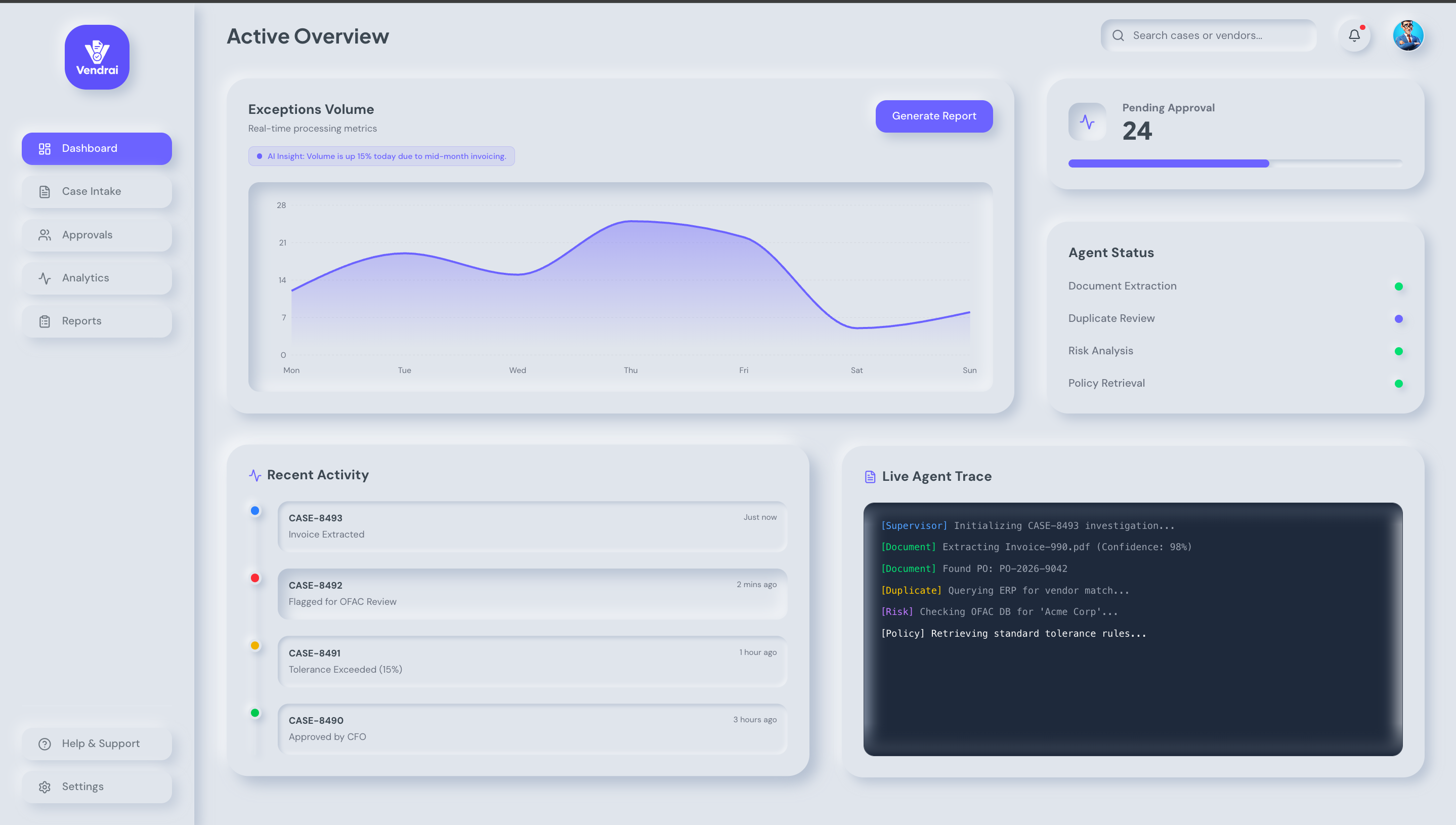
- Specialist agents analyse documents, vendor records, policies, and risk signals.
- Their outputs are stored in shared case state.
- The Reasoning Agent evaluates the full context.
- If information is missing, the system asks for clarification.
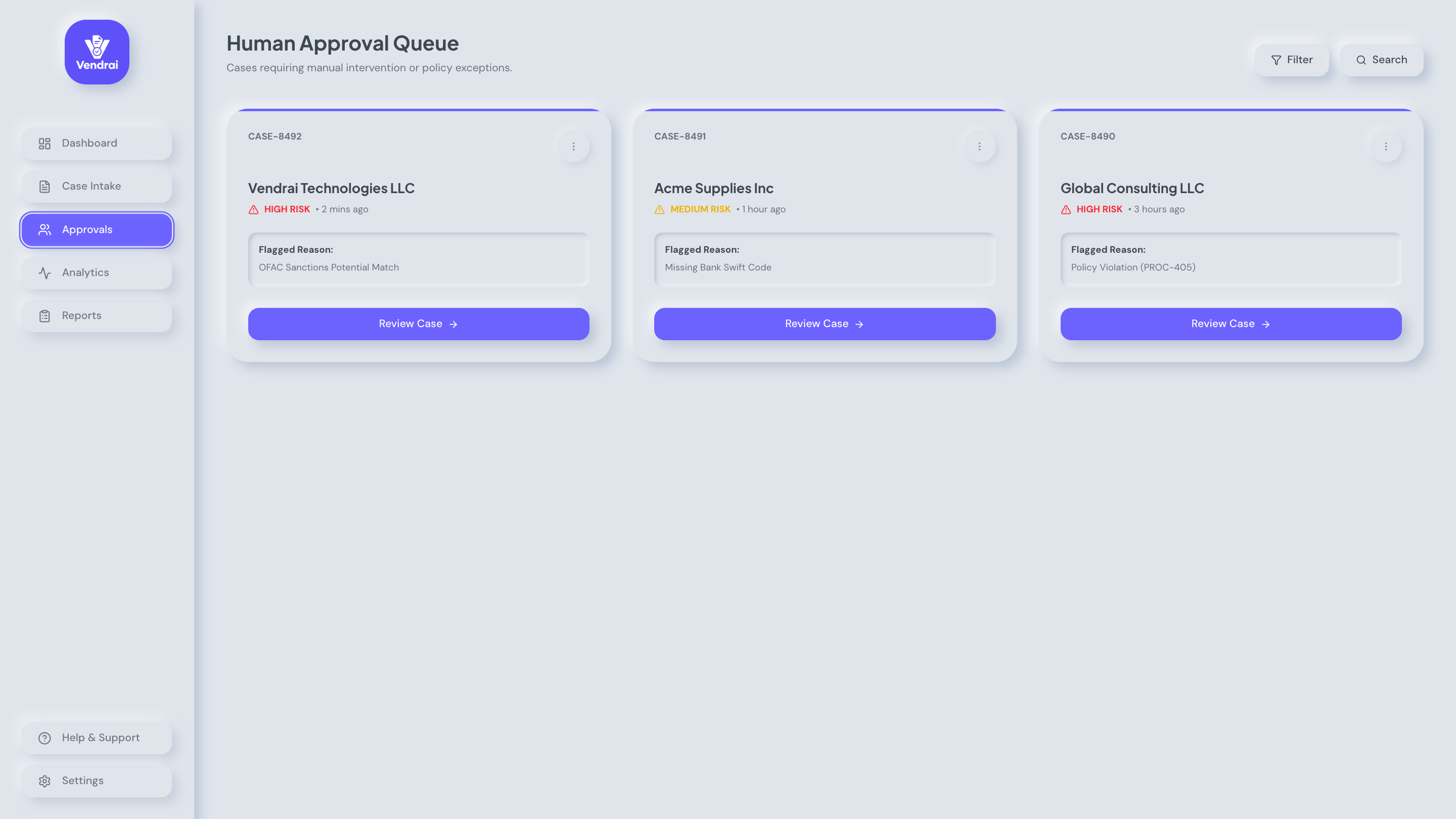
- If a duplicate or risk issue is found, the system routes it to human review.
- If the case is complete, the Evidence Builder creates an approval packet.
- The Verifier checks safety and completeness.
- A human reviewer approves, edits, rejects, or escalates.
- Only after approval, the system performs controlled ERP sync.
- Every step is logged for auditability.
This makes the system more flexible than a rigid workflow script and safer than an uncontrolled autonomous agent.
Technical Execution Plan
For Phase 2, our MVP will focus mainly on supplier onboarding. The planned technical stack is based on free or free-tier tools as much as possible.
Our planned stack:
- Frontend: Next.js, TypeScript, Tailwind CSS, shadcn/ui
- Backend: FastAPI, SQLAlchemy, Pydantic
- Agent Orchestration: LangGraph
- Database: PostgreSQL
- Vector Database: Qdrant (with pgvector for hybrid search)
- Document Storage: MinIO
- Queue and Background Jobs: Redis
- OCR / Document Processing: OCR.space and Docling
- LLM: Gemini Free Tier API (
gemini-2.5-flash) - Observability: Langfuse and OpenTelemetry
- Authentication: Keycloak
The MVP will include:
- vendor onboarding case creation,
- document upload,
- OCR extraction,
- duplicate vendor detection,
- policy retrieval,
- risk check simulation or API integration,
- evidence packet generation,
- human approval queue,
- simulated ERP sync,
- audit logs,
- status chips for workflow visibility,
- latency and tool-call tracking.
We also plan to include guardrails such as PII masking, encryption, role-based access control, tool-call permission checks, and human approval before sensitive actions.
What We Learned
Through this project, we learned that building an agentic AI system is very different from building a normal chatbot. A chatbot can answer questions, but an enterprise agent must manage state, call tools safely, handle ambiguity, recover from errors, and explain its decisions with evidence.
We also learned that human-in-the-loop design is not just an extra feature. It is a core part of building safe AI for finance and procurement. In our system, humans are not used for every small task. Instead, they are placed at the most important control points: vendor creation, duplicate resolution, bank detail changes, risk overrides, invoice exception approval, and payment-related decisions.
Another important learning was that technical architecture matters. Agentic systems need proper separation between the LLM, tools, databases, and sensitive business systems. The LLM should not directly access the database or ERP. It should request actions through controlled tools, and every action should be logged.
Challenges We Faced
One major challenge was choosing a problem that was truly B2B and not just a simple AI chatbot idea. We had to think carefully about where businesses actually lose time and money.
Another challenge was designing the agent workflow without making it a rigid linear script. We wanted the system to dynamically decide whether to continue, ask clarification, retry a failed tool, or escalate to a human.
We also had to think about safety. Finance and procurement workflows involve sensitive company data, vendor bank details, invoices, and approvals. Because of that, we designed the system with role-based access, PII masking, tool-call validation, audit logging, and human approval before risky execution.
A final challenge was balancing ambition with feasibility. The complete vision includes supplier onboarding, invoice exceptions, policy reasoning, ERP integrations, and risk APIs. For Phase 2, we decided to focus first on a strong vendor onboarding MVP that demonstrates the full agentic loop clearly.
Why Vendrai Matters
Vendrai is not trying to replace procurement or finance professionals. Instead, it removes the manual investigation burden so humans can make faster, safer, and more evidence-based decisions.
The business value comes from:
- faster supplier onboarding,
- reduced AP investigation time,
- fewer duplicate vendor records,
- better audit readiness,
- safer vendor risk handling,
- consistent policy application,
- improved visibility into every workflow step.
In simple terms:
Vendrai turns messy vendor and invoice workflows into structured, evidence-based decisions.
About NeuroX 1.0
We found out about NeuroX 1.0 through WhatsApp statuses and shared posts. Our team became interested because the competition felt different from many usual AI competitions.
Many competitions focus mainly on model accuracy, generic chatbots, or small AI demos. NeuroX 1.0 stood out because it focuses on B2B agentic AI and real business workflows. That pushed us to think beyond just using an LLM and instead design a practical enterprise system with business impact, agentic reasoning, architecture, and human control.
As Team GMora, we see NeuroX 1.0 as a valuable opportunity to explore how AI agents can be used responsibly in real organisations. It helped us think about trust, safety, auditability, and practical implementation, not just innovation for the sake of innovation.
Final Summary
Vendrai is a multi-agent Vendor-to-Pay system for procurement and finance teams. It uses autonomous agents to investigate supplier onboarding and invoice exception cases, but keeps humans in control of sensitive decisions.
Our core message is:
The agent investigates. The human approves. The business moves faster.
We believe this makes Vendrai a practical, safe, and scalable B2B agentic AI solution.
Built With
- docker
- fastapi
- gemini
- langfuse
- langraph
- minio
- nextjs
- ocr
- opentelemetry
- postgresql
- quadrant
- tailwind
- typescript

Log in or sign up for Devpost to join the conversation.