-
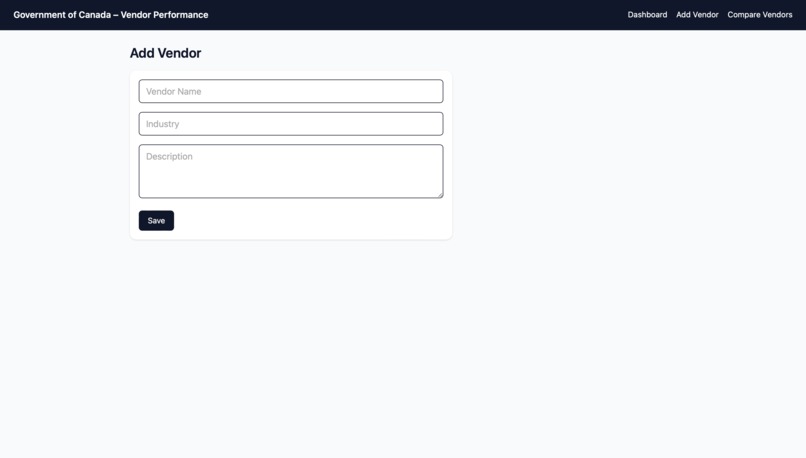
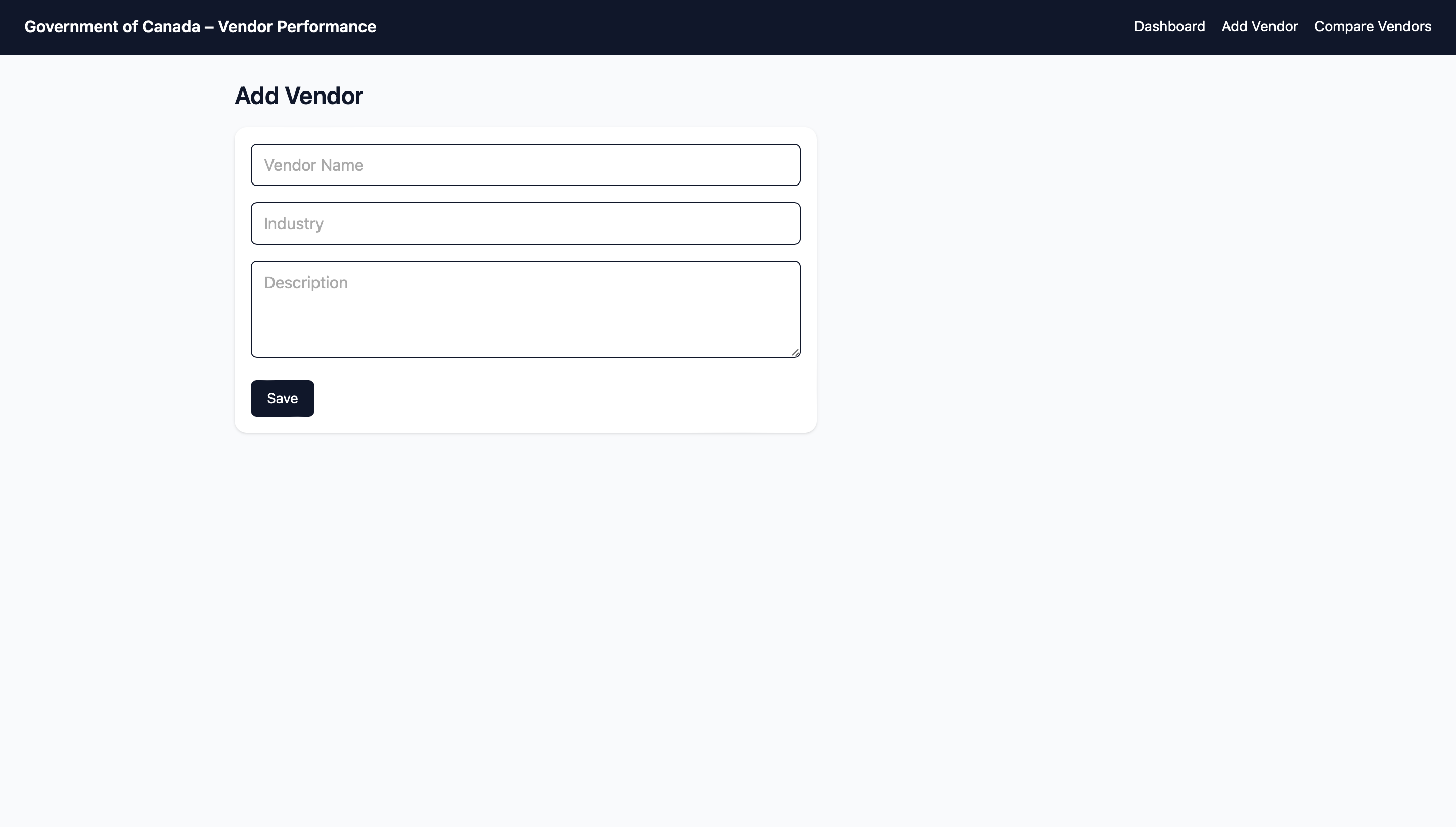
Simple vendor registration form to onboard new contractors into the government-wide tracking system.
-
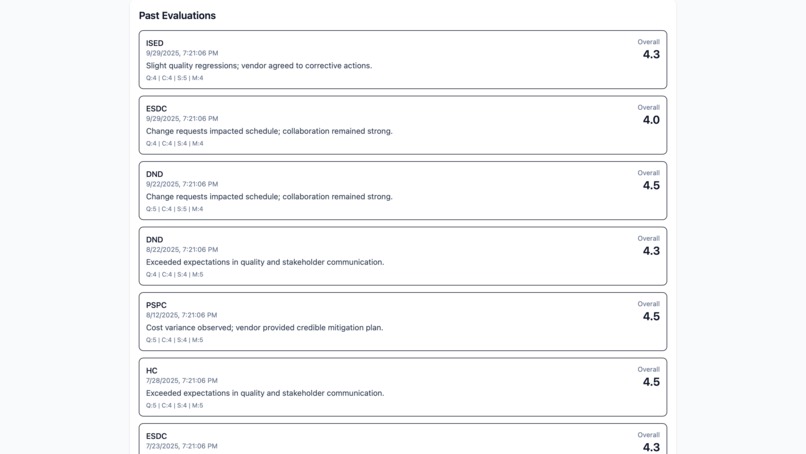
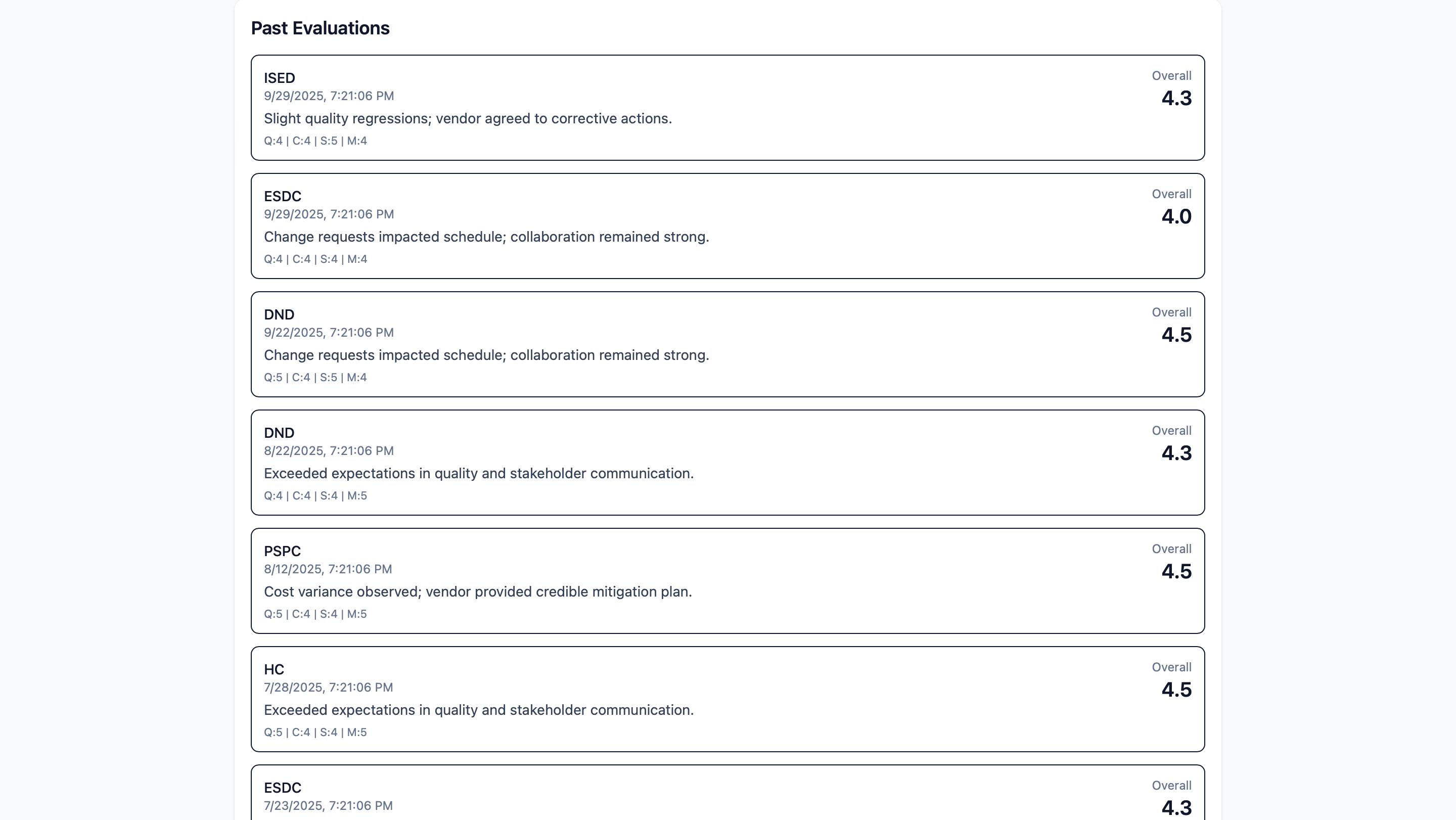
Historical performance dashboard showing vendor scorecards across multiple departments and contracts over time.
-
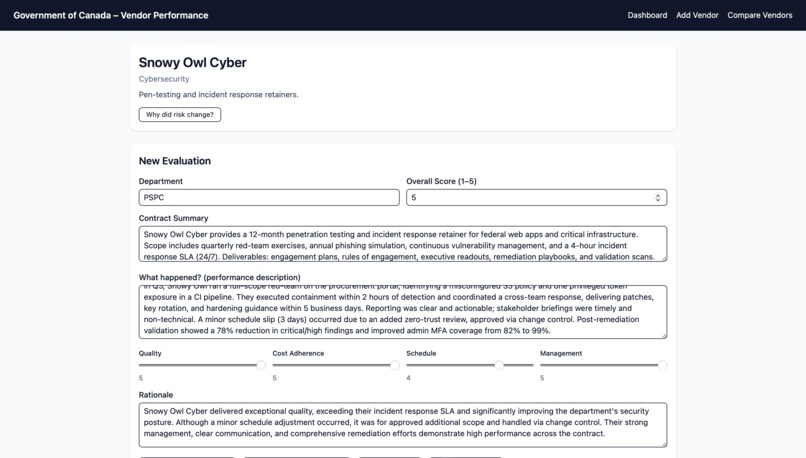
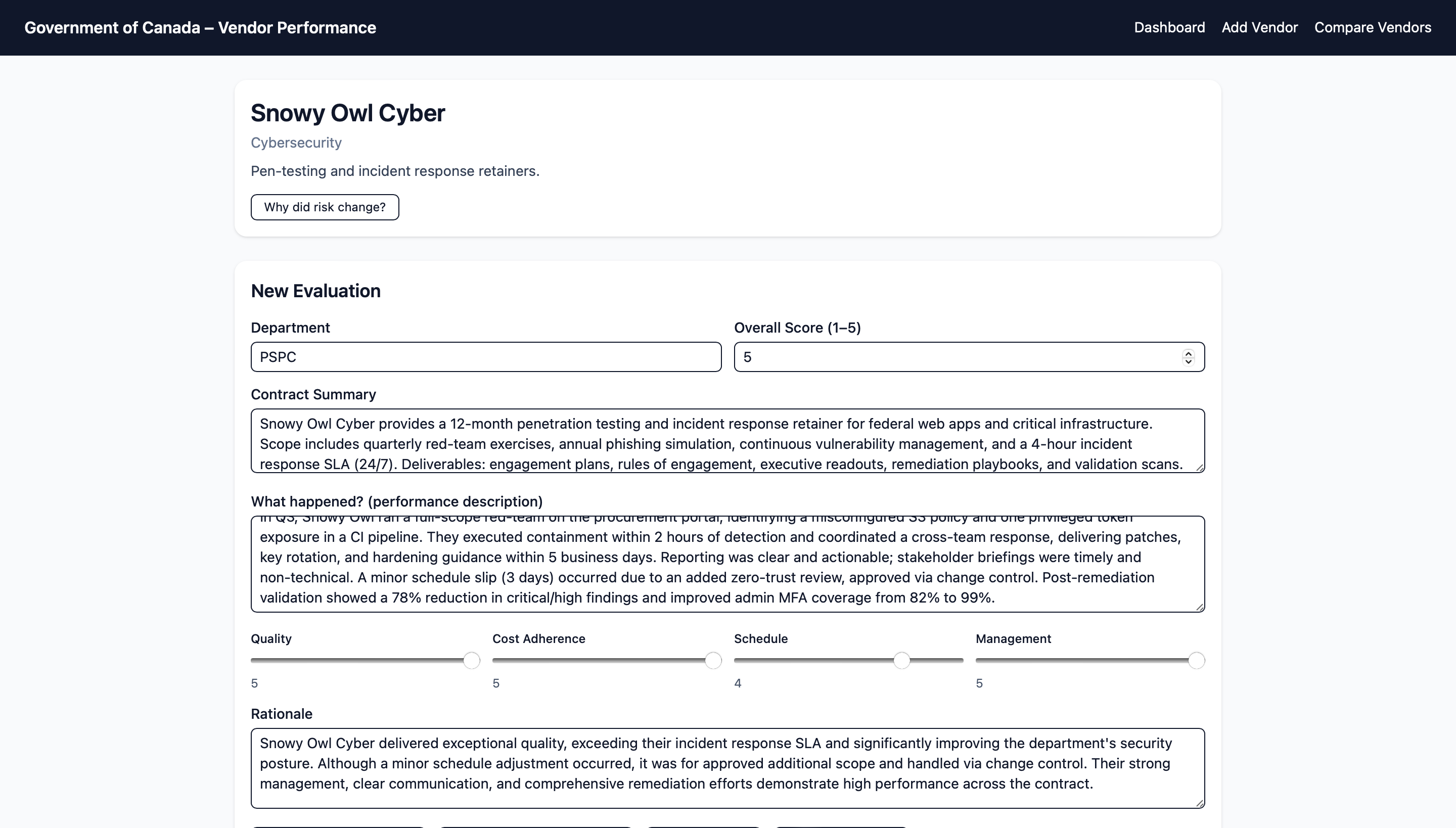
Individual vendor profile page displaying company info, industry category, and complete evaluation history with risk tracking.
-
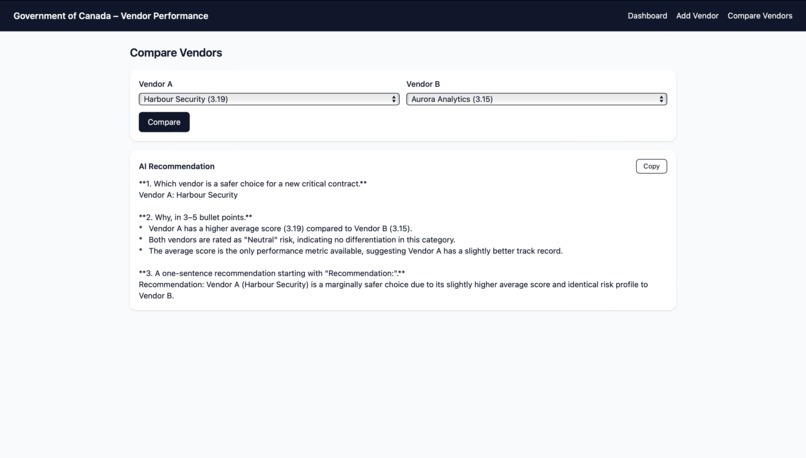
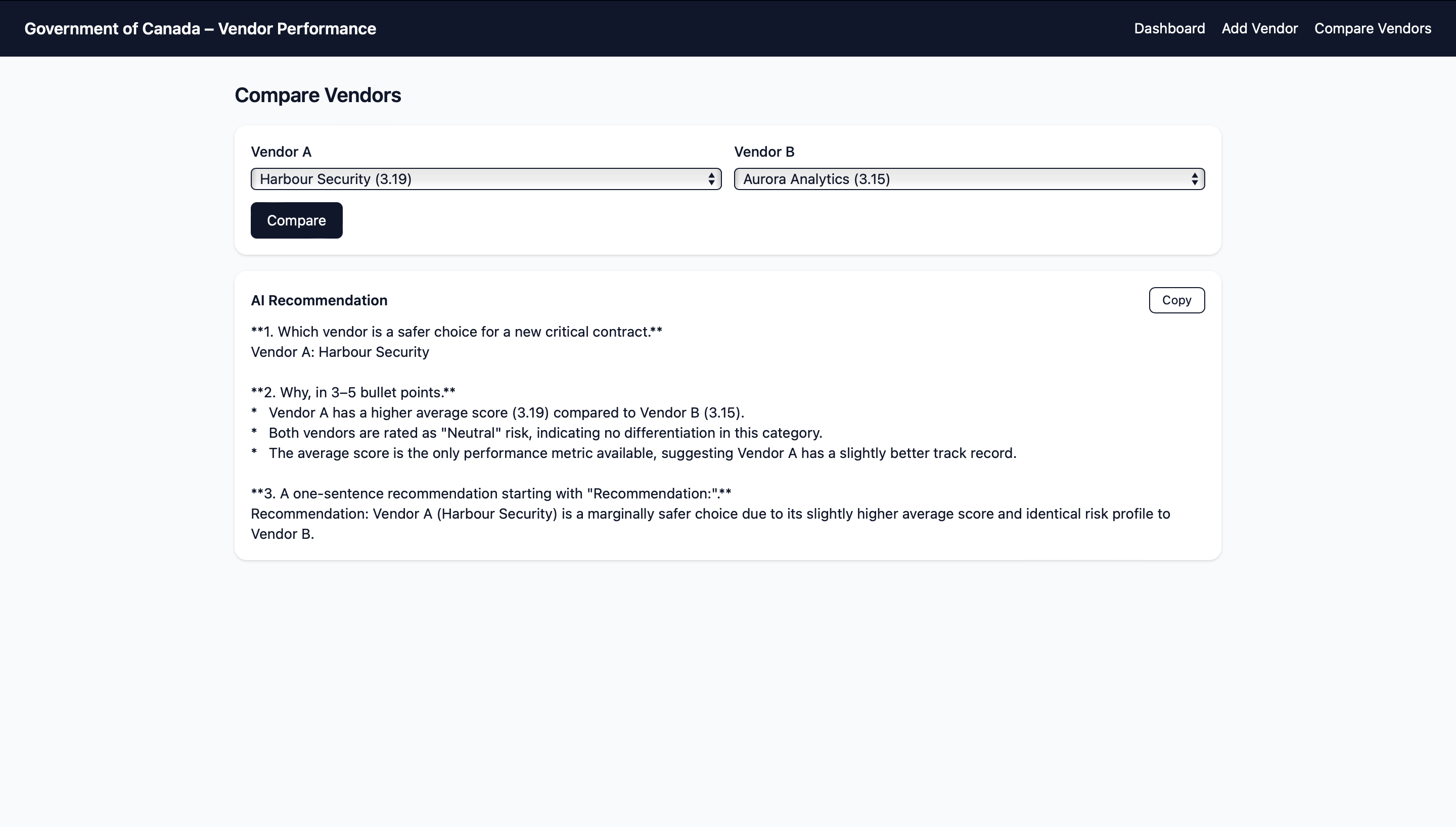
AI-powered vendor comparison tool that recommends the safer contractor choice based on performance scorecards.
-
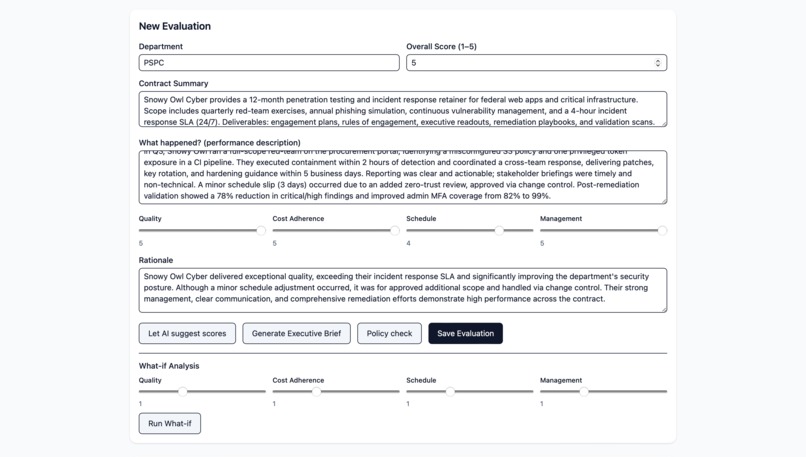
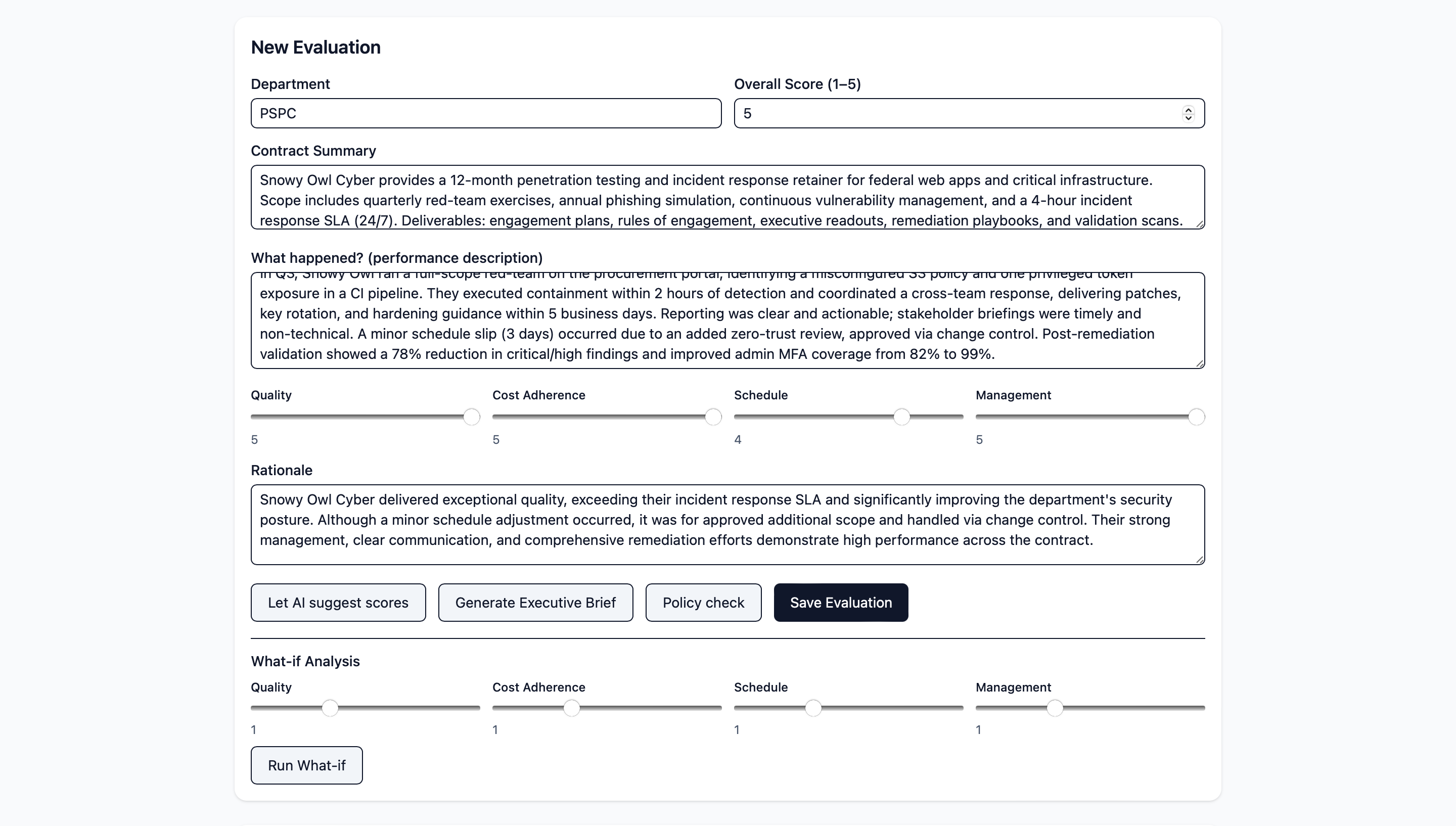
Contract evaluation form where AI analyzes performance data and generates standardized KPI scores with what-if scenario modeling.
VendorVanguard
Inspiration
When we started this hackathon, we knew we wanted to build something that mattered, a solution Canada desperately needed. We explored several different ideas, looking for a problem where AI could truly fill critical gaps and create real impact.
We considered healthcare data integration, supply chain optimization, even municipal service delivery. But then we discovered something that stopped us in our tracks: Every year, the Government of Canada spends over $20 billion on vendors—construction companies, IT firms, consultants, contractors who build our roads, secure our data, and support critical public services. Yet Canada has no government-wide system to track vendor performance or detect fraud.
We couldn't believe it. In 2025, with all our technology, this gap still exists. A vendor can deliver poor quality, miss deadlines, inflate costs, or engage in suspicious billing... and still win a new contract from another department the next day. The data isn't shared, the patterns aren't tracked, and the warning signs are invisible. Bad vendors hide in plain sight. Good vendors go unrecognized. Taxpayer money quietly disappears.
This was it. This was the problem we needed to solve.
What it does
VendorVanguard is the first AI-powered Vendor Performance Intelligence Platform that transforms how the Canadian government evaluates and selects contractors.
Here's how it works: A department uploads their contract data, timelines, deliverables, invoices, issues, and performance notes. Using Gemini's advanced AI, VendorVanguard transforms that messy, inconsistent information into clean, standardized KPIs across four critical dimensions: quality, cost, schedule, and management.
The AI doesn't just parse data, it understands context, identifies patterns, and evaluates performance across multiple dimensions that would take human analysts weeks to assess. From that analysis, our system generates a tamper-resistant vendor scorecard, like a credit score for government contractors.
Every scorecard is shared across all federal departments through a centralized platform. Procurement officers can instantly see a vendor's complete performance history before awarding contracts. A bad vendor can't hide anymore. A good vendor finally gets recognized.
How we built it
We built VendorVanguard using the Gemini API as our core AI engine, leveraging its natural language processing capabilities to extract meaningful insights from unstructured contract documents and performance reports.
Our tech stack includes:
- Gemini API for AI-powered data transformation and analysis
- A centralized database architecture to store and share vendor scorecards across departments
- Standardized KPI frameworks based on government procurement best practices
- Data validation and tamper-resistance mechanisms to ensure scorecard integrity
- An intuitive dashboard interface for procurement officers to access vendor intelligence
The challenge was enormous: decades of inconsistent data formats, siloed departmental systems, no standardization. Manual review would be impossible at scale. But this is exactly where AI could shine—taking chaos and finding clarity.
Challenges we ran into
Our biggest challenge was dealing with the sheer inconsistency of government contract data. Different departments use different formats, terminology, and evaluation criteria. Teaching our AI to understand that "deliverable not met" in one department means the same as "milestone missed" in another required extensive prompt engineering and data normalization strategies.
We also grappled with how to generate fair, standardized scores when departments might have vastly different expectations or contract complexities. A small IT support contract shouldn't be scored the same way as a multi-year infrastructure project.
Finally, ensuring data security and tamper-resistance was critical—these scorecards would influence billions in spending, so we needed to build robust validation mechanisms to prevent manipulation.
Accomplishments that we're proud of
We built a working prototype that can actually process real contract data and generate meaningful vendor scorecards, something the Canadian government has needed for over a decade.
We're proud that we didn't just build a technical solution; we built a system that could genuinely protect billions in taxpayer dollars and bring unprecedented transparency to government procurement.
Most importantly, we successfully harnessed AI to solve a problem that seemed insurmountable through traditional methods. The Gemini API allowed us to turn months of manual analysis into seconds of intelligent processing.
What we learned
We learned that the most impactful solutions often hide in plain sight, in gaps that seem "too big" or "too complex" for anyone to tackle. We learned that AI isn't just about automation; it's about making the impossible possible by finding patterns and insights humans simply couldn't process at scale.
We also learned the importance of standardization and shared data. So many government (and private sector) problems stem from information silos. Breaking down those barriers creates exponential value.
Finally, we learned that sometimes you need to explore multiple ideas before finding the right one. Our brainstorming journey through different problem spaces ultimately led us to something with real, measurable impact.
What's next for VendorVanguard
Short-term: Expand our dataset to include historical procurement data from multiple federal departments, refine our AI models with more training data, and develop integration APIs for existing government procurement systems.
Medium-term: Pilot VendorVanguard with a federal department to validate real-world effectiveness and gather feedback from procurement officers. Build out predictive analytics, not just showing past performance, but forecasting risk factors for future contracts.
Long-term: Expand beyond the federal government to provincial, municipal, and potentially private sector procurement. The same principles apply everywhere: performance data should be shared, vendors should be accountable, and decision-makers deserve clarity.
VendorVanguard started as a hackathon project, but it could become the transparency standard for billions in public spending. This is just the beginning.
Built With
- express.js
- gemini
- node.js
- react
- tailwind

Log in or sign up for Devpost to join the conversation.