-
-
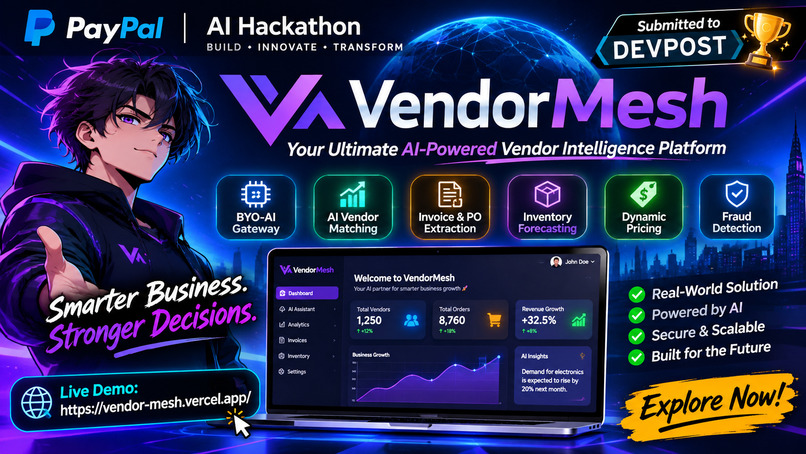
Thumbnail
-
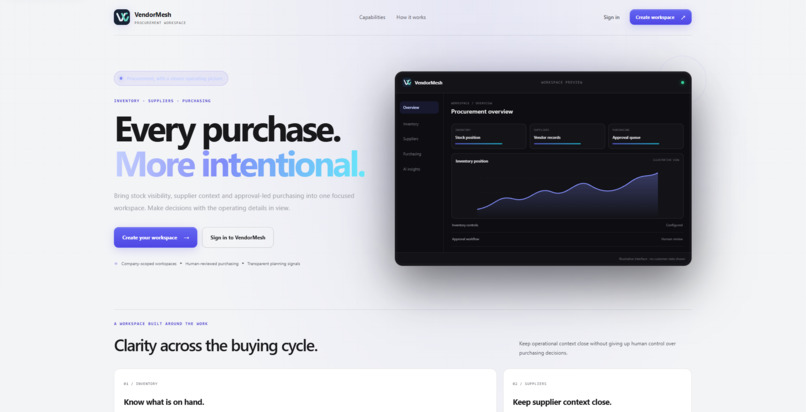
Startup Page
-
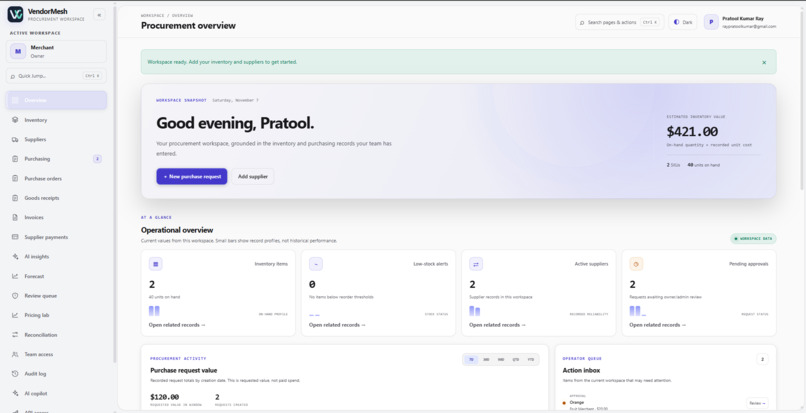
Main Dashboard
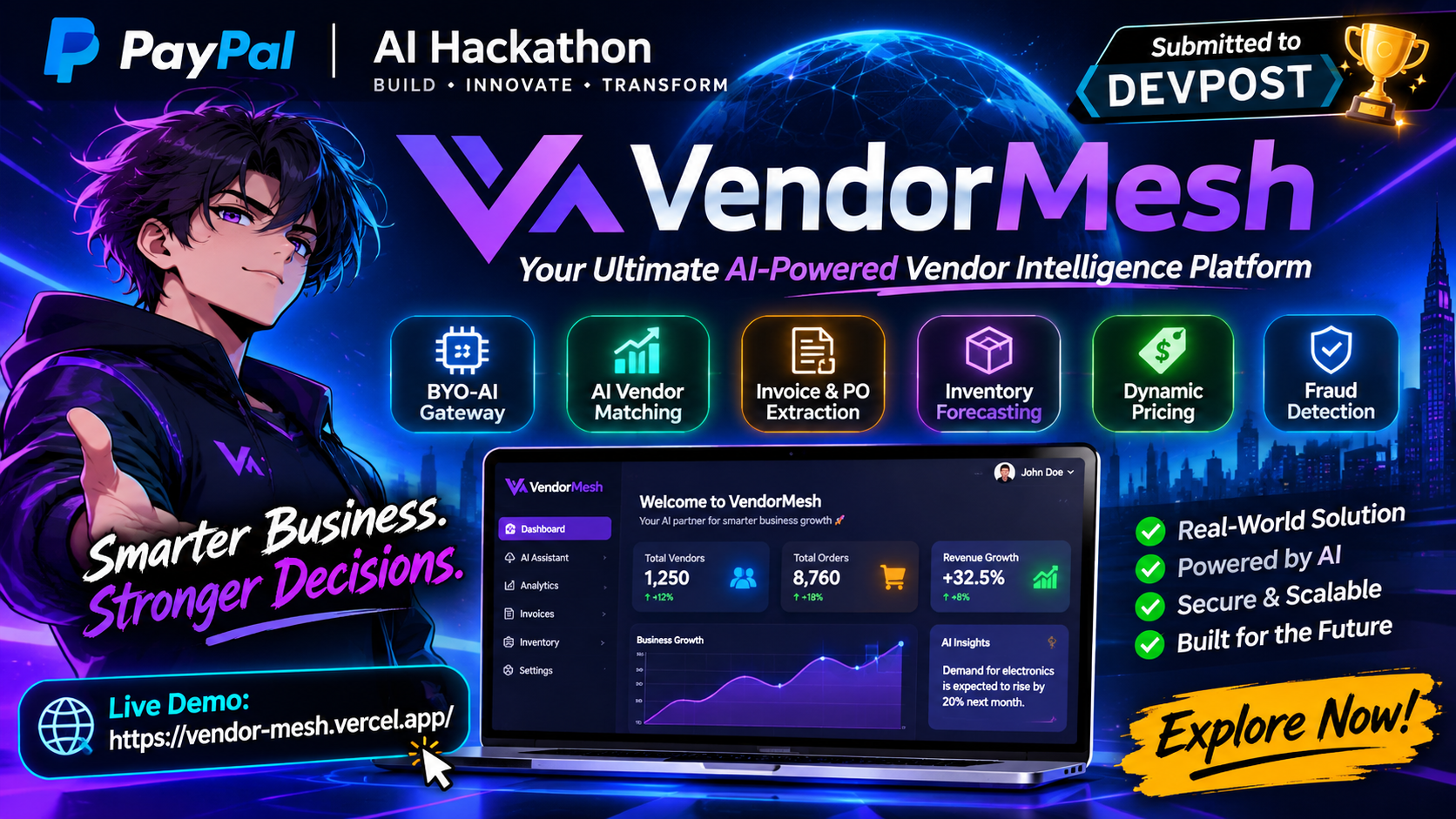
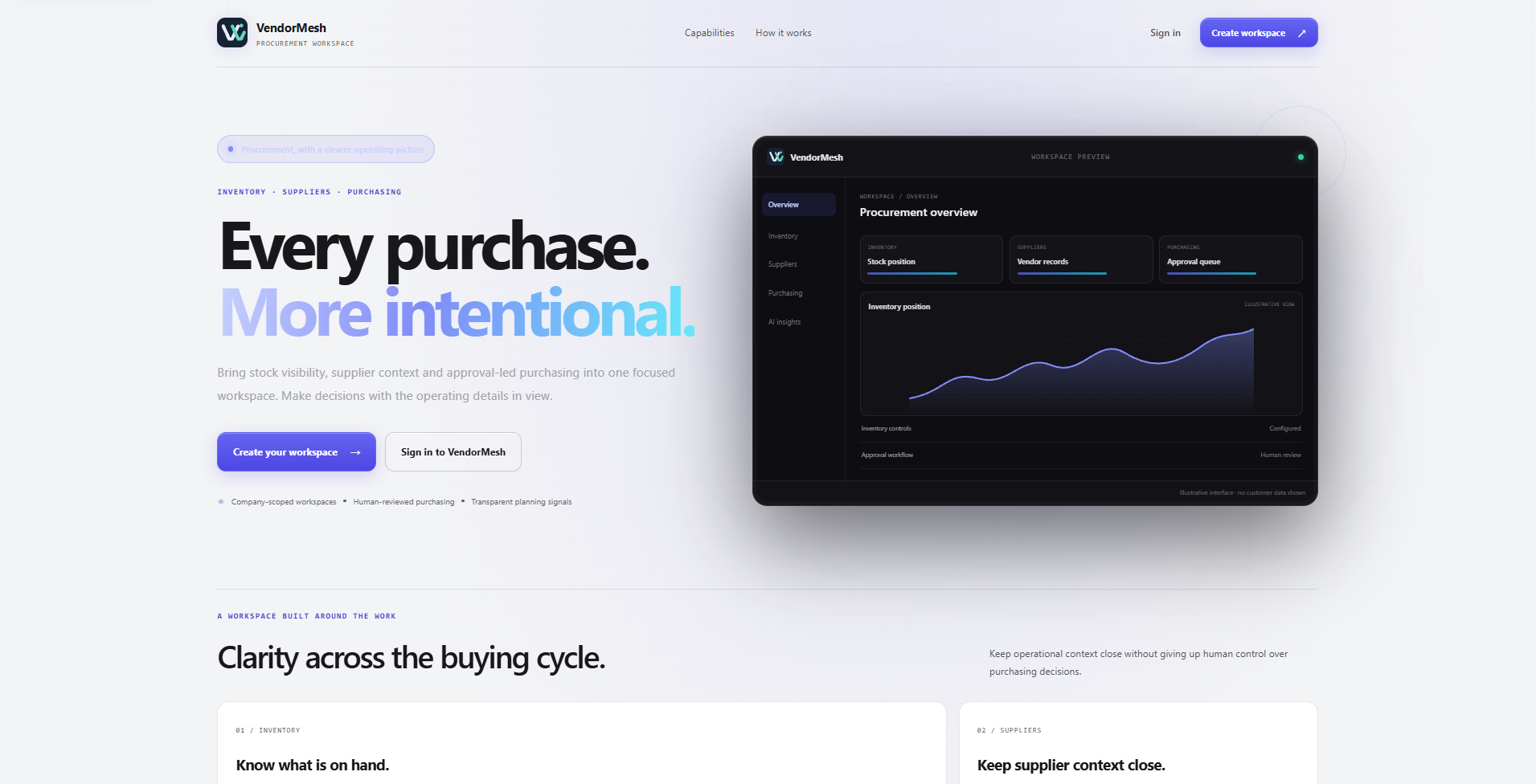
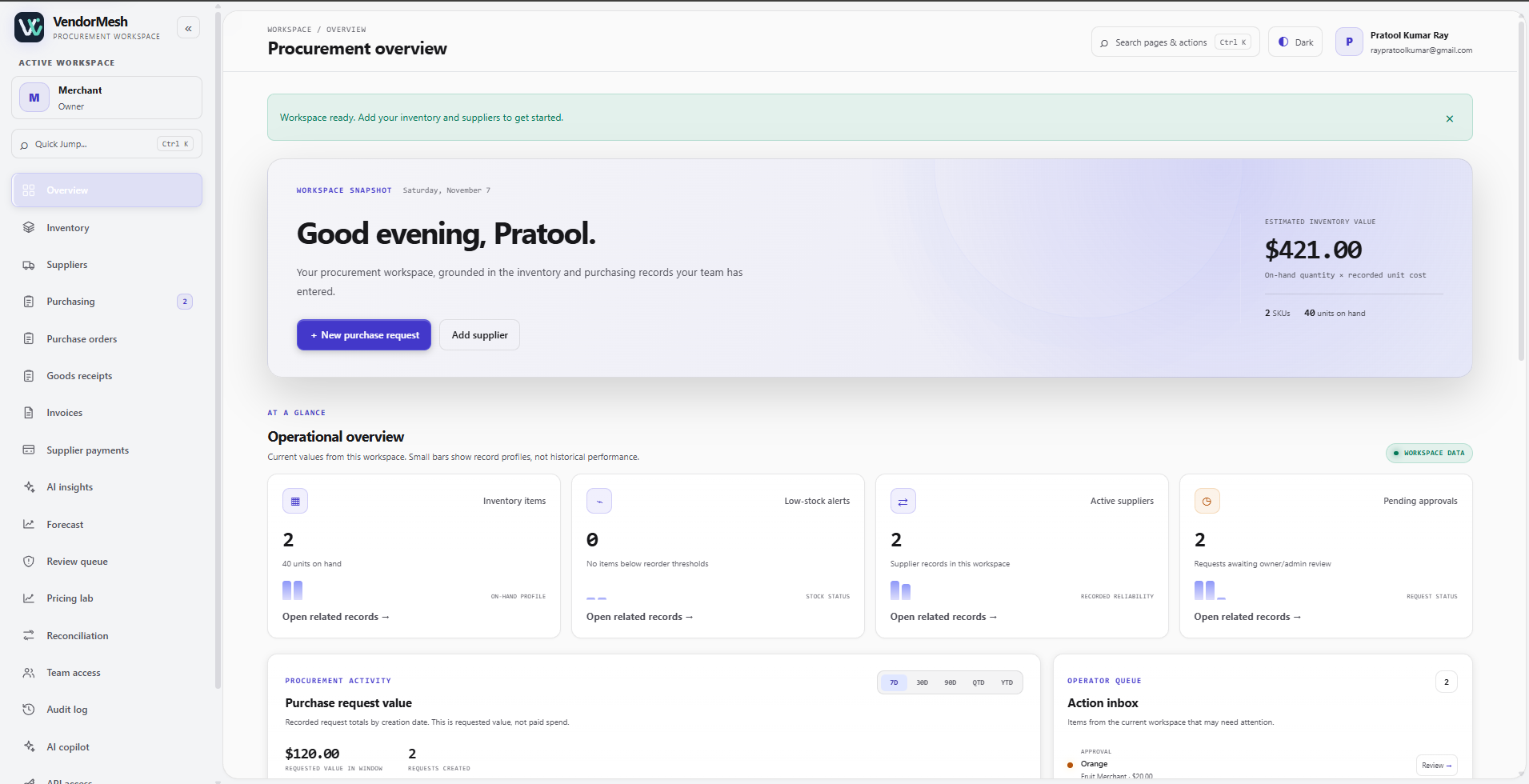
About VendorMesh
💡 Inspiration
Modern businesses depend on multiple vendors, suppliers, invoices, purchase orders, and payment systems. However, managing these operations often involves disconnected tools, manual processes, delayed decisions, and limited visibility into supplier performance.
We wanted to solve a real-world problem: What if businesses had an intelligent AI-powered platform that could simplify their entire vendor management and procurement workflow?
That idea inspired VendorMesh — an AI-powered vendor intelligence and procurement platform designed to make business operations smarter, faster, and more efficient.
Our vision is to move businesses from reactive procurement management to proactive, data-driven decision-making.
🚀 What We Built
VendorMesh brings AI-powered intelligence into vendor and procurement management through a unified platform.
Our core vision includes:
- BYO-AI Gateway: A flexible AI integration layer that allows businesses to connect their preferred AI providers, such as OpenAI and Gemini.
- AI Vendor Matching: Intelligent vendor recommendations based on business requirements, pricing, performance, and reliability.
- Invoice & Purchase Order Intelligence: AI-assisted extraction and analysis of important information from business documents.
- Predictive Inventory Forecasting: Data-driven demand predictions and inventory insights to help prevent stock shortages and overstocking.
- Dynamic Pricing Intelligence: Insights to help businesses evaluate pricing strategies and changing market conditions.
- Fraud & Anomaly Detection: Identification of unusual transactions, suspicious vendor behavior, and unexpected price variations.
Our goal is to create one connected ecosystem where businesses can make informed decisions instead of relying entirely on manual processes.
🛠️ How We Built It
We approached VendorMesh as a modern, cloud-based AI platform with a modular architecture.
The development involved:
- Building a responsive web interface focused on usability and business intelligence.
- Developing backend APIs to support application workflows and data management.
- Integrating database infrastructure for persistent application data.
- Designing AI integration capabilities for intelligent analysis and recommendations.
- Connecting payment-related functionality with the PayPal ecosystem.
- Deploying the application to the cloud to make the platform accessible without requiring local installation.
We focused on creating an architecture that can evolve with additional AI providers, business integrations, and enterprise requirements.
Live Demo: https://vendor-mesh.vercel.app/
GitHub Repository: https://github.com/PratoolGit/VendorMesh
🧠 What We Learned
Building VendorMesh taught us that implementing AI in real-world business applications involves much more than connecting an AI API.
We learned about:
- Designing modular architectures for AI-powered applications.
- Integrating external AI providers and managing API configurations.
- Building secure authentication and backend services.
- Working with databases and cloud deployment environments.
- Connecting payment infrastructure with business workflows.
- Turning complex procurement problems into practical software experiences.
Most importantly, we learned that AI becomes truly valuable when it solves an actual operational problem rather than simply generating responses.
⚡ Challenges We Faced
Developing VendorMesh came with several technical and architectural challenges.
1. AI Integration: Designing a flexible architecture capable of supporting different AI providers while keeping integrations manageable.
2. Backend and Database Configuration: Establishing reliable communication between the frontend, backend APIs, and cloud-hosted database.
3. Deployment: Troubleshooting production environment variables, authentication configuration, database connectivity, and cloud deployment issues.
4. Payment Integration: Understanding how payment infrastructure can fit into a broader vendor procurement ecosystem while maintaining secure transaction workflows.
5. Product Architecture: Bringing multiple complex business capabilities into one coherent platform without making the user experience overwhelming.
Each challenge helped us improve our engineering approach and understand the complexity of building production-oriented AI applications.
🔮 What's Next?
VendorMesh is designed with a long-term vision beyond basic vendor management.
Our future roadmap includes:
- Autonomous AI procurement agents that can assist with sourcing and purchasing decisions.
- Advanced supplier risk intelligence and automated performance monitoring.
- Real-time market intelligence and predictive price optimization.
- End-to-end procurement workflows with deeper PayPal payment integration.
- Automated invoice reconciliation and financial insights.
- Enterprise integrations with ERP, CRM, and inventory management systems.
We envision a future where businesses can delegate repetitive procurement operations to intelligent AI agents while retaining control over important financial decisions.
🌍 Our Mission
VendorMesh is more than a vendor management application. It is a step toward intelligent, autonomous, and connected business operations.
By combining AI, vendor intelligence, procurement automation, and payment infrastructure, we aim to help businesses reduce operational complexity, make smarter decisions, and grow with confidence.
VendorMesh — Smarter Sourcing. Intelligent Decisions. Seamless Payments.
Built With
- ag-grid
- express.js
- gemini
- javascript
- mongodb
- node.js
- openai
- paypal
- react
- render
- rest
- vercel
- vite
