🏆 UiPath Hackathon Judging Matrix Alignment
This project has been deliberately architected to maximize score potential across all official evaluation metrics:
- Business Impact: Automates a mandatory, high-friction compliance task, compressing review times from 2-4 hours to under 2 seconds.
- Platform Usage: Deep deployment of UiPath Maestro Case, API Workflows, Robot actions, and Agentic Human-in-the-Loop configurations.
- Coding Agents Bonus: Built explicitly through collaborative interactions with Claude Code under the UiPath for Coding Agents framework.
💡 Inspiration
Enterprise procurement and IT compliance teams are universally bottlenecked by the mandatory third-party vendor vetting process. Whether maintaining compliance for SOC2, ISO 27001, HIPAA, or PCI-DSS, an analyst must manually dig through vendor websites, audit trust portals, verify SSL expirations, and look up breach histories.
For an organization onboarding 50 vendors a quarter, this burns 100 to 200 hours of highly paid analyst time ($8,000 to $16,000 lost quarterly). We designed VendorGuard AI to completely automate this pipeline using parallel AI agents, feeding the structured outcomes straight into a robust state machine driven by UiPath Maestro Case.
⚙️ Architecture & How It Works
VendorGuard AI splits vendor discovery and risk management into a unified orchestrator pattern:
- UiPath Maestro Case (Intake): A user submits a vendor onboarding request. The request automatically instantiates a new Case case and triggers an API Workflow call to our backend.
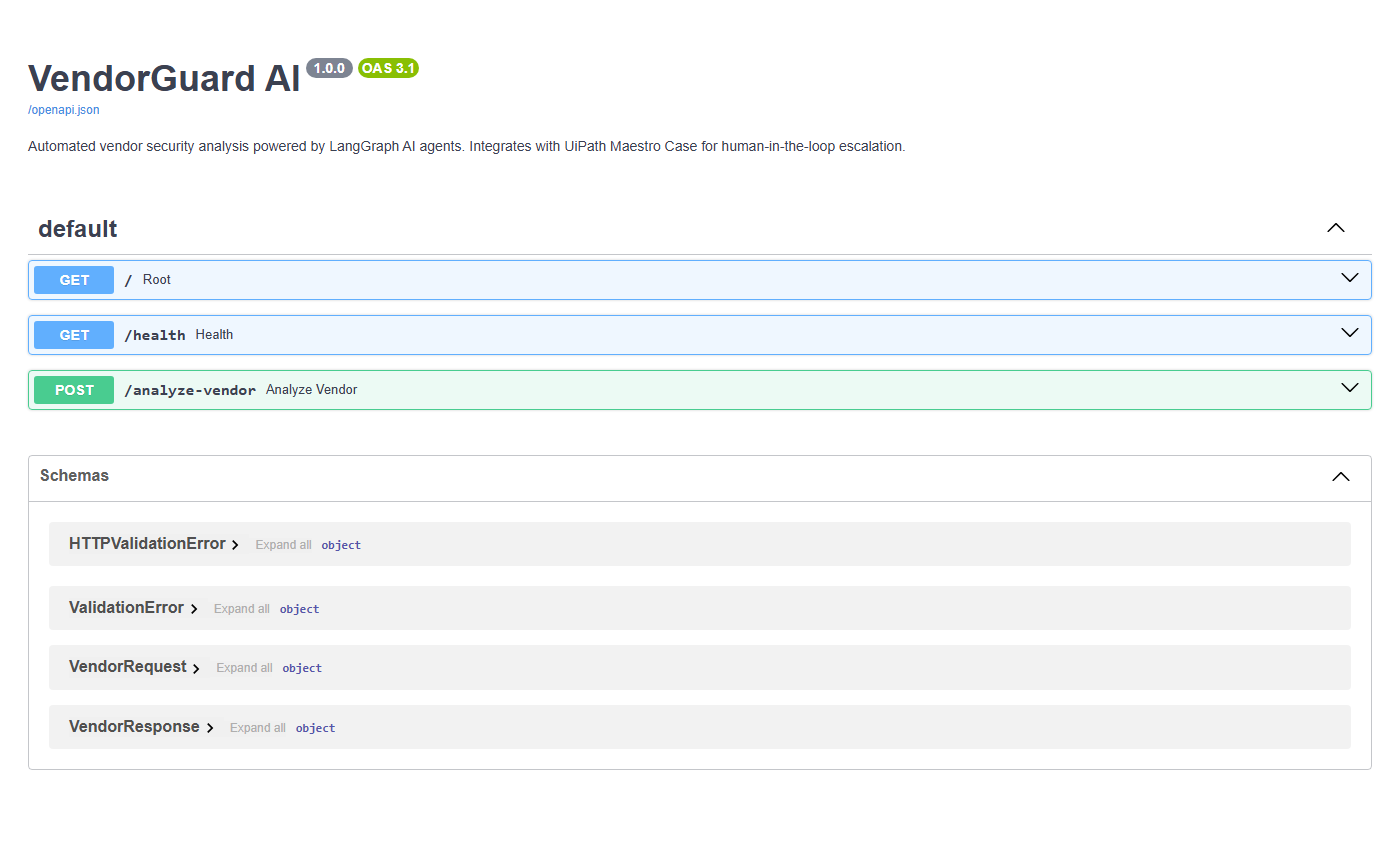
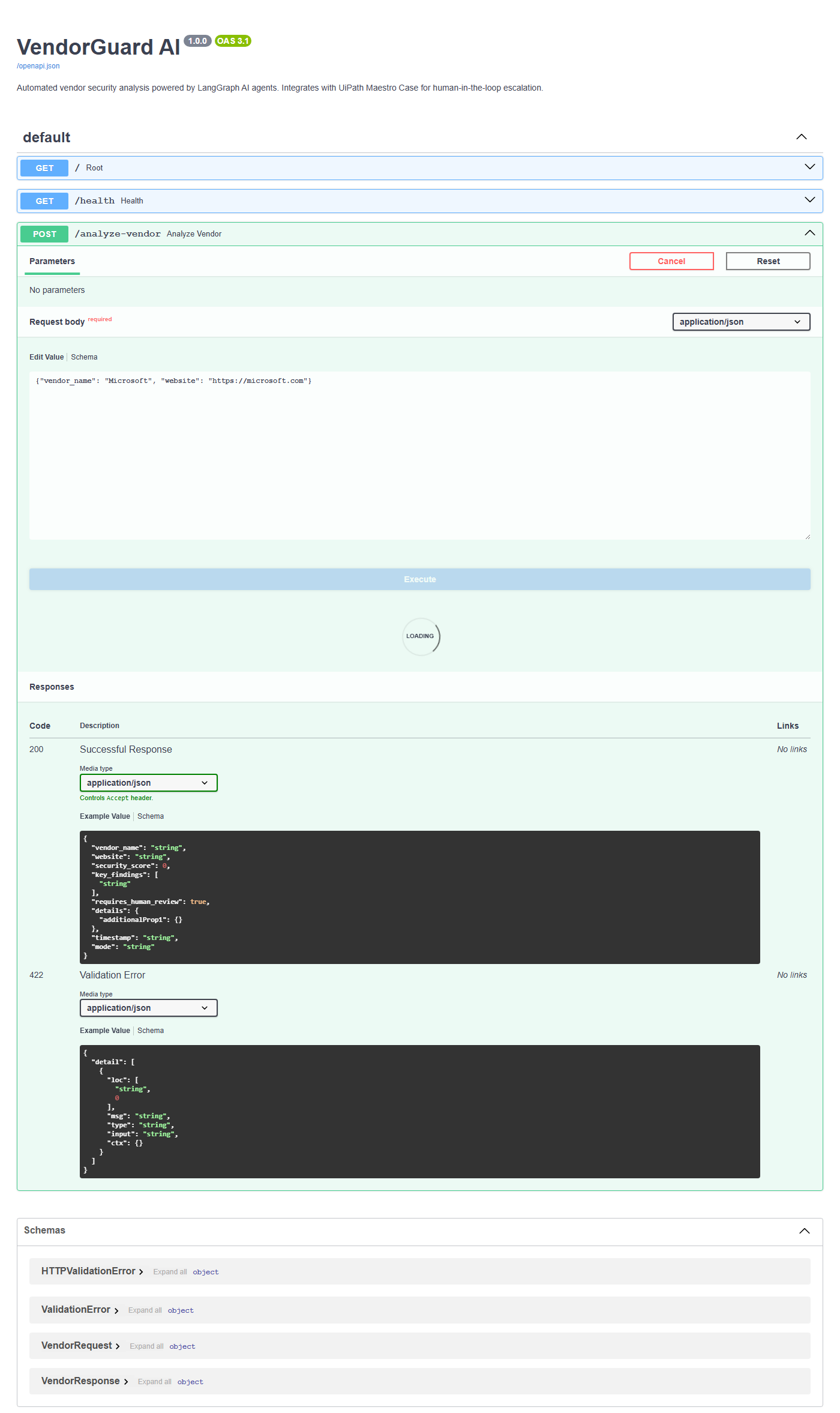
- FastAPI Gateway (
localhost:8000): Captures the payload and fires two decoupled LangGraph agents in parallel. - Agent A (SaaS Auditor): Uses a LangGraph ReAct loop to scrape public documentation, capturing compliance certs (SOC2 Type II, ISO27001, FedRAMP, GDPR, HIPAA) and mapping cloud infrastructure hosting regions.
- Agent B (Threat Intelligence): Interrogates breached database caches, maps bug bounty exposure on platforms like HackerOne/Bugcrowd, evaluates WHOIS domain age risk, and conducts live SSL/TLS handshakes.
- Risk Scoring Evaluator: Merges both agent score contributions into a clean 1-100
security_score. - Maestro Routing Engine:
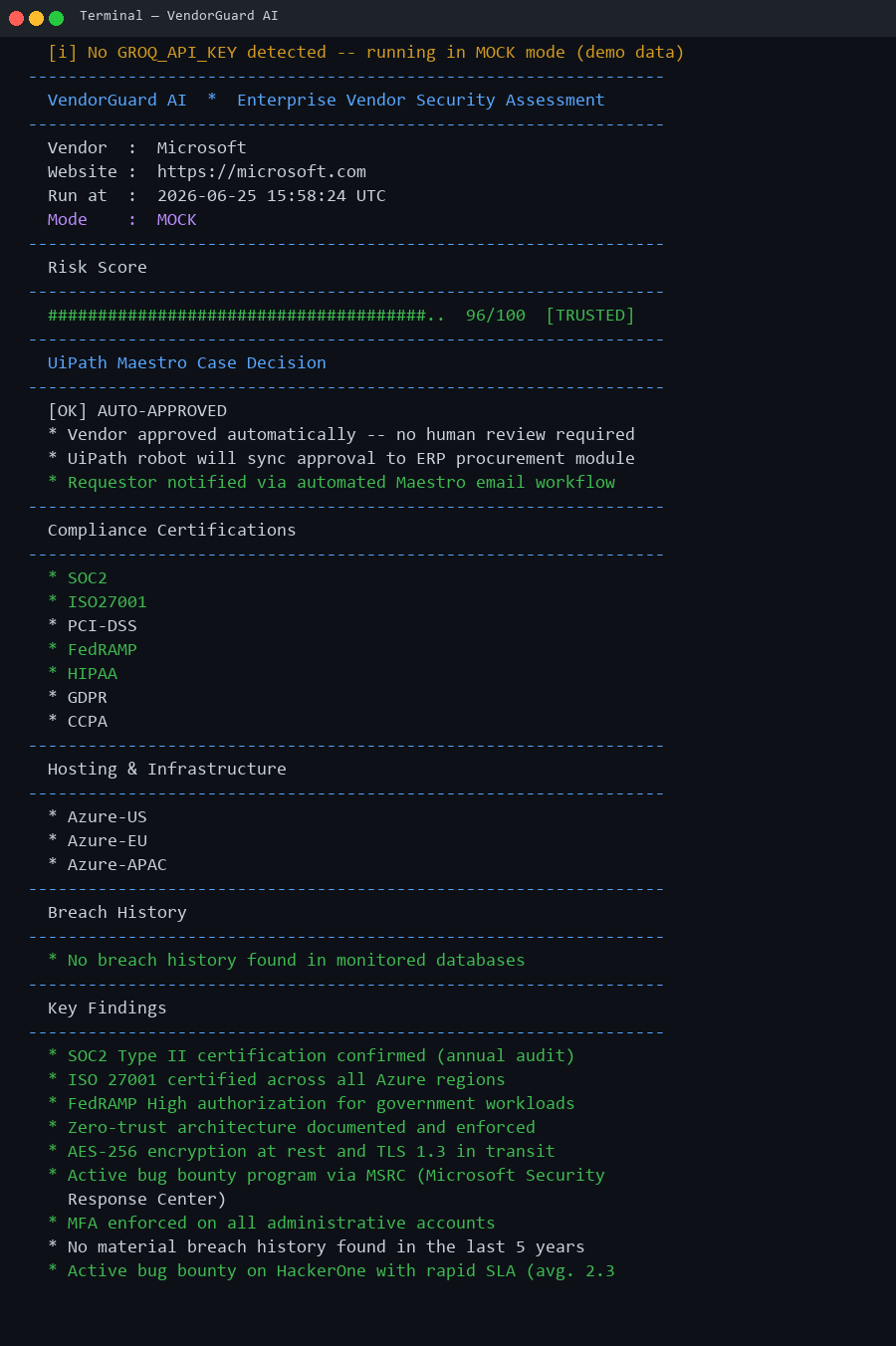
- Score ≥ 70 & No Critical Flag: Auto-Approved. A UiPath Robot seamlessly transitions the stage and syncs the vendor approval payload directly into the enterprise ERP procurement module.
- Score < 70 OR Security Exception: Human Review. Maestro freezes the case, tracks a strict 48-hour SLA, and routes a task directly to a human security analyst with the full AI-generated report embedded inside the form.
🛠️ How We Built It
- Backend Core: Python 3.14 + FastAPI 0.138 + Pydantic v2.
- AI Layer: LangGraph 1.x utilizing non-deprecated graph execution models (
langgraph.prebuilt.create_react_agent) backed by Groq's high-speed inference engine (llama-3.3-70b-versatile). - CLI Engine: An interactive, terminal-safe ANSI visualization dashboard (
evaluate_vendor.py) with clean ASCII formatting for immediate developer/judge review without server initialization. - UiPath Schema: A comprehensive
maestro_case_workflow.jsoncompletely mapping the 5 lifecycle stages, data schemas, human action forms, and notification rules. - Bulletproof Testing: 9/9 robust automated tests validating mock environments, validation boundaries, and risk triggers to guarantee a zero-friction judge demo environment.
🚧 Challenges We Ran Into
- LangChain 1.x Breaking Changes: Midway through, we had to refactor the entire engine away from the legacy, deprecated
AgentExecutorpattern. Migrating to LangGraph required a complete overhaul of our message state manipulation and graph loop orchestration. - Terminal Environment Clashes: Standard Unicode badges threw nasty
UnicodeEncodeErrorflags on localized Windows terminal encodings (cp1255). We refactored our visualization outputs into beautifully structured, pure-ASCII visual elements to guarantee compatibility on any machine. - Review False-Positives: Initial string filtering flagged strings like "No breach history found" as active risks. We hardened the classification boundaries to rely directly on structured tool schemas and strict
"CRITICAL"prefixes.
🚀 Accomplishments That We're Proud Of
- Running a stateless, production-ready, typed FastAPI service that completely passes its test matrix on Python 3.14.
- Orchestrating full Human-in-the-Loop boundaries where the AI acts as a smart filter rather than a loose cannon, adhering to strict enterprise governance.
- 100% Co-Authored by Claude Code: Leveraging natural language co-development to design, debug, and ship a complex multi-agent architecture from scratch.
🔮 What's Next for VendorGuard AI
- Q3 2026: Integrating live BreachDirectory and HaveIBeenPwned API streams, alongside automated PDF compliance archive compilation.
- Q4 2026: Implementing scheduled recurring vendor re-assessments directly via Maestro time-triggers, multi-vendor batch CSV processing, and active Slack escalation integrations.

Log in or sign up for Devpost to join the conversation.