Inspiration
The idea for VendorMender came from my own experience interning with an aggregator that worked with local small businesses dealing with fashion, and home decor in India. I handled vendor onboarding and catalog management, and I quickly realized that no two vendors worked the same way.
Some shared neat spreadsheets. Others sent incomplete catalogs, inconsistent product details, or information in completely different formats. As someone who was just starting out, those variations threw me off — every new vendor felt like learning a new system from scratch.
That experience stayed with me. I started wondering: why should vendors have to adapt perfectly to a marketplace’s structure before they can even get started?
VendorMender grew from that question — a system that starts with whatever a vendor already has, understands the differences, and asks only for what is actually missing.
What it does
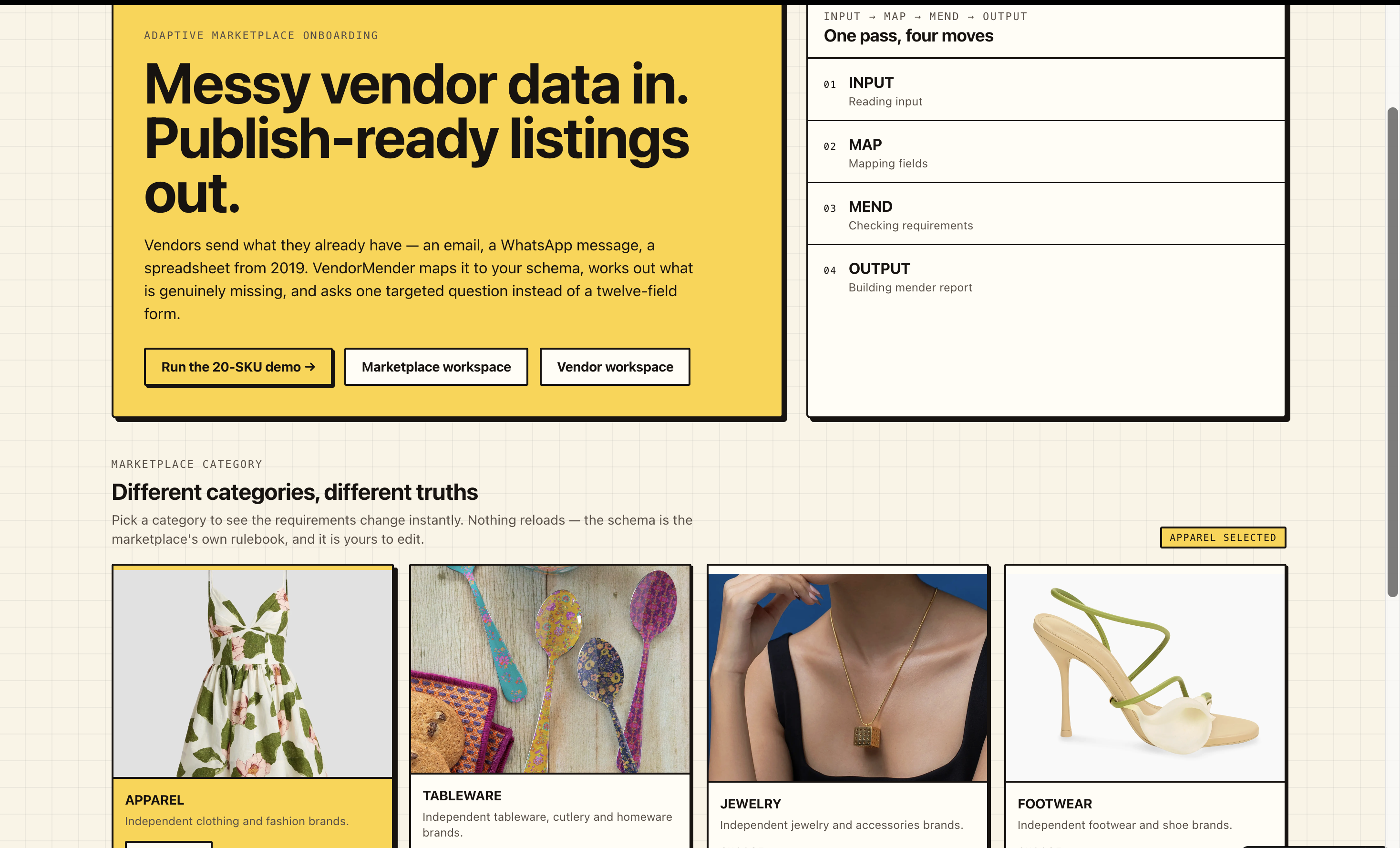
VendorMender turns messy vendor data into marketplace-ready product listings.
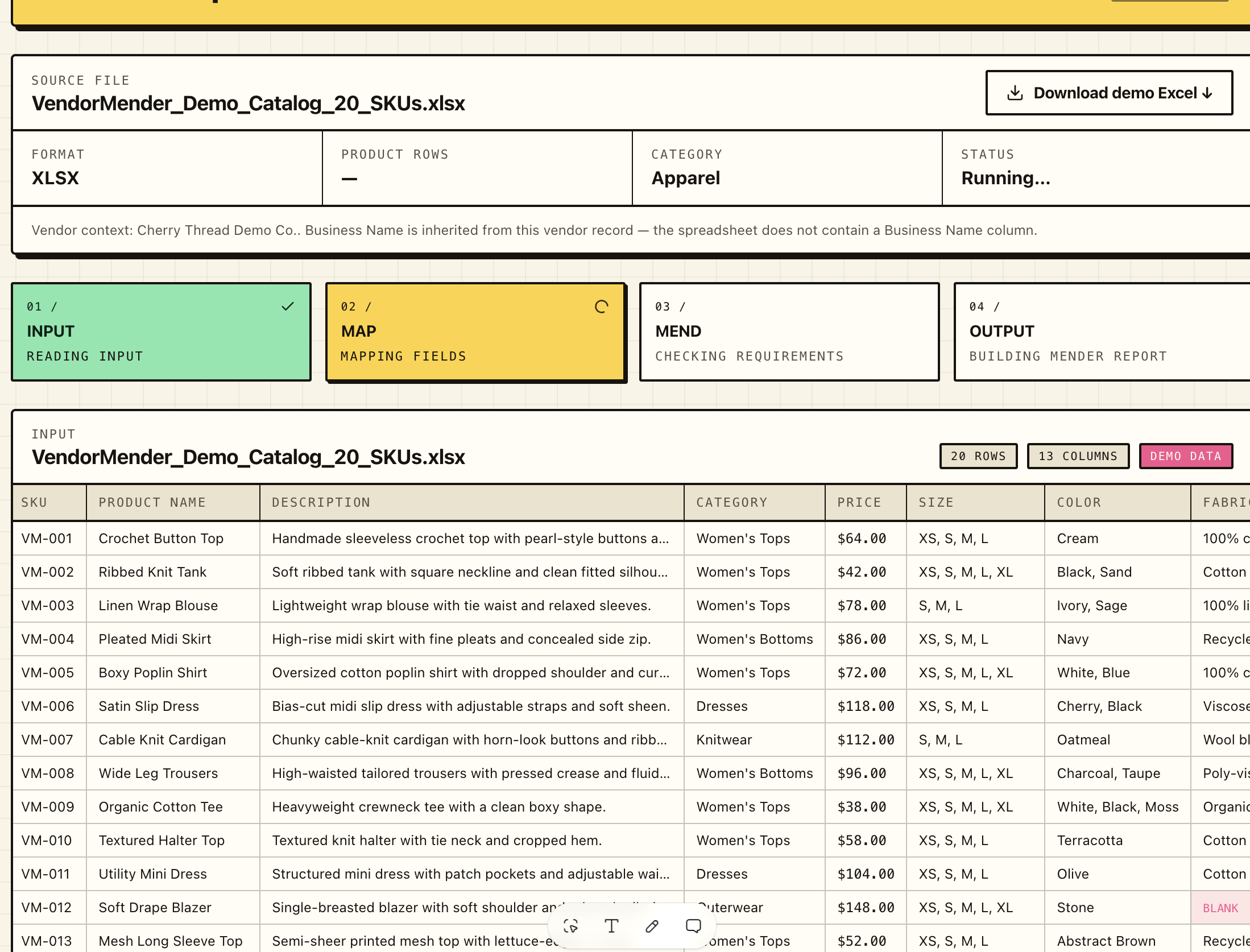
Vendors can upload a catalog or provide product information, and VendorMender compares it against the marketplace’s requirements. AI interprets inconsistent fields such as Mat. → Material, Qty Set → Set Quantity, and DW Safe? → Dishwasher Safe.
High-confidence mappings are applied automatically, uncertain ones can be reviewed, and unrelated information is preserved. A deterministic validation engine then identifies the actual missing requirements for each product instead of forcing vendors through another long form.
Give us what you have. We’ll figure out what’s missing.
How I built it
I built VendorMender as an AI-assisted onboarding workflow with a rule-based readiness engine.
The frontend was built in Lovable, while a Python FastAPI backend handles catalog processing, schema management, semantic mapping, and product validation. The API is deployed on Render, with Gemini used to interpret ambiguous vendor column names based on both headers and sample values.
A key design decision was separating interpretation from validation: AI determines what incoming data probably means, while marketplace-defined requirements determine whether a product is actually ready to publish.
Challenges I ran into
The hardest problem was handling ambiguity without making the system unreliable. Vendor catalogs use everything from abbreviations to company-specific terminology, so simple column matching was not enough. At the same time, allowing AI to freely transform data could introduce incorrect mappings.
I addressed this by combining deterministic mappings, AI confidence scores, human confirmation for uncertain cases, and strict marketplace schemas.
I also worked through full-stack challenges including file parsing, API integration, CORS configuration, deployment, frontend state management, and keeping the mapping experience responsive while the AI runs.
Accomplishments that I'm proud of
I built a working end-to-end prototype rather than stopping at the concept.
VendorMender can ingest a deliberately messy product catalog, understand non-standard fields, explain its mappings, preserve useful unmatched information, and evaluate individual products for publication readiness.
One of my favorite tests was a tableware catalog containing columns such as Mat., Qty Set, and DW Safe?. VendorMender correctly interpreted them as Material, Set Quantity, and Dishwasher Safe, while still detecting a genuinely missing care instruction for one product.
Most importantly, the system asks for only what is actually missing.
What I learned
The biggest lesson was that AI does not need to control the entire workflow to create meaningful value.
AI is powerful at handling ambiguity—understanding what a vendor meant. But business rules are better suited to determining what a marketplace requires.
Separating those responsibilities made VendorMender more explainable and reliable.
I also learned that improving onboarding is not always about creating a better form. Sometimes the better product decision is to remove the form and adapt to the information users already have.
What's next for VendorMender
Next, I want to expand VendorMender from catalog onboarding into a broader vendor activation layer.
That includes persistent vendor profiles so sellers never have to repeat information, support for PDFs and product images, marketplace integrations, richer human-review workflows, and onboarding analytics that show where vendors most frequently get stuck.
Longer term, VendorMender could learn recurring terminology across suppliers and marketplaces, making each subsequent onboarding faster while still keeping humans and marketplace rules in control.
The goal is simple: make getting onto a marketplace feel less like data entry and more like a conversation.
Built With
- ai
- data-validation
- excel/xlsx-processing
- fastapi
- gemini-api
- google-ai
- human-in-the-loop
- lovable
- pandas
- python
- react
- render
- rest-api
- semantic-mapping
- typescript

Log in or sign up for Devpost to join the conversation.