-
-
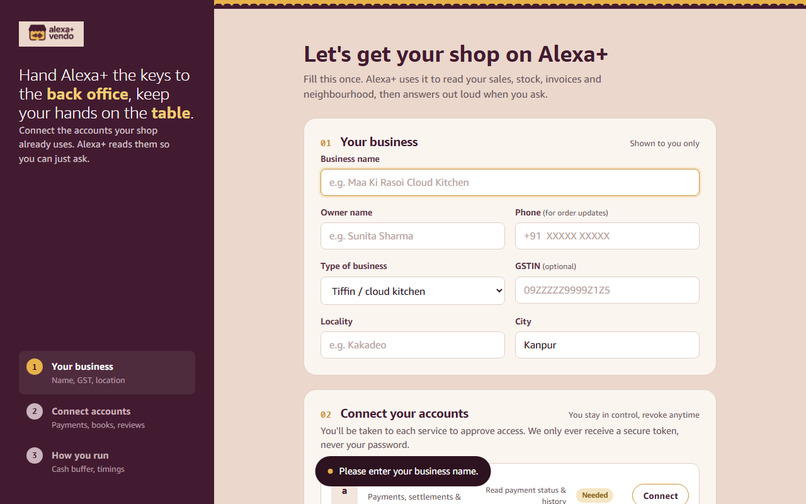
Business Onboarding and Form Validation
-
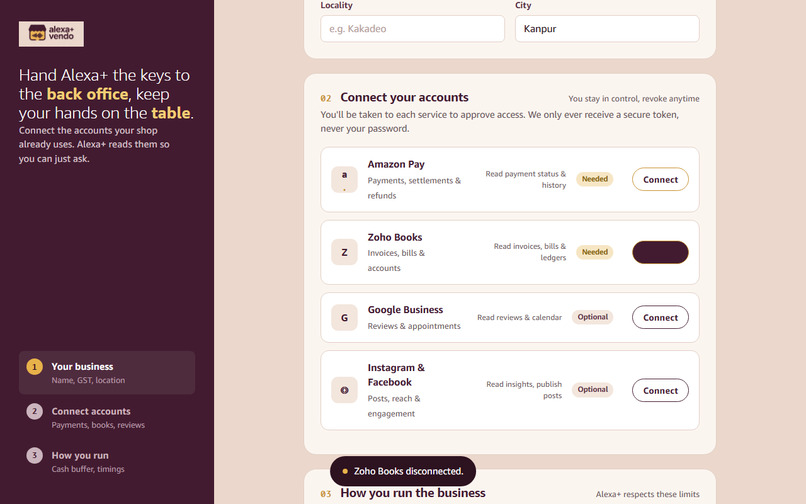
Third-Party Account Integration
-
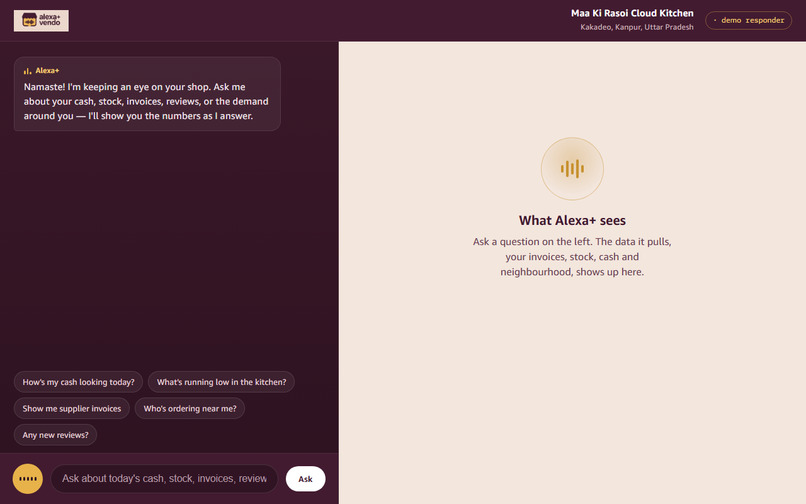
Alexa+ Business Assistant Interface
-
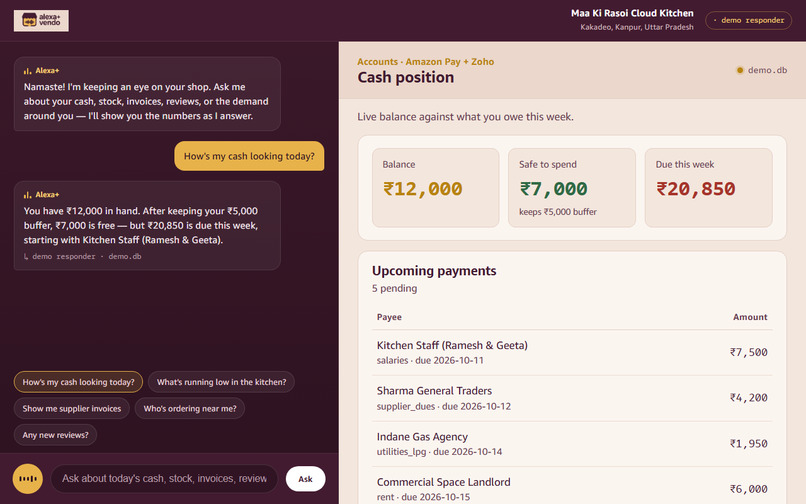
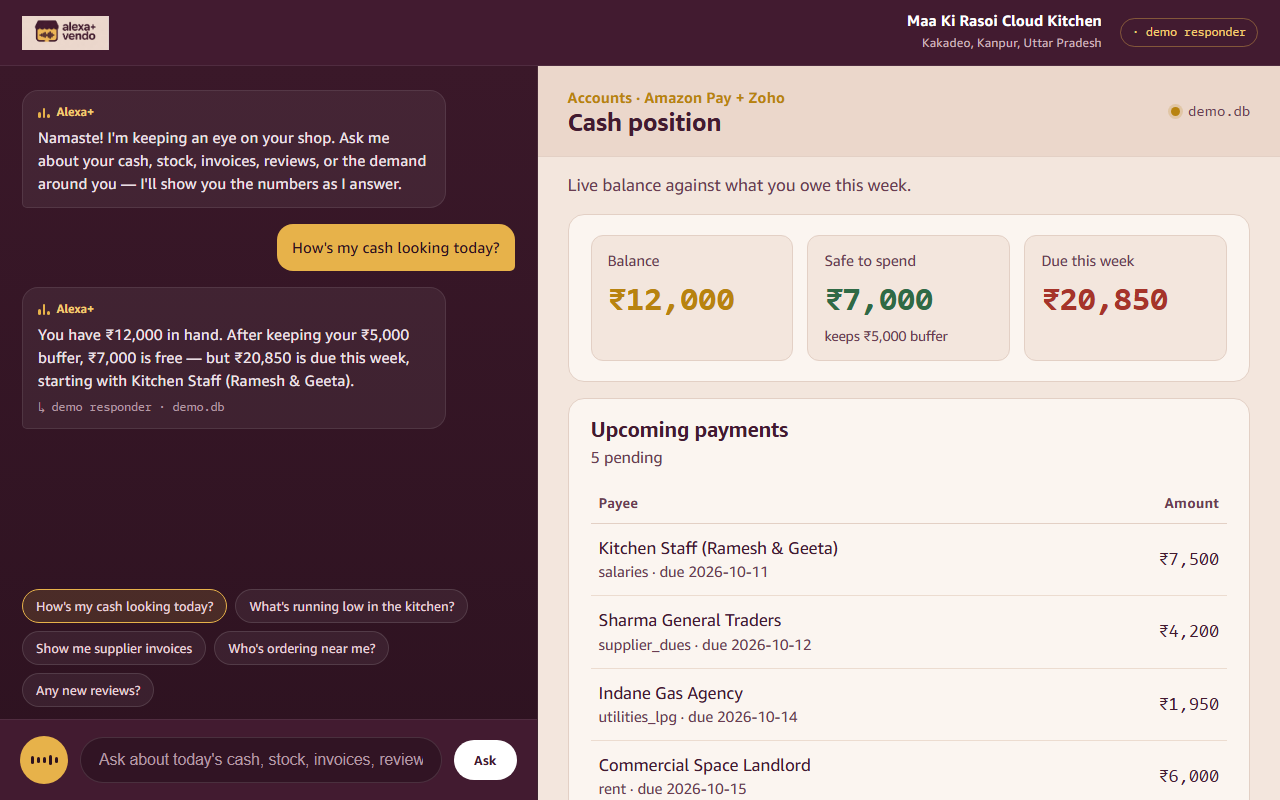
Real-Time Financial Insights
-
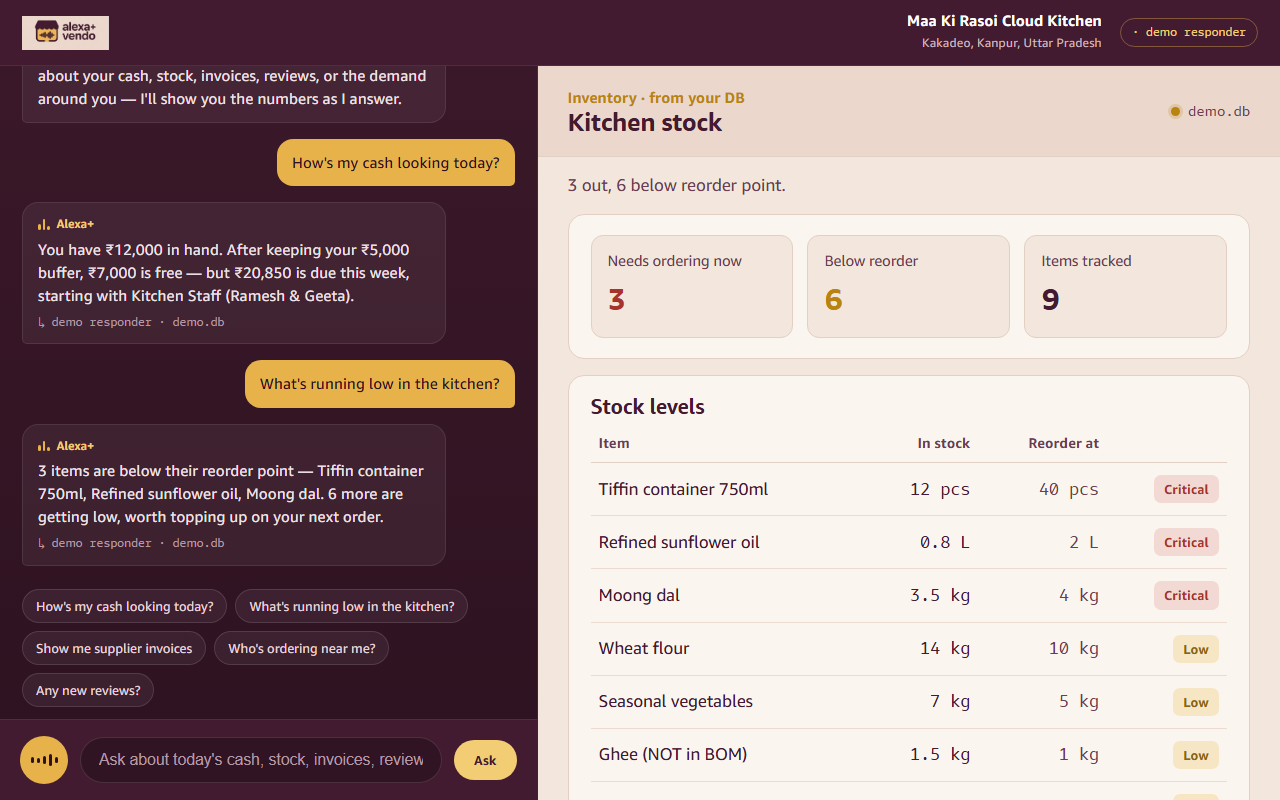
Inventory Monitoring and Stock Alerts
Inspiration
Millions of small business owners in India manage their entire operations through a combination of notebooks, spreadsheets, WhatsApp conversations, and disconnected applications. Whether it's a home-based tiffin service, a neighbourhood grocery store, or a local salon, owners constantly juggle customer orders, inventory, payments, supplier communication, and day-to-day decisions.
While large businesses have access to sophisticated enterprise management systems, small business owners often lack the time, resources, and technical expertise to adopt such solutions.
This inspired us to ask a simple question:
What if running a business were as easy as having a conversation?
With Alexa+, we envisioned an intelligent, voice-first business assistant that doesn't just retrieve information but understands business context, identifies operational problems, recommends decisions, and helps owners take action.
That vision became Vendo - Your Shop. On Autopilot.
What it does
Vendo transforms Alexa+ into an AI-powered business operations assistant for small businesses.
Instead of navigating multiple dashboards, business owners can simply ask:
- "Alexa, how's my cash looking today?"
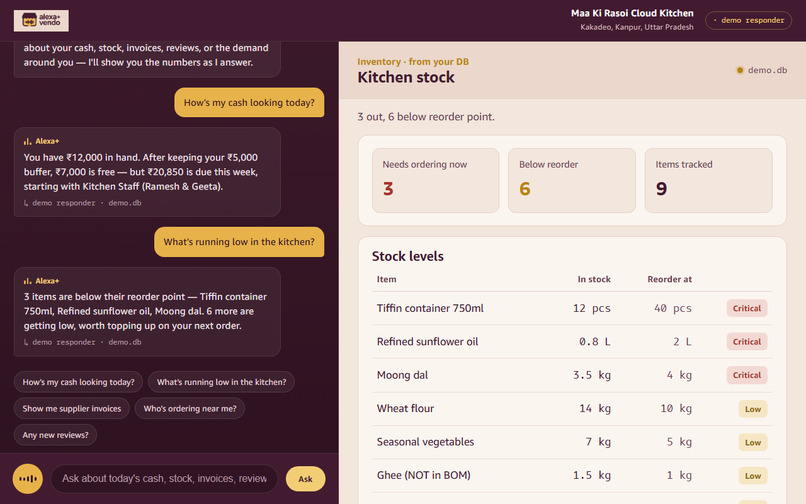
- "What's running low in my kitchen?"
- "Can I accept 20 more tiffin orders tomorrow?"
- "Show me my pending supplier invoices."
- "What payments are due this week?"
- "Do I have enough inventory and cash to fulfill tomorrow's orders?"
Vendo brings together business information and decision-making capabilities through a unified conversational interface.
Key capabilities
1. Conversational Business Intelligence
Business owners can ask natural-language questions about cash flow, inventory, invoices, customer demand, and operational performance. Vendo retrieves relevant information and presents actionable insights through conversational responses and visual dashboards.
2. Intelligent Inventory and Procurement
Vendo monitors stock levels, identifies shortages, calculates ingredient requirements, evaluates supplier options, and recommends procurement decisions based on available cash, safety reserves, and delivery deadlines.
3. Cash-Aware Business Decisions
Rather than simply recommending purchases, Vendo evaluates whether the business can afford them. It considers available cash, upcoming payment obligations, and minimum cash reserves before suggesting expenditures.
4. Order and Capacity Management
For businesses such as tiffin services, Vendo evaluates whether additional customer orders can be fulfilled by considering existing commitments, subscriptions, ingredient availability, kitchen capacity, and procurement requirements.
5. Approval-Based Action Execution
Vendo is designed to keep business owners in control. Sensitive operations require appropriate authorization and approval, with mechanisms to prevent duplicate execution and maintain an auditable action history.
6. Personalized Business Onboarding
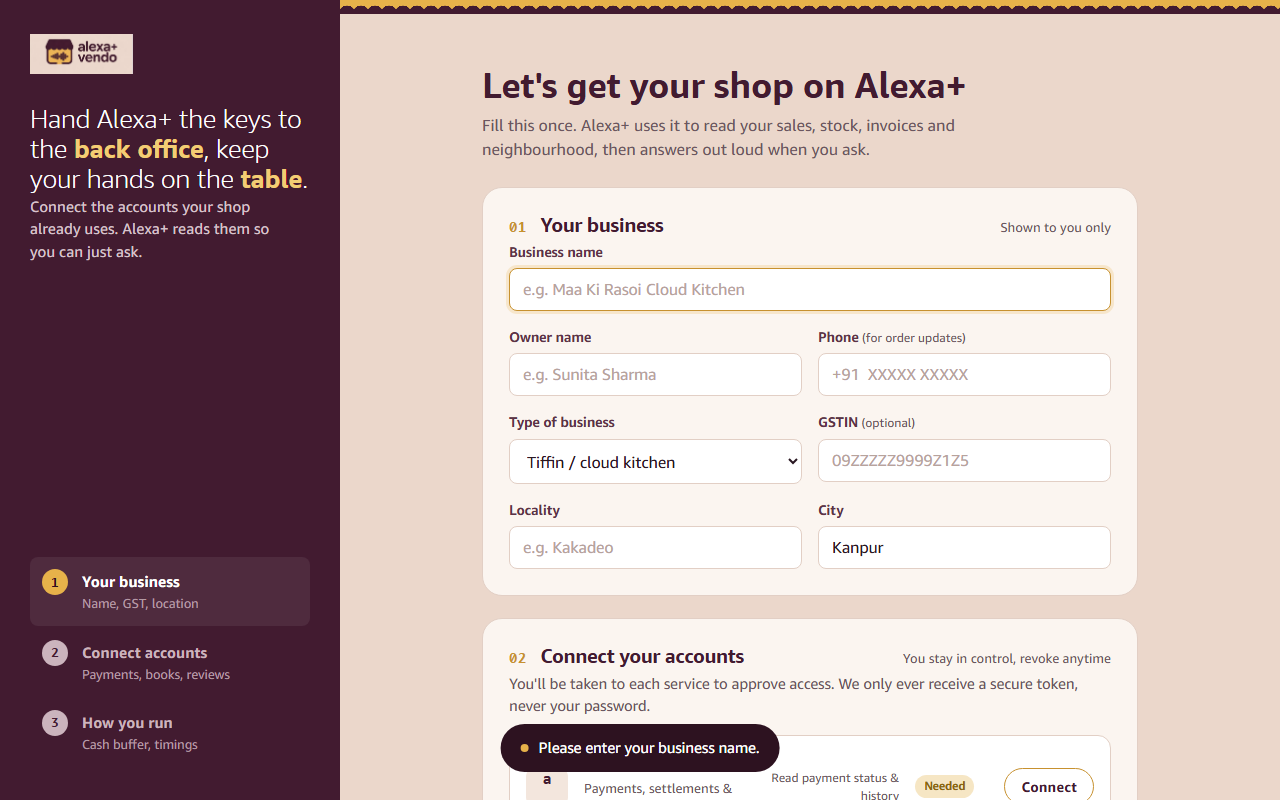
A guided onboarding interface collects business details, operating constraints, and integration preferences. Vendo supports multiple business categories, allowing its operational reasoning to adapt to different business environments.
7. Unified Conversational Dashboard
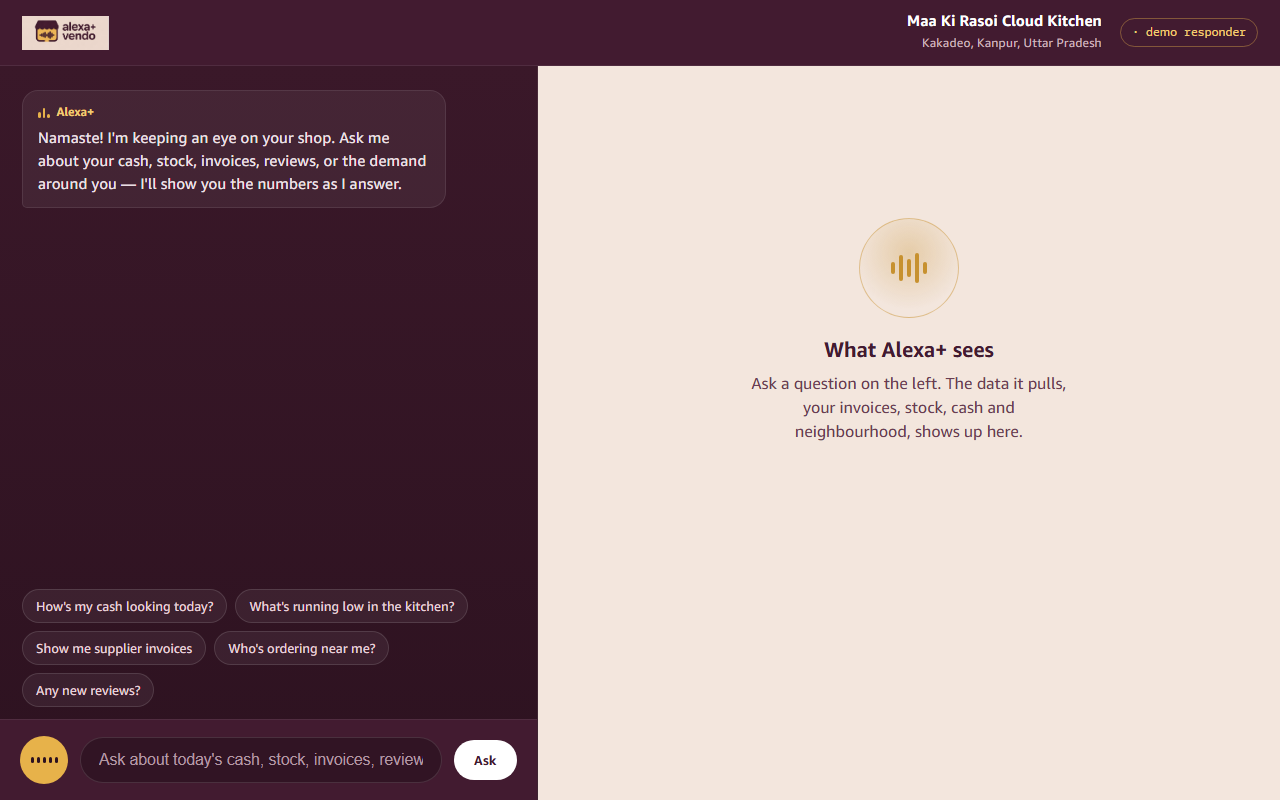
An Alexa+-inspired interface combines natural-language interactions with contextual visualizations of financial data, stock levels, invoices, and operational insights.
External business integrations are represented through adapters and simulated workflows in the current prototype; live third-party activation remains a future step.
How we built it
We designed Vendo around a modular, business-aware architecture that separates conversational interaction, operational reasoning, data persistence, and controlled action execution.
Backend and business intelligence
We developed the backend using Python, FastAPI, SQLite, and the Model Context Protocol (MCP).
The system contains several interconnected components:
- Adaptive Business Orchestrator: Coordinates business context, operational tools, recommendations, and follow-up interactions.
- Business Profile Engine: Stores business-specific information, constraints, and operating preferences.
- Inventory and Demand Engines: Evaluate current stock, projected demand, and material requirements.
- Procurement and Financial Logic: Consider supplier pricing, shortages, obligations, and cash reserves.
- Approval and Action Services: Enforce authorization and explicit approval for sensitive operations.
- Persistent Data Layer: Maintains business profiles, orders, conversations, approvals, and operational records.
Alexa+ and MCP integration
We implemented an MCP-compatible backend exposing business operations through structured tools.
These tools support functions such as retrieving business information, checking inventory, evaluating opportunities, reviewing financial conditions, and managing approval-driven operations.
We also implemented OAuth-related authorization flows, token handling, role-based access controls, and multi-tenant isolation mechanisms.
The current implementation has been validated through local testing and an Alexa+-style simulator. Live Alexa+ integration and certification remain outside the completed prototype.
Frontend
We built a responsive frontend using HTML5, CSS3, and JavaScript, served directly through FastAPI.
The application includes a business onboarding experience and an interactive conversational simulator with dynamically updated information panels.
We used Playwright with Chromium to automate browser testing, validate form interactions, check responsive layouts, and identify frontend integration problems.
Tiffin-service implementation
To demonstrate Vendo's decision-making abilities, we developed an end-to-end tiffin-service workflow.
The backend can evaluate additional meal requests against existing orders, recurring subscriptions, ingredient requirements, inventory availability, kitchen capacity, and financial constraints.
It can then recommend whether orders should be accepted, partially accepted, or accepted after procurement, with approval-gated simulated execution.
Testing and reliability
We developed automated tests covering authentication, MCP functionality, business operations, database interactions, tenant isolation, and frontend-backend integration.
Our latest local verification reported 455 passing tests and 3 intentionally skipped live integration tests, with no reported test failures.
We also performed browser automation testing across desktop, tablet, and mobile screen sizes.
Challenges we ran into
1. Connecting multiple business operations
One of our biggest challenges was transforming separate modules for inventory, payments, orders, and supplier management into a unified system.
A business decision cannot be made using a single data point. Accepting additional orders, for example, requires understanding inventory, fulfillment capacity, procurement costs, and available working capital simultaneously.
We addressed this through an adaptive orchestration layer that coordinates multiple business services.
2. Making the system work across different businesses
A tiffin service measures capacity in meals, while a salon measures appointments and a repair workshop measures jobs.
We had to build business-aware data models and reasoning logic without hardcoding the entire system around one business category.
3. Balancing automation with security
An AI assistant handling financial or operational decisions must never blindly execute sensitive actions.
We implemented authorization controls, approval workflows, tenant isolation, and protections against repeated execution.
4. Integrating Alexa+ and external services
Connecting business functionality to conversational interfaces required careful attention to MCP protocols, authentication, and tool schemas.
Since live third-party credentials and certain integrations were not activated, we developed simulated adapters and local verification workflows to test the architecture safely.
5. Frontend-backend integration
Connecting the onboarding interface and conversational dashboard to persistent backend services introduced challenges involving API contracts, business-profile persistence, application state, and responsive rendering.
Automated browser testing helped us identify and correct integration and layout issues.
Accomplishments that we're proud of
Our biggest accomplishment is building Vendo as more than a conversational dashboard. We created a modular backend capable of combining multiple business constraints to produce explainable operational recommendations.
We're particularly proud of:
- Building an MCP-compatible backend with structured business tools.
- Implementing a full tiffin-service decision workflow involving orders, recipes, inventory, procurement, capacity, and cash constraints.
- Developing approval-gated simulated operations with authorization and idempotency protections.
- Supporting multiple business categories through adaptive profiles and orchestration.
- Building a responsive onboarding interface and conversational business simulator.
- Completing 455 passing automated tests, alongside browser-based interface verification.
- Demonstrating a working local application that connects conversational interactions with operational data.
Most importantly, Vendo demonstrates how conversational AI can evolve from answering questions to supporting meaningful business decisions.
What we learned
Building Vendo taught us that an effective AI assistant needs much more than a language model.
We learned how to design an agentic system that combines tool execution, structured business data, persistent memory, authentication, and human approvals.
We also gained practical experience with MCP server development, API architecture, OAuth security, multi-tenant data isolation, database management, and browser automation testing.
One particularly important lesson was the difference between providing information and enabling decisions.
Telling a business owner that inventory is low is useful. Determining how much to reorder, whether it can arrive on time, and whether the business can afford the purchase is significantly more valuable.
We also learned that trustworthy automation requires transparency, clear safeguards, and the ability for users to remain in control.
What's next for Vendo
Our long-term vision is to make Vendo a truly intelligent, voice-first operating layer for small businesses.
Our next priorities include:
1. Live Alexa+ integration
Connect the verified backend with the supported Alexa+ developer environment and validate real conversational tool execution.
2. Real business account connections
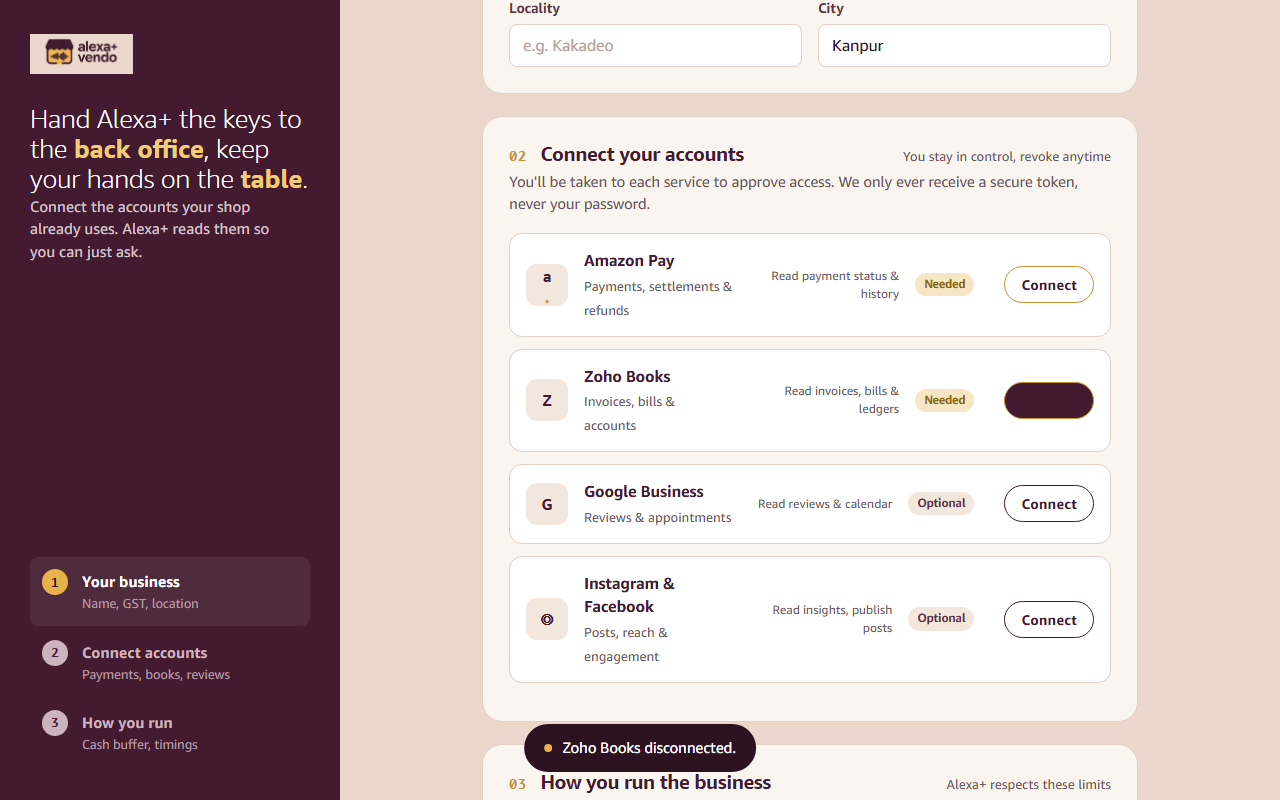
Activate authorized integrations with services such as Amazon Pay, Zoho Books, and Google Business to replace simulated data with permissioned, real-time information.
3. Smarter predictive intelligence
Introduce improved demand forecasting, procurement optimization, anomaly detection, and personalized recommendations using historical business activity.
4. Proactive business assistance
Enable Vendo to identify upcoming stockouts, payment deadlines, operational bottlenecks, and customer opportunities before owners explicitly ask about them.
5. Broader business support
Expand specialized workflows for grocery stores, salons, repair workshops, restaurants, retailers, and other small businesses.
6. Multilingual, voice-first accessibility
Make business management more accessible through natural interactions in Hindi, English, and regional Indian languages.
Ultimately, we want Vendo to become an assistant that understands how a small business operates, helps its owner make better decisions, and reduces the time spent managing repetitive operational tasks.
Our vision is simple: Let business owners focus on growing their business while Vendo helps manage the complexity behind it.


Log in or sign up for Devpost to join the conversation.