-
venai-ai-telehealth-ai-mobile-app-and-marketplace-in-saudi-arabia
Inspiration
Skin conditions are among the most common health problems worldwide, yet getting a diagnosis is often slow. In many places, including parts of Pakistan, dermatologists are scarce and concentrated in big cities, and people wait weeks or search blindly for the right specialist. Many just ignore a worrying rash or mole until it gets worse.
We asked ourselves: what if your phone camera could be the first step? Vena was born from that idea: scan the skin, understand what it might be, and get connected to the right doctor on the same platform.
What it does
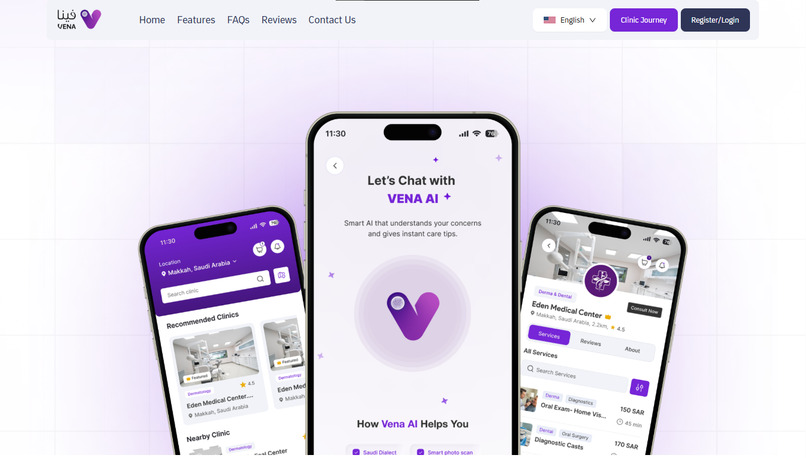
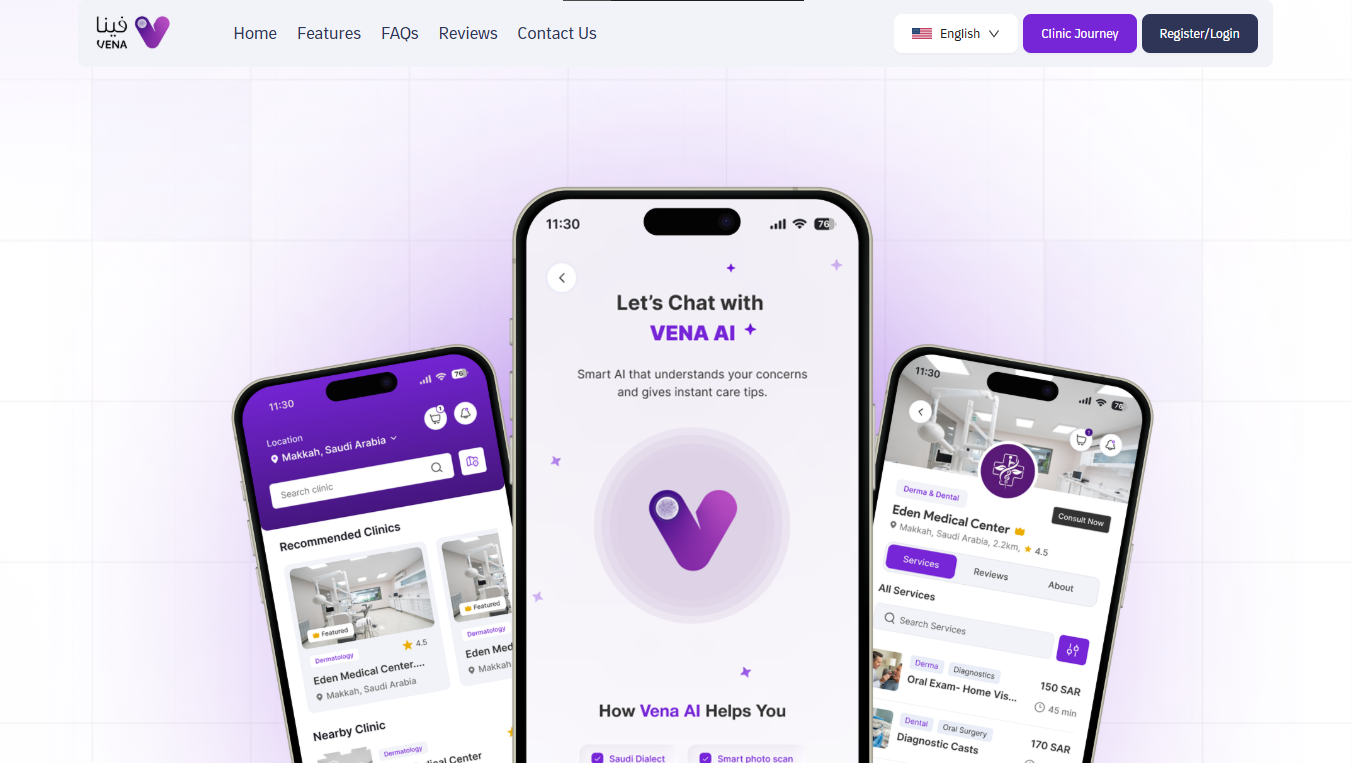
Vena is an AI-powered mobile app that:
- Scans a skin condition from a photo taken with your camera
- Analyzes the image with a deep learning model and suggests likely conditions with confidence scores
- Matches you with the right dermatologist or specialist registered on the platform
- Connects you directly so you can book a consultation without searching elsewhere
Vena is a screening and referral tool, not a replacement for a professional diagnosis.
How we built it
- Mobile app: [Flutter / React Native / Swift / Kotlin] with in-app camera capture
- AI model: a convolutional neural network, fine-tuned from [MobileNet / EfficientNet / ResNet] using transfer learning on [dataset, e.g. HAM10000 / ISIC / DermNet]
- Backend: [Firebase / Node.js / Django] for authentication, doctor profiles and appointments
- Matching logic: the model's predicted condition is mapped to a specialty, and doctors are ranked by relevance and availability
For classification, the model outputs a probability for each class using softmax:
$$ P(y = i \mid x) = \frac{e^{z_i}}{\sum_{j=1}^{K} e^{z_j}} $$
We evaluated performance using the F1 score, which matters more than plain accuracy when classes are imbalanced:
$$ F_1 = 2 \cdot \frac{\text{precision} \cdot \text{recall}}{\text{precision} + \text{recall}} $$
Our model reached [X]% accuracy and an F1 score of [X] on our test set.
Challenges we ran into
- Data quality and imbalance: some conditions have far fewer images than others, and many datasets underrepresent darker skin tones. We used augmentation and class weighting to reduce bias.
- Real-world photos: lighting, blur and camera quality vary a lot compared with clean clinical images.
- Running efficiently on a phone: we had to balance accuracy against model size and speed.
- Responsible design: we worked to make clear that results are suggestions, with clear disclaimers and a nudge to see a doctor.
Accomplishments that we're proud of
- A working end-to-end flow: scan, result, specialist match, consultation
- [A specific milestone, e.g. a model accuracy figure or a user test result]
What we learned
- How to fine-tune and deploy computer vision models for mobile
- Why dataset diversity and fairness matter so much in medical AI
- How to design a health app that builds trust rather than overpromising
What's next for Vena
- Support for more skin conditions and skin tones
- In-app video consultations
- Progress tracking by comparing scans over time
- Partnerships with clinics and dermatology associations
- Multilingual support, including Urdu
Built With
- express.js
- javascript
- keras
- mern
- mongodb
- node.js
- numpy
- pandas
- python
- react
- selenium
- tensorflow
- typescript

Log in or sign up for Devpost to join the conversation.