-
-
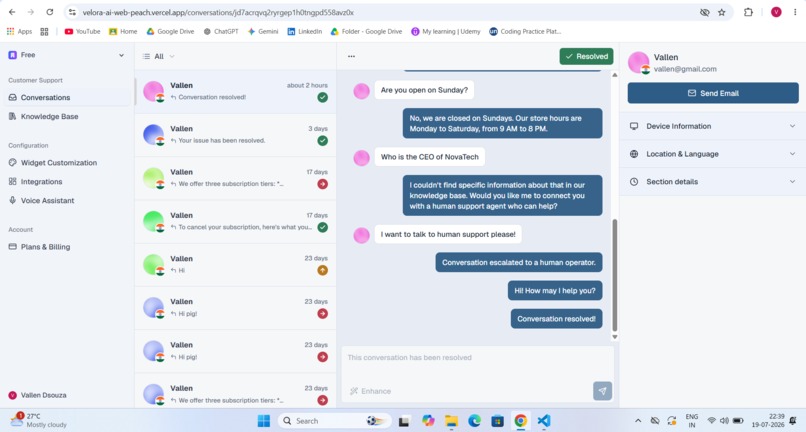
Admin Panel where he can see the conversations
-
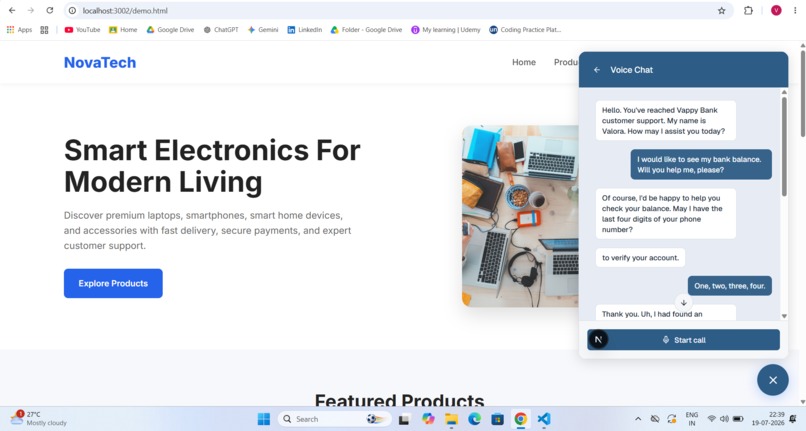
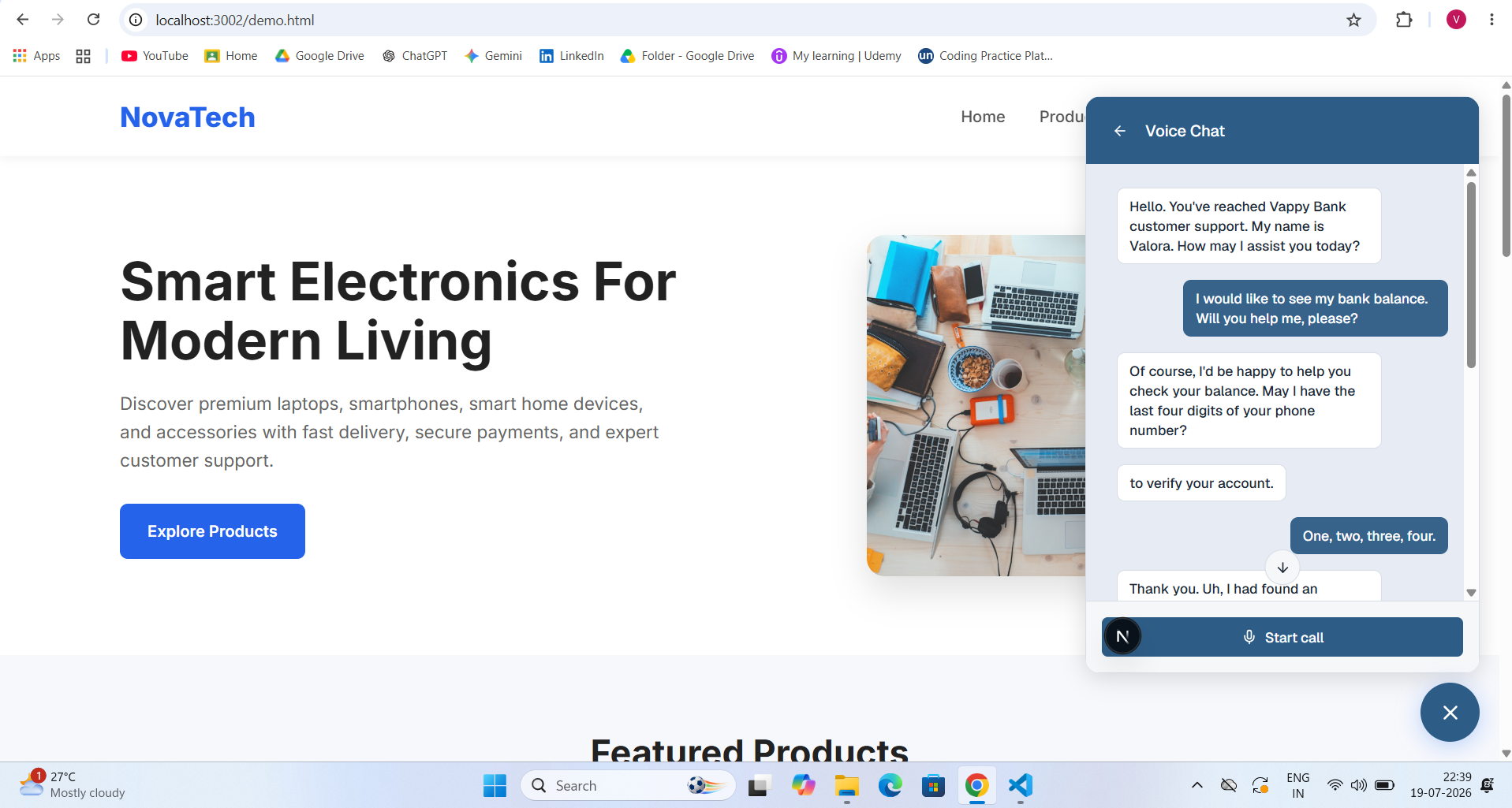
How our AI helps the customer solving issues - Part 1
-
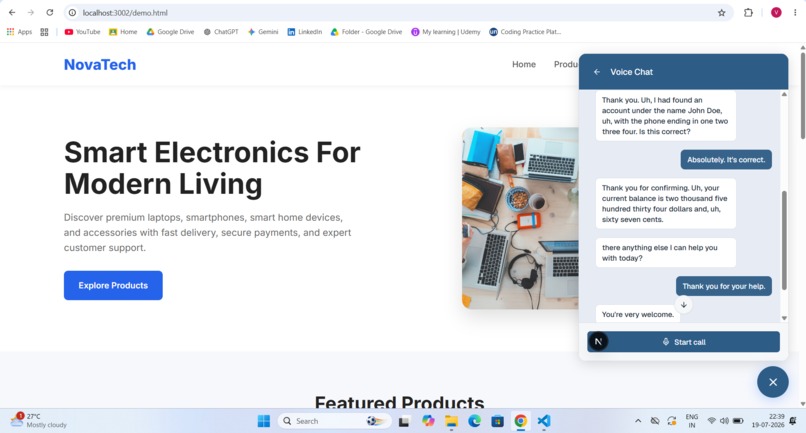
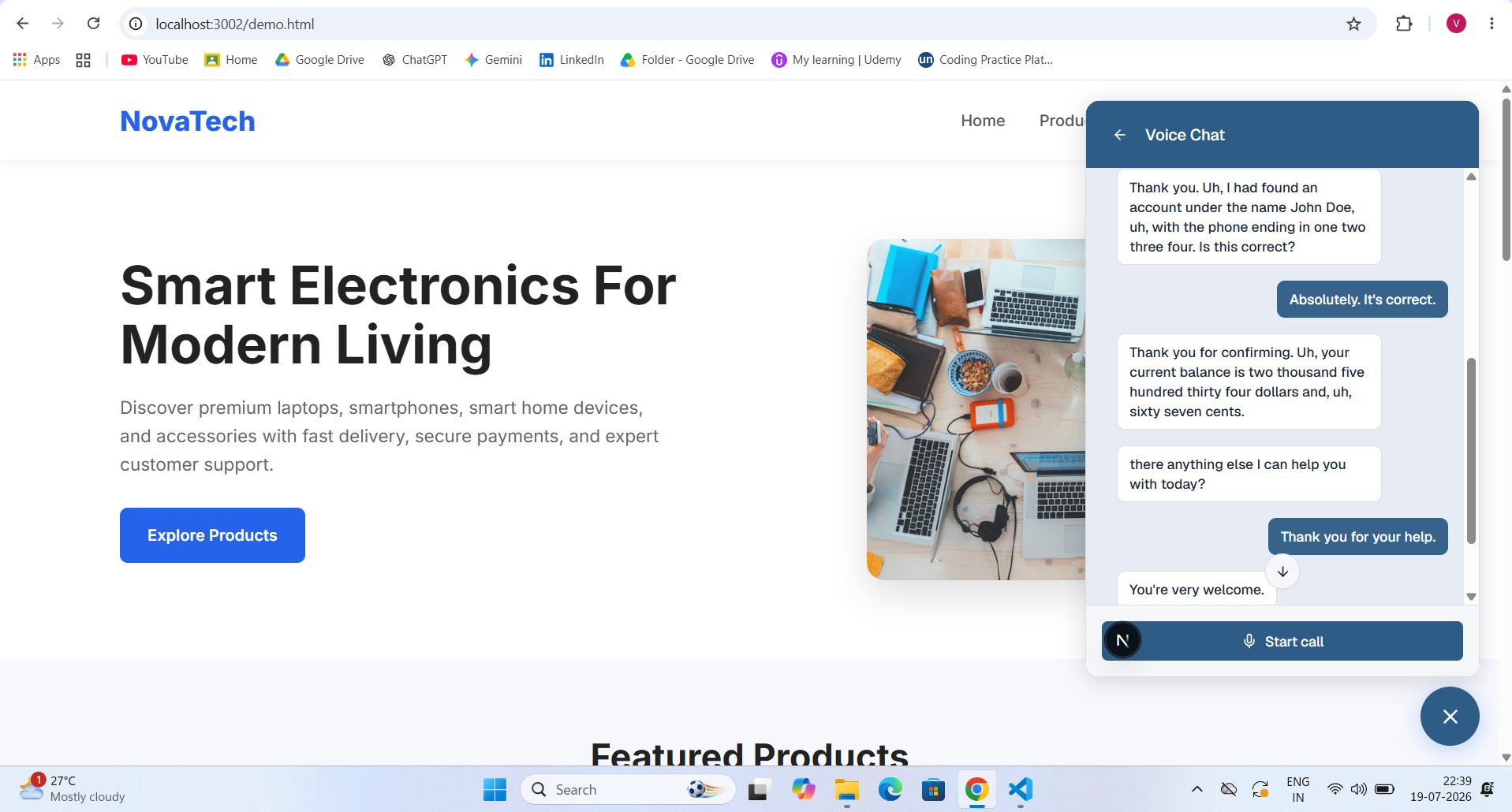
How our AI helps the customer solving issues - Part 2
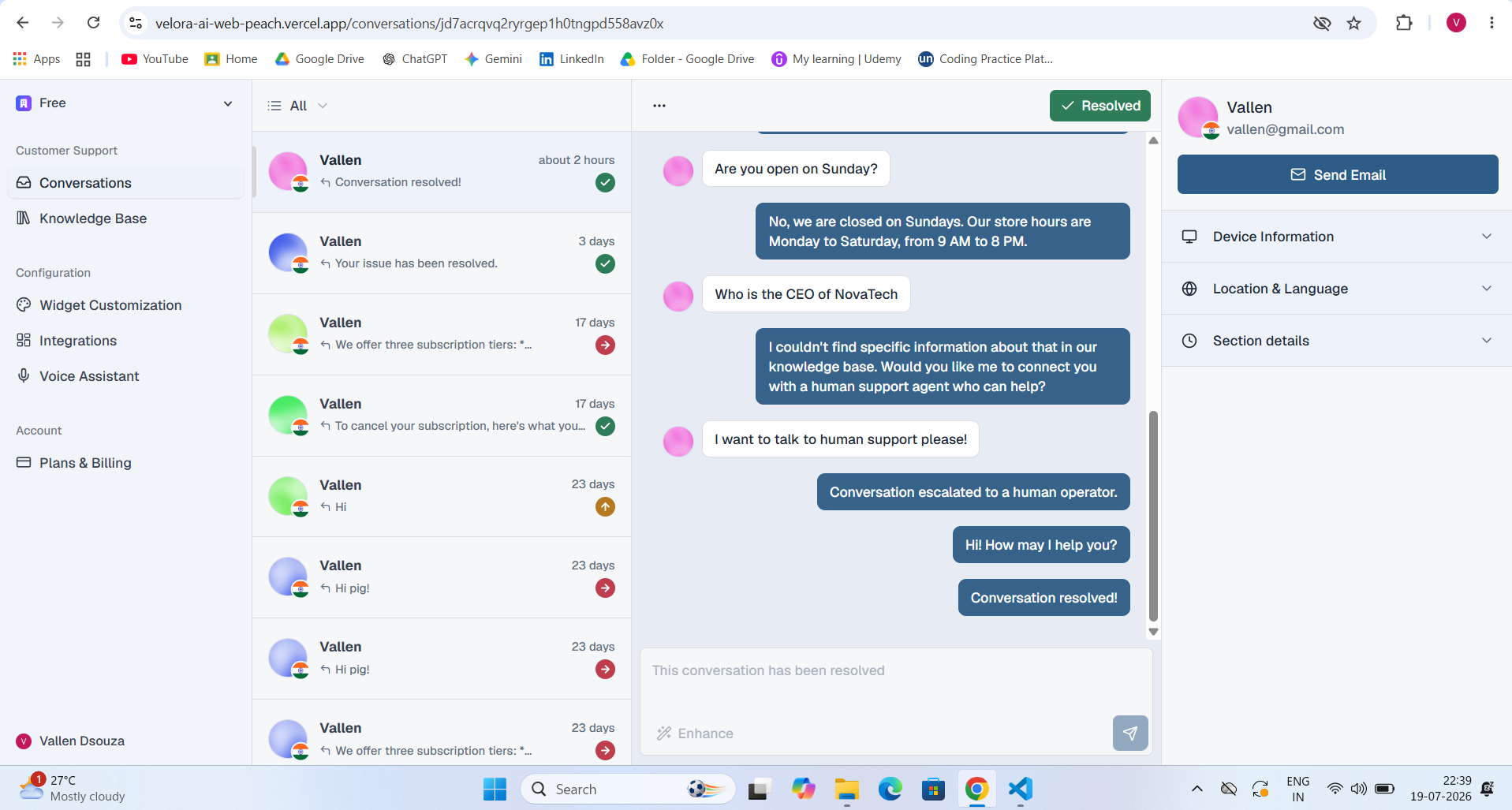
🚀 Velora AI – AI-Powered Customer Support Platform
Inspiration
Businesses today struggle to provide fast, consistent, and personalized customer support while keeping operational costs low. Small and medium-sized businesses, in particular, often cannot afford large customer support teams that operate 24/7.
We wanted to build a platform that enables any business to deploy an intelligent AI support agent in minutes—one that understands company-specific knowledge, answers customer queries naturally, escalates conversations when needed, and even supports voice interactions.
Our vision was simple: make enterprise-grade AI customer support accessible to everyone.
What it does
Velora AI is a multi-tenant AI Customer Support SaaS platform where businesses can create their own AI-powered customer support assistants without writing code.
Each organization can:
- Upload company knowledge bases
- Train AI on custom documents
- Embed a chatbot into their website
- Handle customer conversations using Retrieval-Augmented Generation (RAG)
- Support both text and voice conversations
- Maintain isolated data for every organization
Instead of generic chatbot responses, Velora AI retrieves relevant business information before generating answers, making responses significantly more accurate and contextual.
How we built it
We built Velora AI using a modern full-stack architecture.
Frontend
- Next.js 15
- React 19
- TypeScript
- Tailwind CSS v4
- shadcn/ui
- Jotai for lightweight state management
Backend
- Convex as the reactive backend
- Clerk Authentication
- Clerk Organizations for multi-tenancy
- Convex database for conversations and business data
AI Stack
- Retrieval-Augmented Generation (RAG)
- Vector embeddings
- Semantic document retrieval
- AI-powered response generation
- Vapi AI for voice agents
Deployment & Monitoring
- Turborepo Monorepo
- pnpm Workspaces
- Sentry for monitoring and error tracking
Architecture
The project follows a monorepo architecture.
apps/
 ├── web
 └── widget

packages/
 ├── ui
 ├── backend
 └── shared
The Web App is used by businesses to configure and manage their AI assistant, while the Widget App is embedded into customer websites to provide real-time support.
Multi-Tenant Design
One of our primary goals was complete tenant isolation.
Every business operates inside its own organization using Clerk Organizations. Users can only access their own:
- Documents
- Conversations
- AI agents
- Customer history
- Analytics
This ensures scalability while maintaining strict data separation.
Retrieval-Augmented Generation (RAG)
Instead of relying solely on a language model's general knowledge, Velora AI follows a Retrieval-Augmented Generation pipeline:
- Business documents are uploaded.
- Documents are chunked into smaller sections.
- Each chunk is converted into vector embeddings.
- Relevant chunks are retrieved using semantic similarity.
- The retrieved context is supplied to the LLM.
- The LLM generates an accurate, context-aware response.
This dramatically reduces hallucinations and ensures answers remain grounded in the organization's knowledge base.
Features
- 🤖 AI-powered customer support
- 🏢 Multi-tenant SaaS architecture
- 📚 Knowledge base management
- 🔍 Semantic search using vector embeddings
- 💬 Context-aware chatbot
- 🎙️ AI voice agents
- 🔒 Secure authentication
- 👥 Organization management
- 📈 Conversation history
- ⚡ Real-time backend powered by Convex
- 📊 Scalable monorepo architecture
Challenges we ran into
Building Velora AI involved several technical challenges.
Multi-tenancy
Designing a secure architecture where every organization's data remained completely isolated required careful planning around authentication, authorization, and database access.
RAG Pipeline
Creating an effective Retrieval-Augmented Generation workflow required experimentation with document chunking strategies, embedding generation, and retrieval quality. Poor chunking led to less relevant responses, so we iterated to improve contextual accuracy.
Real-time Synchronization
Keeping conversations synchronized between the dashboard, backend, and embedded widget while maintaining a responsive user experience required efficient state management and real-time data updates.
Voice Integration
Integrating AI voice capabilities introduced additional complexity around session management, conversational flow, and maintaining context between spoken interactions.
What we learned
This project significantly deepened our understanding of modern AI application development.
Some of our biggest takeaways include:
- Building production-ready Retrieval-Augmented Generation systems
- Designing scalable multi-tenant SaaS architectures
- Managing authentication and authorization with Clerk Organizations
- Using Convex for reactive backend development
- Structuring large applications using Turborepo
- Designing reusable component libraries
- Integrating AI voice agents into real-world workflows
- Optimizing developer experience with pnpm workspaces and shared packages
Most importantly, we learned that building reliable AI products is not just about choosing a powerful language model—it is about designing robust data pipelines, retrieval systems, security boundaries, and user experiences that work together seamlessly.
Future Improvements
We plan to continue expanding Velora AI with features such as:
- Human handoff during live conversations
- AI-generated conversation summaries
- Ticketing system integrations
- CRM integrations
- Customer sentiment analysis
- Analytics dashboard
- Multi-language support
- Automated knowledge base synchronization
- Custom AI workflows and agent orchestration
Conclusion
Velora AI demonstrates how modern AI technologies, Retrieval-Augmented Generation, and scalable SaaS architecture can be combined to deliver intelligent customer support that is both accurate and practical. By enabling organizations to create AI assistants trained on their own knowledge, we aim to make high-quality, always-available customer support accessible to businesses of every size.
Built With
- chatbot
- clerk
- convex
- embeddings
- geminiai
- javascript
- jotai
- llm
- multi-tenant
- next.js
- node.js
- pnpm
- rag
- react.js
- rest
- saas
- sentry
- shadcn/ui
- tailwindcss
- turborepo
- typescript
- vapi
- vectordatabase
- vercel


Log in or sign up for Devpost to join the conversation.