-
-
Vela Avatar
-
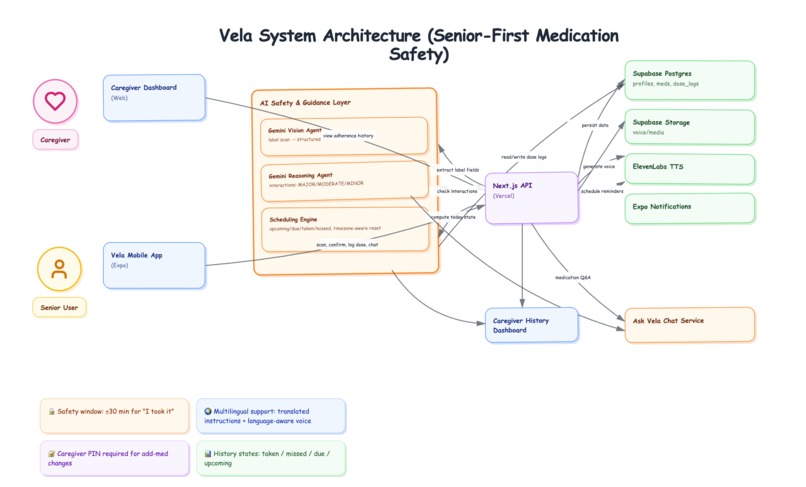
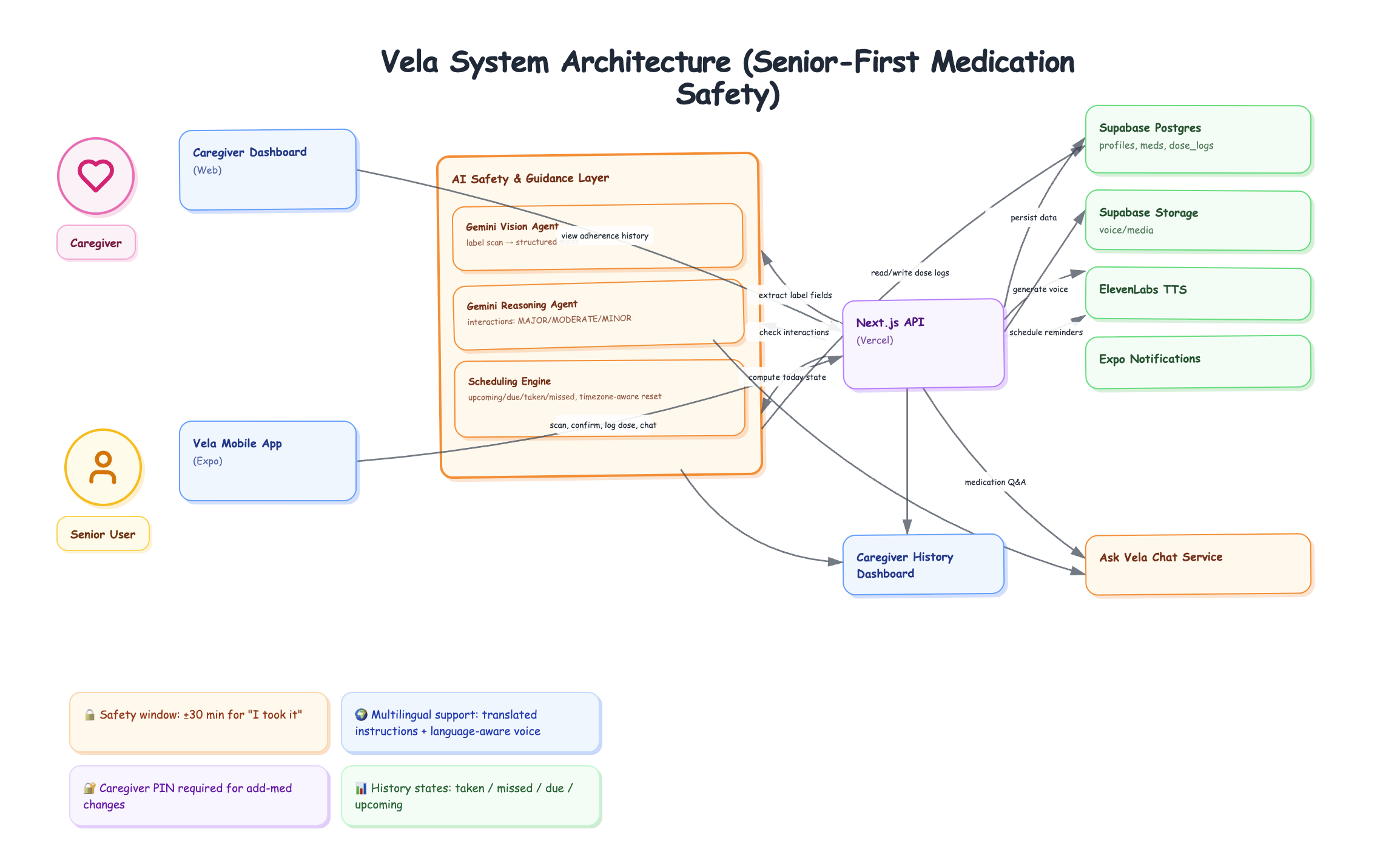
Vela System Architecture and Tools
-
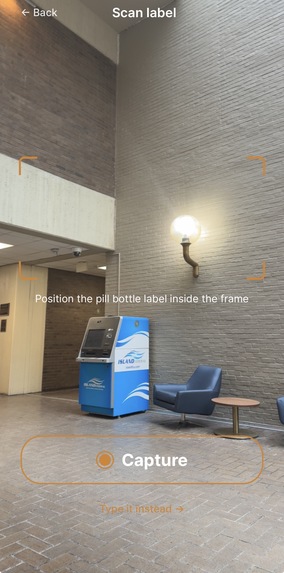
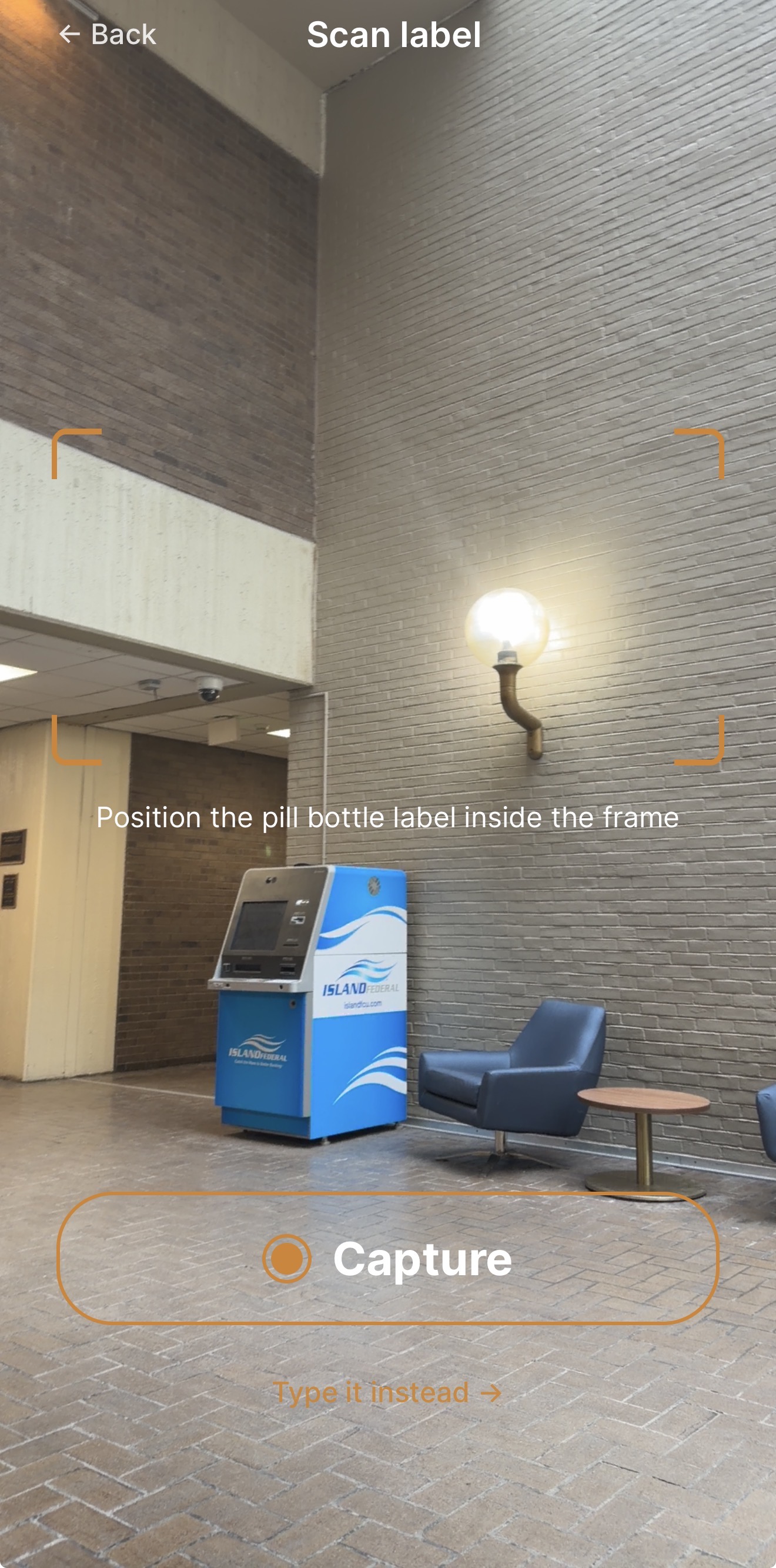
Camera overlay for pill-label scanning
Vela
Inspiration
31% of older patients with multimorbidity were nonadherent to their medication. Medication adherence and aging: challenges and interventions (PMC9245166)
Every day, millions of seniors navigate a ritual that should be simple. Taking their medication. But quietly, it isn't. Pill bottles have labels too small to read. Instructions assume medical literacy. Schedules pile up until they blur together. And one small mistake (a missed dose, a doubled dose, a dangerous combination) can mean a hospital visit.
The people most affected by this are also the least served by existing tools. Most medication apps are designed for caregivers who are tech-savvy, not for the seniors who actually need to take the pills. The result is a gap: caregivers can configure things remotely, but seniors are left to figure it out alone in the moment.
We built Vela (named for the Spanish word for "candle") to be a guiding light in that gap. Not a clinical dashboard. Not a generic reminder. A calm, warm, voice-guided companion that treats seniors as capable adults and gives them exactly what they need, exactly when they need it, in the language they understand best.
What It Does
Vela is an end-to-end medication safety system with two audiences: seniors, who need calm and simple in-the-moment guidance, and caregivers, who need confidence that things are going right even when they're not in the room.
For seniors:
- A single Now Card shows the one medication that needs attention right now: not a list, not a schedule, just the next action. "It's 8 AM. Time for your Lisinopril. Take with water."
- Dose confirmation is only available within a strict ±30 minute window, preventing the "did I take it?" double-dose scenario that causes thousands of ER visits per year.
- Every reminder is delivered with voice playback via ElevenLabs TTS, in the senior's preferred language, with warm and human phrasing rather than robotic alerts.
- Ask Vela is an inline medication chatbot where seniors or caregivers can ask plain-English questions like "Is it safe to have a glass of wine with this?" or "What happens if I miss a dose?" and receive grounded, contextual answers with full awareness of the senior's complete medication list.
For caregivers:
- Scanning a pill label with the camera extracts the full medication details using Gemini Vision, with no manual transcription and no data entry errors.
- Before any new medication is saved, Vela checks it against all current medications and surfaces interaction warnings in plain language, tagged by severity (
MAJOR,MODERATE,MINOR), so risk is caught before it becomes routine. - A caregiver PIN gate prevents unauthorized or accidental schedule changes on shared devices.
- A Medication History dashboard shows day-by-day dose outcomes (taken, missed, due, upcoming), giving caregivers transparent, longitudinal visibility into adherence without having to ask.
Accessibility Is the Product
Vela is not accessible as an afterthought. Accessibility is the core design constraint every other decision was made around.
Visual accessibility: Nothing on screen is ever smaller than 16px. Most senior-facing text renders at 20–26px. The color palette (deep forest green on soft cream) is optimized for reduced contrast sensitivity. Cards are large, tap targets are generous, and the interface never shows more than one primary action at a time.
Cognitive accessibility: The entire senior-facing experience is built around one principle: reduce the number of decisions to zero. The Now Card eliminates choice. The dose window eliminates ambiguity about timing. The voice prompt eliminates the need to read at all. Every feature asks "What does a senior need to do right now?" and then shows only that.
Language accessibility: Medication instructions are translated and stored in the senior's profile language. Voice prompts are generated in that language context, not just translated text read aloud in English phonetics. This matters practically for multilingual families where a caregiver speaks English but the senior is most comfortable in Cantonese, Spanish, or Hindi. The safety-critical moment of understanding how and when to take a medication happens in the language the senior actually understands.
Trust accessibility: For many seniors, the biggest barrier is not knowing who to trust. Vela never guesses. Ask Vela is explicitly bounded: it has daily usage limits, always defers to a doctor for anything clinical, and every answer is grounded in the senior's specific medication profile, not generic internet advice. The system's reliability is designed to make it trustworthy, not just useful.
How We Built It
Frontend: Expo + React Native + Expo Router, with file-based routing gated on auth and profile readiness. A single Zustand store manages all medication, schedule, and dose state. All styling uses a theme.ts token system with no inline values, ensuring visual consistency and easy contrast tuning across the app.
Backend: Next.js API routes on Vercel handle all seven operations: label scan, interaction check, schedule generation, dose logging, Ask Vela chat, voice generation, and caregiver history. Safety logic lives server-side; the client stays lightweight and stateless.
AI pipeline (Gemini 2.0 Flash): We use Gemini in two distinct stages. First, vision extraction: a label image is processed into a structured medication object (name, dosage, form, frequency, instructions). Second, reasoning: interaction checks run the new medication against the full existing list and return severity-tagged warnings in plain language. Separating these stages improves reliability and makes safety outputs independently validatable. Ask Vela sends the complete profile and medication context to Gemini with a constrained system prompt that enforces plain-language responses with no markdown, no generic advice, and no clinical overreach.
Scheduling engine: Dose states (upcoming, due, taken, missed) are computed deterministically on the backend with timezone-aware midnight resets and nearest-dose prioritization. This prevents the drift that breaks most medication apps at 11:59 PM or after a daylight saving transition.
Voice pipeline (ElevenLabs TTS): Audio generation is decoupled from the critical save path to avoid perceived latency. Generated files are cached in Supabase Storage and served by URL to the mobile client, which handles playback natively.
Database: Supabase Postgres persists profiles, medications, schedules, and dose logs as first-class records. Every dose event is an auditable entry; the history dashboard reads directly from these logs, not from inferred state.
Challenges
Making simplicity feel safe. A one-tap interface for seniors requires ironclad correctness underneath. The simpler the UI became, the more important it was to harden backend validation. The ±30 minute dose window is enforced on both client and server. Interaction warnings cannot be bypassed. The Now Card logic handles edge cases (multiple doses due simultaneously, late confirmations, day rollovers) without surfacing any of that complexity to the user.
Making AI outputs reliable for a safety-sensitive context. Raw model output is not safe enough for medication decisions. We solved this by structuring Gemini's work into bounded stages with typed outputs, explicit severity tags, and constrained prompting, transforming a general-purpose language model into a deterministic safety-checking component that produces actionable signals, not prose.
Building for time. There is no hardware reset, no "ignore" button, and no graceful failure mode when a senior doesn't know what to do. Timezone handling, midnight resets, historical state reconstruction, and multilingual voice generation all had to work correctly the first time, every time, not just in the happy path.
What We're Proud Of
We shipped a complete medication safety system (not a feature, not a prototype of one flow) in hackathon time. Scan → confirm → interaction check → schedule → voice reminder → dose confirmation → caregiver history is one connected, tested system. Every piece is load-bearing.
We also built something that could genuinely help a real person. Not because the technology is impressive (though we think it is), but because we started from a real gap and designed backward from the people most affected by it. Seniors deserve software that respects their dignity. Caregivers deserve tools that give them real peace of mind. Vela tries to be both.
What's Next
Clinical escalation paths. When repeated misses or major interaction risks are detected, Vela should be able to alert a caregiver, flag a pharmacist, or generate a summary for a provider visit. Moving from passive logging to proactive intervention is the next meaningful safety layer.
Predictive adherence intelligence. Modeling missed-dose patterns by time-of-day and routine behavior to personalize reminder timing, preventing misses before they happen, not just recording them after.
Dialect-aware voice. Expanding from language-level to dialect-level voice tuning, so a senior from Guangzhou and a senior from Hong Kong both hear reminders that sound natural and familiar to them specifically.
Richer caregiver analytics. Weekly adherence scores, streak tracking, risk windows, and exportable summaries, extending the history dashboard into a tool useful for family coordination and clinical conversations.
Built With
- eleven-labs
- expo.io
- gemini
- google-gemini
- javascript
- next.js
- postgresql
- react-native
- sql
- supabase
- typescript
- vercel
- zustand


Log in or sign up for Devpost to join the conversation.