-
-

App logo
-
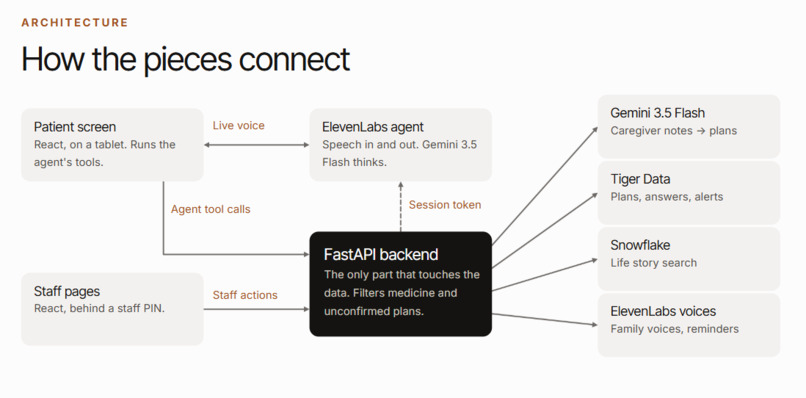
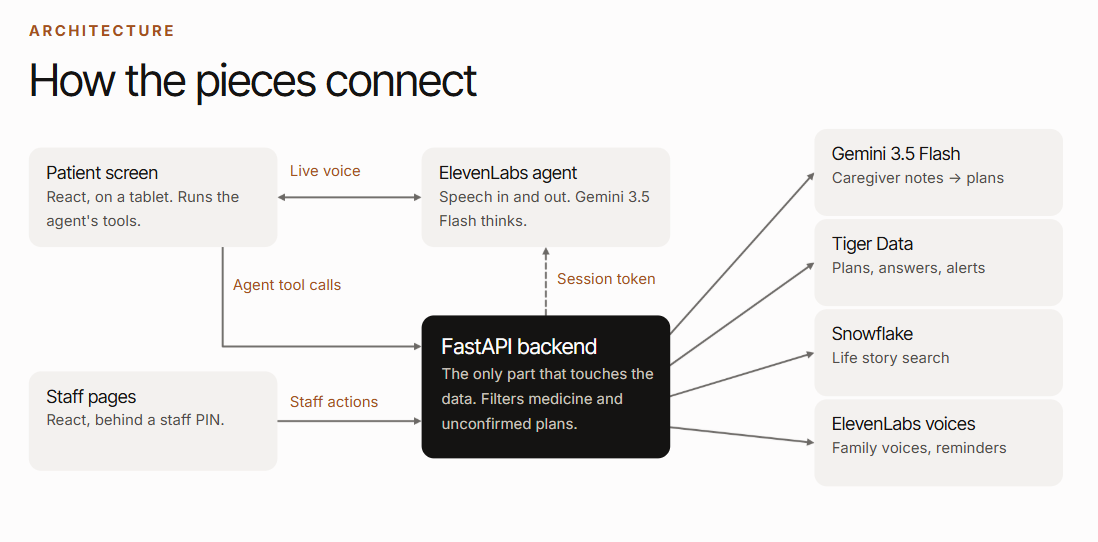
Architecture Overview
-
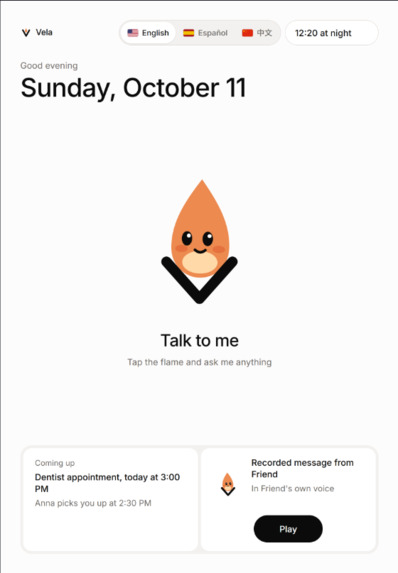
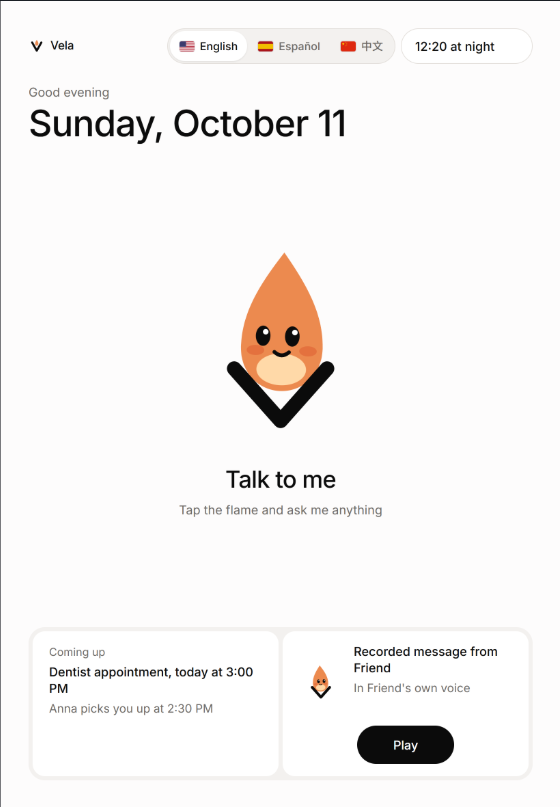
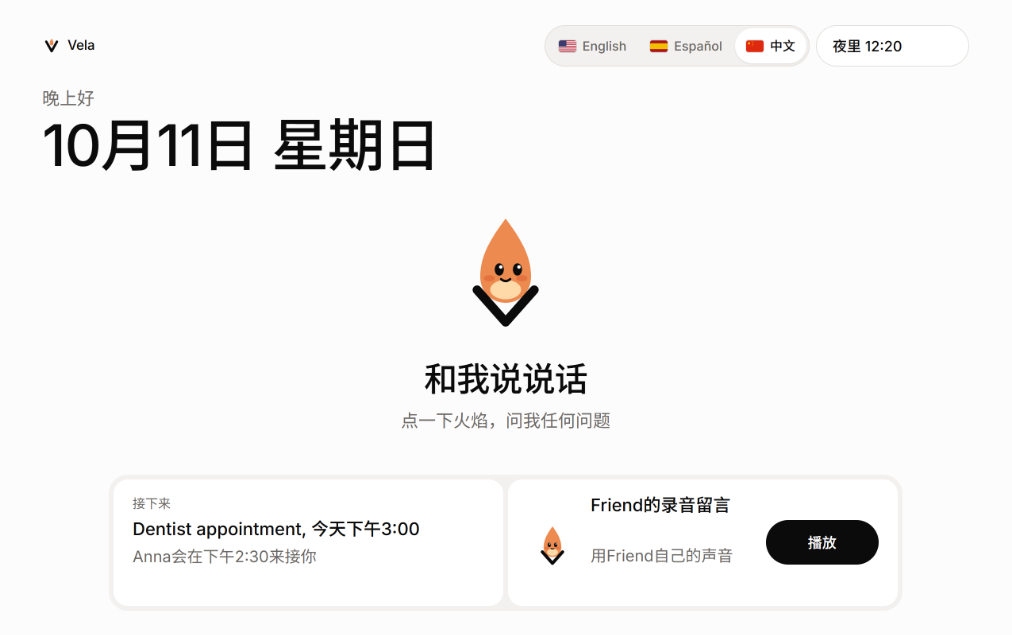
The patient's view from their device
-
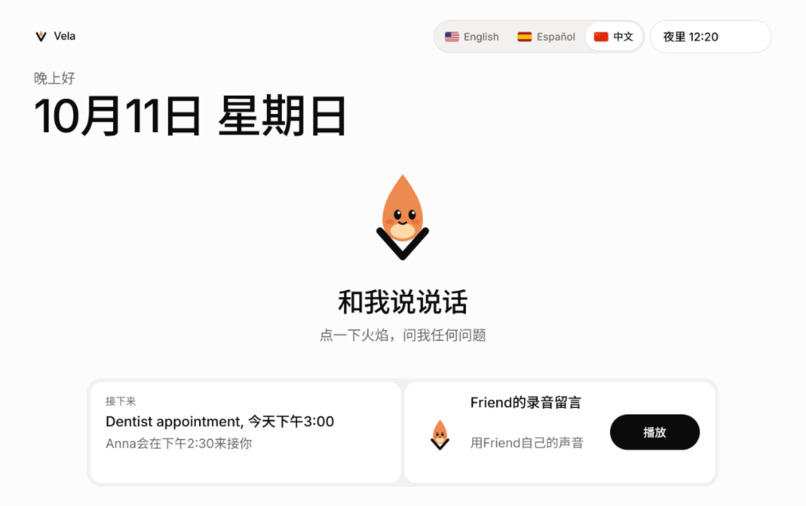
中文
-
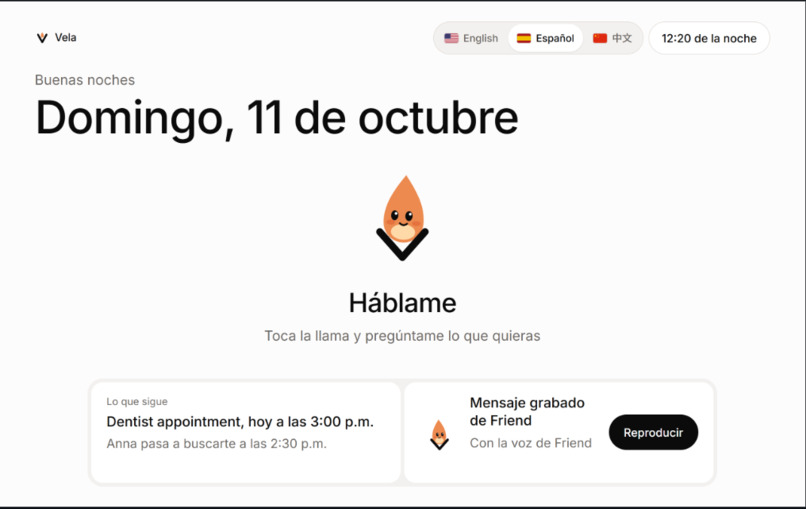
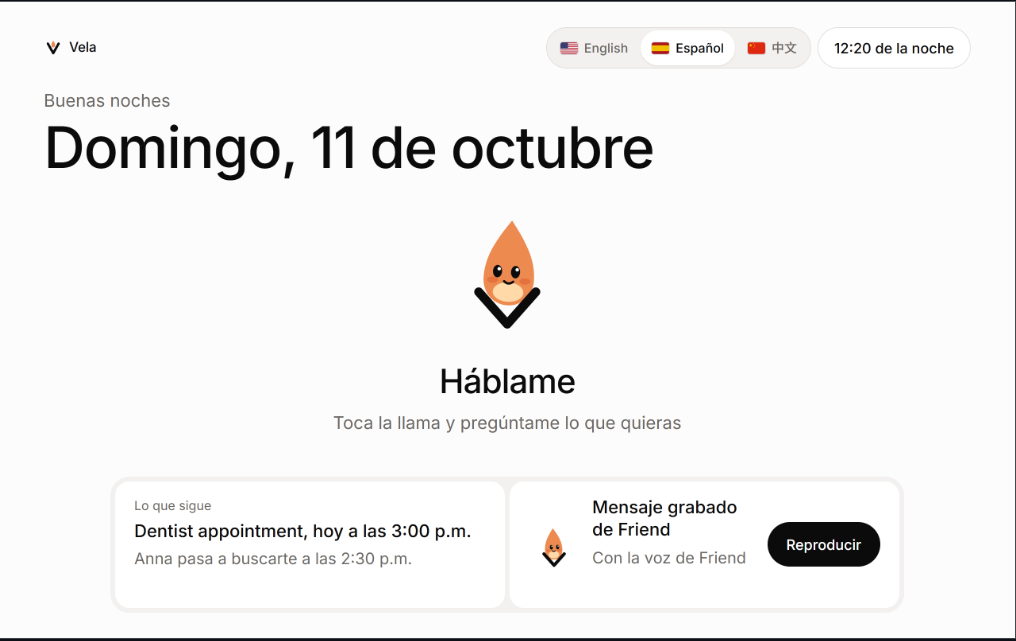
Español
-
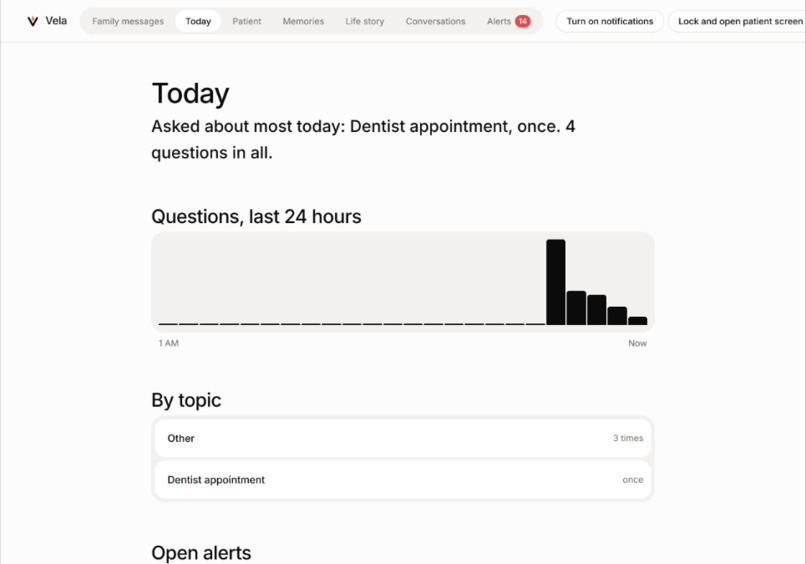
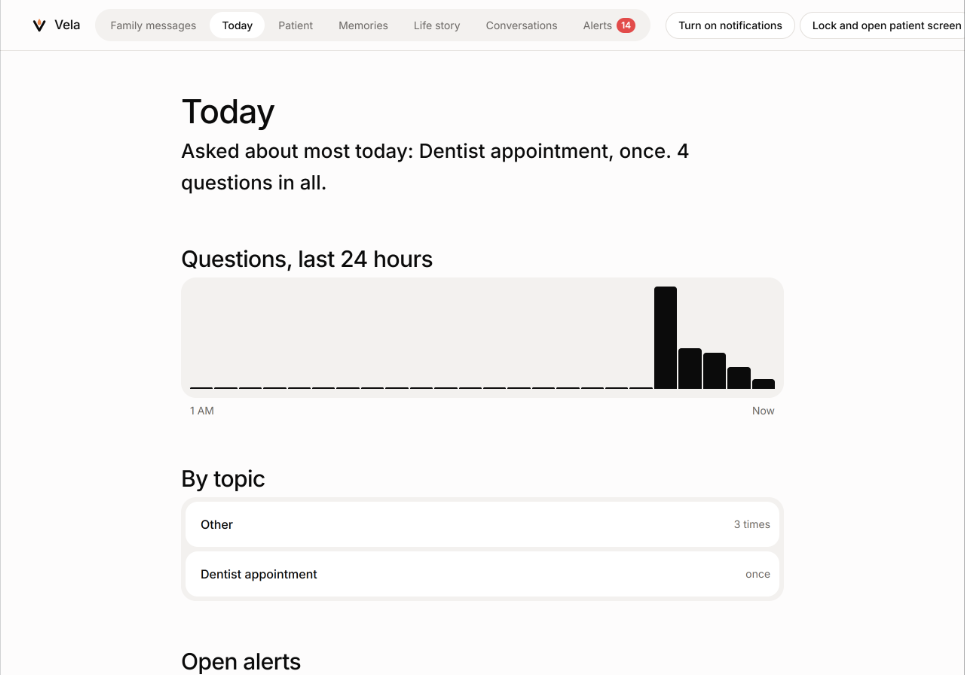
Breakdown of today's questions
-
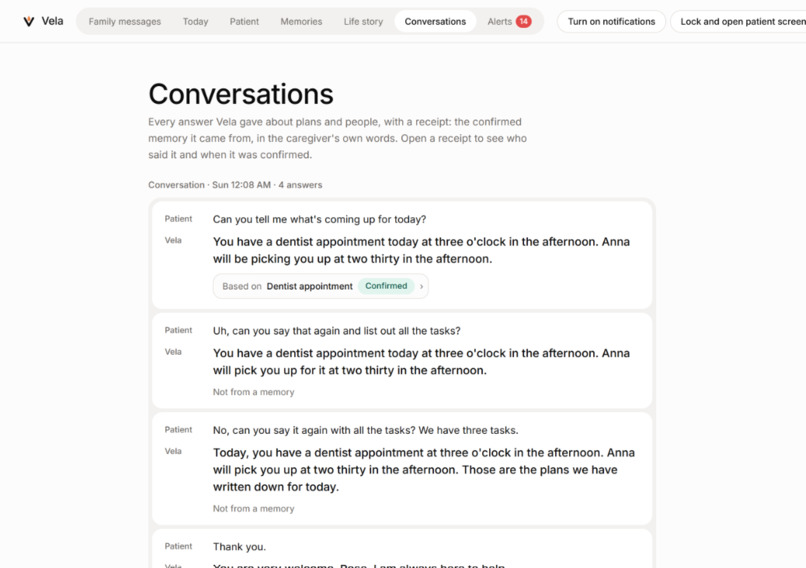
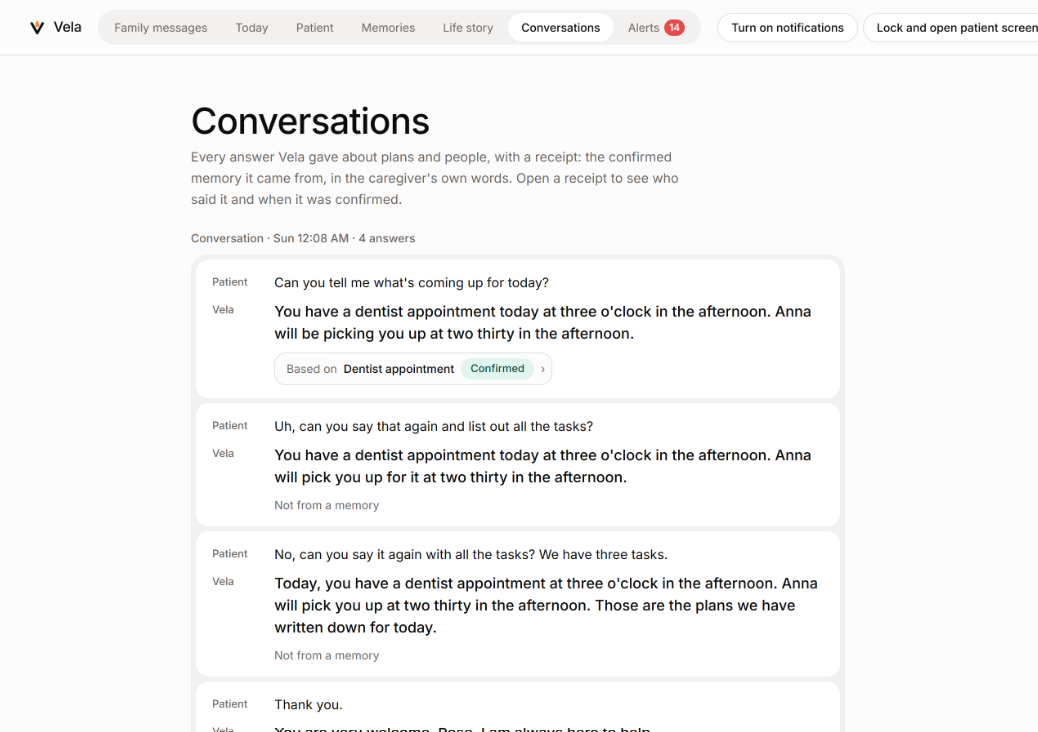
Paper trail: every response given by Vela has a receipt

Inspiration
People living with dementia often ask the same question many times an hour: "When is Anna picking me up?" "Did I take my pills?" Caregivers do their best to answer with love, but it's exhausting, and they won't be there around the clock.
We wanted to build a companion that could answer every time, just as patiently the sixth time as the first. But a voice AI that just makes things up is very dangerous for someone who can't tell when it's wrong. So we built Vela around one rule: it only says what a caregiver has confirmed, and when it doesn't know, it asks a human.
The name comes from the Spanish velar: to keep watch over someone, especially through the night.
What it does
For the patient, Vela is a calm screen with one thing to do: tap the orb and talk.
- Answers questions about plans and people from confirmed memories only
- Admits when plans are uncertain ("Anna said she might visit Saturday")
- If it doesn't know, it says so and asks the care team instead of guessing
- Spoken reminders 30 and 5 minutes before each confirmed plan
- Switches to Spanish or Mandarin when the patient does, keeping names and times exact
- Plays recorded messages from family in their own cloned voice, with their consent. The live companion always uses its own neutral voice, so it never pretends to be a family member
For caregivers, a PIN protected set of pages:
- Type what the caregiver said ("Her dentist appointment is tomorrow at three, I'll pick her up at two thirty") and Vela turns it into a memory to review. Nothing is spoken until a caregiver confirms it
- Answer receipts: every answer Vela gave, linked to the exact memory and the caregiver's original words behind it
- Alerts with a chime when Vela needs a human: a question it couldn't answer, a medication report, or an emergency
Safety
We treated safety as a major feature, not a disclaimer:
- Medication: Vela never confirms or advises a dose, since a wrong answer could cause a missed or double dose. "I took my pills" is logged as self-reported, and never verified
- Emergencies: "I fell," chest pain, or "I'm lost" raises an urgent alert first. A keyword backup in English, Spanish, and Mandarin catches these even if the AI doesn't
- Honesty: it says it's a computer helper when asked, and never promises that help is on the way
- Tested: an automated suite runs 30 scripted conversations and config checks against the live agent. All 30 pass, with every reply quoted as evidence
How we built it
- Frontend: React, TypeScript, and Vite for the patient screen and staff pages
- Backend: FastAPI (Python)
- Voice: an ElevenLabs Agent with client tools (
get_memories,ask_caregiver,log_patient_statement,raise_urgent_alert) running on Gemini Flash. ElevenLabs voice cloning and text to speech power family messages and reminders - Memory: Tiger Data (Postgres with TimescaleDB) and Snowflake. Every memory has an exact source, a timestamp, and a status (pending, confirmed, tentative, superseded). Updates never overwrite: they create a new version, so receipts always show what was true when an answer was given. The Tiger database itself enforces that a confirmed memory must have a confirmation time. Snowflake stores a user's life story and its search engine. It stores prose instead of exact facts, and it's queried by semantics, plus a Cortex Search service.
- Extraction: Gemini turns caregiver speech into structured memories. Gemini fills in a fixed form with a local date and clock time, and our code builds the actual timestamp, because time zones and daylight saving are exactly what language models get wrong
Challenges we ran into
- The venue Wi-Fi blocked database connections. The port looked open, but every Postgres handshake silently timed out. We diagnosed it with a phone hotspot and planned around it
- Built in tools silently disappeared. ElevenLabs dropped the agent's "end call" tool when our client tools were sent separately. Our live config check now catches this
- The agent sometimes said it asked the care team without actually doing it. We added a backup on the patient screen that raises the alert itself if the reply promises to ask
- Spanish broke our emergency matcher. Regular expression word boundaries split on accented letters like "í", so "me caí" didn't match until we switched to Unicode aware matching
- Medication had to be kept out entirely. Three layers (the prompt, the allowed memory types, and a word list in code) make sure a medication schedule never becomes something Vela could read aloud
Accomplishments that we're proud of
- Asked the same question six times, Vela gives the same calm, correct answer every time, and never says "I already told you"
- Every answer can be traced to a caregiver's exact words
- A safety test suite that runs against the real agent, not mocks of it
What we learned
- The hard part of an AI companion is actually trust, not voice. Designing an AI that knows what it doesn't know took more work than just making it talk
- Let language models do language and let structured code handle arithmetic and rules
- Safety needs backups that don't depend on the AI behaving
What's next for Vela
- Testing with real caregivers and families
- A dashboard showing caregivers what the patient keeps asking about, since rising repetition can signal anxiety or decline
- A calm down mode that senses agitation and guides slow breathing
Built With
- elevenlabs
- elevenlabs-agents
- fastapi
- gemini
- postgresql
- psycopg
- pydantic
- python
- react
- react-router
- snowflake
- tiger-data
- timescaledb
- typescript
- uvicorn
- vite


Log in or sign up for Devpost to join the conversation.