-
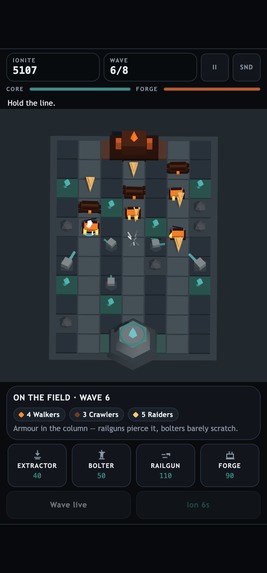
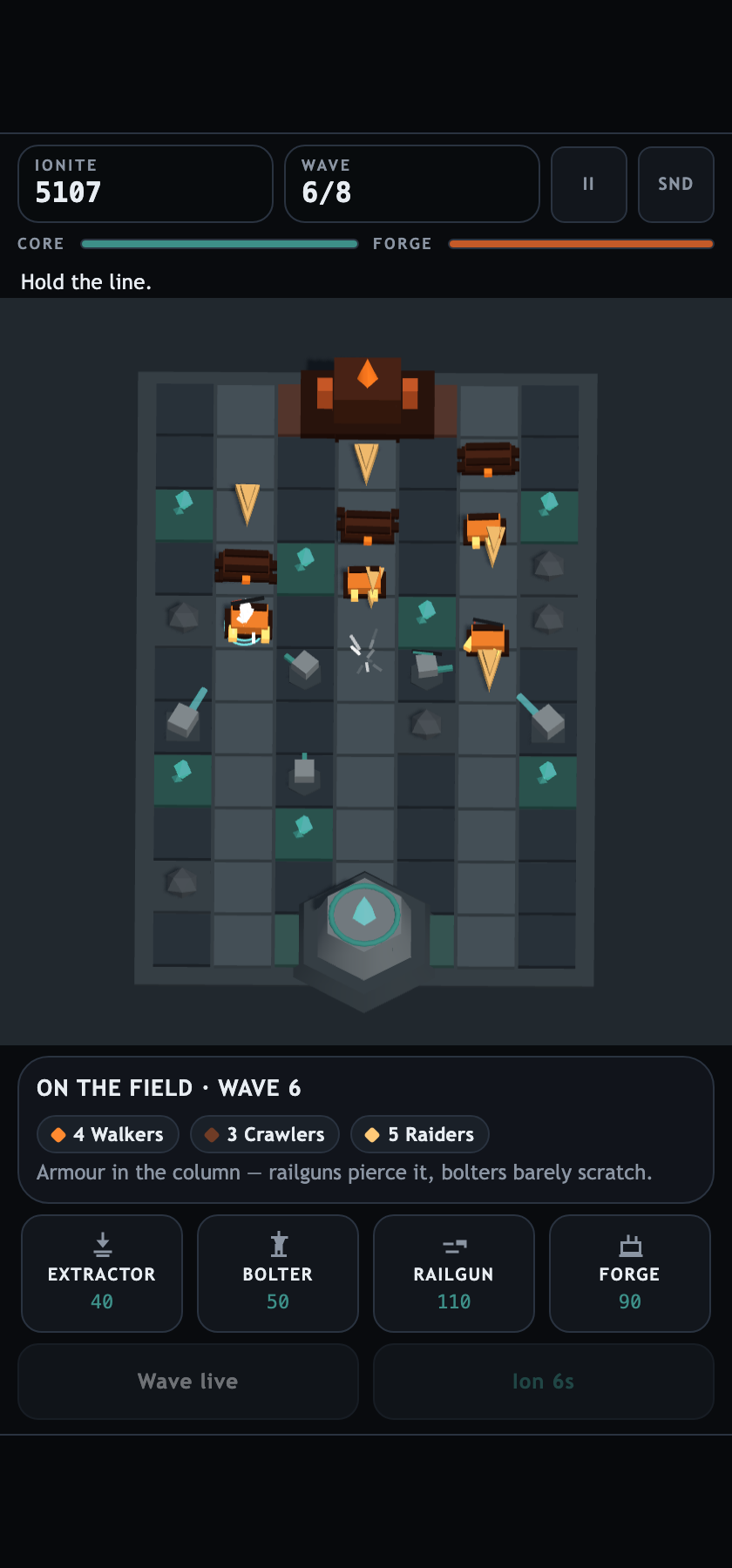
Wave 6 under fire — bolters and railguns holding three lanes
-
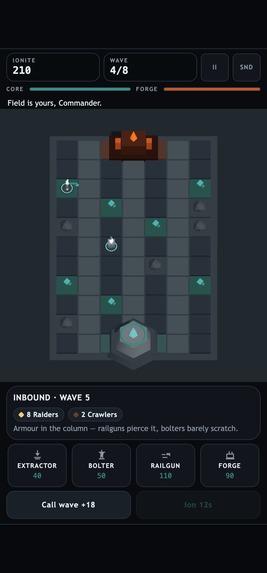
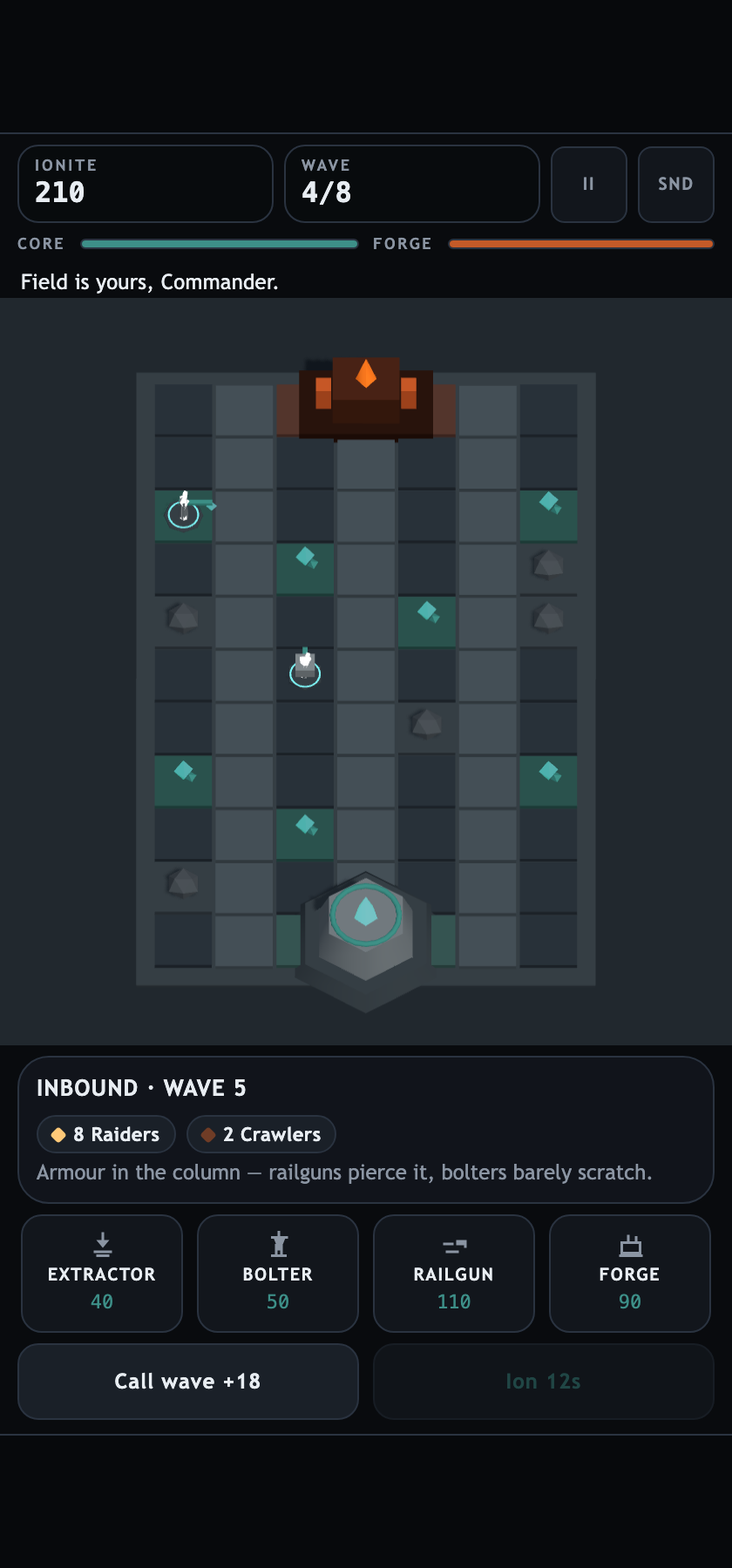
The wave briefing names what is inbound and what counters it
-
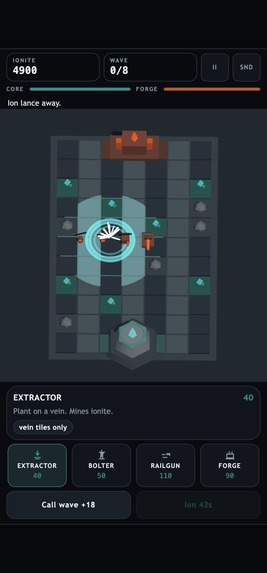
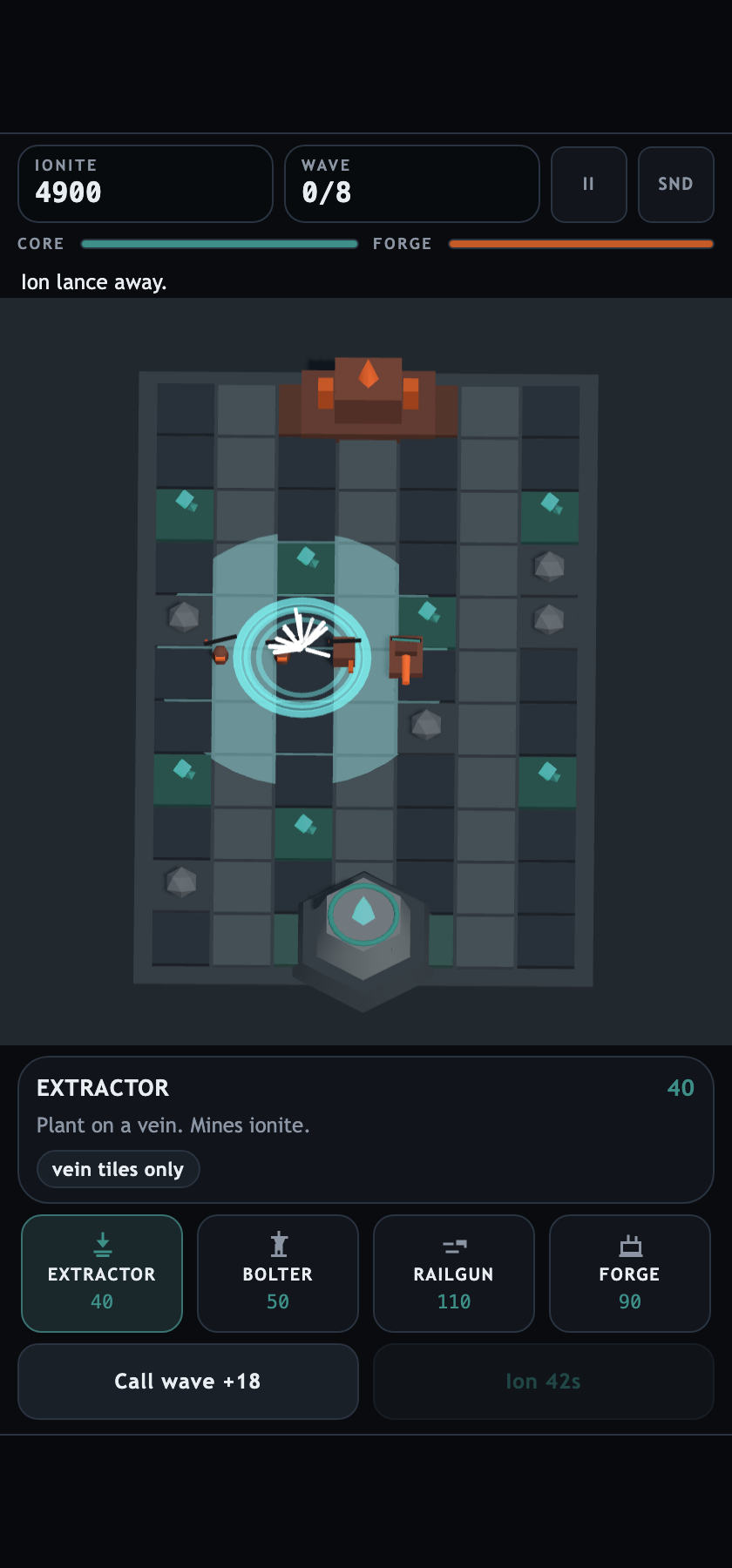
Ion lance detonating on the densest cluster
Inspiration
Command & Conquer taught a generation that a strategy game is really an economy with guns. Vein Command shrinks that feeling to one hand and one sitting: a vertical ionite field, a marching enemy, and the constant question of whether the next 50 ore goes into mining, guns, or the gamble that ends the match early.
What it does
Harvest. Fortify. Strike. Plant extractors on glowing veins (the rich ones sit closest to the enemy), spend ionite on bolters, railguns, and forges, then win one of two ways: hold all eight authored waves, or starve your defense to fund strike tanks and destroy the enemy forge before the waves overwhelm you. An ion lance superweapon charges slowly and dumps on the densest cluster — the spend-or-save decision under pressure.
Four enemy kinds ask different questions: raiders sprint past your guns for the core, walkers and crawlers stop to chew through your structures, and a colossus arrives at the end. Bolters shred swarms; railguns ignore armor. Reading which is coming down which lane is the game.
How we built it
Entirely prompt-built, across several AI tools — and the interesting part is what that workflow turned out to be. The first pass produced a complete, well-architected game (balance as data tables, a simulation with no DOM or WebGL references, renderer and HUD as consumers) that was also nearly unplayable: the whole field rendered close to black, and three of four enemy kinds were within one luminance unit of the ground they walk on.
So the build became measurement-driven. Screenshots were sampled pixel-by-pixel to prove the palette was being crushed (an instanced-mesh colour multiply bug), enemy silhouettes were redesigned against measured luminance and footprint targets, and locomotion was driven off distance travelled so gaits freeze mid-stride when a unit stops to fire. Enemy fire became real projectiles with travel time — verified to change zero balance constants by replaying scripted campaigns before and after.
Challenges we ran into
The submission bundle itself shipped broken once (a missing transitive Three.js file = blank page), which led to building a verifier that walks the emitted import graph and refuses to package an entry with unresolved imports, network calls, or minified code.
The hardest lesson: tests written by the same author as the code inherit its blind spots. Two independent AI reviewers read the source cold and found eleven real defects the test suite structurally could not — including the ion lance destroying the player's own tanks, and a forge that built tanks 18× too fast if you timed the order carelessly. Every finding was reproduced before being fixed.
What we learned
A playable core loop is cheap; a legible one is the actual work. Almost every hard problem here was perceptual, not mechanical — and almost every fix was found by measuring rendered pixels instead of trusting the code.
What's next
A second faction with a different economy, night cycles that grow unharvested veins into spawners, and a short operation list instead of a single field. The loop already teaches the verb the full game would live on: command the vein, or lose it.
Built With
- esbuild
- html5
- javascript
- three.js
- typescript
- webaudio

Log in or sign up for Devpost to join the conversation.