-
-
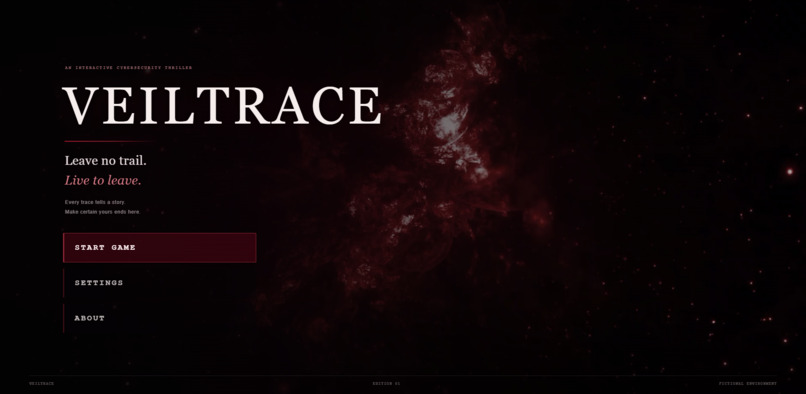
VEILTRACE

VEILTRACE — Every Trace Tells a Story
Inspiration
What if the smallest digital traces we leave behind could reveal far more about us than we realize?
That question inspired VEILTRACE, an interactive, story-driven cybersecurity learning experience. We often think of online privacy in terms of passwords alone, overlooking the information hidden in metadata, location records, app permissions, active sessions, and exposed access tokens. I wanted to explore these risks through an experience that feels less like reading a cybersecurity manual and more like uncovering a mystery.
VEILTRACE places players in an unsettling digital investigation where every clue matters, every decision has consequences, and overlooked evidence can become a security risk.
What It Does
VEILTRACE combines a dark, cinematic atmosphere with interactive puzzles and simulated desktop environments to introduce practical cybersecurity concepts, including:
- Digital footprints: Understanding how seemingly harmless pieces of information can be combined to reveal personal details.
- Location exposure: Exploring how location data and sharing settings can compromise privacy.
- Permissions: Learning why applications should receive only the access they genuinely need.
- Session security: Recognizing suspicious sessions and understanding the importance of managing active access.
- Access tokens: Discovering how exposed tokens can act as credentials and create unauthorized access risks.
- Metadata: Investigating the hidden information files can contain.
- Digital evidence: Understanding why removing one visible clue does not necessarily eliminate every trace of exposure.
The goal is not simply to complete puzzles, but to understand the risks behind them and think more critically about digital security.
How I Built It
I built VEILTRACE as a frontend-focused web game using React, TypeScript, and Vite. The application combines reusable UI components, scene-based progression, interactive puzzle logic, simulated desktop applications, dialogue, and game settings.
I designed the experience around a cinematic sequence that leads into the main menu and then into the game's investigation. Custom video and audio assets help establish the atmosphere, while simulated applications and digital clues make cybersecurity concepts part of the gameplay rather than isolated lessons.
The project also uses structured game data and puzzle validation to organize interactive objects, critical clues, and puzzle outcomes. This modular approach makes it easier to maintain the experience and extend it with additional scenes and challenges.
Challenges I Faced
One of the biggest challenges was balancing educational clarity with immersion. Cybersecurity concepts can become difficult to understand when presented through technical terminology alone, but oversimplifying them can make the lessons feel vague. The challenge was to make players discover risks through believable evidence and meaningful interactions.
Another challenge was coordinating cinematic video playback, audio, transitions, and the game's scene progression without disrupting the experience. Building a consistent interface across the main menu, settings, simulated desktop, and puzzle interactions also required careful attention.
Finally, keeping the code modular while preserving the intended narrative flow meant testing the interaction logic and refining the experience without breaking existing functionality.
What I Learned
Building VEILTRACE strengthened my understanding of React-based application architecture, TypeScript, component organization, state-driven interfaces, and interactive game logic. It also helped me appreciate how audio, visual storytelling, interface design, and pacing can work together to make a technical subject more engaging.
Most importantly, I learned that cybersecurity awareness is more than knowing which settings to change. It means understanding how information connects, how small exposures can accumulate, and why a single corrective action may not remove every underlying risk.
What's Next
VEILTRACE is designed as a foundation for a more immersive cybersecurity learning experience. Further development can expand its puzzle variety, strengthen the explanations accompanying each discovery, and introduce more scenarios that connect individual security mistakes to their wider consequences.
VEILTRACE — Every trace tells a story. The question is whether you know how to read it.
Built With
- css
- cybersecurity
- digital-privacy
- educational-technology
- game
- game-development
- html
- information-security
- interactive-storytelling
- javascript
- puzzle
- react
- typescript
- ui/ux-design
- vite
- web-development

Log in or sign up for Devpost to join the conversation.