Inspiration
Artificial intelligence is becoming part of our everyday lives, but every interaction with an AI service can expose sensitive information. Traditional encryption protects data during transmission, yet it does not prevent an AI provider from accessing the plaintext needed for inference.
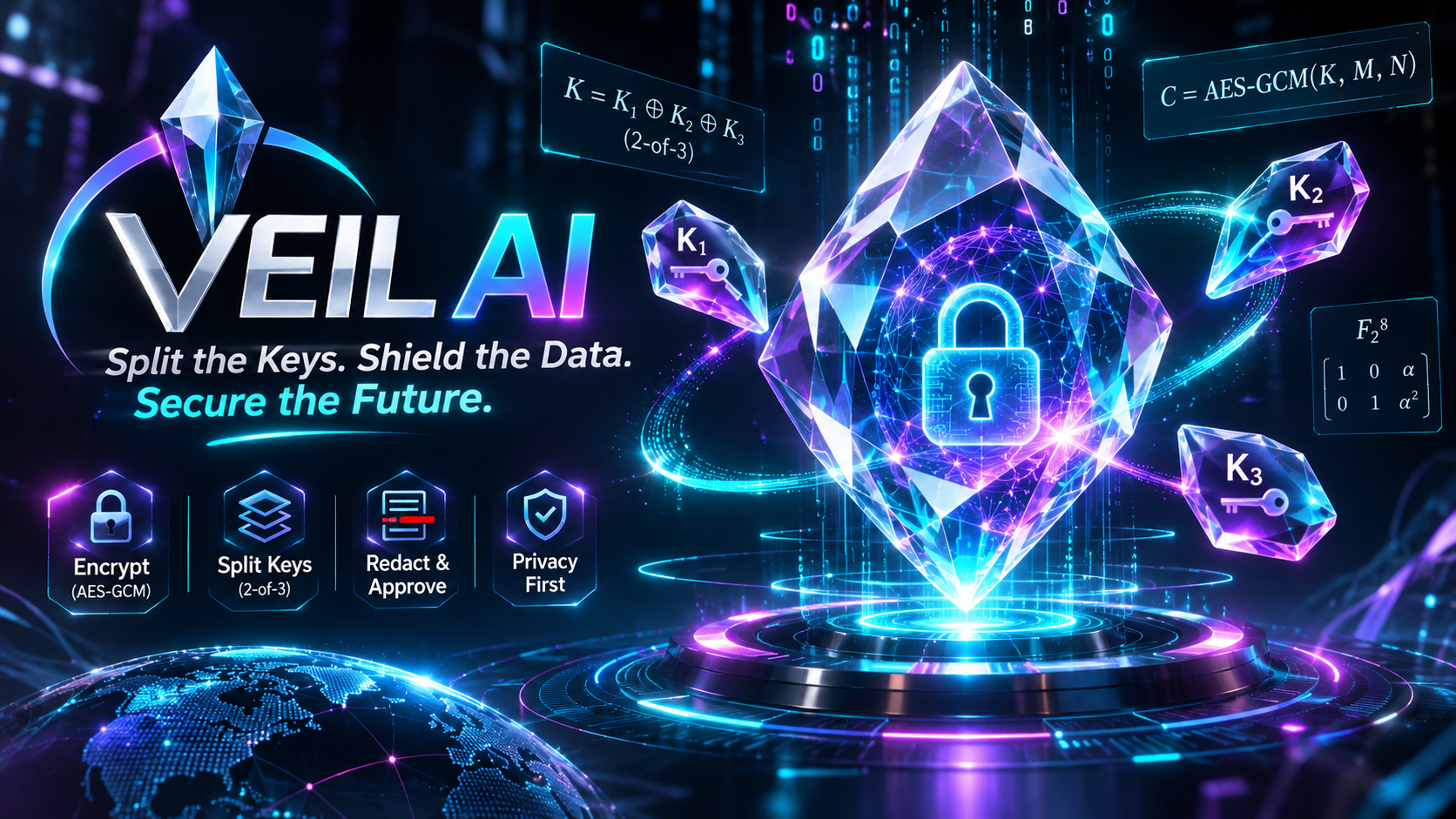
This inspired us to build VEIL//AI — Split the Keys. Shield the Data. Secure the Future.
Our vision was to combine mathematical cryptography, user-controlled privacy, and an immersive 3D experience to make AI security more transparent, interactive, and understandable.
What it does
VEIL//AI is a futuristic, interactive 3D cryptographic privacy gateway designed to give users greater control over sensitive information shared with AI systems.
Its key features include:
- 2-of-3 Secret Sharing: Splits an encryption key into three shares using Shamir's Secret Sharing, requiring any two distinct shares for recovery.
- AES-256-GCM Encryption: Encrypts private prompts locally and detects unauthorized ciphertext modifications.
- AI Privacy Gateway: Redacts explicitly marked sensitive information and lets users review the exact prompt before sending it to an AI provider.
- Interactive 3D Workspace: Features a rotating cryptographic crystal, floating key shards, mathematical visualizations, and neon particle trails.
- Guardian Key Recovery: Supports exporting and importing key shares to demonstrate secure vault recovery.
- Security Simulation: Demonstrates encryption, decryption, key reconstruction, and tampering detection without requiring a paid API.
- Optional AI Integration: Supports configurable providers such as Groq, Gemini, and OpenAI.
Rather than merely displaying security concepts, VEIL//AI connects its interactive controls to working cryptographic operations.
How we built it
We combined web technologies, cryptographic mathematics, and 3D graphics to create VEIL//AI.
Technologies used:
- JavaScript and HTML5: Core application functionality and interactive components.
- CSS3: Responsive layouts, futuristic interface styling, glassmorphism, and neon effects.
- WebGL: Custom 3D rendering, holographic animations, rotating crystals, and particle effects.
- Blender: Creation of the mathematical crystal's 3D assets.
- Web Crypto API: AES-256-GCM encryption and decryption.
- Shamir's Secret Sharing: Threshold cryptography implemented using finite-field mathematics.
- Node.js: Local server, API gateway, and automated testing.
- Rust and WebAssembly: Optional experimental implementation of key-sharing mathematics.
- GitHub and Vercel: Source-code management and web deployment.
We designed the cryptographic operations and visual workspace to work together, allowing users to explore mathematical security concepts through interactive 3D elements.
Challenges we ran into
Our biggest challenge was balancing cryptographic correctness, real-world privacy limitations, and a highly immersive 3D user experience.
Implementing finite-field arithmetic and threshold key reconstruction required careful testing. We also had to ensure that encrypted data could be recovered correctly while unauthorized modifications were rejected.
Building the 3D interface introduced additional difficulties, including maintaining smooth animations, avoiding overlapping interface components, and adapting complex holographic layouts to different screen sizes.
Another important challenge was distinguishing local encryption from privacy during AI inference. Conventional hosted language models still need readable input, so we implemented explicit redaction and user approval instead of claiming fully encrypted AI processing.
Accomplishments that we're proud of
We transformed a complex mathematical security concept into a functional and visually engaging prototype.
Our major accomplishments include:
- Implementing working 2-of-3 key splitting and reconstruction.
- Integrating authenticated AES-256-GCM encryption with tampering detection.
- Building an interactive WebGL environment with cinematic mathematical visualizations.
- Creating an offline security demonstration that works without an AI API key.
- Supporting key-share export, import, and recovery.
- Successfully passing 11 automated tests covering cryptographic behavior, recovery, redaction, and server path security.
- Developing a deployable interactive demonstration with a distinctive 3D interface.
Most importantly, we demonstrated that advanced security mathematics can be made accessible through visual interaction.
What we learned
Developing VEIL//AI strengthened our understanding of cryptography, secure AI architectures, and interactive software engineering.
We learned how finite-field mathematics enables threshold key recovery, how authenticated encryption detects tampering, and why key management is as important as encryption itself.
We also discovered that protecting local information is different from guaranteeing privacy when using third-party AI services. A secure application must communicate its trust boundaries and limitations clearly.
On the development side, we gained practical experience combining WebGL rendering, responsive interface design, browser cryptography, backend APIs, and automated testing into one application.
What's next for VEIL//AI
Our long-term vision is to evolve VEIL//AI from a hackathon prototype into a more robust privacy-focused AI security platform.
Future developments include:
- Advanced Privacy Protection: Automatic sensitive-data detection and stronger redaction controls.
- Independent Key Guardians: Hardware-backed storage and better isolation of cryptographic shares.
- Rust/WASM Optimization: Further development and validation of high-performance cryptographic components.
- Privacy-Preserving AI Research: Exploring confidential computing, secure multiparty computation, and practical applications of homomorphic encryption.
- Enhanced 3D Experience: Gesture-based controls, improved holographic scenes, and richer security visualizations.
- Security Hardening: Independent cryptographic review, penetration testing, and production-grade key management.
VEIL//AI represents our vision of a future where users can understand and control how their private information is protected in AI-powered systems.
Split the Keys. Shield the Data. Secure the Future.
