-
-
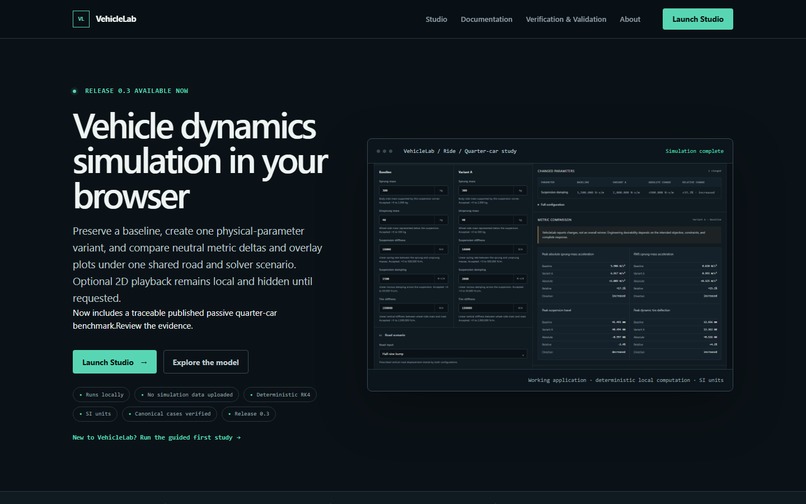
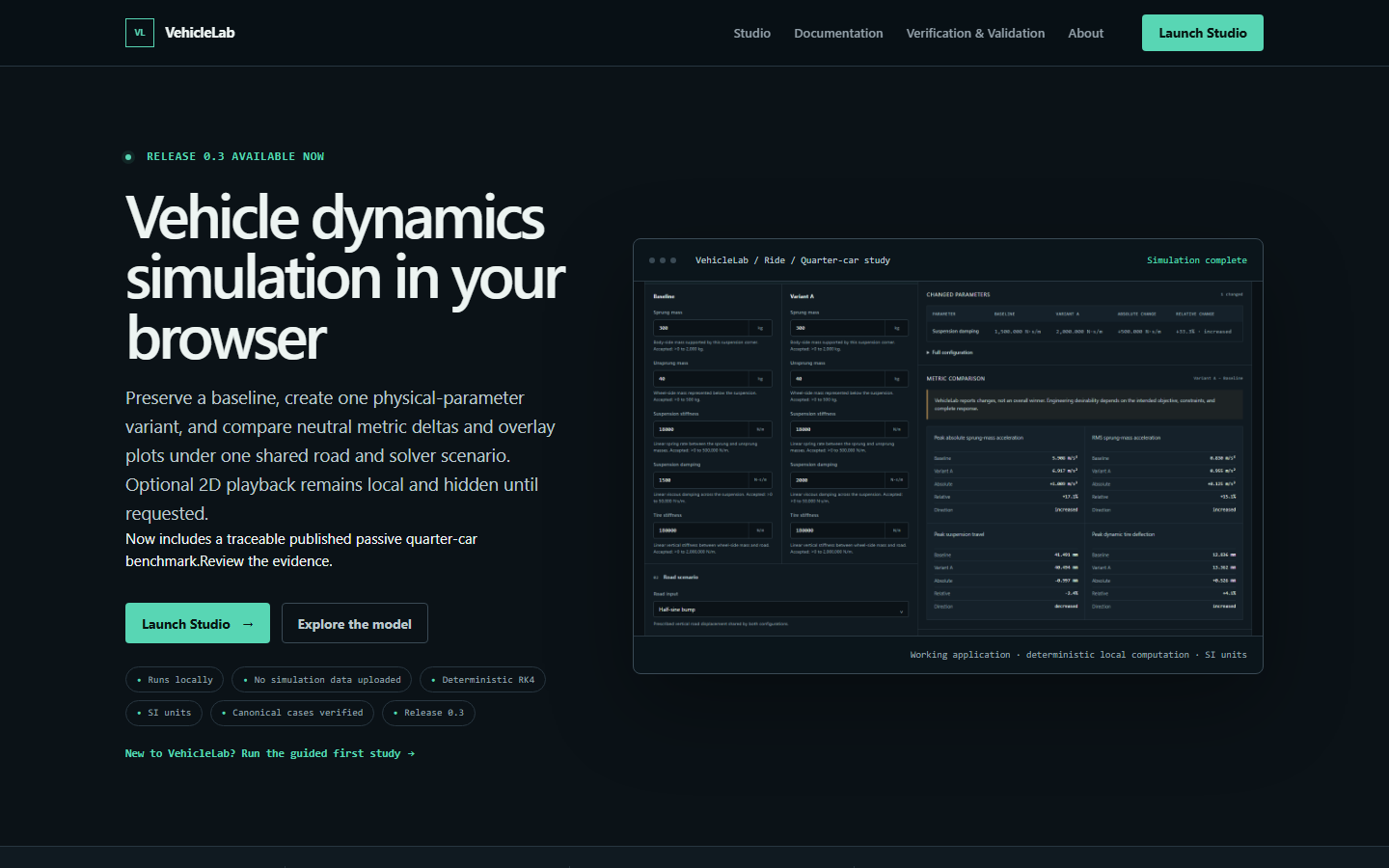
VehicleLab Studio: browser-native vehicle dynamics simulation with transparent models, local execution, and traceable evidence.
-
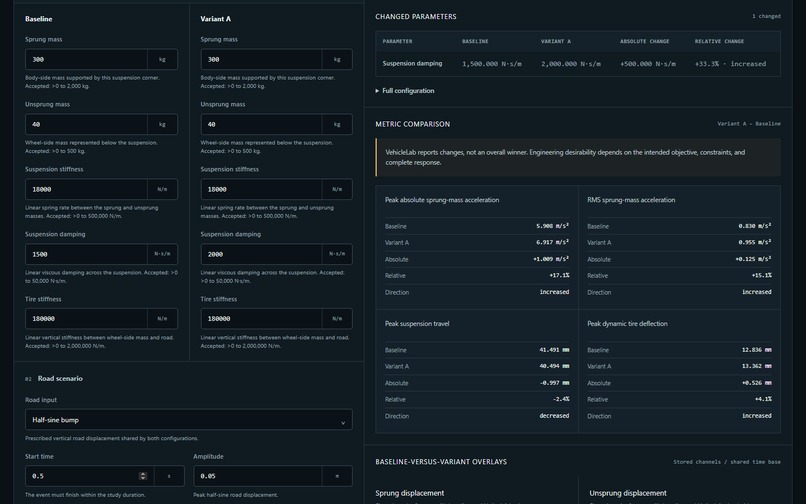
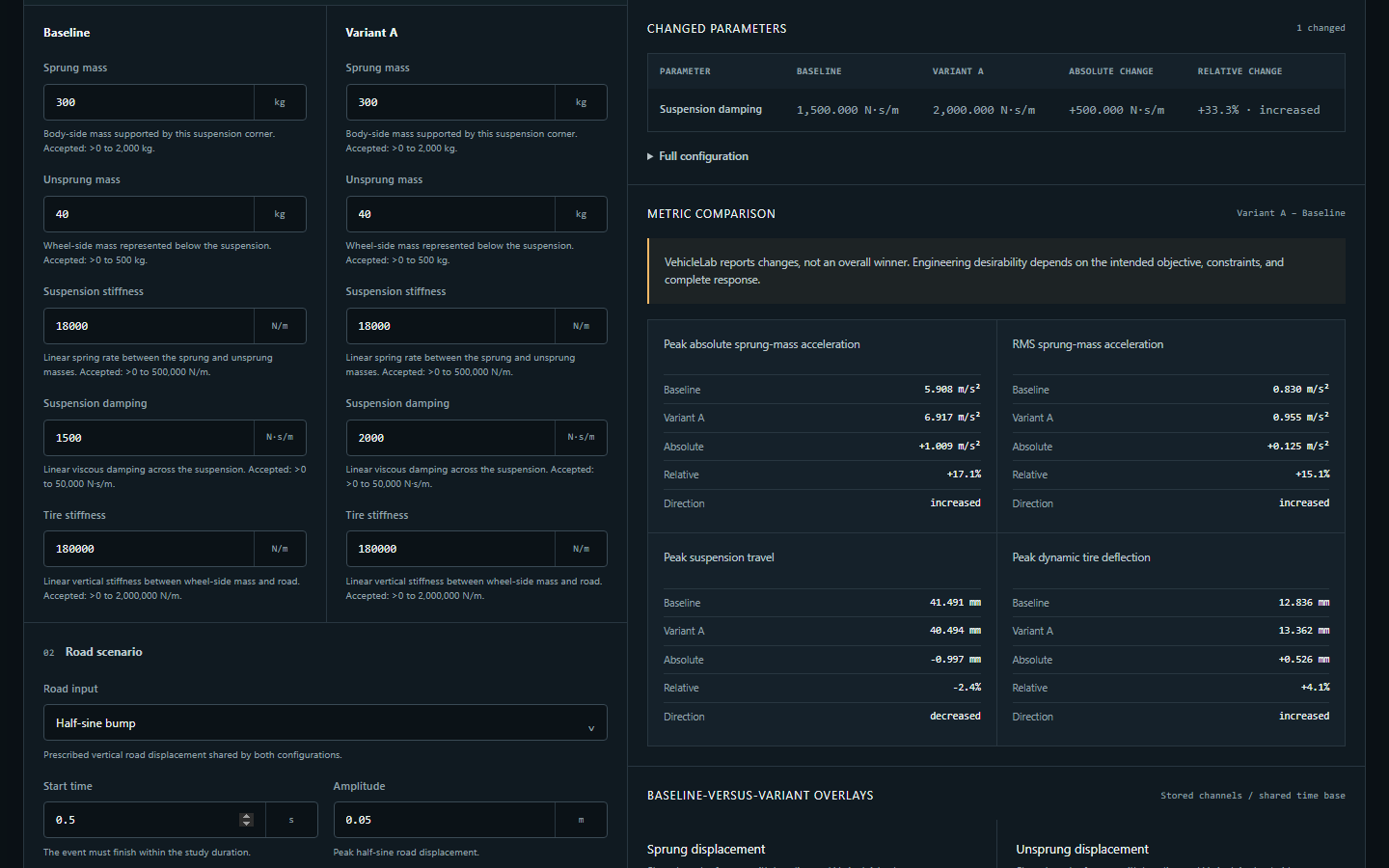
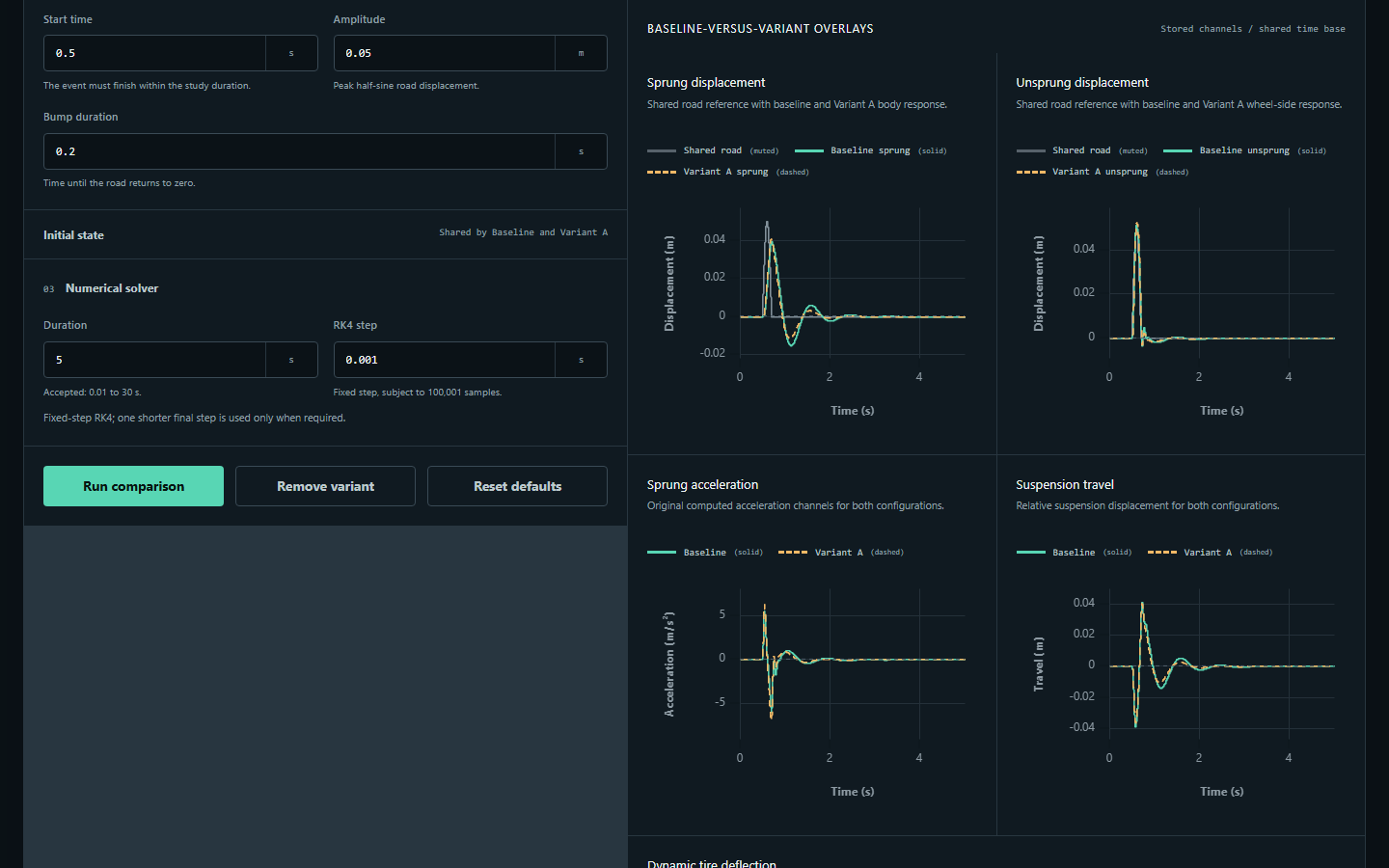
Baseline versus Variant A comparison with changed parameters, neutral metric deltas, and completed-study provenance.
-
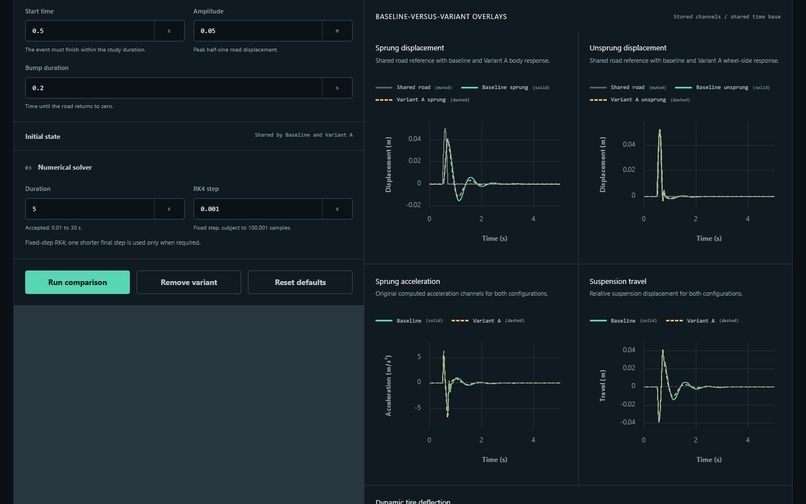
Engineering overlay plots compare body motion, wheel motion, acceleration, suspension travel, and tire deflection.
-
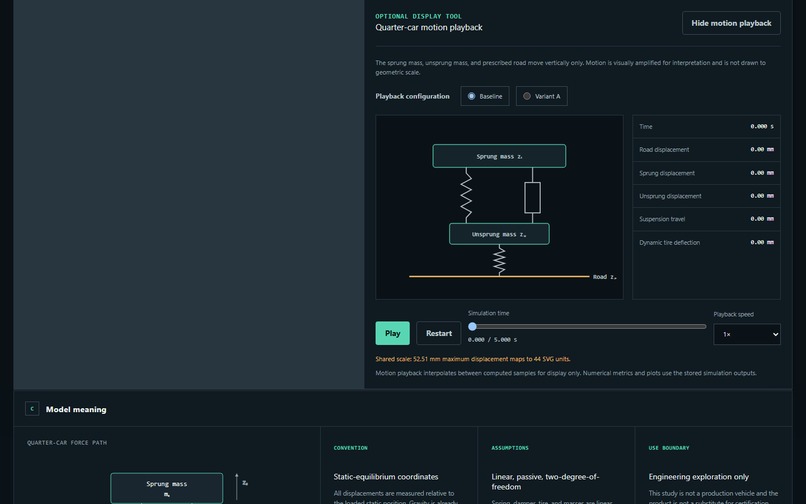
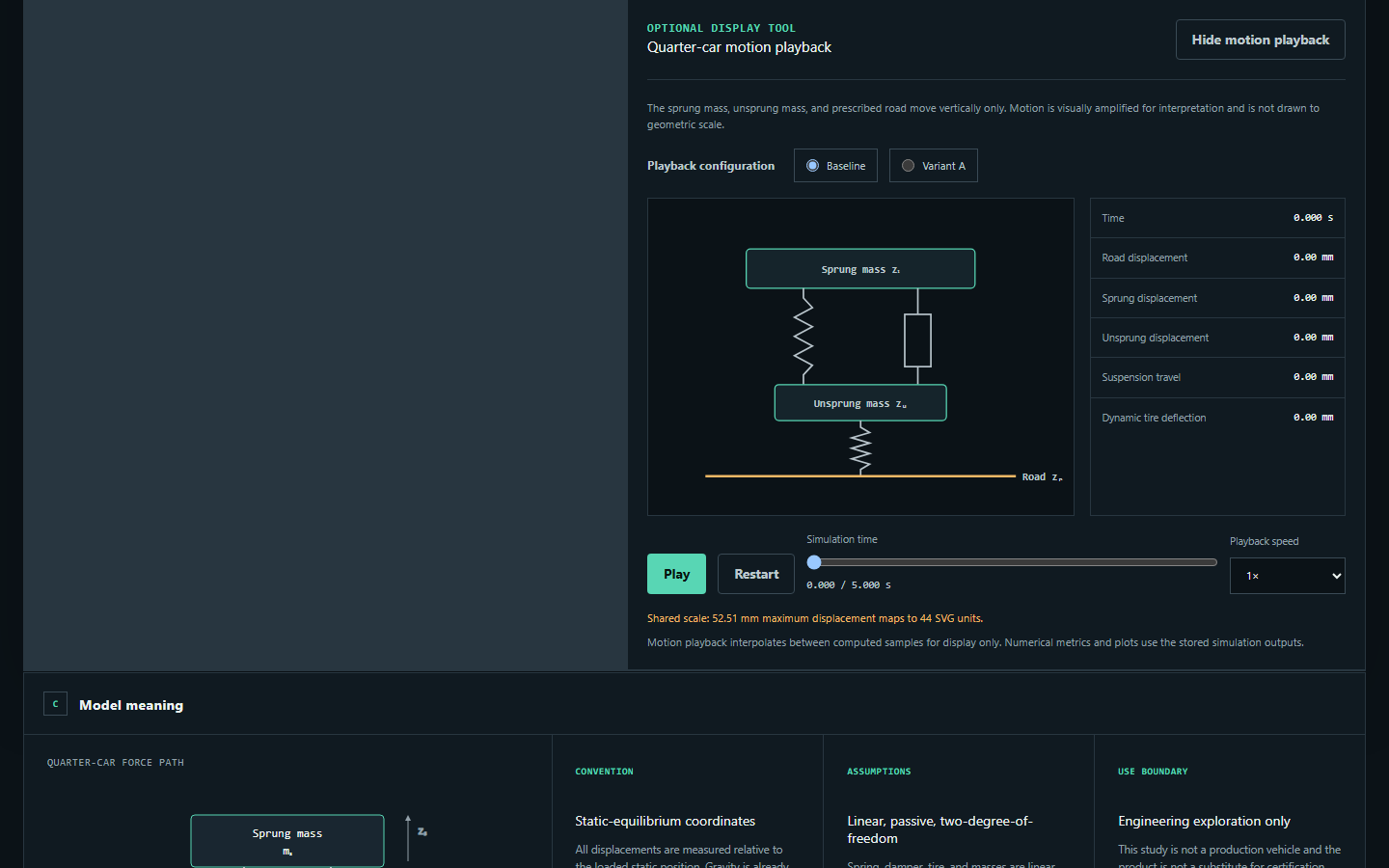
Optional quarter-car motion playback visualizes sprung mass, unsprung mass, road input, and live engineering values.
-
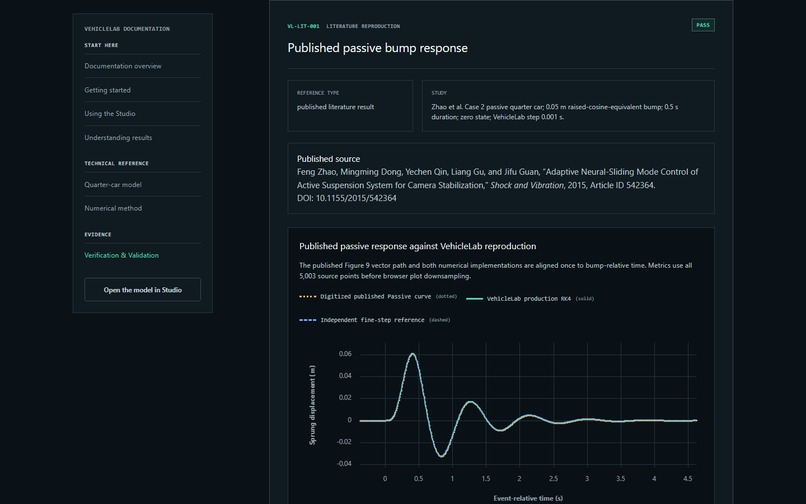
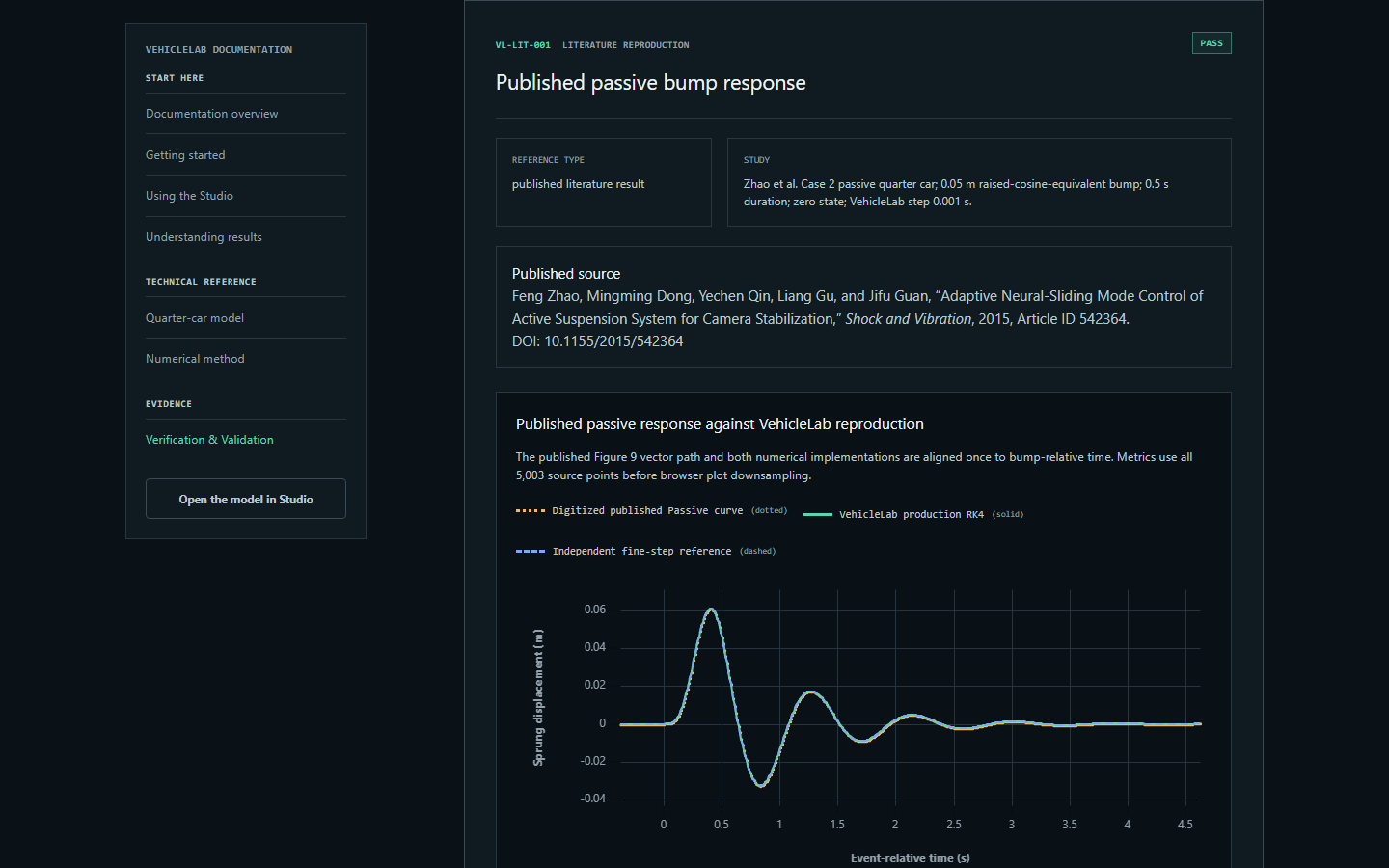
Traceable verification and validation evidence, including a peer-reviewed passive quarter-car benchmark with computed acceptance metrics.
-
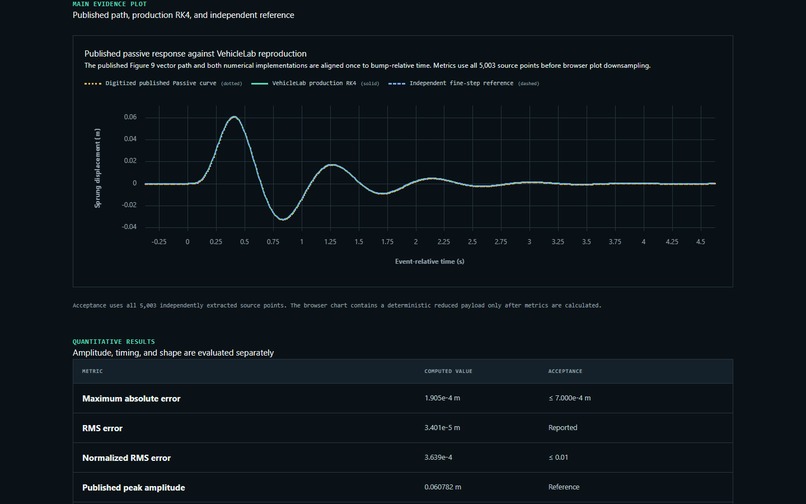
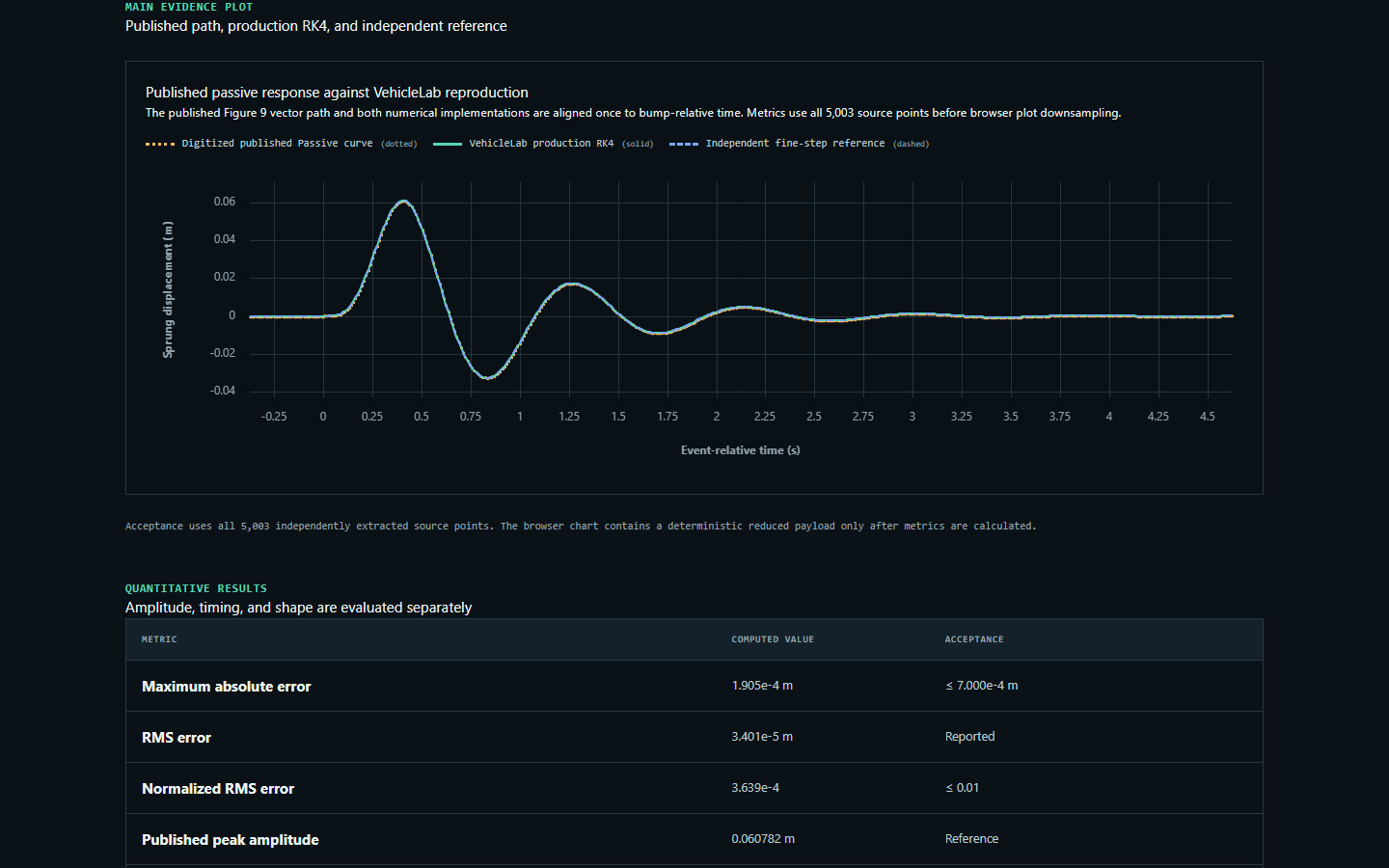
Published response, VehicleLab RK4 result, and an independent numerical reference agree within predeclared digitization-aware tolerances.
Inspiration
Vehicle-dynamics simulation is often split across equations in textbooks, specialist desktop software, and separate validation reports. Students and engineers may be able to run a model, but still struggle to answer basic questions:
- What assumptions are built into the model?
- Which inputs produced the displayed result?
- How does a parameter change affect multiple engineering metrics?
- Is the numerical implementation trustworthy?
- Has the model reproduced any external published result?
VehicleLab Studio was created to bring that complete reasoning chain into one transparent browser-based workflow.
What it does
VehicleLab Studio is a browser-native engineering lab for quarter-car ride-dynamics studies.
A user can:
- configure sprung mass, unsprung mass, suspension stiffness, damping, and tire stiffness
- choose documented road inputs
- run a deterministic simulation locally in the browser
- inspect displacement, acceleration, suspension-travel, and tire-deflection results
- preserve a Baseline and create a Variant A
- compare both configurations under the same road and solver scenario
- review changed parameters, neutral metric deltas, and overlay plots
- replay either completed result through an optional SVG motion visualization
- read the governing equations and numerical method
- inspect generated Verification & Validation evidence
- open and reproduce a published passive quarter-car benchmark
VehicleLab deliberately avoids presenting itself as a production-vehicle or certification tool. It clearly distinguishes mathematical verification, numerical verification, published numerical reproduction, and physical correlation that has not yet been performed.
How we built it
VehicleLab Studio uses:
- Astro and React for the application
- TypeScript and Zod for typed, validated engineering contracts
- a dedicated browser Web Worker for simulation
- deterministic fixed-step fourth-order Runge–Kutta integration
- Float64 result channels
- uPlot for engineering charts
- KaTeX for accessible equations
- Vitest and Playwright for numerical, integration, browser, accessibility, and responsive testing
- Cloudflare Workers Static Assets for deployment
The physics, numerical solver, comparison engine, validation evidence, and UI are separated into independent packages. Simulation calculations do not live inside React components.
GPT-5.6 was used as an engineering and product reasoning partner. It helped define the model boundary, challenge assumptions, plan releases, distinguish verification from validation, design acceptance criteria, and review whether scientific claims were defensible.
Codex implemented the multi-package architecture, browser simulation workflow, comparison engine, documentation system, motion playback, validation pipeline, published-literature reproduction, regression protection, automated tests, and release-ready pull requests.
The AI does not generate the simulation conclusions. VehicleLab produces deterministic numerical results, and every public engineering claim is tied to equations, tests, tolerances, or traceable external evidence.
Challenges we ran into
The hardest challenge was preventing an AI-built engineering application from becoming a polished black box.
We had to:
- preserve a strict separation between physics and presentation
- prevent old simulation responses from replacing newer studies
- keep visible results tied to completed input snapshots
- compare two configurations without mixing scenarios
- build an independent numerical reference rather than validating the solver against itself
- distinguish software verification from physical validation
- extract a published reference curve with auditable provenance
- document a source-paper inconsistency instead of silently ignoring it
- define digitization-aware acceptance criteria before evaluating the final result
- keep the complete workflow usable on mobile devices
Accomplishments that we're proud of
During Build Week, VehicleLab progressed from a first quarter-car simulation into Release 0.3 of a coherent engineering product.
It now includes:
- deterministic browser-local simulation
- a guided learning path from first study to equations and V&V
- Baseline-versus-Variant A comparison
- neutral metric deltas and engineering overlay plots
- optional motion playback
- independent state-space and numerical consistency references
- analytical equilibrium and time-step-convergence evidence
- a traceable reproduction of a peer-reviewed passive quarter-car numerical result
- machine-readable evidence and provenance
- protected numerical regression boundaries
- automated unit, integration, browser, accessibility, and deployment checks
The published benchmark uses 5,003 independently extracted source points and is reproduced within predeclared digitization-aware tolerances. This strengthens external numerical credibility while remaining explicitly separate from experimental or production-vehicle validation.
What we learned
GPT-5.6 and Codex are most effective for engineering software when the work is framed through explicit equations, contracts, assumptions, tolerances, failure conditions, and tests.
The most valuable AI contribution was not producing more code faster. It was helping decide:
- which claim was supportable
- which evidence was still missing
- where a feature could become misleading
- when model complexity should be postponed
- how to turn a technical prototype into a coherent product
What's next for VehicleLab Studio
The next milestones are:
- frequency-domain ride studies
- parameter sweeps and trade-off maps
- reproducible engineering reports
- additional published benchmarks
- physical-data correlation when suitable data become available
- native-kernel and FMU delivery
- higher-fidelity vehicle models only after the current vertical slice remains trusted and reusable
The long-term goal is a multi-fidelity vehicle-simulation platform that engineers can explore in a browser, run locally at scale, and defend using reproducible evidence.
Built With
- astro
- cloudflare
- cloudflareworker
- codex
- gpt-5.6
- katex
- openai
- playwright
- python
- react
- typescript
- uplot
- vitest
- webworkers
- zod

Log in or sign up for Devpost to join the conversation.