Inspiration
Both of us often ride our bicycles on multi-lane roads for school or work. We noticed that when riding in traffic, especially in noisy conditions or when distracted/tired, we would often have cars "sneaking up" behind us, especially where helmet mirrors or conventional radar detectors (which both only sense cars directly behind you) fail. Furthermore, both of those methods rely on visual cues displayed on a small space, which aren't always easily noticed when watching traffic elsewhere. Thus, we decided to build a project that would provide haptic feedback when cars approached from behind in adjacent lanes.
What it does
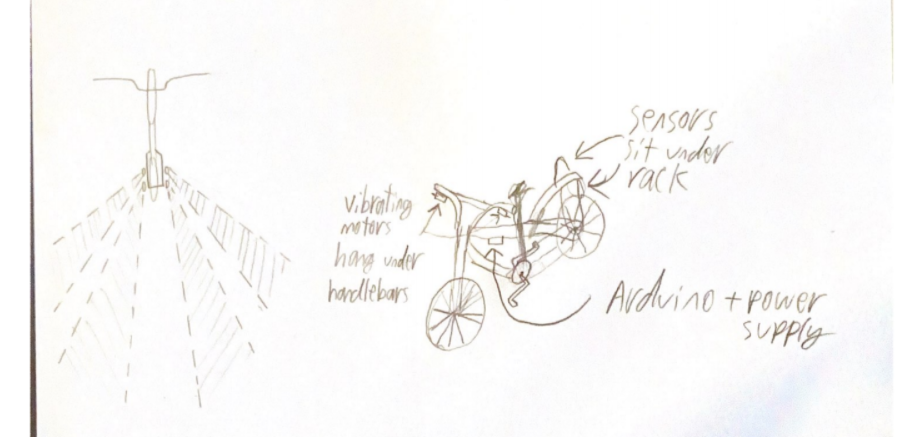
If traffic approaches from the left or the right adjacent lane, this project provides a small vibration on the corresponding handlebar that grows in intensity as the traffic gets near and stops when the traffic enters the rider's field of view. Specifically, it monitors adjacent traffic between 20 and 0 yards behind the bicycle.
How we built it
We planned to connect an Arduino Uno to a 9v battery and two motors, with a breadboard enclosed under a rack or seat and sensors mounted on the back of the rack.
Challenges we ran into
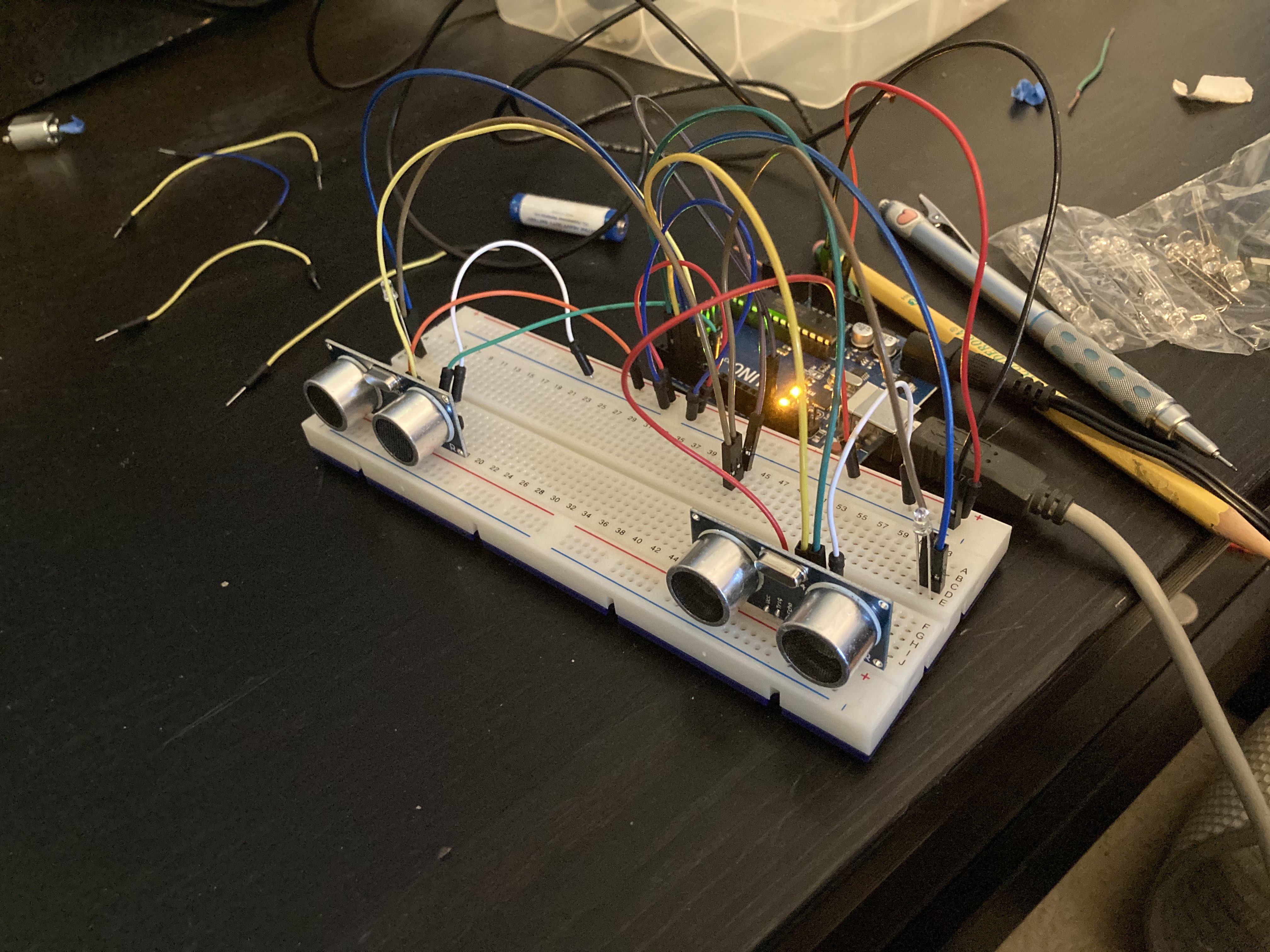
We unfortunately couldn't build a full scale version due to time and budget constraints. Ideally, we'd use an Arduino Uno and four long-range sonar sensors, along with two DC motors connected to off-balance weights to create haptic feedback, but we lacked the budget for the long-range sonar sensors (about $25 each) and we couldn't source the diode needed to connect the motors in time. Thus, we set up two cheap short-range HC-SR04 ultrasonic distance sensors to mimic the two long-range sensors on one side of the bicycle and let two LEDs light up to mark when the motor should be running. Two LEDs lighting up corresponds to running at full power, and one LED lighting up corresponds to running at half power.
Additional challenges we ran into include: -Issues with the Arduino software: The pulseIn() command used with the sensors only worked with some parameters and not others.
Accomplishments that we're proud of
This was both of our first times working with Arduino, so we're pleased that we could get our first project working decently given the time and budget constraints.
What we learned
We learned a lot about Arduino programming and microprocessors in general (for example, the difference between digital and analog pins). We also learned about how ultrasonic sensors work and are read.
What's next for Vehicle Distance Detector for Cyclists
Upgrading hardware and software into a full-sized product.


Log in or sign up for Devpost to join the conversation.