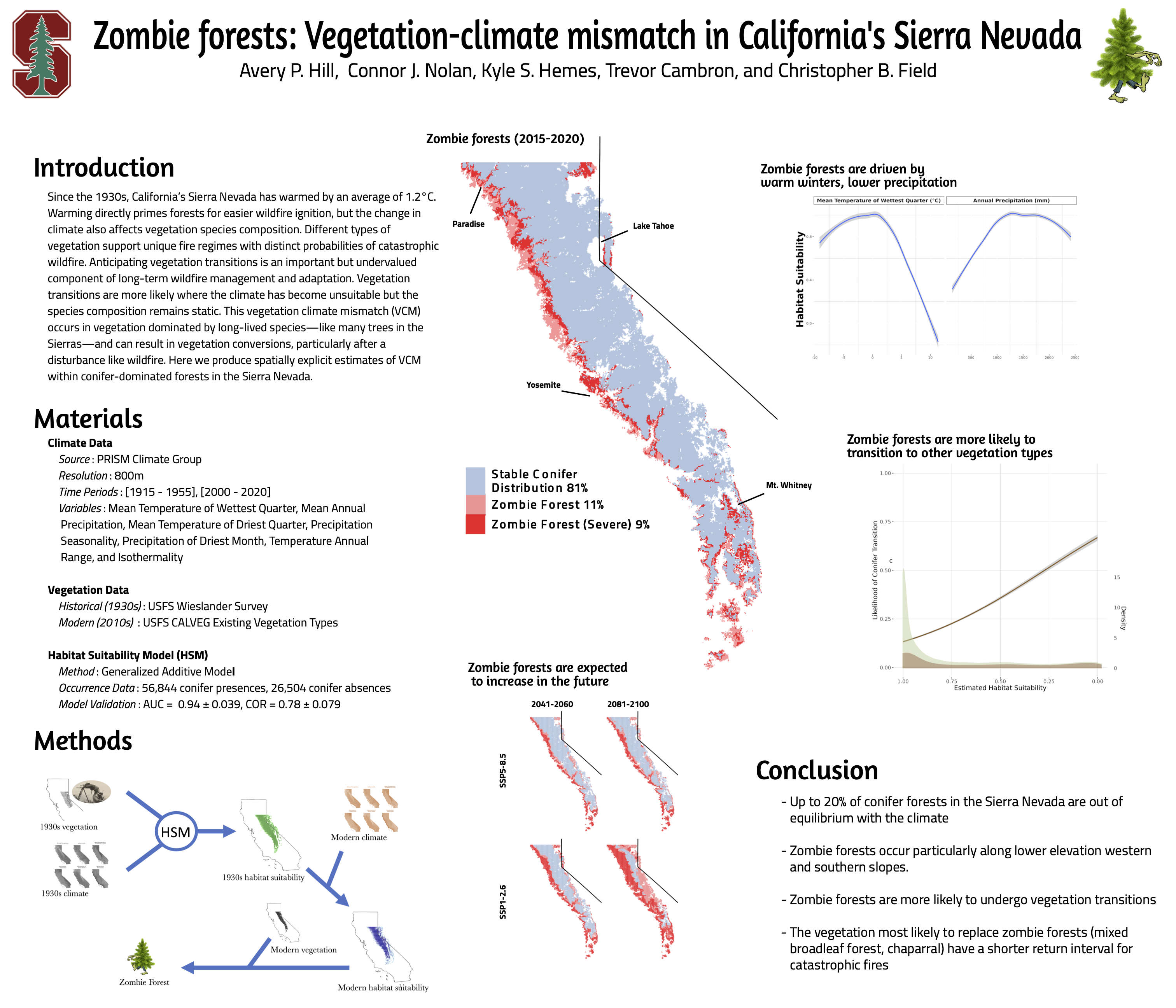
Since the 1930s, California’s Sierra Nevada has warmed by an average of 1.2C. Warming directly primes forests for easier wildfire ignition, but the change in climate also affects vegetation species composition. Different types of vegetation support unique fire regimes with distinct probabilities of catastrophic wildfire. Anticipating vegetation transitions is an important but undervalued component of long-term wildfire management and adaptation. Vegetation transitions are more likely where the climate has become unsuitable but the species composition remains static. This vegetation climate mismatch (VCM) occurs in vegetation dominated by long-lived species—like many trees in the Sierras—and can result in vegetation conversions, particularly after a disturbance like wildfire. Here we produce spatially explicit estimates of VCM within conifer-dominated forests in the Sierra Nevada. Observations from the 1930’s Wieslander Survey provide a foundation for characterizing the historical relationship between Sierra Nevada vegetation and climate before the onset of recent, rapid climate change. Based on comparing the historical climatic niche to the modern distribution of conifers and climate, over 7500 km2 of modern Sierra Nevada coniferous forests (19.5% of the total) are out of equilibrium with the current climate, 95% of which is below an elevation of 2356m. For every 10% decrease in modeled habitat suitability the probability of transition from conifer forests to angiosperm-dominated vegetation increased by 9.2%. Maps of Sierra Nevada VCM can help guide long-term land management decisions by distinguishing areas likely to transition from those expected to remain stable in the near future. This can help direct limited resources to their most effective uses—whether it be protecting land or managing vegetation transitions—in the effort to maintain biodiversity, ecosystem services, and public health in the Sierra Nevada.
Built With
- qgis
- r

Log in or sign up for Devpost to join the conversation.