-
-
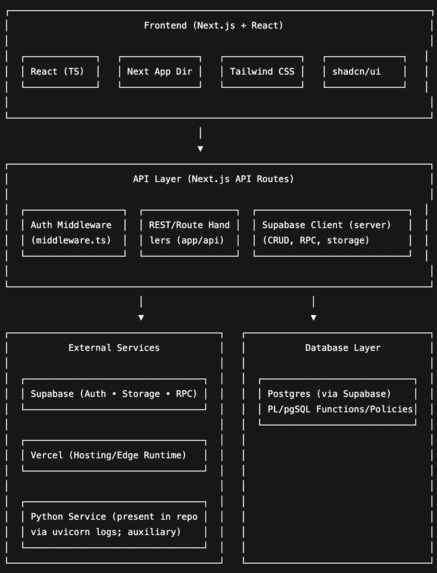
tech stack wireframe
-
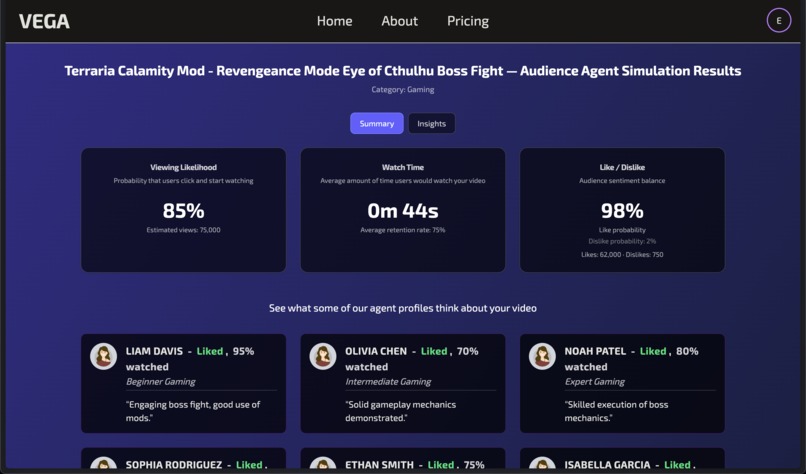
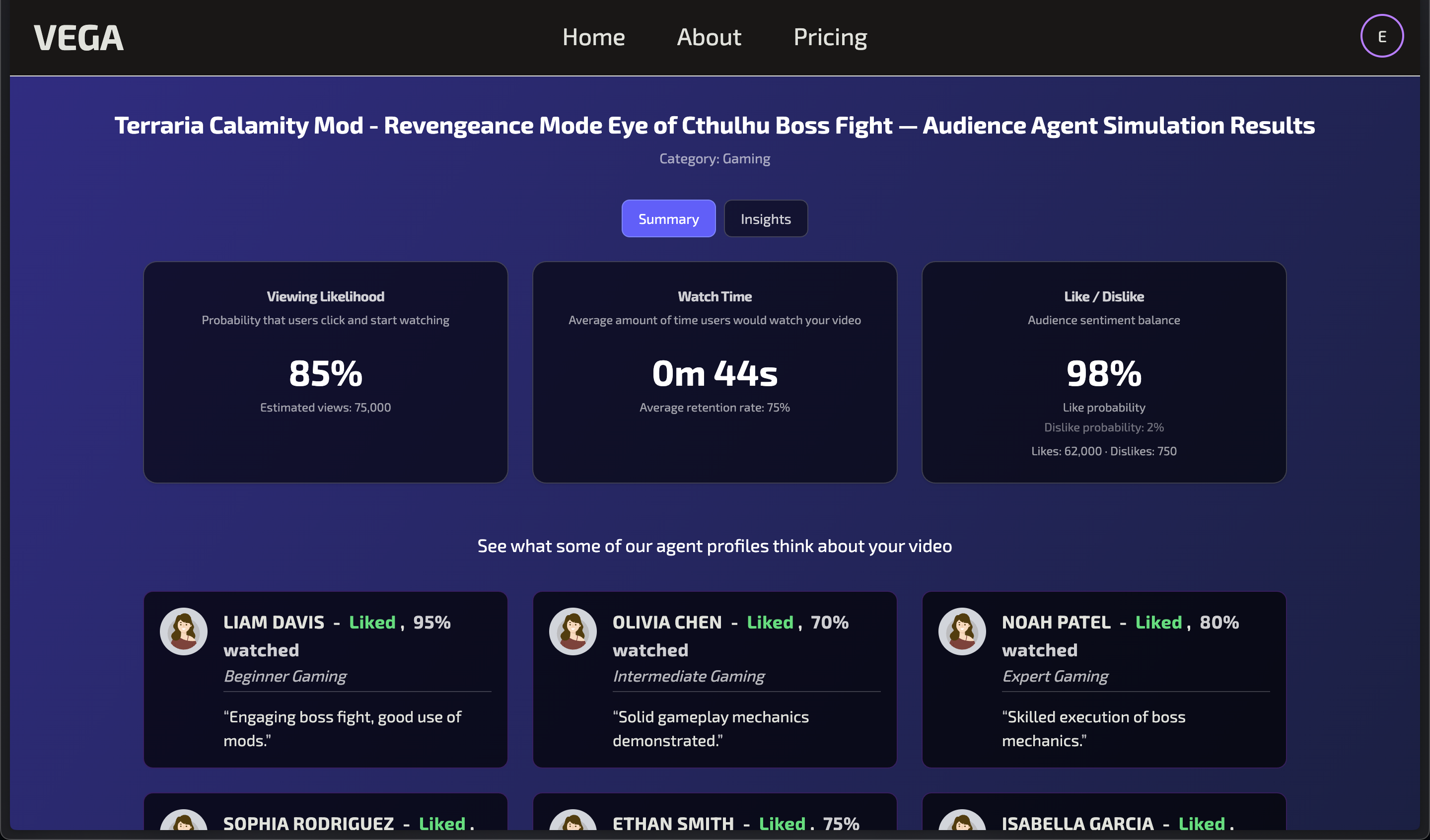
data analysis summary page
-
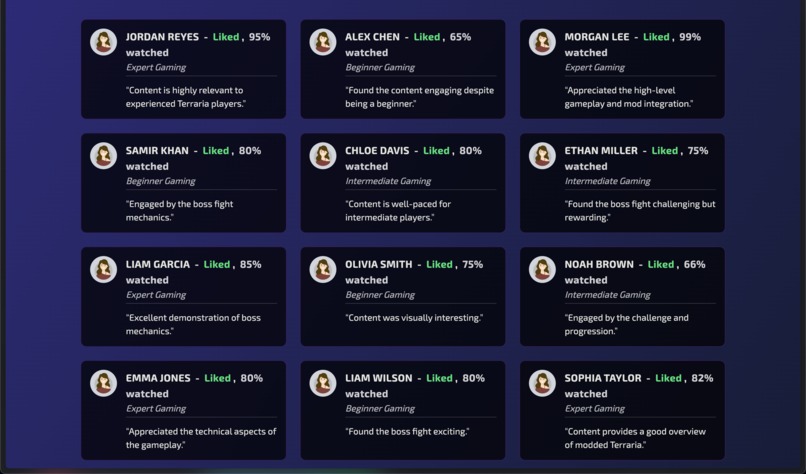
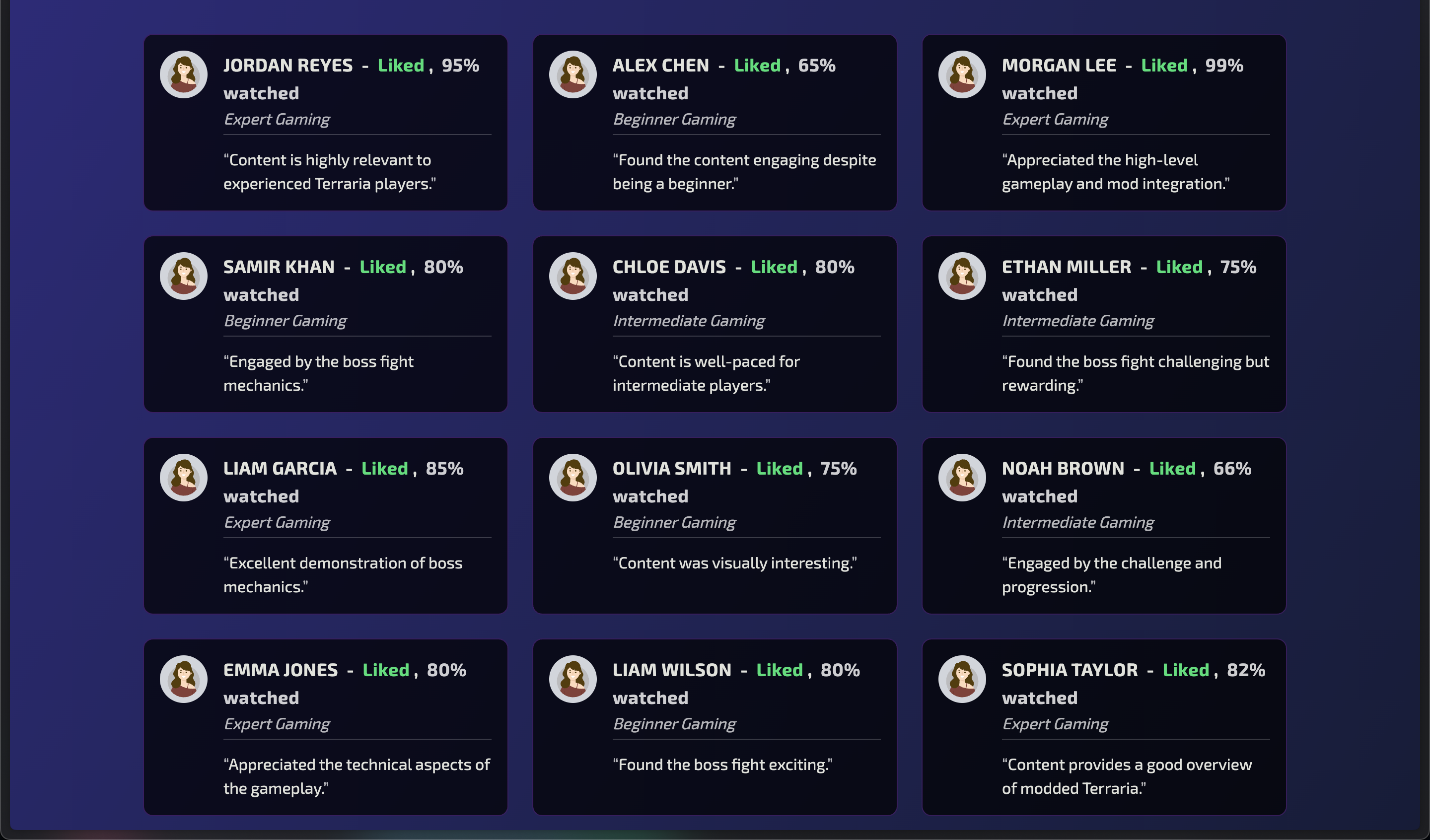
display of multiple agents
Shine Bright, Go Far with VEGA
Inspiration
The idea of making it big on social media is enticing to many, especially young people like Gen Z. We grew up with internet creators and it is no surprise that about 57% of Gen Z want to be internet personalities. Additionally digital marketing has completely exploded and changed the game for businesses who aim to leverage the power of social media to expand their reach. However, it's difficult to get feedback on your content when you're just beginning. Who even knows if people will like the content you post? We wanted to provide a tool to assist small content creators in improving their content.
What it does
Summary: We created specialized agents based on the ten basic categories as described by YouTube: shopping, music, movies & tv, gaming, news, sports, learning, courses, fashion & beauty, and tech. We prompted the agents to simulate video retention, views, and a like/dislike ratio. Afterwards, the program summarizes the results and create feedback based on the user's video that the creator can use to change their video and alter it to make a certain audience they like to engage more with the video.
Key Features:
- Intuitive Upload Design: an easy to use, intuitive interface for users to select a video file from their computer and upload it to the site.
- Personalized AI Agent Generation: by utilizing Google's APK and A2A protocols and systems, we use metadata from a video to feed into system by using a summarizing agent to break down videos for smaller sub-agents to digest. Afterwards, these sub-agents take in that data and simulate how their specific schema would react to the contents of the video.
- Data Driven Interface: a helpful user interface for creators to digest all at once what target demographics truly think about their content. With helpful visuals, stats, simulated comments, and a demographic breakdown of each agent that is generated, our users will truly get a feel for how a specific audience will react to certain content.
- Metrics that Matter: we aim to focus on the most important parts of large content algorithms today: click through rate, viewer retention, and pure watch time. Gone are the days where things like subscribers or just liking and sharing matter. Content algorithms want to make sure that viewers are constantly engaged and are immediately clicking on your video. If it isn't performing well, algorithms don't care to push it to others.
How we built it
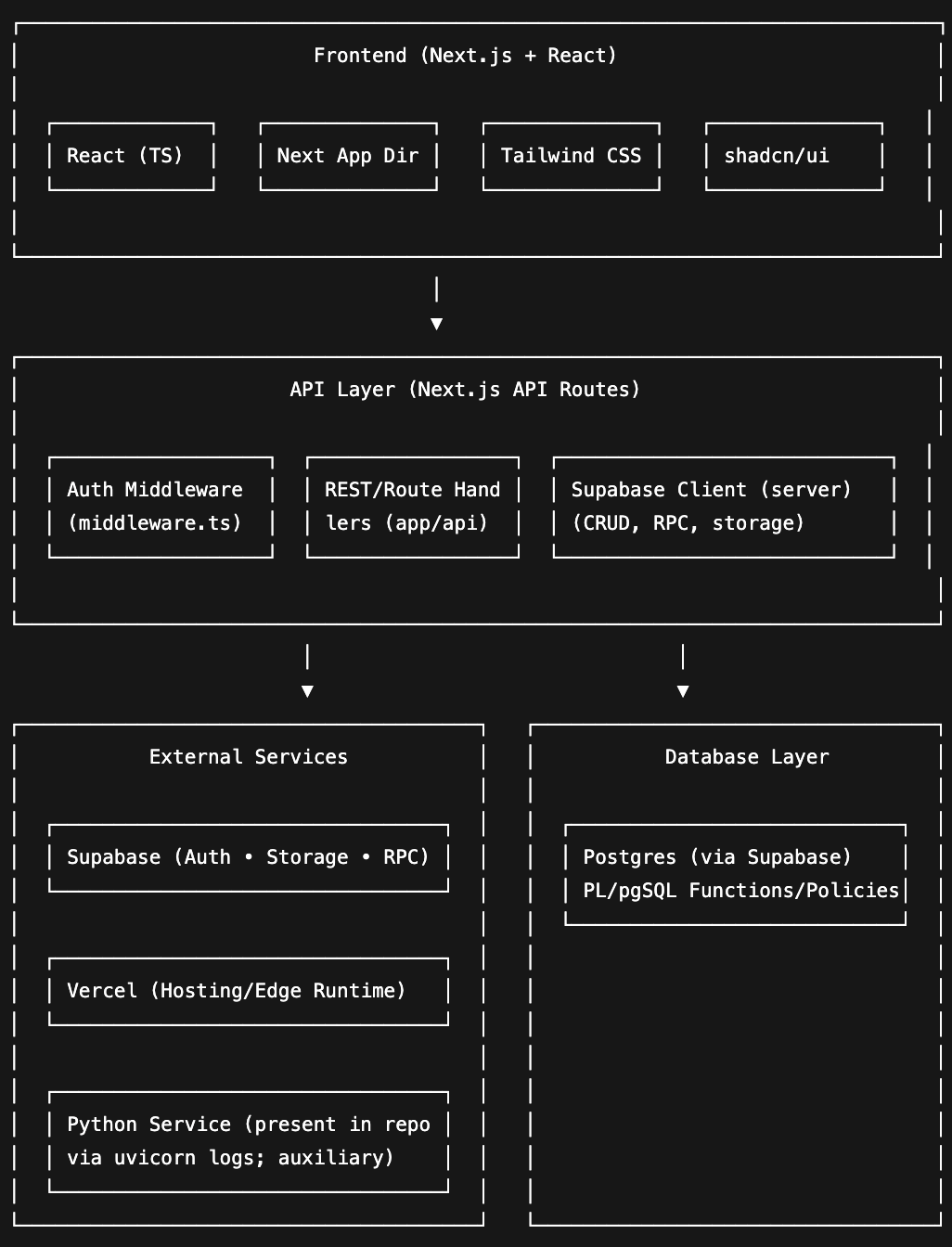
Frontend:
- TypeScript
- Tailwind CSS
- React
Backend:
- Node.js
- Next.js
- supabase
- Google ADK
- Vercel
Challenges we ran into
Challenge 1: Model runtime length:
- One of the biggest challenges we faced was the long runtime of our initial models, especially when handling video data. We initially struggled with processing overhead and memory usage, which slowed down our pipeline. To overcome this, we shifted to using video URIs and file references instead of direct file uploads, experimented with lightweight models, and fine-tuned performance by reducing token counts. These adjustments significantly cut down on runtime without sacrificing too much accuracy.
Challenge 2: Using Google ADK for the first time:
- Since this was our first time using Google ADK, the learning curve was steep. We ran into hurdles when figuring out how to structure our app-to-app (A2A) connections and optimize model usage within the ADK framework. We had a basic idea of the workflow because of the resources in the Hacker Guide and used documentation, trial-and-error, regular incremental testing to create a working pipeline. This not only gave us a functional system but also taught us how to better integrate and optimize new developer tools quickly. Additionally, the learning curve helped us accelerate development because a lot of the tasks we had to repeat for different agents.
Challenge 3: GitHub Conflict
- Like many hackathon projects, we ran into version control issues when merging branches. A major merge conflict caused us to lose several features we had built. While this was frustrating, we used it as an opportunity to prioritize certain components to have them in time for our demo, and we were fortunate that it happened early enough so that we learned from our mistake and did not have conflicts going forward. This streamlined approach actually made our project more focused and stable.
Accomplishments that we're proud of
- Some of our workflows that we were most proud of include creating an efficient and viable prompting system for our A2A process. We were able to compress and convert raw video files to a format much less resource intensive for an AI model to be able to process. Backend to frontend connection was seamless and we were able to make quick work of using API keys to establish an operational website quickly. Making a great agentic workflow that actually provided the results we were looking for was very rewarding. Finally, we were satisfied that we were able to package our ideas into a UI that is accessible, user friendly, and matches the aesthetics of what we were envisioning.
What we learned
- Optimizing AI workflows: We learned how to handle runtime constraints by compressing video inputs, fine-tuning lightweight models, and lowering token counts for faster performance.
- Adapting to new tools: Using Google ADK for the first time taught us how to quickly structure efficient A2A pipelines and connect APIs into a seamless backend–frontend system.
- Version control discipline: Handling GitHub merge conflicts showed us the importance of collaboration workflows and pushed us to prioritize the most impactful features.
- UI/UX design: We gained experience in packaging technical workflows into an accessible, user-friendly interface that aligned with our vision.
What's next for VEGA
- We would love to branch out to other avenues in social media platforms and styles. Currently we base a lot of our approach on the YouTube algorithm in particular, which we felt was fitting since we use a lot of Google technologies. In the future we would love to expand beyond that to help creators adapt to platforms like TikTok and Instagram.
Built With
- api
- next.js
- node.js
- postgress
- react
- supabase
- tailwind
- typescript
- vercel


Log in or sign up for Devpost to join the conversation.