
Inspiration
Vedock was inspired by a real challenge we faced while building an AI-powered cybersecurity research project in 2023. Before we could train a single model, we spent months writing preprocessing scripts, cleaning datasets, tuning hyperparameters, and constantly switching between notebooks, terminals, and different AI tools. AI development felt fragmented rather than integrated.
That experience raised a simple question:
Why isn't there a single platform that manages the complete AI development lifecycle?
Vedock was created to answer that question.
What it does
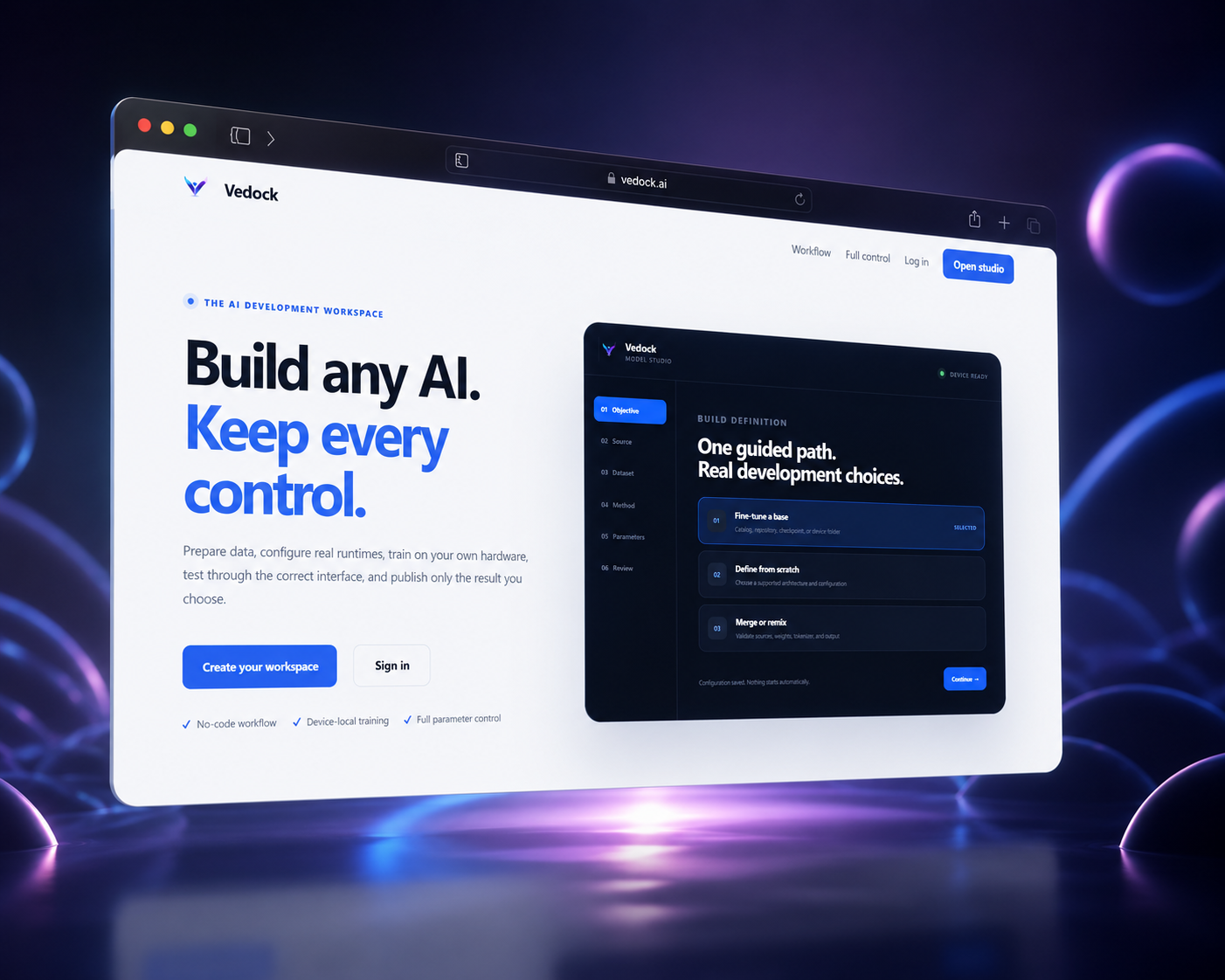
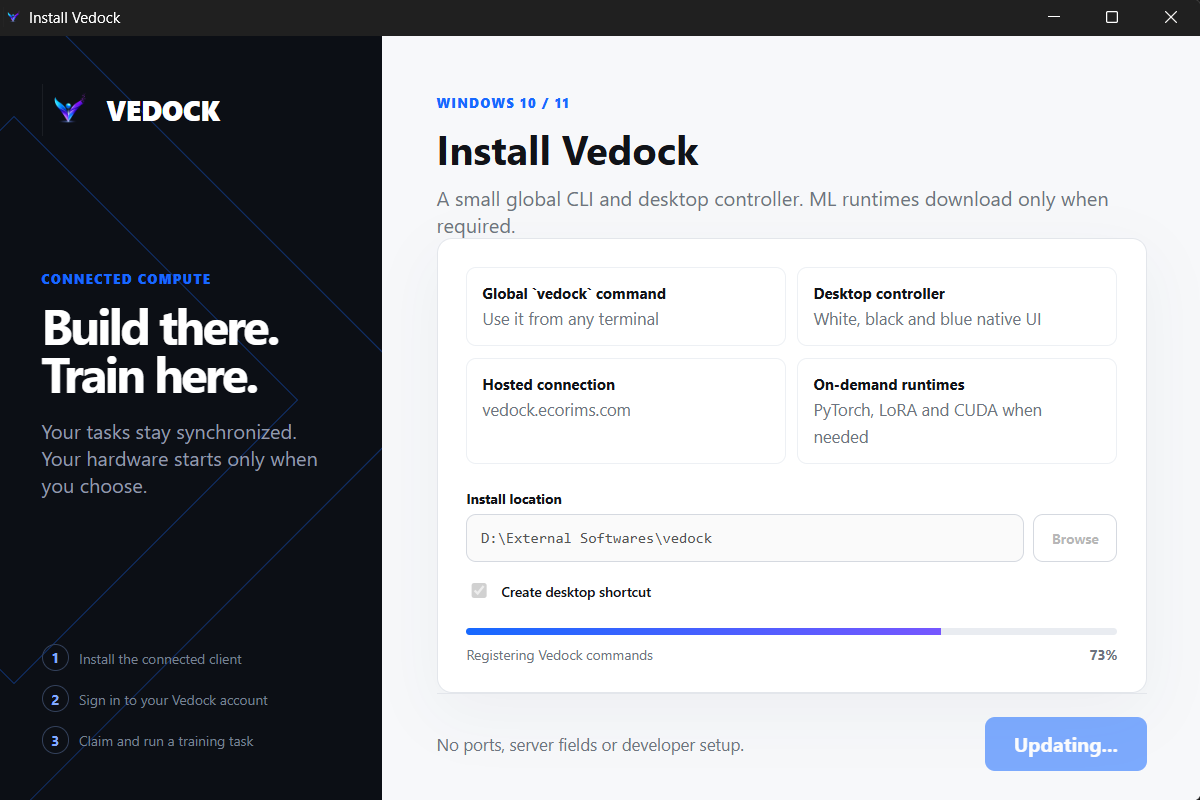
Vedock is a local-first visual AI development platform that simplifies the complete AI workflow.
Users can create projects, import and prepare datasets, clean and validate data, configure training parameters, fine-tune models, monitor training, manage model versions, and immediately test models through a built-in inference playground.
Unlike many no-code AI tools, Vedock provides full control over supported training parameters while remaining accessible to beginners. The platform is designed around a modular architecture capable of supporting LLMs, image generation, image captioning, classification, embeddings, and future multimodal AI.
How we built it
Vedock was built using Python, Flask, PyTorch, Hugging Face Transformers, PEFT (LoRA), SQLite, HTMX, and Tailwind CSS.
The backend follows a modular architecture using Flask Blueprints and SQLAlchemy, while the frontend combines server-rendered templates with HTMX for a responsive user experience.
Throughout development, OpenAI Codex (GPT-5.6) served as an AI engineering collaborator, helping us transform an early terminal-based prototype into a polished visual platform while accelerating backend development, UI implementation, refactoring, and feature iteration.
Challenges we ran into
The biggest challenge was designing a flexible architecture instead of building a tool for only one AI model.
We also had to create a visual dataset preparation pipeline that replaces manual preprocessing scripts, while exposing advanced training options without overwhelming new users. Balancing simplicity with full developer control required multiple iterations of both the interface and backend architecture.
Accomplishments that we're proud of
- Building an end-to-end AI development workflow in a single platform.
- Designing a visual Dataset Studio that replaces manual preprocessing scripts.
- Creating a modular architecture capable of supporting multiple AI model types.
- Giving users complete control over training without requiring code.
- Successfully transforming an early command-line prototype into a modern, intuitive user experience.
What we learned
We learned that AI development is about much more than training models. Dataset preparation, reproducibility, usability, and developer experience are equally important.
We also learned how valuable AI-assisted software engineering can be. Working with OpenAI Codex accelerated development, improved code quality, and allowed us to spend more time solving product and architecture challenges.
What's next for Vedock
Our roadmap includes expanding support for image generation, image captioning, classification, embeddings, and multimodal AI.
We also plan to introduce collaborative workspaces, cloud execution, distributed training, plugin support, a public model hub for sharing AI models, and intelligent AI-assisted recommendations throughout the development workflow.
Our long-term goal is to make building AI as intuitive as building modern software.

Log in or sign up for Devpost to join the conversation.